


Quick Answer: What Is Chinese Bamboo Carving?
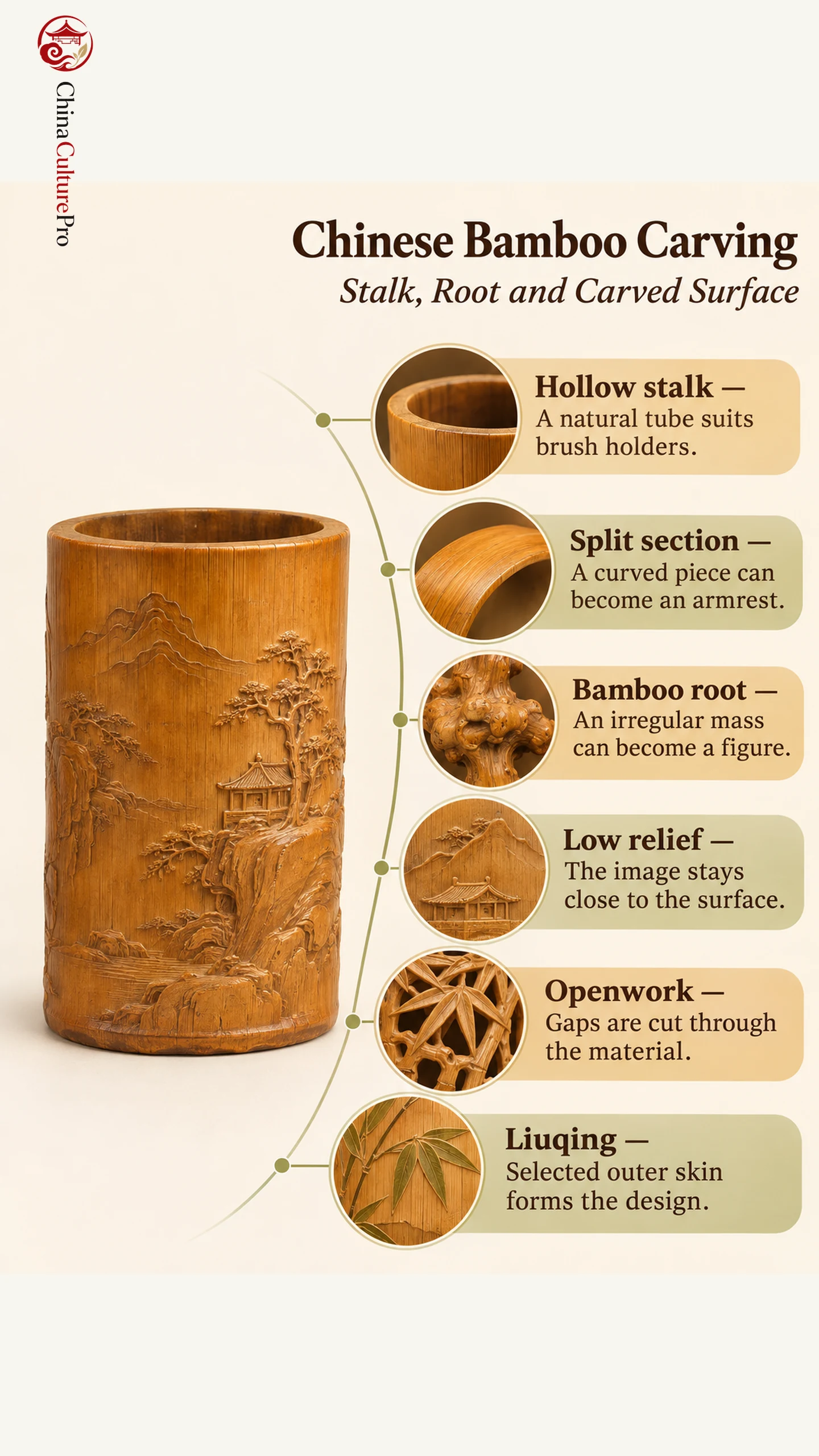
Chinese bamboo carving (竹刻, zhúkè) uses the stalk or root of bamboo to make decorated objects. A hollow stalk can become a brush holder, a split section can make a curved armrest, and a root can become a freestanding figure. Carvers can work in fine lines, low relief, deep relief or openwork. [1][2][3][4]
- Stalk: The hollow form suits cylindrical holders and other tubes.
- Surface: The outer skin and inner fibers can create different tones.
- Root: A solid, uneven piece can be shaped on several sides. [2][3][4]
The type of bamboo and the depth of the carving both help explain how a piece was made. [2][4][5]
Two brush holders can tell the same story and look very different. One uses a thin skin of bamboo to suggest a picture. Another cuts into a thick wall to place figures and landscape at different depths.
How the Part of the Bamboo Shapes the Object
A section of bamboo stalk already has a curved wall and a hollow interior. A brush pot takes advantage of that existing hollow. A long, slim section suits a different form, such as an incense tube. On an armrest, a split section keeps the curve while providing a long surface for a scene, pattern or inscription. Such objects belong to the material culture of the Chinese scholar’s study. [1][2]
A root offers a solid, irregular mass. The Palace Museum’s fisherman by Zhu Sansong is carved from bamboo root. The figure wears a rain cape and carries a basket, bending forward with a raised sleeve. A side view shows how the forward lean and raised arm work together. The root has become a figure that can be read in the round. [2][3]
How Carving Depth Changes the Image
Low relief keeps the image close to the surface. Deep relief creates a larger distance between the highest part of a design and the ground, producing stronger shadows. Openwork removes material all the way through selected spaces. A single object can use more than one of these techniques. [1][2][5]
In liuqing (留青, liúqīng), the carver retains selected areas of the bamboo’s outer skin and removes others to expose the more fibrous surface beneath. The difference between the layers helps define the pattern. Varying the thickness of the skin can also give a shaded effect within the design. The carver can make a branch or leaf lighter without adding paint. [4][6][7][8]
Two Brush Pots With the Same Literary Subject
An early seventeenth-century brush holder by Zhang Xihuang (张希黄, Zhāng Xīhuáng) illustrates Ouyang Xiu’s Ode to the Pavilion of the Inebriated Old Man. The Metropolitan Museum of Art describes a design made in lighter outer skin over the darker, fibrous stalk. The holder stands 13.4 centimeters high. The image continues around the curved wall, so a single view shows only part of the subject. [4]
Gu Jue (顾珏, Gù Jué) treated the same literary subject in a late seventeenth-century brush holder. The museum records bamboo for the carved body and hardwood for its rim and base. At 17.8 centimeters high, Gu’s holder uses a thicker wall and substantial shifts in depth to render figures and landscape. Zhang gets much of the image from the skin and the ground behind it, while Gu works more deeply into the wall. [4][5]
Regional Workshops and Living Traditions
The national heritage record traces the Jiading school to Zhu He and successive generations of his family in the Ming period. Deep carving and pierced designs are prominent in that account. A study of late-Ming craft describes a contrasting Jinling approach associated with Pu Zhongqian, who often worked more lightly on the surface. The two approaches place different emphasis on how much material the tool removes. Jiading workshops could build up depth, while Pu could leave much of the natural surface visible. [1][2][6]
Changzhou’s heritage entry records a local tradition of retaining the outer skin. It identifies lineages associated with Xu Subai and Bai Shifeng. The profile of Xu Bingfang, Xu Subai’s son, records family training and a practice known for landscape subjects. That documented family training shows one way a specialized technique survives within Chinese traditional crafts. [7][8]
FAQs About Chinese Bamboo Carving
Which parts of bamboo can be carved?
Carvers use the hollow stalk, split sections and roots. The natural shape helps determine whether the piece becomes a tube, a curved panel or a sculptural figure. [2][3]
What does liuqing mean in bamboo carving?
The term refers to retaining parts of the outer skin so the design contrasts with exposed bamboo beneath it. [4][7]
How can you tell relief from openwork?
Relief leaves a backing surface behind raised forms. Openwork cuts completely through selected areas, leaving gaps in the design. [1][2]
Sources
[1] China Intangible Cultural Heritage Digital Museum. Bamboo Carving: Jiading Bamboo Carving
[2] Jiading District Government. Jiading Bamboo Carving
[3] The Palace Museum. Bamboo Root Fisherman by Zhu Sansong
[4] The Metropolitan Museum of Art. Zhang Xihuang, Brush Holder With Ode to the Pavilion of the Inebriated Old Man
[5] The Metropolitan Museum of Art. Gu Jue, Brush Holder With Ode to the Pavilion of the Inebriated Old Man
[6] Chang Bei, China Intangible Cultural Heritage Digital Museum. Late-Ming Craft Schools in Jiangsu and Their Influence
[7] China Intangible Cultural Heritage Digital Museum. Bamboo Carving: Changzhou Liuqing Bamboo Carving
[8] China Intangible Cultural Heritage Digital Museum. Representative Practitioner: Xu Bingfang