


Quick Answer: What Is a Cantonese Wok-Ear Wall?
A wok-ear gable wall (镬耳山墙, huò’ěr shānqiáng) is the raised end wall of a traditional Cantonese building. Its rounded upper outline resembles the handle of a traditional wok. The wall rises above the roof tiles and can serve as a fire-separating wall between nearby buildings.[1][2][3]
- Look at the short side: The profile belongs to the gable wall.[1][2]
- Look above the tiles: The wall continues above the roof slopes.[1][3]
- Look along the lane: Repeated curved gables create a recognizable village skyline.[2][3]
The curved edge gives the wall its name. Its masonry and position explain how it separates adjacent roof spaces.[1][3]
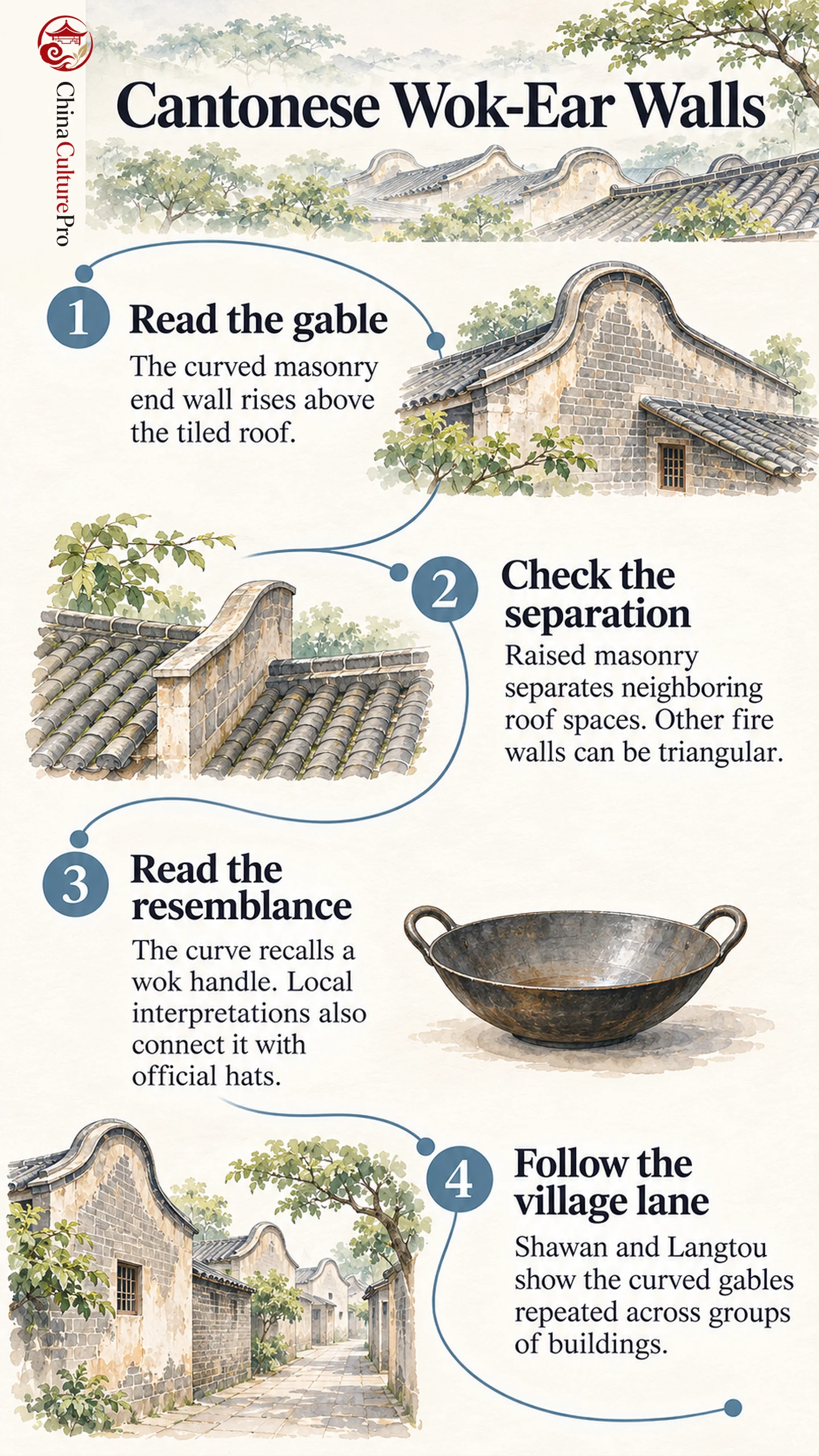
Seen from a lane, the gable can appear as a dark outline above grey roof tiles. A view from the side makes clear where the wall rises past the roof it borders.[1][2]
How the Wall Meets the Roof
The gable closes the short end of a building. Its top rises higher than the tiled slopes, so part of the masonry remains visible above the roof. At Langtou Village, researchers describe the curved walls alongside grey tiles and dark grey brick as features of the historic building groups.[1][3]
In closely packed buildings, a raised masonry wall helps interrupt the route a fire could take from one roof to the next. Guangzhou’s conservation guide also records triangular fire-separating gables. The comparison helps explain why the whole wall matters. Its continuous masonry rises between roof surfaces. The curved outline identifies the wok-ear form among other kinds of traditional Chinese architecture.[1][3]
Why the Curve Has More Than One Reading
The name compares the upper shape to the ear, or handle, of a cooking vessel. A study at Langtou records cultural readings that connect the wok with having enough to eat and the outline with a traditional official’s hat. These readings help explain why a useful end wall could also express aspirations for a household.[2][3]
The same silhouette can occur on neighboring houses. Ownership records can identify a particular family and its history.[2][3][4]
Examples at Shawan and Langtou
Guangzhou’s official guide identifies clusters of wok-ear houses in Shawan Ancient Town, in Panyu. Looking along the lanes, you can see the wall profile repeated among different residences. A single gable helps you see the details. A row of them shows how the form shapes the settlement.[2]
In Langtou Village, Guangzhou’s cultural bureau identifies Jimo Lou as the residence built by Huang Guyi. He also built seven adjoining houses for his sons. The gable profile therefore repeats across buildings linked by a documented family history. The account places wok-ear gables alongside carved brick, stone and wood. The curved walls sit beside sculpted ridge ornaments, but occupy the ends of the buildings. In the surrounding village, rows of houses and lanes make a comb-like plan. A study of Langtou connects the village’s air movement to the arrangement of lanes, courtyards and ponds.[3][4]
FAQs About Wok-Ear Walls
Is a wok-ear wall a type of roof?
It is the end wall. Its upper shape rises beyond the tiled roof and changes the silhouette.[1][2]
Were the walls used to limit fire spread?
Traditional accounts describe a separating role for the raised masonry between roofs.[1][3]
Does the shape prove a household held official rank?
The resemblance to an official hat is one cultural association. The owner’s history depends on the evidence for the house.[3][4]
Sources
[1] Guangzhou Municipal Government. Technical Guidelines for Historic Building Features
[2] Guangzhou Municipal Government. Lingnan Architecture and Wok-Ear Houses in Shawan
[3] China Rural Water and Hydropower. Study of Lingnan Water-Village Landscape and Design
[4] Guangzhou Municipal Bureau of Culture, Radio, Television and Tourism. Langtou Village and Its Historic Buildings