

Quick Answer: What Is a Bangu Drum?
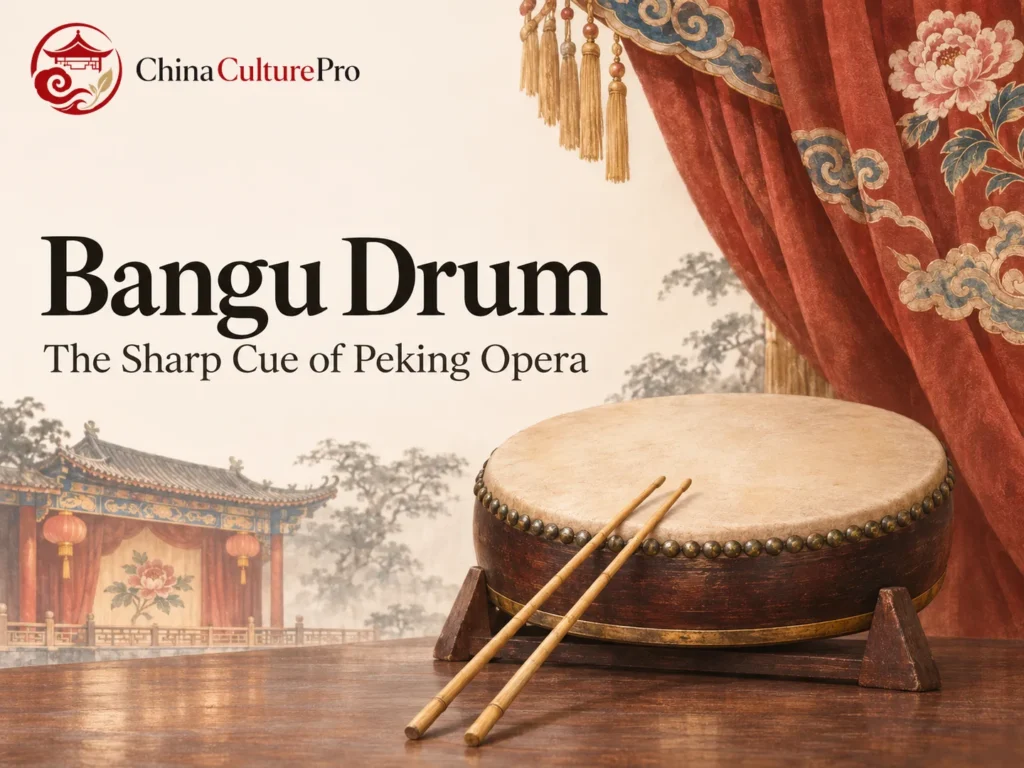
The bangu (板鼓, bǎngǔ) is a shallow, single-headed Chinese drum with a sharp, dry sound. A small opening under the middle of its taut hide lets that part of the head vibrate. In Peking opera, the drummer uses the instrument alongside a wooden clapper to guide the ensemble.[1][2]
- Build: A thick hardwood body supports most of the stretched skin.[1][2]
- Playing: The drummer strikes the small central zone with one or two slender sticks.[2]
- Role: Short strokes can cue other instruments, punctuate stage actions and help mark the rhythm of singing.[1][2]
The bangu is also heard in regional ensembles beyond Peking opera.[2][4]

When a character enters to a burst of percussion, listen for the short taps among the ringing notes. The bangu produces a brief sound that can mark the moment for a movement or the next ensemble entry.[1][2]
Why the Center Sounds Different
Although the skin covers the whole top, only a small circle at the center lies over an opening in the wood. That opening is the drum heart (鼓心, gǔxīn). The China National Peking Opera Company describes a drum around 25 centimeters across, with a central opening around 5 to 7 centimeters across. The skin runs across the opening and is supported by thick wood outside it.[2]
The Metropolitan Museum of Art holds a nineteenth-century example from the Elevated Tone Workshop in Guangzhou. The drum is 25.4 centimeters across and 7 centimeters deep. Its maker joined six wedges of wood inside a brass band and covered the top with cowhide. The catalogue gives the outer dimensions. Compare the diameter with the opera company’s much smaller opening, which sets the area where the skin can vibrate freely.[1][4]
How the Drummer Cues Peking Opera
Peking opera‘s percussion section (武场, wǔchǎng) includes the drum, clapper, gongs and cymbals. A player can lead a percussion entry with a stroke, build urgency with repeated strokes, or cue an entrance with a hand gesture that the audience never hears.[2][3]
The same musician operates the wooden clapper (板, bǎn). A paiban clapper makes a wooden click and can mark the beat during singing. The drum can add a brief accent or a run of quick taps around that beat. The guide to Peking opera percussion explains how these cues fit with larger patterns of gongs and cymbals.[2][3]
How to Pick Out the Bangu by Ear
Listen for a narrow, crisp tap or a quick roll before a fuller gong or cymbal sound. During singing, the separate clapper can be heard against the sustained bowed line of the jinghu. Watch the drummer’s hands if they are visible. During some passages the percussionist holds the clapper in the left hand and uses a stick in the right.[2][3]
The small striking area described by the opera company produces one sound among many kinds of Chinese drums and gongs. The Chinese Music Archive describes drums with a larger opening, giving a lower sound, in southern ensembles such as shifan luogu. In either setting, the drum’s central playing surface is small in relation to its outer rim.[2][4] For a larger drum that also cues a performance, listen to the broad hide head of a Southern lion dance drum.
FAQs About the Bangu Drum
Is the drum heart a hole in the skin?
The hole is in the wooden body below the skin. The hide stays intact and vibrates across that small opening when struck.[1][2]
Is the bangu the same instrument as the ban?
The bangu is a skin-headed drum. The ban is a wooden clapper. The same percussionist commonly plays both in Peking opera.[2][3]
Sources
[1] The Metropolitan Museum of Art. Bangu by Elevated Tone Workshop, Object 89.4.27
[2] China National Peking Opera Company. The Instruments of Peking Opera
[3] The Palace Museum. The Peking Opera Percussion Section
[4] Chinese Music Archive. Bangu and Other Percussion Instruments