

Quick Answer: Which Mountains Are Sacred in Chinese Culture?
Chinese sacred mountains are places where landscape, worship, religious institutions and historical memory meet. Several familiar groupings answer different questions.
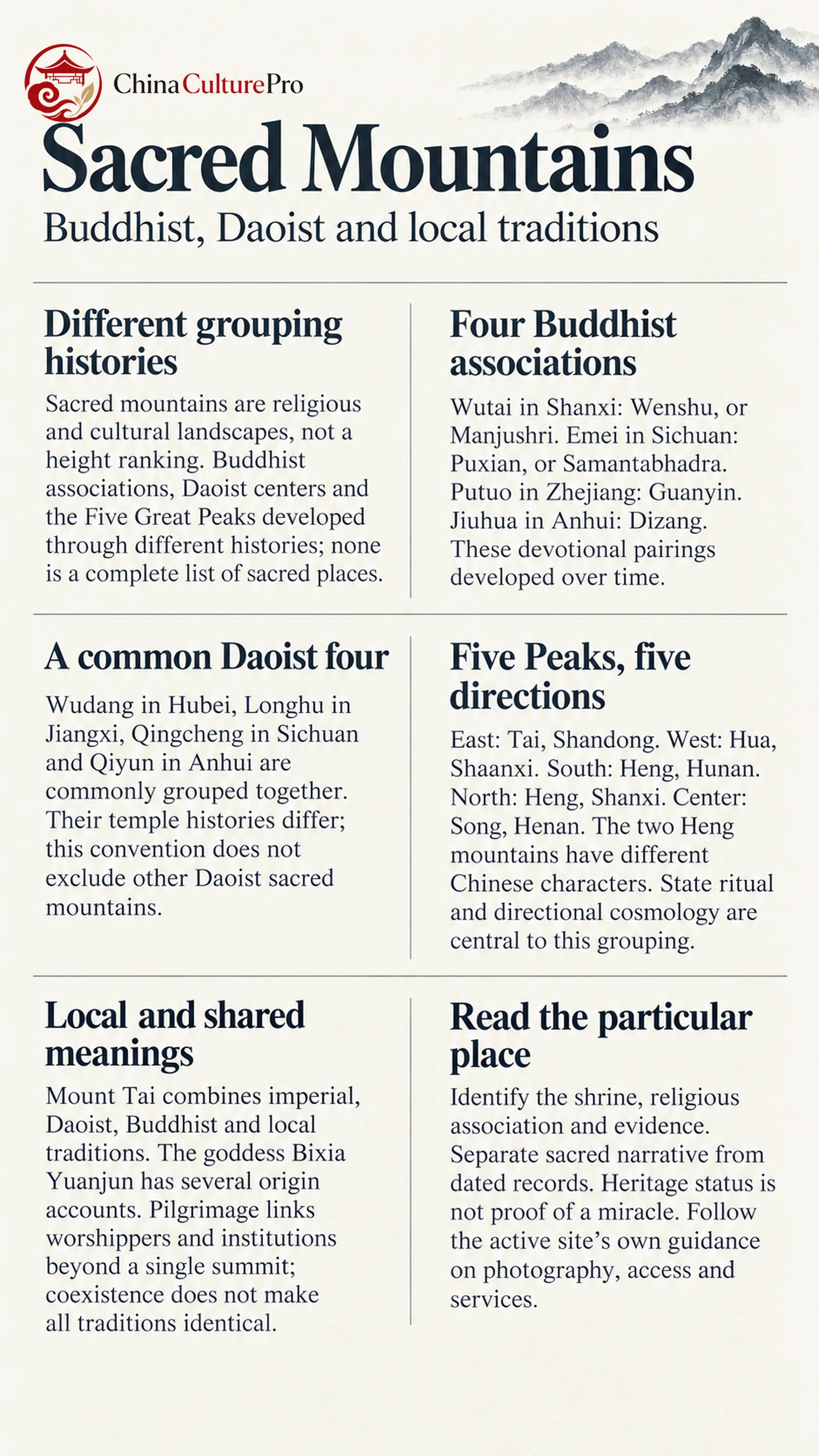
- **Buddhist mountains:** Four well-known sites are associated with particular bodhisattvas.
- **Daoist mountains:** A common four-mountain grouping highlights important Daoist religious centers.
- **Five Great Peaks (五岳, Wǔyuè):** A separate directional system links mountains with historical state ritual and cosmology.
These categories overlap with local devotion and do not assign every mountain exclusively to one religion. The wider guide to religion in China supplies the broader context.
A mountain can be sacred through a bodhisattva’s presence in religious tradition, an imperial ceremony, a local deity or generations of pilgrimage. Famous lists provide useful orientation, but their names should not obscure the different histories behind them.
Three Mountain Groupings, Different Histories
The familiar lists were not established together. Historical research traces the pairing of the four Buddhist mountains with four bodhisattvas through changing texts and institutions. The Five Great Peaks developed through a different history of territorial symbolism and state sacrifice. A site can also attract local worship that does not fit neatly into either grouping.[1][6]
“Sacred” identifies a religious or cultural relationship with place. It is not a measure of elevation, scenic beauty or hiking difficulty. Nor does a list of four or five exhaust China’s sacred landscapes.
The Four Buddhist Mountains and Their Bodhisattvas
The common Buddhist associations are best read as a devotional geography. These bodhisattvas are not four mountain creator gods.
| Mountain | Province | Bodhisattva association |
|---|---|---|
| Mount Wutai (五台山, Wǔtáishān) | Shanxi | Wenshu (文殊, Wénshū), Manjushri |
| Mount Emei (峨眉山, Éméishān) | Sichuan | Puxian (普贤, Pǔxián), Samantabhadra |
| Mount Putuo (普陀山, Pǔtuóshān) | Zhejiang | Guanyin (观音, Guānyīn) |
| Mount Jiuhua (九华山, Jiǔhuáshān) | Anhui | Dizang (地藏, Dìzàng) |
These associations developed historically rather than appearing fully formed at one moment. Wutai, for example, became a major center of Manjushri worship and pilgrimage. Its temples, images and routes form a religious landscape; a summit alone does not explain its significance.[1][2]
A Common Grouping of Four Daoist Mountains
The following sites are commonly grouped as four famous Daoist mountains. This is a useful convention, not a universal list excluding other Daoist sacred sites.[3]
| Mountain | Province |
|---|---|
| Mount Wudang (武当山, Wǔdāngshān) | Hubei |
| Mount Longhu (龙虎山, Lónghǔshān) | Jiangxi |
| Mount Qingcheng (青城山, Qīngchéngshān) | Sichuan |
| Mount Qiyun (齐云山, Qíyúnshān) | Anhui |
Their histories differ. Wudang’s large religious building complex bears the imprint of imperial patronage, especially during the Ming period. Qingcheng is closely associated with early organized Daoist traditions and successive temple communities. Neither example makes mountain religion solely a philosophical retreat or a martial-arts setting.[4][5]
The guide to Daoist temples explains how shrines, clergy and ritual institutions give such places religious meaning.
The Five Great Peaks: Directions and Imperial Ritual
The Five Great Peaks (五岳, Wǔyuè) form a directional framework. Their standard modern identification is:
| Direction | Mountain | Province |
|---|---|---|
| East | Mount Tai (泰山, Tàishān) | Shandong |
| West | Mount Hua (华山, Huàshān) | Shaanxi |
| South | Southern Mount Heng (衡山, Héngshān) | Hunan |
| North | Northern Mount Heng (恒山, Héngshān) | Shanxi |
| Center | Mount Song (嵩山, Sōngshān) | Henan |
The two Hengshan names share a pronunciation in Mandarin but use different characters and refer to different provinces. Shanxi’s northern mountain must also be distinguished from Shaanxi, the province of the western peak.
The system connects with imperial sacrifice and the directional cosmology discussed in the Five Elements (五行, wǔxíng). Calling the peaks simply “five Daoist mountains” hides their state-ritual history and Buddhist or local associations. The UNESCO-hosted proposal describing four peaks as an extension of Tai is a tentative-list submission, not proof that all five share one World Heritage inscription.[6]
Local Deities, Pilgrims and Layered Religious Landscapes
Mount Tai shows several layers together: imperial ceremonies, Daoist shrines, Buddhist scripture inscriptions and landscape celebrated through literature. One mountain can support different forms of sacred meaning without those traditions becoming identical.[7]
Bixia Yuanjun (碧霞元君, Bìxiá Yuánjūn), often called the Lady of Mount Tai, adds a local devotional focus. The Palace Museum records multiple accounts of her origin. Such stories explain religious understandings of the goddess; they should not be merged into one verified historical biography.[8]
Pilgrimage also connects people and institutions across space. Wutai’s religious significance, for example, extends through visits, patronage and cultural exchange beyond the mountain itself.[2]
How to Read a Sacred Mountain as a Cultural Place
Start with the particular place: which temple or shrine, which deity or bodhisattva, and which historical evidence explains its reputation? Separate a sacred narrative from a dated inscription or surviving building. A heritage listing recognizes selected values; it does not establish the truth of a miracle or provide a universal worship procedure.
When encountering an active religious space, follow its own guidance on access, photography and services. Chinese temple etiquette explains why local instructions matter more than a single nationwide checklist.
FAQs About Chinese Sacred Mountains
Are the Five Great Peaks the same as the four Buddhist mountains?
No. The Five Great Peaks are a directional and historical state-ritual grouping. The four Buddhist mountains are associated with bodhisattvas. Their names and organizing principles differ.
Why are two mountains called Hengshan?
Mandarin gives 衡山 and 恒山 the same pronunciation, Héngshān. The southern mountain is in Hunan; the northern mountain is in Shanxi. Chinese characters and province names resolve the ambiguity.
Does a sacred mountain belong to only one religion?
No. Buddhist, Daoist, imperial and local traditions can coexist in a mountain landscape. A dominant association does not prove that other religious histories are absent.
Are sacred mountains simply the highest mountains?
No. Religious texts, institutions, state rites, local deities and pilgrimage explain sacred status. Height and scenic reputation alone do not establish it.
Sources
[1] Jing Tianxing, Chinese Academy of Social Sciences repository. The Evolution of the Four Bodhisattvas and Their Sacred Mountain Sites
[2] UNESCO World Heritage Centre. Mount Wutai
[3] General Administration of Sport of China. Experiencing Mount Qiyun in Anhui
[4] UNESCO World Heritage Centre. Ancient Building Complex in the Wudang Mountains
[5] UNESCO World Heritage Centre. Mount Qingcheng and the Dujiangyan Irrigation System
[6] State Party submission, UNESCO Tentative Lists. The Four Sacred Mountains as an Extension of Mount Taishan
[7] UNESCO World Heritage Centre. Mount Taishan
[8] Palace Museum. Court Performances for Bixia Yuanjun’s Birthday