
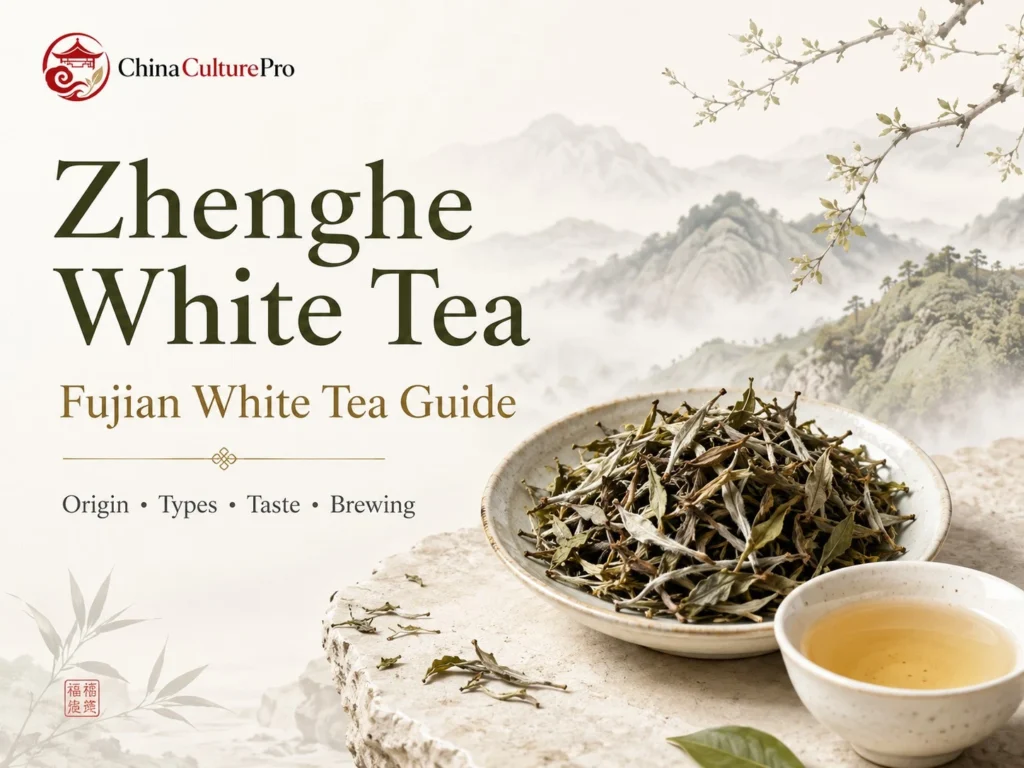

Quick Answer: What Is Zhenghe White Tea?
Zhenghe White Tea, or Zhenghe Bai Cha, is a regional Chinese white tea system centered on Zhenghe County in northern Fujian. It belongs to Chinese white tea and Fujian white tea, but it is not one single tea name or a subordinate version of Fuding White Tea.
It is made mainly through withering, drying, and sorting, with no frying and no rolling. Its distinction comes from northern Fujian mountain origin, local tea tree resources, craft tradition, and a fuller, steadier taste profile.
The basic identity is clear:
-
Tea Type: Chinese white tea.
-
Chinese Name: 政和白茶.
-
Pinyin: Zhenghe Bai Cha.
-
Core Region: Zhenghe County, Nanping, northern Fujian / Minbei.
-
Regional Character: inland mountain environment, different from Fuding’s coastal-mountain setting.
-
Key Tea Tree Resources: Zhenghe Da Bai, Shuixian, and local Caicha / Qunti varieties.
-
Core Process: withering, drying, and sorting.
-
Main Types: Baihao Yinzhen, Bai Mudan, Gong Mei, Shou Mei, aged Zhenghe white tea, and Zhenghe white tea cake.
-
General Style: mellow, fuller, steadier, smooth, sweet, and substantial without being dull or heavy.
-
Brewing: different types need different water temperatures; many Zhenghe styles can handle slightly more heat than very delicate white teas, but Silver Needle still needs care.
Compared with the brighter and more pekoe-forward Fuding style, Zhenghe White Tea is often appreciated for fuller body, steadier aroma, deeper soup texture, and a more settled taste. This is not a higher-or-lower ranking. It is a different regional white tea aesthetic.
The core point: Zhenghe White Tea is an independent northern Fujian white tea system shaped by mountain origin, Zhenghe Da Bai, Shuixian and local tea resources, white tea processing, tea types, and clean storage.
To understand the broader category, read our [Chinese White Tea] guide.
Name, Tea Type, and Basic Identity
The name Zhenghe White Tea combines a place name and a tea type. Zhenghe refers to Zhenghe County in Nanping, Fujian. White Tea refers to the tea category made mainly through withering and drying.
| Identity Point | Zhenghe White Tea |
|---|---|
| Chinese Name | 政和白茶 |
| Pinyin | Zhenghe Bai Cha |
| Tea Type | Chinese white tea / Fujian white tea |
| Regional System | Northern Fujian White Tea / Minbei White Tea |
| Core Region | Zhenghe County, Nanping, Fujian |
| Key Tea Tree Resources | Zhenghe Da Bai, Shuixian, local Caicha / Qunti |
| Core Process | withering, drying, sorting |
| Not The Same As | green tea, dark tea, Pu-erh, flower tea, Fuding White Tea, or one single cultivar |
| Main Forms | loose tea, pressed cake, fresh tea, aged tea |
Zhenghe White Tea should not be understood as one flavor, one product, one cultivar, or only one tea type. It can include Baihao Yinzhen, Bai Mudan, Gong Mei, Shou Mei, aged white tea, and pressed white tea cakes, but it should not be reduced to “the alternative to Fuding.”
Its identity comes from four parts: Zhenghe County and the northern Fujian mountain environment; Zhenghe Da Bai, Shuixian, and local tea tree resources; white tea processing through withering and drying; and different finished tea types. Good Zhenghe White Tea should be elegant and substantial, with clean aroma, clear liquor, sweet mellow taste, smooth body, and a soft natural leaf base.
To compare major Chinese tea categories, read our Chinese Tea Types guide.
Main Origins: Zhenghe County and Northern Fujian
Zhenghe County is located in northern Fujian, under Nanping. It belongs to the Minbei, or northern Fujian, tea world. This makes its regional character different from Fuding, which is closer to the coastal mountain environment of northeastern Fujian.
| Origin / Area | Chinese | Location | Why It Matters |
|---|---|---|---|
| Zhenghe County | 政和县 | northern Fujian, under Nanping | the core administrative region of Zhenghe White Tea |
| Minbei / Northern Fujian | 闽北 | northern mountain region of Fujian | the broader regional setting behind Zhenghe’s steadier white tea style |
| Local Mountain Areas | 各乡镇 / 山场 | within Zhenghe County | different villages and mountain areas may show different microclimates and tea styles |
| Shitun, Dongping, Tieshan, Lingyao | 石屯、东平、铁山、岭腰 | local Zhenghe areas | local names often discussed by tea drinkers when talking about Zhenghe white tea origins |
Zhenghe is an inland mountain county, so its tea is often described through mountain valleys, forest ecology, mist, cooler air, and a steadier climate. Unlike Fuding’s “mountain and sea” language, Zhenghe is more often discussed as a Minbei mountain tea.
These regional conditions help explain why many drinkers value Zhenghe White Tea for body, depth, steadiness, and texture across infusions, not only for a bright first impression. Local areas such as Shitun, Dongping, Tieshan, and Lingyao can also carry their own microclimate and tea identity.
Zhenghe also has a strong local tea culture. Phrases such as “thousand-year white tea, hundred-year gongfu” are best understood as regional cultural language rather than a simple historical formula. They reflect how local people connect white tea, craftsmanship, and long tea-making memory.
Tea Tree Cultivars: Zhenghe Da Bai, Shuixian, and Local Varieties
Zhenghe White Tea is strongly associated with Zhenghe Da Bai, while Shuixian and local Caicha / Qunti materials also help shape the broader local white tea context. These are tea tree resources, not finished tea categories.
| Tea Tree Resource | Chinese | Common English Rendering | Key Features | Common Use |
|---|---|---|---|---|
| Zhenghe Da Bai | 政和大白茶 | Zhenghe Big White Tea | important Zhenghe white tea cultivar, plump buds and leaves, visible white down, often associated with fuller white tea style | Baihao Yinzhen, Bai Mudan, Gong Mei, Shou Mei |
| Shuixian | 水仙 | Shuixian / Narcissus | northern Fujian tea resource, larger leaves, fuller body, steadier character | Bai Mudan, Shou Mei, and local white tea expressions |
| Local Caicha / Qunti | 当地菜茶 / 群体种 | local landrace / seed-grown tea varieties | local variation, mixed genetic background, natural character | often discussed in Gong Mei and traditional local tea context |
Zhenghe Da Bai, also called Zhenghe Big White Tea, is the central cultivar identity of Zhenghe White Tea. It is known for plump buds and leaves, visible white down, and white tea suitability. Compared with Fuding Da Bai, it is often described as later-sprouting and more associated with a fuller, steadier style.
Shuixian is an important northern Fujian tea resource known from Wuyi and Minbei tea traditions. In Zhenghe white tea, it can contribute fuller body and a more settled taste when used appropriately.
Local Caicha / Qunti material adds local variation, especially in Gong Mei and older tea traditions. These seed-grown or local group varieties may look less standardized than modern clonal cultivars, but they can bring sweetness, texture, and regional character.
Zhenghe Da Bai is the main cultivar base, while Shuixian and local Qunti materials are important supplements. The key distinction: Zhenghe Da Bai, Shuixian, and Qunti are tea tree resources; Baihao Yinzhen, Bai Mudan, Gong Mei, and Shou Mei are finished tea types.
How Zhenghe White Tea Is Made
Zhenghe White Tea follows the core white tea process: picking, withering, drying, and sorting, with no frying and no rolling. Its quality depends on raw material, weather, withering control, drying, and the maker’s experience.
The raw material may include buds, leaves, or tender stems from Zhenghe Da Bai, Shuixian, or local Caicha / Qunti varieties. Picking standards vary by type: Baihao Yinzhen uses single buds; Bai Mudan uses one bud with one or two leaves; Gong Mei is linked with Qunti young shoots; Shou Mei uses more mature leaves and sometimes appropriate stems; aged tea or cakes are made from suitable white tea material after storage or pressing.
| Step | Chinese Term | What It Does | Key Point |
|---|---|---|---|
| Picking | 采摘 | selects buds, young shoots, or leaves according to tea type | Zhenghe Da Bai is often described as later-sprouting than Fuding Da Bai, so picking season may differ |
| Withering | 萎凋 | lets fresh leaves slowly lose moisture and undergo slight natural transformation | the core step that shapes aroma, sweetness, body, and texture |
| Drying | 干燥 | stabilizes aroma and moisture content | should preserve sweetness and prevent dull, sour, or unstable storage notes |
| Sorting | 拣剔 | removes unsuitable material, coarse stems, broken pieces, or impurities | keeps the finished tea clean and even |
White tea is not “unprocessed tea.” It is lightly processed tea, and withering and drying are active craft decisions. Poor withering can make the tea raw, thin, or uneven; poor drying can make it dull, sour, or unstable in storage.
Zhenghe processing is often associated with indoor withering, combined withering, and a more gradual mountain-climate rhythm, though not every Zhenghe tea follows the same method. The key is patient control: the maker reads the weather, leaf condition, spreading thickness, humidity, and timing until aroma, sweetness, and body reach balance.
Main Types of Zhenghe White Tea
Zhenghe White Tea includes the major Fujian white tea categories: Baihao Yinzhen, Bai Mudan, Gong Mei, Shou Mei, aged white tea, and pressed cakes. The names may look familiar, but the Zhenghe style gives them a different regional foundation.
| Type | Chinese | Raw Material | Appearance | Aroma | Taste | Best For |
|---|---|---|---|---|---|---|
| Baihao Yinzhen | 白毫银针 | single buds, often from Zhenghe Da Bai or suitable local material | plump buds, white down, needle-like form | pekoe aroma, clean sweetness, often steadier than very bright Fuding styles | fresh, sweet, smooth, delicate, with some body | drinkers who want delicacy without excessive lightness |
| Bai Mudan | 白牡丹 | one bud with one or two leaves | bud and leaves connected, green leaves with silver down | pekoe aroma plus floral aroma, often more restrained | fresh, sweet, floral, mellow, with body | drinkers who want floral aroma and fuller texture |
| Gong Mei | 贡眉 | Qunti young shoots or suitable local material | natural bud-and-leaf form, less standardized | sweet aroma, floral aroma, honey-like variation | sweet, mellow, smooth, varied | drinkers who like local material character |
| Shou Mei | 寿眉 | more mature leaves, often with appropriate stems | more open leaves, larger leaf material | plant-like aroma, sweet aroma, floral or aged notes | sweet, mellow, thicker, durable | daily drinking, aging, and cakes |
| Aged Zhenghe White Tea | 老政和白茶 | aged form of suitable Zhenghe white tea | depends on base tea and storage | aged aroma, jujube, herbal aroma, honey-like sweetness, woody sweetness | sweet, mellow, smooth, thicker | drinkers who like aged white tea depth |
| Zhenghe White Tea Cake | 政和白茶饼 | pressed form of suitable Zhenghe white tea | cake, brick, or tuo shape | depends on base tea and storage | depends on base tea and storage | storage, sharing, simmering, and aged tea drinking |
Zhenghe Baihao Yinzhen can be delicate and clean, but it may feel steadier than very bright Fuding Silver Needle. Zhenghe Bai Mudan often shows floral aroma with more soup texture. Gong Mei carries local material variation and sweetness, while Shou Mei brings body, durability, and aging potential.
Aged Zhenghe White Tea is a storage state, not a separate tea type. Zhenghe White Tea Cake is also a form, not a grade. The same “Silver Needle” or “White Peony” name does not guarantee the same feeling as Fuding; Zhenghe often brings a steadier, fuller foundation.
To compare the single-bud white tea style, read our Baihao Yinzhen Tea guide. To compare the bud-and-leaf white tea style, read our Bai Mudan Tea guide.
What Zhenghe White Tea Tastes Like
Zhenghe White Tea is usually appreciated for a mellow, steady, sweet, and fuller-bodied taste profile. It should feel substantial, but not dull; deep, but not muddy; calm, but not flat.
| Tasting Point | Good Zhenghe White Tea |
|---|---|
| Dry Aroma | clean pekoe aroma, floral aroma, sweet aroma, honey-like aroma, or aged aroma |
| Liquor Color | pale apricot, apricot-yellow, golden, orange-yellow, or amber depending on type and age |
| Taste | sweet, mellow, smooth, substantial, clean |
| Mouthfeel | fuller body, steady soup texture, smooth but not heavy |
| Aftertaste | clean sweetness, gentle returning sweetness, comfortable finish |
| Leaf Base | soft, bright, naturally opened |
Different Zhenghe white teas show different flavor focuses:
| Type | Aroma Focus | Taste Focus | Liquor Color |
|---|---|---|---|
| Baihao Yinzhen | pekoe aroma, clean sweetness, restrained floral hints | fresh, sweet, smooth, delicate, with more body than expected | pale apricot, light yellow |
| Bai Mudan | pekoe aroma plus floral aroma, more restrained than many bright styles | fresh, sweet, floral, mellow, with body | pale apricot, apricot-yellow |
| Gong Mei | sweet aroma, floral aroma, honey-like variation | sweet, mellow, varied | apricot-yellow, orange-yellow |
| Shou Mei | plant-like aroma, sweet aroma, floral or aged notes | sweet, mellow, thicker, durable | apricot-yellow, orange-yellow, golden |
| Aged Zhenghe White Tea | aged aroma, jujube, herbal aroma, honey-like sweetness, woody sweetness | sweet, mellow, smooth, thicker | orange-yellow, orange-red, amber |
The key words are mellow, steady, sweet, and substantial. Zhenghe White Tea should have body, but it should not taste muddy, rough, dull, or heavy.
Judge quality by balance: clean natural aroma, clear liquor, sweet mellow taste, smooth body, and soft natural leaf base. Avoid moldy, sour, smoky, or warehouse-like aroma, cloudy liquor, rough taste, or blackened stiff leaves.
A Chinese tea drinker may say Zhenghe White Tea has tang gan, or soup texture: weight and smoothness in the mouth, not just fragrance. Its strength often appears in later infusions, where steadier aroma, fuller body, and calm sweetness become clearer.
How to Taste Zhenghe White Tea Like a Tea Drinker
Tasting Zhenghe White Tea requires attention to both aroma and soup texture. The aroma should be clean, but the body is just as important.
- Look At The Dry Tea Check whether buds and leaves are natural, intact, and type-appropriate. Silver Needle should show plump downy buds; Bai Mudan should show connected buds and leaves; Shou Mei should show open leaves and suitable stems. Aged tea should not look blackened, moldy, or dirty.
- Smell The Dry Aroma Fresh Zhenghe white tea may show pekoe, floral, sweet, or honey-like notes. Aged tea may show aged aroma, jujube, herbal aroma, or woody warmth. Avoid moldy, sour, stuffy, smoky, or warehouse-like smells.
- Check The Liquor The liquor should be clear, whether pale apricot, apricot-yellow, golden, orange-yellow, or amber. Darkness is not the main point; clarity is.
- Taste The Liquor And Soup Texture Silver Needle should feel clean and delicate; Bai Mudan should balance floral aroma with body; Gong Mei should show sweetness and variation; Shou Mei should show thickness and durability; aged tea should feel smooth and cleanly transformed. For Zhenghe White Tea, the second and third infusions often reveal more than the first.
- Look At The Leaf Base The brewed leaves should be soft, bright, and naturally opened. Avoid blackened, stiff, slimy, rotten-looking, or excessively broken leaves.
The practical rule is simple: every type should pass the same first test: clean aroma, clear liquor, and comfortable taste.
For aroma, mouthfeel, Hui Gan, and aftertaste, read our Chinese Tea Tasting guide.
How to Brew Zhenghe White Tea
Different Zhenghe white teas need different brewing temperatures. Many Zhenghe styles can handle slightly higher heat than very delicate white teas, but this does not mean every Zhenghe tea should be brewed aggressively.
| Type | Water Temperature | Gaiwan Brewing | Cup Brewing | Notes |
|---|---|---|---|---|
| Baihao Yinzhen | 85–90°C / 185–194°F | 5g / 100–120ml, 20–40 seconds to start | 2–3g / 200–250ml, 3–5 minutes | treat gently; avoid aggressive boiling water |
| Bai Mudan | around 90°C / 194°F | 5g / 100–120ml, 20–40 seconds to start | 2–3g / 200–250ml, 3–5 minutes | slightly higher heat helps release body |
| Gong Mei | 90–95°C / 194–203°F | 5g / 100–120ml, 15–30 seconds to start | 3–4g / 250ml, 3–5 minutes | hotter water helps release sweetness and texture |
| Shou Mei | 90–95°C / 194–203°F | 5g / 100–120ml, 15–30 seconds to start | 3–4g / 250ml, 3–5 minutes | mature leaves need more heat for body |
| Aged Zhenghe White Tea | 95–100°C / 203–212°F | 5g / 100–120ml, 15–30 seconds to start | 3–4g / 250ml, 3–5 minutes | can be brewed first, then simmered |
| Zhenghe White Tea Cake | 95–100°C / 203–212°F | 5g / 100–120ml, 15–30 seconds to start | 3–4g / 250ml, 3–5 minutes | pry gently; aged cakes can be simmered |
Brewing tips:
- Match the water temperature to the tea: Silver Needle needs care; Bai Mudan can take slightly more heat; Gong Mei, Shou Mei, aged tea, and cakes can handle hotter water.
- Use a gaiwan for serious tasting: it shows Zhenghe’s soup texture and later-infusion stability.
- Use a glass cup for visual appreciation: Silver Needle and Bai Mudan open beautifully in water.
- Use a large mug for daily drinking: Gong Mei and Shou Mei are practical for simple brewing.
- Simmer aged tea and cakes: brew first, then simmer for deeper sweetness.
- Do not crush tea cakes: broken fragments release too quickly and may taste rough.
- Enjoy it plain: milk and sugar cover the natural sweetness, aroma, and body.
The basic principle is brew according to the tea: do not use boiling water aggressively on Zhenghe Silver Needle, and do not use lukewarm water for aged tea.
To learn practical brewing methods, read our How to Brew Chinese Tea guide. For gaiwans, glass cups, mugs, porcelain pots, and other brewing vessels, read our Chinese Teaware guide.
Fresh Zhenghe White Tea vs Aged Zhenghe White Tea
Zhenghe White Tea can be enjoyed fresh or aged. These are two drinking stages, not a strict quality ranking.
| Point | Fresh Zhenghe White Tea | Aged Zhenghe White Tea |
|---|---|---|
| Aroma | pekoe aroma, floral aroma, sweet aroma, honey-like sweetness | aged aroma, jujube, herbal aroma, honey-like sweetness, woody sweetness |
| Liquor | pale apricot, golden, clear | orange-yellow, orange-red, amber, clear |
| Taste | clean, sweet, mellow, already with some body | sweet, mellow, smooth, thicker |
| Texture | elegant but substantial, not thin | rounder, warmer, more settled |
| Best For | fresh sweetness, floral aroma, early body | aged depth, smoothness, slow drinking |
| Key Standard | clean sweetness and body | clean storage and natural transformation |
Fresh Zhenghe White Tea is valued for clean sweetness, floral aroma, and early body. Aged Zhenghe White Tea is valued for clean transformation, deeper sweetness, aged aroma, smoothness, and thicker body.
Fresh tea is not inferior, and aged tea is not automatically better. New Zhenghe can feel like early autumn in northern Fujian: clear, sweet, but already calm. Aged Zhenghe feels warmer and deeper. Both can be worth drinking.
To explore aged white tea more deeply, read our Aged White Tea guide.
Zhenghe White Tea Cake and Pressed White Tea
Zhenghe White Tea Cake is pressed white tea. It is a form, not a tea type or quality grade. Loose Zhenghe white tea can be softened with steam and pressed into a cake, brick, or tuo shape for easier storage, transport, aging, and portioning. Pressing is especially common with Shou Mei, but Gong Mei and Bai Mudan cakes also exist. Silver Needle cakes are less common.
| Checkpoint | Good Zhenghe White Tea Cake | Problem Zhenghe White Tea Cake |
|---|---|---|
| Raw Material | clean, natural, suitable for white tea | excessive broken material, dust, or low-grade filler |
| Aroma | clean sweet aroma or clean aged aroma | moldy, sour, smoky, warehouse-like smell |
| Inside And Outside | relatively consistent material | good surface material but poor inner material |
| Compression | firm but able to open in brewing | pressed too tightly and difficult to brew open |
| Liquor | clear, bright, type-appropriate color | cloudy, dull, dark, or muddy |
| Taste | sweet, mellow, smooth, substantial | rough, thin, sour, harsh |
| Leaf Base | natural, soft, not overly broken | blackened, stiff, fragmented, or rotten-looking |
When brewing Zhenghe white tea cake, pry gently and keep the leaves as intact as possible. Too many fragments can release too quickly and taste rough. The first infusion can be slightly longer to let the tea open.
Aged Zhenghe white tea cakes, especially aged Shou Mei cakes, can be brewed first and then simmered for deeper sweetness and body. But a cake is not automatically better than loose tea: good cake tea depends on raw material, processing, pressing, and storage; poor cake tea cannot be saved by shape.
Zhenghe White Tea vs Fuding White Tea
Zhenghe and Fuding are two important Fujian white tea systems. They are not a high-low comparison. They represent different regional backgrounds, cultivars, processing habits, and taste aesthetics.
| Point | Zhenghe White Tea | Fuding White Tea |
|---|---|---|
| Region | northern Fujian / Minbei | northeastern Fujian |
| Environment | inland mountain setting | coastal-mountain setting |
| Cultural Identity | Zhenghe white tea tradition, Minbei tea culture | Taimu Mountain, Fuding white tea culture |
| Key Cultivars | Zhenghe Da Bai, Shuixian, local Qunti | Fuding Da Bai, Fuding Da Hao |
| General Aroma | more restrained, steadier, less outwardly bright | cleaner, brighter, more pekoe-forward, floral |
| General Taste | fuller, mellower, more substantial, stronger soup texture | fresher, sweeter, softer, more elegant |
| Style Impression | steady, deep, substantial | clear, bright, fresh-sweet |
| Drinking Impression | often reveals strength in later infusions | often gives an attractive first impression |
Fuding White Tea is often bright, clean, fresh, and pekoe-forward. Zhenghe White Tea is often fuller, steadier, and more substantial. This is not a high-low ranking: Fuding often gives a clearer first impression, while Zhenghe often shows more depth across the second and third infusions.
A simple comparison: Fuding can feel like a clear spring morning; Zhenghe can feel like a quiet autumn afternoon.
To compare this regional system with another major origin, read our Fuding White Tea guide.
Zhenghe White Tea vs Chinese White Tea
Zhenghe White Tea is part of Chinese White Tea. It is not a separate category outside Chinese white tea.
| Point | Zhenghe White Tea | Chinese White Tea |
|---|---|---|
| Scope | regional white tea system centered on Zhenghe, Fujian | broad category of white tea made in China |
| Identity | place name plus tea type | country-level tea category |
| Relationship | one important part of Chinese White Tea | includes Zhenghe, Fuding, Jianyang / Shuiji, Songxi, Jian’ou, and other white tea regions |
| Key Features | northern Fujian origin, Zhenghe Da Bai, Shuixian, fuller and steadier style | broader range of origins, cultivars, and styles |
| Best Use Of Term | when discussing white tea from Zhenghe | when discussing the whole Chinese white tea category |
Chinese White Tea is the larger category, including Zhenghe, Fuding, Jianyang / Shuiji, Songxi, Jian’ou, and other regional expressions. Zhenghe White Tea is one important regional system within it, valued for northern Fujian origin, Zhenghe Da Bai, Shuixian and local tea resources, white tea craft, and a mellow, steady, full-bodied style.
How to Choose Good Zhenghe White Tea
Good Zhenghe White Tea should not rely only on packaging, origin words, or comparison with Fuding. The tea itself must show clear identity and clean quality.
| Checkpoint | What To Look For | Warning Signs |
|---|---|---|
| Product Name | Zhenghe White Tea plus a clear type such as Baihao Yinzhen, Bai Mudan, Gong Mei, or Shou Mei | only “white tea” with no origin or type |
| Origin | Zhenghe, Nanping, northern Fujian / Minbei, or credible local mountain area | vague origin or non-Zhenghe tea sold as Zhenghe |
| Cultivar | Zhenghe Da Bai, Shuixian, or clear local material | unclear cultivar or suspicious origin claim |
| Category | clear tea type: Silver Needle, White Peony, Gong Mei, Shou Mei, aged tea, cake | vague category or confusing label |
| Dry Leaf | natural buds and leaves, visible white down where appropriate, natural color | too much dust, blackened material, dull color |
| Aroma | clean pekoe, floral, sweet, honey-like, or aged aroma | moldy, sour, stuffy, smoky, warehouse-like smell |
| Liquor | clear and bright | cloudy, muddy, dull, or dark without clarity |
| Taste | sweet, mellow, smooth, substantial, not dull | bitter, rough, thin, sour, harsh, or heavy in a bad way |
| Leaf Base | soft, bright, naturally opened | blackened, stiff, rotten-looking, overly broken |
Watch for vague labels, exaggerated ancient-tree or secret-process stories, fake or artificially aged tea, moldy or sour aroma, dull heaviness sold as “Zhenghe style,” and tea that looks dark or thick but brews cloudy, thin, or harsh.
Four buying rules matter most: clear origin, clear category, clean aroma, and mellow substantial taste. Good Zhenghe White Tea should have body, but it should feel steady, not lifeless.
How to Store Zhenghe White Tea
Use these storage rules:
- Seal It Well: use a sealed pouch, tin, jar, or clean storage bag.
- Keep It Dry: moisture can make white tea dull, sour, or moldy.
- Avoid Light: strong light can weaken aroma and darken the tea.
- Keep It Cool: normal cool room temperature is usually enough.
- Avoid Odors: keep it away from spices, coffee, smoke, incense, Pu-erh, and scented teas.
- Do Not Refrigerate: refrigerators often have moisture and food odors.
- Protect White Tea Cakes From Moisture: the center of a cake can trap moisture if the environment is humid.
- Protect Loose Tea From Crushing: loose tea can break easily and lose aroma faster.
- Drink Fresh Tea For Aroma And Body: young Zhenghe white tea can already show clean sweetness and soup texture.
- Age Tea Only Under Clean Conditions: aged Zhenghe white tea can become deeper and smoother, but not every tea improves with age.
The storage principle is simple: clean, dry, sealed, dark, cool, and odor-free. Stable storage is better than constant handling. Clean storage matters more than a high year number.
Benefits and Caffeine
Zhenghe White Tea contains common tea compounds such as tea polyphenols, amino acids, and caffeine. Many drinkers find it mellow and easy to drink, but this is a drinking experience, not a medical claim.
Important cautions:
- Zhenghe White Tea contains caffeine.
- A mellow taste does not mean it is caffeine-free.
- Avoid drinking large amounts before sleep.
- People sensitive to caffeine should drink moderately.
- People with stomach sensitivity should adjust amount and strength.
- Pregnant people, people taking medication, or people with medical concerns should ask a qualified professional.
- Herbal aroma in aged white tea is an aroma note, not a medical effect.
- Do not treat Zhenghe White Tea as medicine.
Do not use Zhenghe White Tea as a promise for weight loss, blood sugar control, blood pressure control, cancer prevention, or disease treatment. It is tea; its best value is taste, culture, texture, and the calm pleasure of drinking it properly.
Final Thoughts
Zhenghe White Tea is not one single tea name and not a subordinate version of Fuding White Tea. It is a regional Chinese white tea system centered on Zhenghe County in northern Fujian, built on Minbei mountain terroir, Zhenghe Da Bai, Shuixian and local tea tree resources, and white tea processing through withering, drying, and sorting.
Its richness comes from Baihao Yinzhen, Bai Mudan, Gong Mei, Shou Mei, fresh white tea, aged white tea, loose tea, and pressed cakes. A good Zhenghe White Tea should show clear regional identity, clean natural material, proper white tea processing, elegant but fuller aroma, clear liquor, sweet mellow substantial taste, and a soft, naturally opened leaf base.
Its value is not only the name “Zhenghe,” and not only a comparison with Fuding. It is the northern Fujian white tea style created by origin, cultivars, processing, tea types, and storage. If Fuding White Tea is a bright doorway into Chinese white tea, Zhenghe White Tea shows its quieter depth.
FAQs About Zhenghe White Tea
What is Zhenghe White Tea?
Zhenghe White Tea is a regional Chinese white tea system centered on Zhenghe County in northern Fujian. It is not one single tea name. It includes Baihao Yinzhen, Bai Mudan, Gong Mei, Shou Mei, aged white tea, and pressed white tea cakes.
Is Zhenghe White Tea the same as white tea?
No. White tea is the broader tea category. Zhenghe White Tea is one important northern Fujian regional system within Chinese white tea.
Where is Zhenghe White Tea from?
Zhenghe White Tea comes from Zhenghe County in Nanping, northern Fujian. It belongs to the Minbei mountain tea world, which is different from Fuding’s coastal-mountain setting.
What tea trees are used for Zhenghe White Tea?
The most important tea tree resources include Zhenghe Da Bai, Shuixian, and local Caicha / Qunti varieties. Zhenghe Da Bai is the main cultivar identity, while Shuixian and local varieties add regional depth and variation.
What are the main types of Zhenghe White Tea?
The main types include Baihao Yinzhen, Bai Mudan, Gong Mei, Shou Mei, aged Zhenghe white tea, and Zhenghe white tea cake.
What does Zhenghe White Tea taste like?
Zhenghe White Tea is often mellow, steady, sweet, smooth, and full-bodied. It is usually less outwardly bright than Fuding White Tea, but often has more soup texture and a more settled taste.
Is Zhenghe White Tea green tea?
No. Zhenghe White Tea is white tea. It is made through withering, drying, and sorting, with no frying and no rolling. Green tea uses heat fixation, so the processing logic is different.
What is the difference between Zhenghe White Tea and Fuding White Tea?
Fuding White Tea is often brighter, fresher, and more pekoe-forward. Zhenghe White Tea is often fuller, steadier, and more substantial, with stronger soup texture. They are different Fujian white tea systems, not a high-low ranking.
Is Zhenghe White Tea better than Fuding White Tea?
No. They are different styles. Choose Fuding if you like a brighter, fresher, more immediately elegant style. Choose Zhenghe if you like a fuller, steadier, more substantial white tea.
Can Zhenghe White Tea be aged?
Yes. Zhenghe White Tea can be aged when raw material, processing, dryness, and storage are suitable. Aged Zhenghe white tea may show aged aroma, jujube, herbal aroma, honey-like sweetness, and a smoother body.
What is Zhenghe White Tea cake?
Zhenghe White Tea cake is pressed white tea. It is a form, not a tea type or quality grade. It is often made from Shou Mei, but Gong Mei and Bai Mudan cakes also exist.
How do you brew Zhenghe White Tea?
Use different temperatures for different types. Baihao Yinzhen usually does well around 85–90°C. Bai Mudan often uses around 90°C. Gong Mei and Shou Mei often use 90–95°C. Aged tea and cakes can use 95–100°C and may be simmered.
Does Zhenghe White Tea have caffeine?
Yes. Zhenghe White Tea contains caffeine. Its mellow taste does not mean it is caffeine-free.
How should I store Zhenghe White Tea?
Store it sealed, dry, dark, cool, and away from strong odors. Do not refrigerate it. Keep it away from moisture, smoke, spices, coffee, Pu-erh, and scented teas.
How do I choose good Zhenghe White Tea?
Look for clear origin, clear tea type, clean aroma, clear liquor, sweet mellow body, and a soft natural leaf base. Avoid vague labels, moldy or sour smells, cloudy liquor, dull heaviness, and exaggerated packaging stories.