
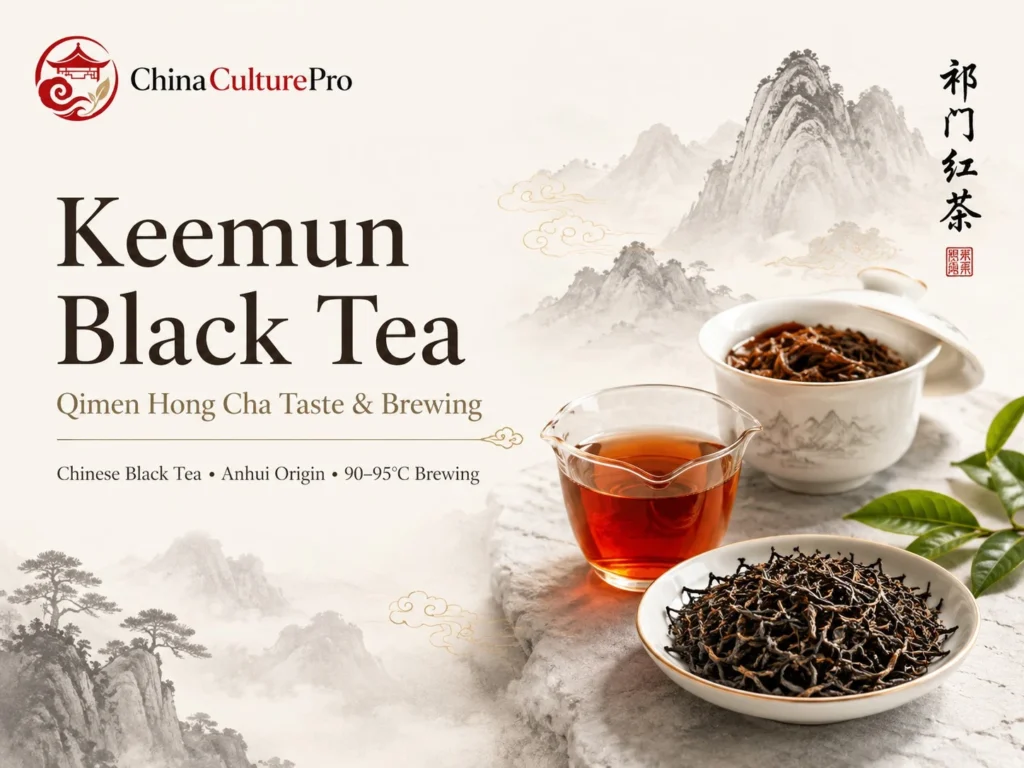

Quick Answer: What Is Keemun Black Tea?
Keemun Black Tea, also called Keemun Tea or Qimen Hong Cha, is a classic Chinese black tea from Qimen County in Huangshan, Anhui Province. In Chinese tea classification, it is called Hong Cha, or red tea. In English, the same tea category is usually called black tea.
This can be confusing. Keemun Black Tea is not Chinese dark tea, or Hei Cha. Chinese red tea and English black tea refer to the fully oxidized tea category that includes Keemun, Dian Hong, Lapsang Souchong, and Jin Jun Mei. Chinese dark tea is a different post-fermented tea category.
The basic points are:
Tea Type: Chinese red tea, called black tea in English.
Core Origin: Qimen County, Huangshan, Anhui Province.
Name Meaning: Keemun is an older English spelling of Qimen; Hong Cha means red tea.
Dry Leaf: fine, tight, even twisted leaves with a lustrous dark color.
Liquor: bright, clear red or reddish amber.
Core Aroma: Keemun aroma, often combining floral, honey, fruity, light cocoa, and gentle woody notes.
Taste: fresh, mellow, smooth, refined, lightly sweet, and low in rough bitterness.
Brewing: usually 90–95°C, with a gaiwan, porcelain teapot, or Western cup.
Key Difference: Dian Hong is sweeter and thicker with more golden buds; Lapsang Souchong may show pine smoke or longan-like depth; Jin Jun Mei is bud-heavy, honey-sweet, and delicate; Keemun is more elegant, floral, and refined.
Key Point: Keemun Black Tea is a classic Chinese black tea from Qimen, Anhui, known in Chinese as Qimen Hong Cha. Good Keemun should be judged by Qimen origin, fine and even twisted leaves, lustrous dark color, natural Keemun aroma, bright red liquor, fresh mellow sweetness, low bitterness, and clean Hui Gan.
Keemun, Qimen Hong Cha, and Chinese Red Tea: Are They the Same?
Keemun Black Tea, Keemun Tea, Qimen Hong Cha, and Qimen Black Tea can all refer to the same tea. The difference is mostly spelling and tea-language context.
| Term | Chinese | Meaning | Best Use |
|---|---|---|---|
| Keemun Black Tea | 祁门红茶 | common English name; Keemun is an older spelling of Qimen | clearest main keyword |
| Keemun Tea | 祁门红茶 | shortened English name | useful in product descriptions |
| Qimen Hong Cha | 祁门红茶 | modern pinyin with Chinese tea-category name | precise Chinese tea term |
| Qimen Black Tea | 祁门红茶 | modern pinyin with English category name | clear for English readers |
| Chinese Red Tea | 中国红茶 | Chinese tea-category term for black tea | useful for explaining Hong Cha |
| Chinese Dark Tea / Hei Cha | 中国黑茶 | post-fermented dark tea category | not Keemun |
The important distinction is this: English black tea = Chinese red tea, but Chinese dark tea = Hei Cha, a different category. Keemun Black Tea is red tea in Chinese and black tea in English. It should not be confused with Pu’er ripe tea, Liu Bao, or other dark teas.
To compare Keemun with other tea categories, read our Chinese Tea Types guide.
Why Keemun Black Tea Is So Famous
Keemun Black Tea is famous because of its origin, aroma, refinement, and historical role in the global black tea market. It is one of the best-known Chinese black teas outside China, but its real value is not only its reputation. It is the cup itself: elegant aroma, bright liquor, and a smooth, mellow taste.
Its reputation comes from several factors:
- Keemun Aroma: the signature “Qimen Xiang” is a refined mix of floral, honey, fruity, cocoa-like, and gentle woody notes.
- Qimen Origin: Qimen County lies in the Huangshan and historical Huizhou tea region, where humid mountains, mist, and tea-growing tradition shape the tea.
- Classic Chinese Black Tea Identity: Keemun is one of the most recognized representatives of Chinese red tea.
- International Recognition: it entered Western markets early and became familiar to many black tea drinkers.
- High-Fragrance Reputation: it is often mentioned in the traditional saying of the world’s great high-fragrance black teas, alongside Darjeeling and Uva.
- Elegant Drinking Style: compared with many strong Assam or Ceylon-style black teas, Keemun is usually more refined, aromatic, and suitable for plain drinking.
A Chinese tea drinker would not judge Keemun only by a famous name. Origin matters, but final quality depends on leaf material, oxidation control, refining, storage, and whether the Keemun aroma is natural and present in the liquor.
To understand where Keemun fits among Chinese black teas, read our Chinese Black Tea guide.
Where Keemun Black Tea Comes From
Keemun Black Tea is most closely linked with Qimen County in Huangshan, Anhui Province. The surrounding Huangshan and old Huizhou tea region also forms part of its broader cultural and tea-growing background.
| Origin | Chinese Name | Location | General Style | Typical Price Position |
|---|---|---|---|---|
| Core Qimen Area | 祁门核心产区 | Qimen County, Huangshan, Anhui | classic Keemun aroma, fine twisted leaves, fresh mellow taste | highest |
| Huangshan / Huizhou Region | 黄山 / 徽州产区 | Qimen and nearby historical Huizhou tea areas | close to the Keemun style, with some regional variation | medium to high |
| Broader Anhui Black Tea | 安徽其他红茶 | other Anhui black tea areas | may share some Anhui black tea character, but not core Keemun | medium |
| Keemun-Style Tea | 祁门风格茶 | regions outside core Qimen, sometimes using Keemun-style processing | can look similar, but aroma and taste may differ greatly | varies |
| Hubei Keemun / Similar Market Names | 湖北祁红 / 类祁红 | non-core origins using related market names | should not be treated as Qimen County Keemun | lower to medium |
Qimen origin adds value, but origin alone does not guarantee quality. A weak Keemun can still come from a famous area if the leaf material, oxidation, refining, or storage is poor. A Keemun-style black tea may be drinkable, but it should be labeled honestly and not sold as core Qimen Keemun without clear origin.
What Is Keemun Aroma?
Keemun aroma, or Qimen Xiang, is the central identity of Keemun Black Tea. It is not one single smell. It is a layered aroma profile that can include floral, honeyed, fruity, cocoa-like, woody, and sometimes very light smoky notes.
| Aroma Layer | What It Feels Like | Good Sign | Warning Sign |
|---|---|---|---|
| Orchid-Like Floral Aroma | elegant, clean floral note | refined and natural | sharp perfume-like smell |
| Honey Sweetness | flower honey or gentle nectar sweetness | soft, rounded, natural | sugary, flat, or artificial |
| Ripe Fruit / Dried Fruit | ripe fruit, dried plum, apricot-like warmth | adds depth and sweetness | sour fruit or fermented sourness |
| Light Rose-Like Note | subtle rose-like lift | delicate, not loud | strong rose perfume smell |
| Cocoa / Dark Chocolate Hint | faint cocoa or dark chocolate depth | gives structure and warmth | burnt, bitter, or muddy cocoa |
| Gentle Woodiness | calm woody undertone | makes aroma stable | old, dusty, or stale wood smell |
| Very Light Smokiness | faint background in some teas | subtle and clean | heavy smoke that covers the tea |
Good Keemun aroma should be elegant, fine, and lasting. It should rise from the hot cup, stay present in the liquor, and leave a clean aroma in the empty cup after drinking. Chinese tea drinkers often smell the lid aroma, cup-base aroma, and cooled aroma. In a good Keemun, all three should feel clean and connected.
Bad Keemun aroma is easy to notice: strong artificial fragrance, heavy smoke, sour dullness, mustiness, or stale storage smell. Keemun is not meant to smell like perfume, and it is not meant to taste like heavily smoked Lapsang Souchong.
What Does Keemun Black Tea Taste Like?
Good Keemun Black Tea should taste fresh, mellow, smooth, refined, and lightly sweet. It should have enough body to feel satisfying, but it should not rely on heavy bitterness or rough astringency.
| Tasting Point | Good Keemun Black Tea | Weak Or Poor Keemun Black Tea |
|---|---|---|
| Aroma In Liquor | floral, honeyed, fruity, cocoa-like notes appear in the tea soup | aroma stays only in the dry leaf or lid, not in the liquor |
| First Sip | fresh, mellow, smooth, and clean | rough, bitter, sour, flat, or harsh |
| Sweetness | natural honey-like or fruit-like sweetness | empty sweetness or no sweetness |
| Body | refined and rounded, not thin | watery, weak, or hollow |
| Astringency | low to moderate, able to fade | drying, rough, or throat-tightening |
| Cocoa Note | light cocoa or dark chocolate depth | burnt, muddy, or bitter cocoa impression |
| Smokiness | very light background if present | heavy smoke that dominates the cup |
| Hui Gan | clean returning sweetness | weak or messy aftertaste |
| Finish | comfortable and clean | sour, stale, dry, or locked throat feeling |
Good Keemun is not proven by being strong, bitter, or dark. Its quality is in fine aroma, mellow liquor, and a clean finish. The floral, honey, fruit, and cocoa notes should work together rather than compete.
Compared with Dian Hong, Keemun is usually more elegant and floral. Compared with Lapsang Souchong, it is not a heavy smoke tea. Compared with Jin Jun Mei, it has a more classic black tea frame rather than only bud-heavy sweetness.
What Good Keemun Black Tea Looks Like
Dry leaf appearance is useful, but Keemun should not be judged by golden tips alone. Unlike many Dian Hong teas, Keemun does not need to be covered in golden buds to be good.
| Good Signs | Warning Signs |
|---|---|
| fine, tight, even twisted leaves | coarse, loose, broken, or heavily mixed leaves |
| lustrous dark or dark brown-black color | dull gray, dead black, or faded color |
| some golden tips may appear, but not excessive | unusually golden appearance that does not match Keemun style |
| dry, clean texture | damp, soft, sticky, or flexible leaves |
| natural floral, honeyed, or sweet dry aroma | sour, moldy, stale, smoky-heavy, or chemical smell |
| bright, clear red liquor | dark, muddy, cloudy, or dull liquor |
| red, even, soft leaf base | dark, hard, uneven, or lifeless spent leaves |
The best visual signs are fine twisted leaves, a lustrous dark color, bright red liquor, and a soft red leaf base. If the dry tea looks dull, broken, damp, or smells stale, the Keemun aroma will usually be weak.
Keemun Mao Feng, Keemun Hao Ya, and Keemun Gongfu: What Is the Difference?
English sellers often use names such as Keemun Mao Feng, Keemun Hao Ya, Keemun Gongfu, or Keemun Congou. These names can help, but they are not absolute quality guarantees because sellers may use them differently.
| Type | Chinese Name | General Meaning | Typical Style | Buying Note |
|---|---|---|---|---|
| Keemun Mao Feng | 祁红毛峰 | a more complete-leaf, often earlier-picked style | lighter, cleaner, sweeter, more delicate | good for drinkers who want elegance and clarity |
| Keemun Hao Ya | 祁红豪芽 | bud-rich or tip-focused Keemun; sometimes graded as Hao Ya A / B | higher aroma, stronger liquor, more premium positioning | check seller credibility; names vary |
| Keemun Gongfu / Congou | 祁红工夫 | traditional Gongfu black tea style with refining and sorting | stable, classic, balanced Keemun character | good for traditional Keemun experience |
| Keemun Xin Ya | 祁红新芽 | early new-bud style in some markets | fresh, tender, and often lighter | not always standardized |
These names are useful style clues, not final proof. A good Keemun Mao Feng should still have clean aroma and bright liquor. A Keemun Hao Ya label does not guarantee quality if the tea smells stale, tastes rough, or lacks Keemun aroma.
How Keemun Black Tea Is Made
Keemun Black Tea is a fully oxidized black tea. In Chinese tea language, red tea processing is often called “fermentation,” but in English it is clearer to describe this as enzymatic oxidation, not microbial fermentation.
| Step | Chinese Term | What Happens | Why It Matters |
|---|---|---|---|
| Picking | 采摘 | tender buds and young leaves are picked | leaf tenderness affects grade and refinement |
| Withering | 萎凋 | fresh leaves lose moisture and soften | builds the aroma foundation |
| Rolling | 揉捻 | leaves are rolled into fine twisted strips | shapes the leaf and releases tea juices |
| Oxidation / “Fermentation” | 发酵 / 氧化 | enzymes transform leaf chemistry and color | forms black tea aroma, red liquor, and mellow taste |
| Drying | 干燥 | heat stops oxidation and stabilizes the tea | fixes aroma and final flavor |
| Refining | 精制 | sorting, grading, and cleaning improve consistency | important for traditional Gongfu black tea quality |
Oxidation control is critical. Under-oxidized tea can taste green or thin. Over-oxidized tea can taste sour, dull, or heavy. Good Keemun should show bright red liquor, elegant aroma, and fresh mellow taste.
Harvest Time and Grades of Keemun Black Tea
Keemun Black Tea should not be judged exactly like green tea. Early spring material can be valuable, but Keemun quality also depends on oxidation, refining, leaf shape, aroma, and storage.
| Season | Chinese Name | Time | Characteristics | Price Position |
|---|---|---|---|---|
| Spring Tea | 春茶 | usually late March to May | finer aroma, fresher taste, better tenderness | highest |
| Summer Tea | 夏茶 | usually June to August | stronger taste, more bitterness or roughness, aroma may be less refined | medium |
| Autumn Tea | 秋茶 | usually September to October | aroma can be pleasant, but body and freshness vary | medium |
Spring Keemun often gives the most refined aroma and fresh mellow liquor. Summer tea can be stronger but rougher. Autumn tea may have good fragrance, but the result depends heavily on the year and the maker.
Do not buy only by season. A clean, well-processed Keemun with natural aroma is better than an expensive seasonal label with dull liquor or stale storage.
Keemun Black Tea vs Dian Hong vs Lapsang Souchong vs Jin Jun Mei
Keemun, Dian Hong, Lapsang Souchong, and Jin Jun Mei are all important Chinese black teas, but they represent different origins, materials, and taste directions.
| Point | Keemun Black Tea | Dian Hong Tea | Lapsang Souchong Tea | Jin Jun Mei Tea |
|---|---|---|---|---|
| Core Origin | Qimen, Anhui | Yunnan, especially Fengqing / Lincang areas | Tongmu, Wuyi Mountains, Fujian | Tongmu, Wuyi Mountains, Fujian |
| Leaf Material | usually smaller-leaf Anhui material | Yunnan large-leaf tea trees | Wuyi small-leaf material | tender buds |
| Dry Leaf | fine, tight, dark, even | large, strong, often golden-tipped | dark, tight, sometimes smoky | fine, bud-heavy, often golden and dark |
| Core Aroma | Keemun aroma: floral, honey, fruit, light cocoa | honey, malt, sweet potato, fruit | pine smoke in traditional style, longan-like, woody | honey, flower, fruit, tender bud sweetness |
| Taste | refined, mellow, floral, clean | sweet, thick, rich, often fuller | deep, warm, woody, sometimes smoky | soft, honeyed, delicate, high-end |
| Best For | elegant floral black tea | sweet, thick Yunnan black tea | smoky or longan-style Wuyi black tea | bud-heavy honey-sweet Wuyi black tea |
Choose Keemun for elegant floral-honey aroma, Dian Hong for sweet thickness, Lapsang Souchong for pine-smoke or longan-like depth, and Jin Jun Mei for bud-heavy sweetness and delicacy.
To compare Keemun with Yunnan black tea, read our Dian Hong Tea guide. To compare Keemun with smoky Wuyi black tea, read our Lapsang Souchong Tea guide. To compare Keemun with a bud-heavy Wuyi black tea, read our Jin Jun Mei Tea guide.
Keemun Black Tea vs English Breakfast and Earl Grey
Many English readers know black tea through English Breakfast or Earl Grey. Keemun can appear in blends, but single-origin Keemun is a different experience.
| Point | Keemun Black Tea | English Breakfast | Earl Grey |
|---|---|---|---|
| Type | single-origin Chinese black tea | usually a black tea blend | scented black tea |
| Flavor | floral, honeyed, fruity, light cocoa | stronger, brisker, often milk-friendly | bergamot aroma over a tea base |
| Drinking Style | best tasted plain first | often drunk with milk and sugar | often drunk plain, with lemon, or sometimes milk |
| Strength | medium, refined | stronger and heavier | depends on base tea |
| Main Purpose | aroma and refined liquor | breakfast strength and body | scented tea experience |
Keemun can be drunk with milk, but it is better to taste it plain first. Milk can soften the tea, but it can also cover the Keemun aroma. If the tea is high-grade and aromatic, plain drinking usually shows more of its value.
How to Brew Keemun Black Tea
Keemun Black Tea is more heat-tolerant than green tea, but that does not mean it should be boiled for a long time. High-quality, aromatic Keemun is best brewed hot but controlled.
| Brewing Method | Teaware | Water Temperature | Leaf Amount | Steeping Time | Best For |
|---|---|---|---|---|---|
| Western Cup Brewing | mug or teacup | 90–95°C | 2–3g / 250ml | 2–4 minutes | simple daily brewing |
| Gaiwan Brewing | porcelain gaiwan | 90–95°C | 4–5g / 100–120ml | 10–30 seconds first infusion, then extend | aroma layers and multiple infusions |
| Porcelain Teapot | porcelain teapot | 90–95°C | 3–4g / 200ml | 2–3 minutes | sharing with one or two people |
| Strong Daily Tea | mug or teapot | 95–100°C | adjust by taste | shorter if strong | lower-grade or milk-friendly brewing |
Use 90–95°C water for most Keemun. Do not steep too long, or bitterness, sourness, and roughness can rise. Rinsing is usually unnecessary unless the tea is old, dusty, or stored poorly. Taste it plain first before adding milk or sugar.
For water temperature and brewing control, read our How to Brew Chinese Tea guide. For gaiwans, teapots, and teaware choices, read our Chinese Teaware guide.
How to Taste Keemun Black Tea
Tasting Keemun should focus on fine leaf shape, natural Keemun aroma, bright red liquor, fresh mellow taste, low roughness, and clean aftertaste. Do not judge it like Assam, milk tea, or smoky Lapsang Souchong.
| Tasting Check | What To Look For |
|---|---|
| Dry Leaf Shape | fine, tight, even twisted leaves |
| Dry Leaf Color | lustrous dark or dark brown-black color |
| Dry Aroma | natural floral, honey, fruity, cocoa-like sweetness |
| Hot Aroma | elegant, rising, clean Keemun aroma |
| Cup-Base Aroma | clean lasting aroma after drinking |
| Liquor Color | bright, clear red or reddish amber |
| First Sip | fresh, mellow, smooth, and not rough |
| Aroma In Liquor | floral and honey notes present in the tea soup |
| Astringency | low to moderate, able to fade |
| Hui Gan | clean returning sweetness |
| Leaf Base | red, even, soft, and lively |
Good Keemun should not only smell good in the dry leaf. The aroma should enter the liquor. If the lid smells fragrant but the tea tastes thin, bitter, or hollow, the quality is incomplete.
For aroma, mouthfeel, Hui Gan, and aftertaste, read our Chinese Tea Tasting guide.
How to Choose and Buy Keemun Black Tea
Keemun Black Tea has several common buying traps: vague origin, Keemun-style labeling, exaggerated grade words, unusual golden-tip claims, and beautiful gift boxes with weak tea information.
| What To Check | Good Sign | Warning Sign |
|---|---|---|
| Origin | clearly says Qimen, Keemun, Anhui, or Huangshan | only says “Anhui black tea” with no Qimen detail |
| Keemun-Style Label | honestly says Keemun-style if not from Qimen | sold as core Keemun without origin clarity |
| Tea Type | clearly presented as Chinese black tea / Hong Cha | confused with Chinese dark tea or generic black tea |
| Keemun Type | Mao Feng, Hao Ya, Gongfu, or Congou clearly explained | grade name used without useful detail |
| Harvest / Grade | harvest, grade, or style information is transparent | vague “imperial,” “supreme,” or “premium” only |
| Year / Production Date | clear production or packing date | no year or old tea sold as fresh high-aroma Keemun |
| Dry Leaf Shape | fine, tight, even twisted leaves | coarse, broken, mixed, or dusty leaves |
| Dry Leaf Color | lustrous dark color | dull, gray, faded, damp-looking, or dead black |
| Aroma | natural floral, honey, fruit, cocoa-like notes | sour, stale, moldy, smoky-heavy, or perfumed |
| Liquor | bright, clear red liquor | muddy, dark, cloudy, or dull liquor |
| Golden Tips | some tips may appear, but not the only selling point | too much focus on golden tips like Dian Hong marketing |
| Packaging | sealed, practical, informative | luxury box with little tea information |
| Price | matches origin, type, seller credibility, and aroma | very cheap “Keemun Hao Ya” or “top grade Keemun” |
Good Keemun is not cheap, but expensive Keemun is not automatically good. The safest tea is not the one with the most dramatic label; it is the one with clear origin, clear type, fresh aroma, bright liquor, and honest seller information.
How to Store Keemun Black Tea
Keemun Black Tea is more stable than green tea, but its fine aroma can still fade with air, light, heat, moisture, and odors. Good storage protects the Keemun aroma.
Store Keemun Black Tea this way:
- Seal It Tightly: use a sealed tin, foil bag, or airtight container.
- Keep It Away From Light: light weakens aroma and color.
- Keep It Dry: moisture can ruin black tea.
- Use Cool Room Temperature: refrigeration is usually unnecessary.
- Avoid Odors: keep it away from coffee, spices, flowers, pu’er tea, and scented tea.
- Drink After Opening: for best aroma, finish opened tea within about 6–12 months.
- Do Not Age It Like Pu’er: Keemun is not a long-aging dark tea.
Keemun is easier to store than green tea, but high-fragrance Keemun aroma becomes weaker with time. A tea that once smelled floral and honeyed can become flat if left open too long.
Common Mistakes With Keemun Black Tea
Many Keemun problems come from judging it by the wrong black tea standard or confusing Chinese tea categories.
| Mistake | Better Method |
|---|---|
| Confusing Chinese red tea with Chinese dark tea | remember Keemun is Hong Cha, not Hei Cha |
| Treating every Anhui black tea as Keemun | check Qimen / Keemun origin details |
| Treating Keemun-style tea as core Qimen Keemun | read the origin carefully |
| Thinking stronger always means better | good Keemun is mellow, aromatic, and clean |
| Thinking smokier always means better | Keemun is not a heavy smoked tea |
| Judging only by golden tips | Keemun is not Dian Hong; golden tips are not the only standard |
| Using boiling water and long steeping | use hot water with controlled time |
| Adding milk immediately | taste it plain first to judge Keemun aroma |
| Expecting Assam-like strength | Keemun is more refined and aromatic |
| Storing high-aroma tea too long | drink it while the aroma is still clear |
| Using cups or water with odors | use clean water and clean teaware |
| Buying only by gift box or grade words | judge origin, aroma, liquor, and taste |
The most common mistake is chasing strength. Keemun is not meant to be a rough, bitter, heavy black tea. Its best quality is elegant aroma, smooth liquor, and a clean finish.
Keemun Black Tea Benefits
Keemun Black Tea is often enjoyed as a refined daily black tea because it is:
- Refreshing: it contains caffeine and can feel clear and warming.
- Low In Calories: plain Keemun has almost no calories when unsweetened.
- Rich In Tea Polyphenols: like other teas, it contains natural plant compounds.
- Suitable For Daily Tea Drinking: it is smooth enough for plain drinking.
- Flexible: it can be drunk plain and can sometimes take milk.
- A Good Alternative To Sweet Drinks: it gives aroma and flavor without sugar.
Keemun Black Tea is tea, not medicine. It should not be presented as a treatment for weight loss, blood pressure, cancer, or disease. Many people enjoy it because of its elegant Keemun aroma, mellow taste, and clean finish.
Final Thoughts
Keemun Black Tea is a classic Chinese black tea from Qimen, Anhui. Keemun is the older English spelling of Qimen, and Qimen Hong Cha is the modern pinyin and Chinese tea name.
Good Keemun should be judged by Qimen origin, fine and even twisted leaves, lustrous dark color, natural Keemun aroma, bright red liquor, fresh mellow sweetness, low bitterness, and clean Hui Gan. It is not simply stronger, darker, or smokier.
Its real quality lies in the balance of floral aroma, honey sweetness, fruity notes, light cocoa depth, elegant lasting fragrance, smooth body, and a clean comfortable finish.
FAQs About Keemun Black Tea
What is Keemun black tea?
Keemun Black Tea is a classic Chinese black tea from Qimen County in Anhui Province. It is known for fine twisted leaves, bright red liquor, elegant Keemun aroma, mellow taste, and clean aftertaste.
Is Keemun the same as Qimen Hong Cha?
Yes. Keemun is an older English spelling of Qimen. Qimen Hong Cha is the modern pinyin and Chinese tea name for 祁门红茶.
Why is Chinese red tea called black tea in English?
Chinese red tea and English black tea refer to the same fully oxidized tea category. Chinese names focus on the red liquor, while English names focus more on the dark dry leaves. Chinese dark tea, or Hei Cha, is a different post-fermented category.
What does Keemun black tea taste like?
Good Keemun tastes mellow, smooth, refined, lightly sweet, and clean. It often has floral, honey, fruity, light cocoa, and gentle woody notes, with low to moderate astringency.
What is Keemun aroma?
Keemun aroma, or Qimen Xiang, is the signature aroma of Keemun Black Tea. It can include orchid-like floral aroma, honey sweetness, ripe fruit, light rose-like notes, cocoa depth, gentle woodiness, and sometimes very light smokiness.
Is Keemun black tea smoky?
Keemun is not a heavy smoked tea. Some Keemun may have a very light smoky or woody background, but heavy pine smoke is more associated with traditional Lapsang Souchong.
What is the difference between Keemun Mao Feng and Keemun Hao Ya?
Keemun Mao Feng is usually lighter, cleaner, sweeter, and more delicate. Keemun Hao Ya is often positioned as a higher-grade, bud-rich style with stronger aroma and fuller liquor. Seller naming can vary, so taste and aroma still matter.
What is the difference between Keemun and Dian Hong?
Keemun is more floral, refined, and elegant. Dian Hong is usually sweeter, thicker, more golden-tipped, and often has honey, malt, fruit, or sweet potato notes.
What is the difference between Keemun and Lapsang Souchong?
Keemun is known for floral-honey Keemun aroma and smooth mellow taste. Lapsang Souchong, especially traditional versions, may have pine smoke, woody depth, and longan-like sweetness.
What is the difference between Keemun and Jin Jun Mei?
Keemun has a classic black tea frame with floral, honey, fruit, and cocoa notes. Jin Jun Mei is a bud-heavy Wuyi black tea that is often softer, honey-sweet, floral-fruity, and more delicate.
How do you brew Keemun black tea?
Use 90–95°C water. For Western cup brewing, use about 2–3g per 250ml and steep for 2–4 minutes. For gaiwan brewing, use 4–5g per 100–120ml and short infusions. Do not oversteep.
How should Keemun black tea be stored?
Store Keemun sealed, dry, dark, cool, and away from odors. Refrigeration is usually unnecessary. After opening, drink it within about 6–12 months for the best aroma.