
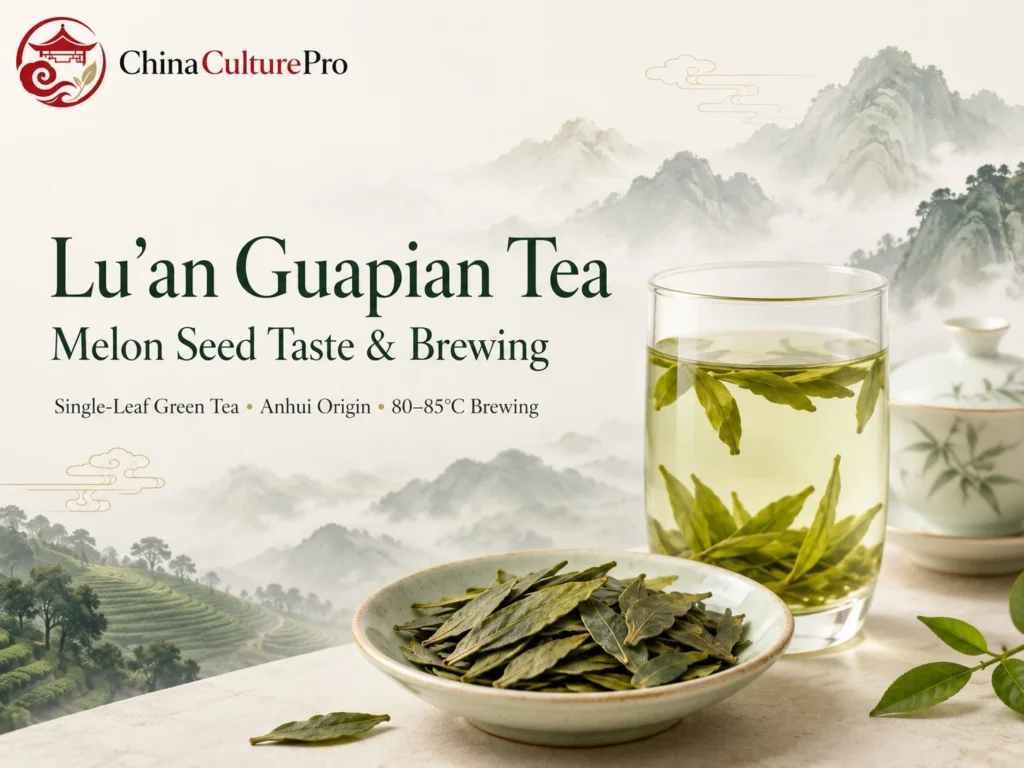

Quick Answer: What Is Lu’an Guapian Tea?
Lu’an Guapian Tea, also written as Liu’an Guapian or Liu An Gua Pian, is one of China’s famous green teas. It comes from Lu’an in Anhui Province and is also translated as Lu’an Melon Seed Tea because the finished leaves resemble melon seed slices.
What makes Lu’an Guapian unusual is its leaf material. Most famous Chinese green teas are made from tender buds or bud-and-leaf sets. Lu’an Guapian is made from single leaves, with the buds and stems removed. This gives it a fuller, more mellow green tea taste than many delicate bud teas.
The basic points are:
Tea Type: Chinese green tea, not oxidized.
Core Origin: Lu’an, Anhui Province, around the Dabie Mountain region.
Name Meaning: Lu’an is the origin; Guapian means melon-seed-shaped leaf slices.
Leaf Material: single leaves, usually without buds or stems.
Leaf Shape: complete, even leaf slices, often slightly lifted at the edges.
Typical Aroma: clean chestnut-like, fresh, roasted, lightly floral, or gentle vegetal aroma.
Taste: fresh, mellow, slightly thick, clean, and comfortable after swallowing.
Brewing: usually 80–85°C, using a glass cup, porcelain cup, or gaiwan.
Key Difference: Longjing, Biluochun, Huangshan Maofeng, and Xinyang Maojian are bud or bud-and-leaf teas; Lu’an Guapian is a single-leaf famous green tea.
Key Point: Lu’an Guapian is not every flat or melon-seed-shaped green tea, and not every sliced-looking green tea should be treated as authentic Lu’an Guapian. Good Lu’an Guapian should be judged by origin, leaf position, clean removal of buds and stems, complete single leaves, natural melon-seed-like shape, clean aroma, bright liquor, fresh mellow body, bitterness transformation, and clean returning sweetness.
Lu’an Guapian, Liu’an Guapian, Liu An Gua Pian, and Melon Seed Tea: Are They the Same?
The English names can be confusing because sellers use different pinyin spellings and translations. Lu’an Guapian, Liu’an Guapian, Liu An Gua Pian, Lu’an Melon Seed Tea, and Melon Seed Tea may all refer to the same tea name, but the terms need careful reading.
| Term | Chinese | Meaning | Scope |
|---|---|---|---|
| Lu’an Guapian Tea | 六安瓜片 | the common English pinyin name | broadest and most practical search term |
| Liu’an Guapian | 六安瓜片 | another pinyin spelling | same tea name, different spelling |
| Liu An Gua Pian | 六安瓜片 | spaced pinyin spelling | same tea name, often seen in tea shops |
| Lu’an Melon Seed Tea | 六安瓜片 | translated name | explains the leaf shape |
| Melon Seed Tea | 六安瓜片 | shorter translated name | useful, but can be misunderstood |
| Guapian-Style Green Tea | 瓜片风格绿茶 | green tea made in a similar sliced-leaf style | not always Lu’an Guapian |
A simple rule: Lu’an Guapian, Liu’an Guapian, Liu An Gua Pian, and Lu’an Melon Seed Tea can refer to the same tea, but not every sliced green tea is Lu’an Guapian.
“Melon Seed” describes the leaf shape, not the flavor. Lu’an Guapian does not taste like melon seeds, and it does not contain melon seeds. Authentic Lu’an Guapian should be clearly connected to Lu’an, Anhui, or a related traditional production area.
Why Lu’an Guapian Is So Famous
Lu’an Guapian is famous because it is unusual among Chinese green teas. It does not compete by having more buds or more visible tips. Its identity comes from single-leaf material, clean removal of buds and stems, melon-seed-like shape, careful firing, and a fuller green tea taste.
Its reputation comes from several factors:
- Distinctive Single-Leaf Material: Lu’an Guapian is made from single leaves rather than tender buds.
- No Buds And No Stems: traditional processing removes buds and stems, leaving the leaf as the main material.
- Classic Melon Seed Shape: the finished leaves look like flattened or slightly curled melon seed slices.
- Anhui Tea Origin: Lu’an is a traditional tea area in Anhui, connected with the Dabie Mountain environment.
- Clean Firing Skill: careful firing can bring a clean roasted or chestnut-like aroma.
- Mellow Green Tea Body: Lu’an Guapian often has more body than very tender bud teas.
- Famous Tea Reputation: it is widely recognized as one of China’s famous green teas, but the name alone does not guarantee quality.
A Chinese tea master would not judge Lu’an Guapian by the number of buds. For this tea, too many buds can be a warning sign, not a premium feature. The better question is whether the single leaves are complete, clean, well-fired, and comfortable to drink.
To understand where Lu’an Guapian fits among Chinese green teas, read our Chinese Green Tea guide.
Where Lu’an Guapian Tea Comes From
Lu’an Guapian is most closely linked with Lu’an in Anhui Province. Traditional production areas are often associated with mountain environments, older tea-making practices, and careful leaf handling.
| Origin | Chinese Name | Location | General Style | Typical Price Position |
|---|---|---|---|---|
| Core Lu’an Area | 六安核心产区 | Lu’an and nearby traditional tea areas | complete single leaves, clean aroma, mellow taste | highest |
| Jinzhai / Yu’an / Huoshan Areas | 金寨 / 裕安 / 霍山 | important Lu’an-area tea regions | classic Guapian style, quality varies by garden and maker | medium to high |
| Qiyun Mountain Area | 齐云山产区 | one recognized traditional core area | known for classic origin value and careful production | high |
| Inner Mountain Area | 内山产区 | deeper mountain areas around Lu’an | often cleaner aroma and finer liquor when well-made | medium to high |
| Outer Mountain Area | 外山产区 | surrounding hills and lower-elevation areas | similar style, often more accessible for daily drinking | medium |
| Other Guapian-Style Tea | 其他瓜片风格茶 | other Anhui areas or other provinces | may look similar, but origin value and taste can differ greatly | varies |
Origin affects value, but it is not the only standard. A famous Lu’an label can still produce weak tea if the leaves are broken, stems are not removed cleanly, firing is poor, or storage is bad. A non-core Guapian-style tea can still be enjoyable if it is fresh, clean, well-made, and honestly labeled.
To compare Lu’an Guapian with other tea categories, read our Chinese Tea Types guide.
What Does Lu’an Guapian Tea Taste Like?
Good Lu’an Guapian should taste fresh, mellow, clean, and slightly thick. Compared with many bud-based green teas, it often has more body. Its flavor should feel full but not rough, roasted but not burnt, and fresh without being watery.
| Tasting Point | Good Lu’an Guapian | Weak Or Poor Lu’an Guapian |
|---|---|---|
| Aroma | clean chestnut-like, roasted, fresh, light floral, or gentle vegetal aroma | heavy grassiness, stale smell, dull aroma, burnt smell, or artificial fragrance |
| First Sip | fresh, mellow, clean, and rounded | harsh, thin, sour, or rough |
| Body | has some thickness and content | watery, flat, or empty |
| Roasting / Fire Aroma | clean, warm, and balanced | burnt, smoky, dull, or stuffy |
| Bitterness | light and able to fade | heavy bitterness that stays |
| Astringency | controlled and clean if present | drying, rough, or throat-tightening |
| Liquor | bright yellow-green or clear green-yellow | dark, muddy, dull, or cloudy |
| Hui Gan | clean returning sweetness | weak or absent aftertaste |
| Finish | fresh, mellow, and comfortable | dry mouth, stale aftertaste, or throat discomfort |
Good Lu’an Guapian is not thick because it is bitter. Its body should come from leaf material, clean firing, and balanced taste. A good cup can have a clean chestnut-like or roasted aroma, but that aroma should never become burnt, smoky, or stuffy.
Compared with Longjing, Lu’an Guapian is less about flat bud-and-leaf elegance. Compared with Xinyang Maojian, it is less about fine straight tips and brisk force. Its strength is single-leaf depth: fresh taste with body, clean firing, and a comfortable finish.
What Good Lu’an Guapian Tea Looks Like
Dry leaf appearance is especially important for Lu’an Guapian because the leaf material is part of its identity. Good tea should show complete single leaves, not mixed buds, obvious stems, or heavy broken pieces.
| Good Signs | Warning Signs |
|---|---|
| complete single leaves | many buds, obvious stems, or mixed leaf material |
| clean removal of buds and stems | buds and stems left in large amounts |
| natural melon-seed-like leaf shape | shapeless fragments or heavily broken leaves |
| slightly lifted or naturally curled edges | overly twisted, crushed, or irregular pieces |
| glossy green, deep green, or natural green color | overly bright green, dull gray, burnt edges, or dark brown color |
| even leaf size and moderate thickness | uneven size, coarse leaves, or mixed-grade material |
| dry, clean, and light texture | damp, soft, or flexible leaves |
| clean fresh, chestnut-like, or roasted dry aroma | moldy, sour, stale, burnt, or chemical smell |
Do not judge Lu’an Guapian by whether it has more buds. It is not a bud tea. A better visual rule is: look for complete single leaves, clean removal of buds and stems, natural melon-seed-like shape, glossy green color, and no broken, burnt, damp, or stale leaves.
Lu’an Guapian vs Longjing vs Biluochun vs Huangshan Maofeng vs Xinyang Maojian
Lu’an Guapian, Longjing, Biluochun, Huangshan Maofeng, and Xinyang Maojian are all famous Chinese green teas, but they should not be judged by the same standard. Lu’an Guapian is the most unusual in this group because it is defined by single leaves rather than tender buds.
| Point | Lu’an Guapian | Longjing Tea | Biluochun Tea | Huangshan Maofeng Tea | Xinyang Maojian Tea |
|---|---|---|---|---|---|
| Leaf Material | single leaves, no buds or stems | buds and young leaves | buds and young leaves | plump buds and leaves | buds and young leaves |
| Leaf Shape | melon-seed-like single leaf slices | flat, smooth, straight | fine, tight, curled like a snail | plump, slightly curved, peak-like | fine, round, tight, straight |
| Visible White Hairs | not the main standard | usually not obvious | obvious and important | naturally visible | naturally visible |
| Main Aroma | clean chestnut-like, roasted, fresh, light floral | bean-like, chestnut-like, lightly roasted | floral-fruity, tender, lively | orchid-like, fresh floral, tender chestnut-like | roasted chestnut-like, tender, clean floral |
| Taste | fresh, mellow, thicker, clean | clear, fresh, mellow, structured | delicate, fragrant, lively | soft, gentle, mellow | brisk, fresh, energetic, clean |
| Processing Character | single-leaf shaping and careful firing | pan-fired and flattened | pan-fired and curled | baked green tea character | pan-fired and shaped into fine straight leaves |
| Classic Origin | Lu’an, Anhui | Hangzhou / West Lake and nearby areas | Dongting Mountain area of Taihu Lake, Suzhou | Huangshan, Anhui | Xinyang, Henan |
| Best Brewing Range | 80–85°C, sometimes 85–90°C for mature tea | 75–85°C | 75–80°C | 80–85°C | 80–85°C, sometimes 85–90°C for mature tea |
Longjing is flat and structured, Biluochun is curled and lively, Huangshan Maofeng is soft and floral, Xinyang Maojian is fine and brisk, and Lu’an Guapian is a fuller single-leaf green tea with clean firing and mellow body.
To compare Lu’an Guapian with Dragon Well, read our Longjing Tea guide. To compare Lu’an Guapian with Green Snail Spring, read our Biluochun Tea guide. To compare Lu’an Guapian with Yellow Mountain Maofeng, read our Huangshan Maofeng Tea guide. To compare Lu’an Guapian with Xinyang Maojian, read our Xinyang Maojian Tea guide.
How Lu’an Guapian Tea Is Made
Lu’an Guapian is a green tea, so it is not oxidized like oolong or black tea. Its processing is unusual because the tea is made from single leaves, with buds and stems removed.
| Step | Chinese Term | What Happens | Why It Matters |
|---|---|---|---|
| Picking | 采摘 | leaves with suitable maturity are picked | Lu’an Guapian needs leaf material with enough body |
| Leaf Sorting / Ban Pian | 扳片 | buds, stems, and unsuitable leaves are removed | creates the classic single-leaf, no-bud, no-stem standard |
| Spreading | 摊放 | fresh leaves rest and lose some moisture | reduces raw grassy sharpness and prepares the leaves |
| Sha Qing | 杀青 | heat stops oxidation | keeps the tea green and fresh |
| Shaping | 整形 | leaves are shaped into natural slices | supports the melon-seed-like appearance |
| La Lao Huo / Final Firing | 拉老火 | leaves are carefully fired, traditionally with repeated heat control | builds clean roasted aroma and mellow body |
| Drying | 干燥 | leaves are fully dried for storage | stabilizes aroma and keeps the tea clean |
The two key steps are Ban Pian and La Lao Huo. Ban Pian explains why Lu’an Guapian has no buds and no stems. La Lao Huo helps shape its clean roasted aroma and mellow taste. Too little firing can leave raw grassy notes; too much can create burnt, smoky, or dull flavors.
Harvest Time and Grades of Lu’an Guapian
Lu’an Guapian does not follow the same harvest logic as many tender bud teas. Earlier and younger are not always better. The tea needs leaves with suitable maturity, because its body comes from single leaves rather than tiny buds.
| Harvest Period | Chinese Name | Time | Characteristics | Price Position |
|---|---|---|---|---|
| Pre-Grain Rain | 谷雨前 | before Grain Rain, often mid to late April | suitable leaf maturity, balanced aroma and body | high |
| Around Grain Rain | 谷雨前后 | around Grain Rain | often a traditional quality window for Lu’an Guapian | high |
| Early Spring | 早春 | around Qingming or earlier spring | finer aroma, but leaves may be too tender for classic depth | medium to high |
| Late Spring | 春尾茶 | after Grain Rain and before early summer | fuller leaves and stronger taste, but can lose delicacy | medium |
| Summer / Autumn Tea | 夏秋茶 | summer or autumn | heavier bitterness, weaker aroma, usually not the high-quality standard | low |
A practical buying rule: Lu’an Guapian is not about chasing the earliest bud. It is about suitable leaf maturity, clean leaf sorting, good firing, and comfortable taste. Very tender tea may be delicate, but it may not show the classic thickness of Lu’an Guapian.
How to Brew Lu’an Guapian Tea
Lu’an Guapian is a green tea, but it is usually more forgiving than very tender bud teas. Its single leaves and fuller body can handle slightly warmer water, especially when the tea is more mature or well-fired. Still, boiling water and long steeping can make it bitter, rough, or overly fire-forward.
| Brewing Method | Teaware | Water Temperature | Leaf Amount | Steeping Time | Best For |
|---|---|---|---|---|---|
| Glass Cup Brewing | glass cup | 80–85°C | 2–3g / 200ml | 2–3 minutes | seeing single leaves open |
| Gaiwan Brewing | porcelain gaiwan | 80–85°C | 3–4g / 150ml | 30–60 seconds first infusion | tasting and better control |
| Porcelain Cup Or Pot | porcelain cup or teapot | 80–85°C | 3–4g / 150ml | 1–2 minutes | sharing with one or two people |
| More Mature Or Well-Fired Tea | glass cup or gaiwan | 85–90°C | adjust by taste | shorter steeping if stronger | fuller body, but avoid boiling |
Brewing tips:
- Use 80–85°C water for most Lu’an Guapian.
- Use 85–90°C only for more mature or well-fired tea. Avoid boiling water and long steeping.
- Do not rinse Lu’an Guapian. The first infusion carries much of the aroma and taste.
- Do not oversteep. Long steeping can turn body into bitterness.
- Use a glass cup for appearance. The single leaves opening in water are part of the experience.
- Brew 2–3 times. Better tea may give 3–4 infusions with longer later steeps.
For water temperature and brewing control, read our How to Brew Chinese Tea guide. For glass cups, gaiwans, and teaware choices, read our Chinese Teaware guide.
How to Taste Lu’an Guapian Tea
Tasting Lu’an Guapian should focus on single-leaf integrity, clean firing, bright liquor, fresh mellow body, bitterness transformation, and clean Hui Gan. Do not judge it by bud count.
| Tasting Check | What To Look For |
|---|---|
| Dry Leaf Material | complete single leaves, not bud-heavy or stem-heavy |
| Leaf Shape | melon-seed-like slices, natural and even |
| Dry Leaf Aroma | clean chestnut-like, roasted, fresh, or lightly floral; no stale smell |
| Liquor Color | bright yellow-green or clear green-yellow |
| Wet Aroma | clean roasted, chestnut-like, fresh, or gentle vegetal aroma |
| First Sip | fresh, mellow, rounded, and not harsh |
| Body | has thickness without roughness |
| Fire Aroma | clean and warm, not burnt, smoky, or stuffy |
| Bitterness | light if present, and able to fade |
| Hui Gan | clean returning sweetness |
| Finish | mouth feels fresh and comfortable |
| Spent Leaves | complete, soft, natural single leaves |
Good Lu’an Guapian should feel full but clean. Its firing should add warmth and depth, not burnt flavor. Its bitterness should fade, its Hui Gan should return cleanly, and the mouth should feel comfortable after swallowing.
For aroma, mouthfeel, Hui Gan, and aftertaste, read our Chinese Tea Tasting guide.
Lu’an Guapian vs Other Guapian-Style Tea
Lu’an Guapian has the strongest reputation among Guapian-style green teas, but other sliced or flat-leaf green teas can still be useful for daily drinking if they are honestly labeled.
| Point | Lu’an Guapian | Other Guapian-Style Tea |
|---|---|---|
| Origin | Lu’an, Anhui, and related Lu’an-area production | other Anhui areas or other provinces |
| Reputation | one of China’s famous green teas | lower, but may still have quality |
| Leaf Material | complete single leaves, usually no buds or stems | may include buds, stems, or mixed leaf material |
| Leaf Shape | natural melon-seed-like slices | may be less even or less complete |
| Aroma | clean chestnut-like, roasted, fresh, or light floral | may be simpler, greener, or less cleanly fired |
| Taste | fresh, mellow, thicker, clean Hui Gan | may be lighter, rougher, or less stable |
| Price | higher, especially core-origin tea | usually more affordable |
| Buying Risk | higher imitation risk | less origin pressure, but quality still varies |
| Best For | origin-focused tasting, gifting, classic Guapian experience | daily drinking and value-focused buying |
Buying Lu’an Guapian means paying for origin, single-leaf craft, mellow body, clean firing, and famous-tea experience. Other Guapian-style teas can still be good daily teas, but they should not be sold as Lu’an Guapian without clear origin.
How to Choose and Buy Lu’an Guapian Tea
Lu’an Guapian is widely recognized, so imitations and vague “melon seed tea” labels can appear in the market. Buying carefully matters, especially because this tea should not be judged by the same bud standards as many other green teas.
| What To Check | Good Sign | Warning Sign |
|---|---|---|
| Origin | clearly says Lu’an, Anhui, or a related Lu’an-area origin | only says “Melon Seed Tea” or “Guapian” with no origin detail |
| Specific Area | mentions Jinzhai, Yu’an, Huoshan, Qiyun Mountain, or another relevant area when available | famous origin words used vaguely without detail |
| Leaf Material | complete single leaves | many buds, obvious stems, or mixed leaf material |
| Buds / Stems | buds and stems are removed cleanly | bud-heavy or stem-heavy “Lu’an Guapian” |
| Leaf Shape | natural melon-seed-like slices | shapeless, broken, overly twisted, or crushed leaves |
| Leaf Color | glossy green, deep green, or natural green | overly bright green, dull gray, burnt edges, or dark brown |
| Aroma | clean chestnut-like, roasted, fresh, or lightly floral | sour odor, stale smell, chemical fragrance, burnt smell, or heavy grassiness |
| Fire Aroma | warm, clean, and balanced | burnt, smoky, stuffy, or dull |
| Year / Production Date | current-year tea with clear production information | no year, no production date, or old tea sold as fresh |
| Packaging | sealed, practical, and informative | luxury box with vague tea information |
| Grade Claims | origin, leaf material, firing, and freshness support the grade | “top grade” or “supreme grade” with no useful details |
| Price | matches origin, quality, and seller credibility | very cheap “authentic Lu’an Guapian” |
The safest approach is not buying the most expensive tea. If you do not have a reliable Lu’an Guapian source, a clearly labeled current-year Guapian from a transparent seller may be safer than a suspicious “top grade Lu’an Guapian.” Good Lu’an Guapian is not cheap, but expensive Lu’an Guapian is not automatically good.
How to Store Lu’an Guapian Tea
Lu’an Guapian is a green tea. Its clean aroma, firing character, and fresh mellow taste can fade if the tea is exposed to air, light, heat, moisture, or strong odors.
Store Lu’an Guapian tea this way:
- Seal It Tightly: use a sealed tin, foil bag, or airtight container.
- Keep It Away From Light: light speeds up aroma and color loss.
- Keep It Cool: refrigeration can help, especially for high-quality spring tea.
- Keep It Dry: moisture can ruin green tea quickly.
- Avoid Odors: Lu’an Guapian absorbs smells from spices, coffee, flowers, and other teas.
- Use Small Portions: divide larger amounts into smaller packs to reduce repeated opening.
- Drink After Opening: for best freshness, finish opened tea within about 1–3 months.
If refrigerating Lu’an Guapian, seal it well and let the sealed package return closer to room temperature before opening to avoid condensation. Once the clean aroma fades and the liquor turns dull, the best part of the tea is already weakened.
Common Mistakes With Lu’an Guapian Tea
Many Lu’an Guapian mistakes come from judging it like a bud tea or mistaking roughness for thickness.
| Mistake | Better Method |
|---|---|
| Thinking no buds means low quality | Lu’an Guapian is traditionally a no-bud, no-stem single-leaf tea |
| Thinking more buds means better Lu’an Guapian | many buds can be a warning sign for this tea |
| Treating every sliced green tea as Lu’an Guapian | check origin, leaf material, shape, and seller details |
| Using boiling water for long steeping | use 80–85°C water for most Lu’an Guapian |
| Mistaking strong bitterness for body | good body should feel mellow, not harsh |
| Mistaking burnt smell for good firing | clean firing is warm and balanced, not scorched |
| Mistaking stale or stuffy flavor for roasted aroma | stale flavor is storage damage; clean roast should feel fresh |
| Buying only by packaging or grade words | origin, leaf material, firing, freshness, and taste matter more |
| Storing good tea too long | drink Lu’an Guapian while it is fresh |
| Judging it by Longjing, Biluochun, Huangshan Maofeng, or Xinyang Maojian standards | Lu’an Guapian has its own single-leaf standard |
Learn what makes Lu’an Guapian different before judging or buying more expensive tea. It is not trying to be a bud tea; its value comes from clean single leaves, proper firing, mellow body, and comfortable Hui Gan.
Lu’an Guapian Tea Benefits
Lu’an Guapian is often enjoyed as a fresh, mellow, clean daily green tea because it is:
- Refreshing: it contains caffeine and can feel clear and lively.
- Low In Calories: plain Lu’an Guapian has almost no calories when unsweetened.
- Rich In Tea Polyphenols: like other green teas, it contains natural plant compounds.
- A Lighter Alternative To Sweet Drinks: it gives aroma and taste without sugar.
- Easy To Drink Daily: when brewed well, it is fresh, mellow, and pleasant.
Lu’an Guapian is tea, not medicine. It should not be presented as a treatment for disease, weight loss, blood pressure, or cancer.
Final Thoughts
Lu’an Guapian is not every flat or melon-seed-shaped green tea, and not every sliced-looking green tea should be treated as authentic Lu’an Guapian.
Real Lu’an Guapian should be judged by origin, leaf position, clean removal of buds and stems, complete single leaves, natural melon-seed-like shape, clean aroma, bright liquor, fresh mellow body, bitterness transformation, and clean returning sweetness. Good Lu’an Guapian is not better because it has more buds, and it is not better simply because it is more tender.
A good cup should have complete single leaves, naturally slightly lifted edges, glossy green or deep green color, clean chestnut-like, roasted, fresh, or light floral aroma, bright yellow-green liquor, fresh taste with body, light bitterness that can fade, and a clean comfortable finish.
FAQs About Lu’an Guapian Tea
What is Lu’an Guapian tea?
Lu’an Guapian tea, also written as Liu An Gua Pian, is a famous Chinese green tea from Lu’an, Anhui. It is known for complete single leaves, no buds or stems, melon-seed-like shape, clean aroma, mellow body, and fresh taste.
Is Lu’an Guapian the same as Liu An Gua Pian?
Yes. Lu’an Guapian, Liu’an Guapian, and Liu An Gua Pian are different English spellings for the same Chinese tea name, 六安瓜片.
What does Melon Seed Tea mean?
Melon Seed Tea is a translation of Lu’an Guapian. It refers to the leaf shape, which looks like melon seed slices. It does not mean the tea tastes like melon seeds.
Where does Lu’an Guapian tea come from?
Lu’an Guapian comes from Lu’an in Anhui Province, especially traditional Lu’an-area tea regions such as Jinzhai, Yu’an, Huoshan, and recognized mountain areas around Lu’an.
Why does Lu’an Guapian use leaves instead of buds?
Lu’an Guapian uses single leaves because this is part of its traditional identity. Removing buds and stems helps create its melon-seed-like shape, mellow body, and clean roasted green tea character.
What does Lu’an Guapian tea taste like?
Good Lu’an Guapian tastes fresh, mellow, clean, and slightly thick. It may have chestnut-like, roasted, fresh, light floral, or gentle vegetal aroma, with light bitterness that fades into clean Hui Gan.
What is the difference between Lu’an Guapian and Longjing?
Lu’an Guapian is made from single leaves with no buds or stems, and it has a fuller, more mellow body. Longjing is made from buds and young leaves, pressed flat, and often has a clearer bean-like or chestnut-like aroma.
What is the difference between Lu’an Guapian and Xinyang Maojian?
Lu’an Guapian is a single-leaf tea with a melon-seed-like shape and mellow body. Xinyang Maojian is a fine, round, tight, straight bud-and-leaf tea with brisker taste and direct Hui Gan.
How do you brew Lu’an Guapian tea?
Use 80–85°C water, preferably in a glass cup or gaiwan. Use about 2–3g per 200ml for glass cup brewing and steep for around 2–3 minutes. Do not use boiling water.
How can you tell if Lu’an Guapian tea is good?
Good Lu’an Guapian has complete single leaves, no obvious buds or stems, natural melon-seed-like shape, clean chestnut-like or roasted aroma, bright yellow-green liquor, mellow body, light bitterness that fades, clean Hui Gan, and soft spent leaves.