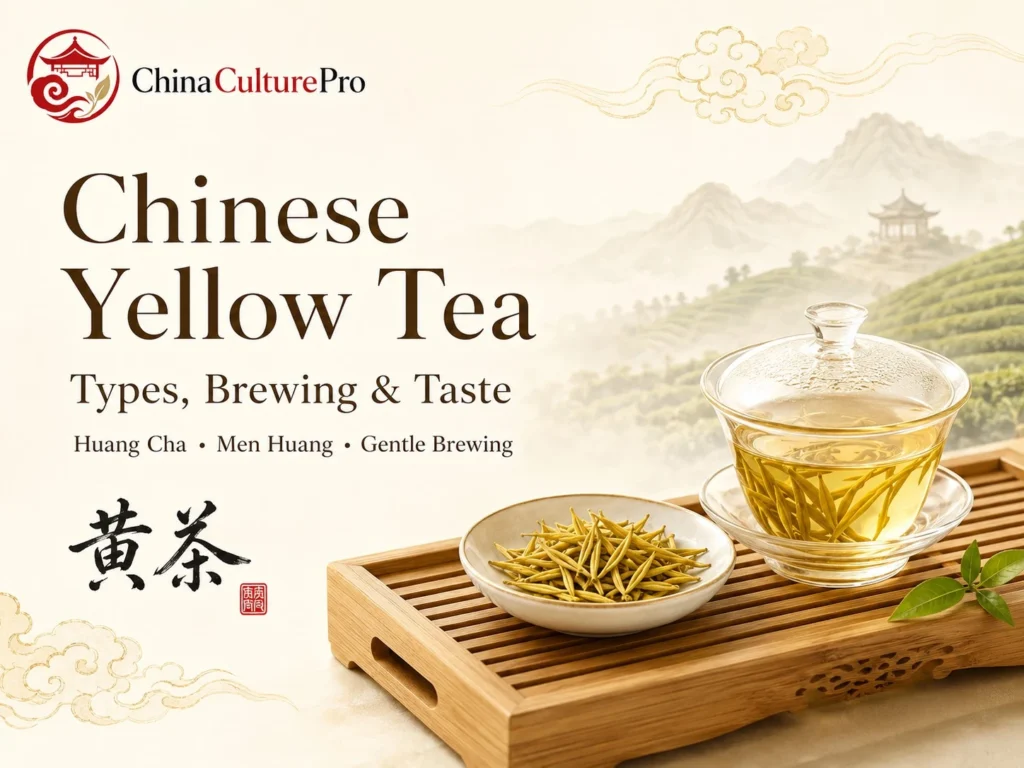

Quick Answer: What Is Chinese Yellow Tea?
Chinese yellow tea, or Huang Cha (黄茶), is one of the six major types of Chinese tea. It is also one of the rarest and least understood Chinese tea categories.
The core of yellow tea is not the color yellow. It is Men Huang (闷黄), often translated as yellowing. After Sha Qing, the tea leaves are gently wrapped, piled, or covered under controlled warmth and moisture. This step moves the tea away from the sharper freshness of green tea and toward a softer, smoother, sweeter style.
Yellow tea is close to green tea in craft, but it is not green tea. It is not stale green tea. It is not tea that simply turned yellow with age. Good yellow tea should be mellow but not flat, sweet but not cloying, gentle but not weak, and clean after drinking.
| Item | Detail |
|---|---|
| Main Topic | Chinese Yellow Tea / Huang Cha / 黄茶 |
| Tea Category | Chinese tea shaped by yellowing |
| Core Craft | Sha Qing, Men Huang, drying |
| Key Difference | Softer and less grassy than green tea |
| Famous Types | Junshan Yinzhen, Huoshan Huangya, Mengding Huangya |
| Taste Direction | Mellow, smooth, sweet, gentle, nutty, clean |
| Best Brewing Style | Gentle water, glass cup or gaiwan, short infusions |
Key Point: Chinese yellow tea is special because of Men Huang. This step softens green sharpness, reduces raw grassy notes, and gives the tea a warmer, smoother, more rounded character.
A Chinese tea master might say: yellow tea is about “just enough.” Too little yellowing, and it tastes like green tea. Too much yellowing, and it becomes stuffy. The beauty is in the balance.
Why Yellow Tea Matters in Chinese Tea Culture
Yellow tea matters because it represents one of the most delicate craft judgments in Chinese tea culture.
Green tea seeks clear freshness. White tea values natural withering and gentle sweetness. Oolong tea values aroma, roast, and layered changes. Chinese black tea values full oxidation and sweet red liquor. Dark tea values post-fermentation and storage. Yellow tea sits quietly between these stronger identities.
Its character is subtle:
- Softer than green tea
- More controlled than white tea
- Less aromatic than oolong
- Lighter than black tea
- Not post-fermented like dark tea
- Gentle, sweet, smooth, and refined
Yellow tea is also rare. The production process is slow and difficult, especially the Men Huang step. It requires judgment of heat, moisture, timing, leaf condition, and aroma. Many traditional yellow tea areas produce limited quantities, and some teas once made as yellow tea are now often made closer to green tea because green tea is easier to produce and sell.
Experienced Chinese drinkers often judge yellow tea by:
- Whether the yellowing is balanced
- Whether the liquor is bright and clean
- Whether the aroma is sweet, nutty, or softly floral
- Whether the taste is mellow without becoming dull
- Whether the tea avoids raw greenness, stuffiness, sourness, or burnt notes
- Whether the finish feels fresh and comfortable
Yellow tea is not meant to impress through power. Its charm is restrained: soft, sweet, clean, and precise.
How Chinese Yellow Tea Is Made
The defining step in yellow tea is Men Huang, or yellowing. Without this step, yellow tea would be much closer to green tea.
| Step | Chinese Term | What It Does | Key Point |
|---|---|---|---|
| Picking | 采摘 | selects tender buds or leaves | many famous yellow teas use fine bud material |
| Sha Qing | 杀青 | controls enzyme activity | similar foundation to green tea |
| Light Rolling / Shaping | 轻揉 / 理条 | shapes the leaves when needed | not every yellow tea is heavily rolled |
| Men Huang | 闷黄 | gently yellows the leaves under warmth and moisture | the soul of yellow tea |
| Drying | 干燥 | stabilizes aroma, taste, and moisture | should be clean, not burnt or stuffy |
Men Huang may happen in different ways depending on the tea. Some teas are yellowed while still warm after Sha Qing. Some are yellowed after partial drying. Some may go through more than one round of yellowing and drying.
The goal is not to suffocate the leaf. The goal is to soften it. Good yellowing turns sharp freshness into mellow sweetness.
Common craft problems include:
- Too little yellowing: the tea tastes too much like green tea, with stronger grassy notes.
- Too much yellowing: the aroma becomes stuffy or dull.
- Poor heat or moisture control: the tea may taste sour, mixed, or heavy.
- Over-drying or harsh firing: the delicate sweetness becomes burnt or rough.
Good yellow tea should show the effect of yellowing without tasting “stewed.” Men Huang should bring harmony, not dullness.
Chinese Yellow Tea vs Green Tea and Other Tea Types
Yellow tea is most often confused with green tea. The two can look similar, and both may use tender buds or young leaves. The difference is Men Huang.
| Tea Type | Difference From Yellow Tea | Main Character |
|---|---|---|
| Green Tea | no Men Huang step; freshness is locked earlier | fresh, grassy, clear |
| Yellow Tea | uses Men Huang after Sha Qing | mellow, smooth, sweet, less grassy |
| White Tea | mainly withered and dried, not fixed like yellow tea | sweet, soft, natural |
| Oolong Tea | partially oxidized, often roasted | aromatic, layered |
| Black Tea / Hong Cha | fully oxidized | sweet, red-bright |
| Dark Tea / Hei Cha | post-fermented | aged, thick, mellow |
| Pu-erh Tea | Yunnan tea with storage and Sheng / Shou paths | mountain, maocha, aging |
Yellow tea is not failed green tea. It is also not green tea that turned yellow after poor storage. It is an independent Chinese tea type with its own craft logic.
A simple way to understand it: green tea preserves bright freshness; yellow tea softens that freshness into a smoother and sweeter cup.
Famous Chinese Yellow Tea Origins and Types
Chinese yellow tea is rare, but several names are important for understanding the category.
| Tea | Chinese Name | Region | Style | Taste Direction | Quick Note |
|---|---|---|---|---|---|
| Junshan Yinzhen | 君山银针 | Junshan Island, Yueyang, Hunan | bud tea | delicate, sweet, soft, apricot-yellow liquor | most famous yellow tea, rare and expensive |
| Huoshan Huangya | 霍山黄芽 | Huoshan, Anhui | bud or young-leaf tea | mellow, sweet, nutty, clean | practical beginner choice |
| Mengding Huangya | 蒙顶黄芽 | Mengding Mountain, Sichuan | bud tea | sweet, soft, floral, yellow liquor | famous Sichuan yellow tea |
| Mogan Huangya | 莫干黄芽 | Moganshan, Zhejiang | bud tea | clean, sweet, gentle, floral | small-production yellow tea |
| Beigang Maojian | 北港毛尖 | Yueyang, Hunan | Maojian-style yellow tea | mellow, sweet, lightly floral | traditional Hunan yellow tea |
| Huang Da Cha | 黄大茶 | Anhui and nearby areas | larger-leaf yellow tea | fuller, sweet, toasted, more rustic | more affordable and less delicate |
These names are entry points, not a full encyclopedia. Junshan Yinzhen is the most famous, but it is not always the easiest place to start. Huoshan Huangya is often more practical for beginners because it shows yellow tea character clearly without the same price pressure.
Three Beginner Anchors for Yellow Tea
A simple way to begin is to use three anchor teas: Junshan Yinzhen, Huoshan Huangya, and Mengding Huangya.
| Beginner Anchor | Taste Direction | What It Teaches | Beginner Note |
|---|---|---|---|
| Junshan Yinzhen | delicate, sweet, soft, famous | the prestige and tenderness of yellow bud tea | rare, expensive, and often copied |
| Huoshan Huangya | mellow, sweet, nutty, clean | the clearest practical yellow tea entry | usually the safest beginner choice |
| Mengding Huangya | sweet, soft, floral, gentle | Sichuan yellow tea and soft sweetness | good for understanding regional style |
Beginners do not need to chase the most famous name first. A better path is to build a taste standard: what balanced yellowing feels like, how yellow tea differs from green tea, and what clean mellow sweetness tastes like.
For many readers, Huoshan Huangya is the most useful starting point.
What Chinese Yellow Tea Tastes Like
Chinese yellow tea should taste mellow, smooth, sweet, and clean. It should feel softer than green tea, but it should not feel empty.
Common yellow tea taste directions include:
- Mellow body: soft and rounded, not sharp.
- Smooth liquor: easy to drink, without roughness.
- Natural sweetness: gentle sweetness, not heavy or cloying.
- Nutty aroma: light chestnut, cooked nut, or warm grain notes.
- Soft floral notes: subtle, not high and perfumed.
- Less grassy character: less raw green taste than many green teas.
- Apricot-yellow liquor: clear yellow or golden-yellow liquor, not cloudy.
- Clean aftertaste: fresh, sweet, and comfortable after swallowing.
Quality is in the balance:
- Mellow but not flat
- Sweet but not cloying
- Smooth but not heavy
- Yellow but not stuffy
- Fresh but not sharp
- Clean but not empty
Good Men Huang brings softness. It should not create sourness, stuffiness, dullness, burnt flavor, or mixed odors. If a yellow tea tastes stale, sour, or muddy, the problem is not “yellow tea character.” It is usually craft or storage.
For a broader framework for judging aroma, liquor texture, sweetness, and aftertaste across Chinese teas, read our Chinese Tea Tasting guide.
How to Brew Chinese Yellow Tea
Yellow tea is delicate, especially famous bud teas. It should be brewed more gently than dark tea or black tea.
| Yellow Tea Type | Water Temperature | Brewing Note |
|---|---|---|
| Junshan Yinzhen | 80–85°C | gentle brewing, protect bud aroma and soft sweetness |
| Huoshan Huangya | 80–90°C | flexible, good beginner range |
| Mengding Huangya | 80–90°C | gentle brewing, preserve floral sweetness |
| Mogan Huangya | 80–90°C | light, clean, and careful brewing |
| Huang Da Cha | 90–95°C | larger leaves can handle slightly hotter water |
Practical brewing rules:
- Use moderate water temperature: 80–90°C works for most yellow teas.
- Use gentler water for bud teas: Junshan Yinzhen should not be hit with boiling water.
- Avoid long steeping: yellow tea can become bitter or dull when over-brewed.
- Use a glass cup or porcelain gaiwan: both help show liquor color and control extraction.
- Prefer short repeated brews: several lighter infusions are better than one long steep.
- Separate leaves from liquor in time: do not leave fine yellow tea sitting too long.
Yellow tea may be close to green tea, but it has its own brewing rhythm. The goal is to bring out softness and sweetness without flattening the delicate aroma.
Best Teaware for Chinese Yellow Tea
Yellow tea works best with clean, neutral teaware that does not hide its subtle aroma.
| Teaware | Best Use | Why It Works / Caution |
|---|---|---|
| Glass Cup | Junshan Yinzhen, tender yellow bud teas | shows bud shape and yellow liquor clearly |
| Porcelain Gaiwan | tasting most yellow teas | neutral, flexible, good control |
| White Porcelain Cup | observing liquor color | makes apricot-yellow liquor easier to see |
| Porcelain Teapot | sharing Huoshan Huangya or Mengding Huangya | clean and stable for small groups |
A glass cup is useful when the appearance of buds matters. A porcelain gaiwan is better for tasting because it controls infusion time. Heavy clay or strongly absorbent teaware is usually not ideal for delicate yellow tea because it may mute the aroma.
Storage and Freshness of Yellow Tea
Yellow tea is not a long-aging tea like Pu-erh or many dark teas. Its storage logic is closer to green tea.
Good storage should be:
- Sealed: to reduce moisture and air exposure.
- Dry: dampness damages aroma and freshness.
- Cool: cool storage helps preserve quality.
- Odor-free: yellow tea easily absorbs kitchen, perfume, smoke, and spice odors.
- Away from sunlight: light weakens aroma and liquor quality.
Yellow tea may feel softer than green tea because of Men Huang, but that does not mean it should be stored casually for years. Most yellow tea is best enjoyed while still fresh and clean.
The goal of storage is not to age yellow tea. The goal is to preserve its mellow sweetness and clean aroma.
Yellow Tea Benefits: What to Say Carefully
Many people search for yellow tea benefits, but this section should stay short. Yellow tea can be part of a healthy daily tea habit, but it is not medicine.
- Gentle daily drinking: many people find yellow tea softer than some green teas.
- Tea polyphenols: yellow tea contains natural tea compounds such as polyphenols and catechins.
- Caffeine: yellow tea contains caffeine, and the amount depends on tea type and brewing strength.
- Softer drinking feel: Men Huang can reduce some sharp grassy character compared with green tea.
- Not a treatment: yellow tea should not be presented as a cure.
Do not promise weight loss, blood sugar control, cancer prevention, detox, or disease treatment. A fairer statement is simple: yellow tea is smooth, gentle, and pleasant for daily drinking when brewed properly.
Common Mistakes About Chinese Yellow Tea
Yellow tea is rare, so it is easy to misunderstand.
- Thinking yellow tea is green tea: yellow tea has Men Huang; green tea does not.
- Thinking yellow color means yellow tea: color alone is not proof.
- Thinking stale green tea is yellow tea: old green tea turning yellow is not Huang Cha.
- Thinking yellower is always better: too much yellowing can create stuffy flavor.
- Thinking yellow tea is always higher than green tea: it is a different style, not a higher rank.
- Thinking every tea with “yellow” in the name is yellow tea: some tea names include “yellow” but belong to other categories.
- Using boiling water for fine bud tea: delicate yellow tea can become bitter or dull.
- Steeping too long: long steeping can hide the soft sweetness.
- Treating stuffy flavor as Men Huang: proper yellowing creates mellow sweetness, not stale or sour flavor.
- Buying Junshan Yinzhen by name only: famous yellow tea names can be copied or misused.
- Ignoring freshness: yellow tea does not usually improve through long storage.
The better rule: good yellow tea should be yellow but not stuffy, gentle but not flat, sweet but not cloying, and clean after drinking.
How to Choose Chinese Yellow Tea for Beginners
Beginners should not start by asking, “Which yellow tea is the most expensive?” A better question is: “Which yellow tea style helps me understand the category?”
- For the most famous yellow tea: choose Junshan Yinzhen, but be careful with price and authenticity.
- For the most practical beginner choice: choose Huoshan Huangya. It is usually clearer, more accessible, and easier to learn from.
- For Sichuan yellow tea: choose Mengding Huangya if you want a soft, sweet, lightly floral direction.
- For comparison: try Huoshan Huangya next to Huang Da Cha to feel the difference between finer bud tea and a fuller larger-leaf style.
- For a limited budget: start with Huoshan Huangya or Huang Da Cha instead of chasing rare famous names.
- For tasting practice: focus on clean aroma, mellow sweetness, and whether the tea feels smoother than green tea.
A practical beginner standard is simple: Does the tea feel mellow without being dull? Is the aroma clean? Is the sweetness natural? Does it finish fresh and comfortable? If yes, it is a useful yellow tea to learn from.
How Chinese Yellow Tea Connects to Chinese Tea Culture
Chinese yellow tea completes the six-type Chinese tea system. It connects green-tea craft with a softer yellowing process and gives readers a clearer view of how small changes in production can create a separate tea category.
- To understand the full tea system first, read our Chinese Tea Culture guide.
- To compare yellow tea with green, white, oolong, black, dark, and Pu-erh tea, read our Chinese Tea Types guide.
- To see why yellow tea is often confused with fresh fixed tea, read our Chinese Green Tea guide.
- To compare yellow tea with natural withered tea, read our Chinese White Tea guide.
- To compare yellow tea with aromatic partially oxidized tea, read our Chinese Oolong Tea guide.
- To compare yellow tea with fully oxidized Hong Cha, read our Chinese Black Tea guide.
- To compare yellow tea with post-fermented Hei Cha, read our Chinese Dark Tea guide.
- For brewing temperatures and methods, read our How to Brew Chinese Tea guide.
- For cups, gaiwans, and teapots, read our Chinese Teaware guide.
- For cautious wellness wording, see the Yellow Tea Benefits section above.
- For famous yellow bud tea, read our Junshan Yinzhen guide.
- Huoshan Huangya is a useful practical beginner yellow tea, but it does not yet have a separate published guide.
- Mengding Huangya is an important Sichuan yellow tea, but it does not yet have a separate published guide.
Final Thoughts
Chinese yellow tea is not simply yellow-colored tea. Its core is Men Huang, or yellowing.
This step makes yellow tea close to green tea in craft, but softer, smoother, sweeter, and less grassy in taste. Good yellow tea should be yellow but not stuffy, gentle but not flat, sweet but not cloying, and clean after drinking.
To understand yellow tea, readers should not judge only by liquor color or famous names. They should judge whether the yellowing is balanced, the aroma is clean, the liquor is smooth, the sweetness is natural, and the finish is fresh and comfortable.
That is the Chinese yellow tea aesthetic: rare, quiet, mellow, precise, and balanced.
FAQs About Chinese Yellow Tea
What is Chinese yellow tea?
Chinese yellow tea, or Huang Cha, is one of the six major Chinese tea types. Its defining process is Men Huang, or yellowing. This step makes the tea softer, smoother, sweeter, and less grassy than green tea while keeping a light and clean character.
Is yellow tea the same as green tea?
No. Yellow tea and green tea are close, but they are not the same. Green tea is fixed and dried to preserve freshness. Yellow tea adds Men Huang after Sha Qing, giving the tea a softer, mellower, and less grassy taste.
What does yellow tea taste like?
Chinese yellow tea usually tastes mellow, smooth, sweet, gentle, lightly nutty, and less grassy than green tea. Good yellow tea should have clean aroma, soft liquor, natural sweetness, and a fresh aftertaste. It should not taste sour, stuffy, burnt, or stale.
Why is yellow tea rare?
Yellow tea is rare because the Men Huang process is slow and difficult to control. It requires careful judgment of warmth, moisture, timing, and leaf condition. Production is small, and many tea drinkers outside China have never tasted true yellow tea.
What is Men Huang in yellow tea?
Men Huang, or yellowing, is the core process of yellow tea. After Sha Qing, the tea leaves are gently covered, wrapped, or piled under controlled warmth and moisture. This softens the taste, reduces raw grassy notes, and creates a mellow yellow tea character.
What are the main types of Chinese yellow tea?
The main Chinese yellow teas include Junshan Yinzhen from Hunan, Huoshan Huangya from Anhui, Mengding Huangya from Sichuan, Mogan Huangya from Zhejiang, Beigang Maojian from Hunan, and Huang Da Cha from Anhui and nearby areas.
What is Junshan Yinzhen?
Junshan Yinzhen is a famous Chinese yellow tea from Junshan Island in Yueyang, Hunan. It is made from tender buds and is known for delicate sweetness, soft liquor, and light yellow tea soup. It is rare, expensive, and often copied.
What is Huoshan Huangya?
Huoshan Huangya is a yellow tea from Huoshan, Anhui. It is known for a mellow, sweet, clean, and slightly nutty taste. For many beginners, it is one of the most practical yellow teas because it shows yellow tea character without the same price pressure as Junshan Yinzhen.
What is Mengding Huangya?
Mengding Huangya is a famous yellow tea from Mengding Mountain in Sichuan. It is known for soft sweetness, gentle floral notes, and smooth yellow liquor. It is useful for understanding Sichuan yellow tea and the refined, sweet side of Huang Cha.
How do you brew yellow tea?
Brew yellow tea gently, usually with 80–90°C water. Fine bud teas such as Junshan Yinzhen do better around 80–85°C. Use a glass cup or porcelain gaiwan, avoid long steeping, and use several short infusions instead of one long brew.
What water temperature is best for yellow tea?
Most Chinese yellow tea works well with 80–90°C water. Delicate bud teas, such as Junshan Yinzhen, should use the lower end of the range. Larger-leaf yellow teas, such as Huang Da Cha, can usually handle slightly hotter water.
Is yellow tea caffeinated?
Yes. Yellow tea contains caffeine. The amount depends on tea type, leaf grade, amount of tea, water temperature, and steeping time. People sensitive to caffeine should drink moderately, especially when using more leaves or longer infusions.
Is yellow tea good for weight loss?
Yellow tea can be part of a healthy daily tea habit, but it is not a weight-loss medicine. It contains caffeine and tea compounds, but body weight depends on diet, activity, sleep, metabolism, and overall lifestyle.
How should yellow tea be stored?
Yellow tea should be stored sealed, dry, cool, odor-free, and away from sunlight. It is closer to green tea in storage logic than Pu-erh or dark tea. Yellow tea is usually best enjoyed fresh rather than aged for many years.
What is the best yellow tea for beginners?
Huoshan Huangya is often the best yellow tea for beginners because it is more accessible, shows yellow tea character clearly, and is easier to learn from. Junshan Yinzhen is the most famous, but it is rarer, more expensive, and harder to buy confidently.