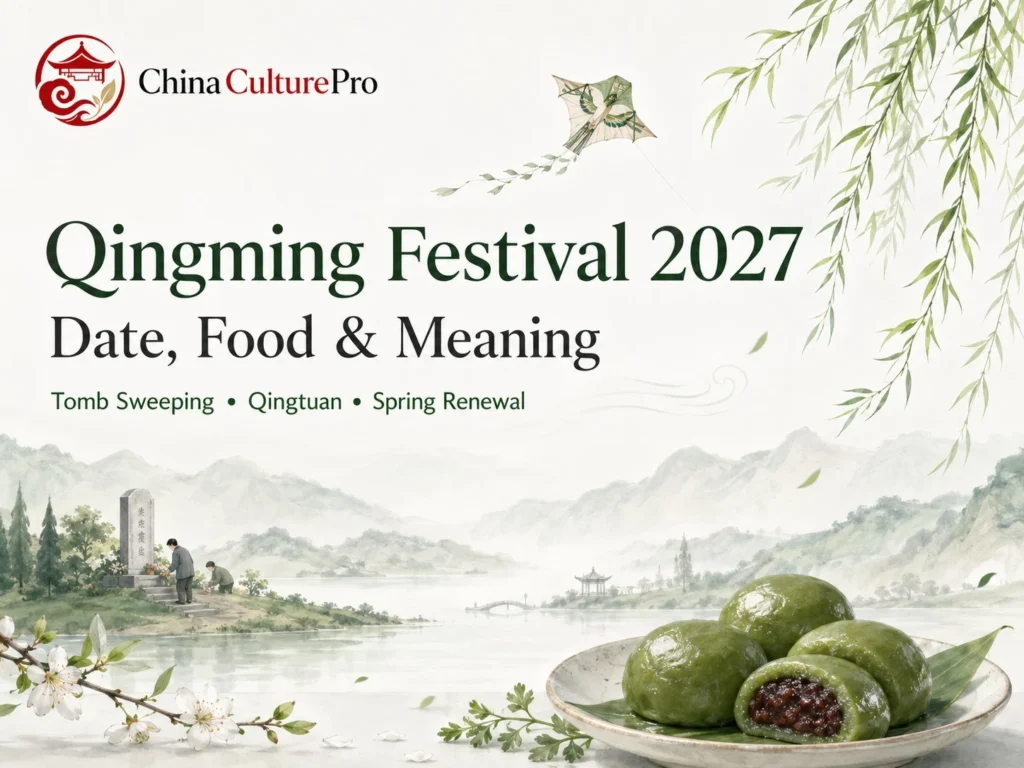

Quick Answer: What Is Qingming Festival 2027?
Qingming Festival 2027 falls on Monday, April 5, 2027. It is also known as Tomb-Sweeping Day or Ching Ming Festival. In Chinese, the festival is called Qingming Jie (清明节). “Qing” means clear, and “ming” means bright. Qingming is both a traditional Chinese festival and one of the 24 solar terms, which makes it different from most Chinese festivals based on the lunar calendar. The main customs include tomb sweeping, ancestor worship, cleaning graves, offering flowers or food, spring outings, flying kites, and eating qingtuan in some regions. Its deeper meaning is not only mourning. Qingming is about remembering ancestors, keeping family roots visible, and meeting spring as life begins to grow again.| Item | Detail |
|---|---|
| 2027 Date | April 5, 2027 |
| Day of Week | Monday |
| Chinese Name | Qingming Jie / 清明节 |
| Also Called | Tomb-Sweeping Day, Ching Ming Festival |
| Calendar Basis | Solar term, usually April 4–5 |
| Main Customs | Tomb sweeping, ancestor worship, spring outings, qingtuan |
| Main Meaning | Family memory, ancestor respect, spring renewal |
What Is Qingming Festival?
Qingming Festival is one of the most distinctive festivals in Chinese culture because it is not purely sad and not purely joyful. The English name Tomb-Sweeping Day captures its most visible custom, but not its full meaning.
On Qingming, families visit ancestral graves, clear weeds, add fresh soil, place offerings, bow, burn incense where allowed, and remember those who came before them. This side of the festival is solemn.
But Qingming also comes in spring, when the air warms, grass turns green, willows move in the wind, and flowers open. Families may go on spring outings, fly kites, walk in fields or parks, and feel the season returning to life.
This is the core of Qingming: remembrance and spring renewal happen on the same day. Chinese culture does not place ancestors in a sealed-off world. They remain part of family memory, family language, and the road descendants still walk.
Qingming is not only about grief. It is about connection. People visit tombs not only to see a grave, but to tell their ancestors: the family is still here, and the descendants still remember where the road began. Then they turn back toward spring, because life must continue.
When Is Qingming Festival? Date Rule and Upcoming Dates
Qingming Festival does not follow a fixed lunar date like Chinese New Year, Dragon Boat Festival, or Mid-Autumn Festival. It is one of the 24 solar terms, so its date is based on the sun’s position.
Qingming usually falls about 15 days after the Spring Equinox. On the Gregorian calendar, it is much more stable than most Chinese traditional festivals. It usually falls on April 4 or April 5, and only rarely on April 6.
| Year | Qingming Festival Date | Day of Week | Public Holiday Note |
|---|---|---|---|
| 2026 | April 5, 2026 | Sunday | Official schedule may vary |
| 2027 | April 5, 2027 | Monday | Official schedule may vary |
| 2028 | April 4, 2028 | Tuesday | Official schedule may vary |
| 2029 | April 4, 2029 | Wednesday | Official schedule may vary |
| 2030 | April 5, 2030 | Friday | Official schedule may vary |
Date note: Qingming follows a solar term, not a fixed lunar date. That is why it stays close to the Gregorian calendar, while many other Chinese festivals move more widely from year to year.
In Mainland China, Qingming Festival is a public holiday. The exact holiday window and make-up workday arrangement are announced by the government each year, so travelers should check the official schedule for the exact year.
Why Qingming Means “Clear and Bright”
The word Qingming has a strong visual feeling in Chinese. It is not just a calendar label.
“Qing” suggests clear air, clean rain, fresh wind, and the fading of winter heaviness. “Ming” suggests bright light, visible spring, and the world becoming distinct again. Together, Qingming feels like a season washed clean.
This is why the name matters. Qingming is not a dark ghost festival. It is a memorial day touched by spring light.
A famous Chinese line says, “During Qingming, rain falls thick and fine.” The rain in this image is not only sadness. It softens the air, moistens the soil, deepens memory, and makes the new green brighter. Rain falls on the tomb, but it also falls on the young grass.
| Qingming Element | Cultural Meaning |
|---|---|
| Spring Rain | Soft memory, cleansing, renewal |
| New Green | Life returning, family continuity |
| Willow Branches | Farewell, spring, protection |
| Clear Air | Seasonal change becoming visible |
| Bright Light | Hope, continuity, the living moving forward |
For Chinese readers, Qingming carries both weather and emotion. You can almost feel the damp soil, the light rain, the willow branches, and the grave path underfoot. Ancestors and new life stand under the same sky.
Qingming Festival Traditions and Customs
Qingming customs vary by region, family, city, village, and lineage. There is no single national version that every household follows in exactly the same way. Still, several customs are widely recognized.
| Custom | What People Do | Meaning |
|---|---|---|
| Tomb Sweeping | Clean graves, remove weeds, add soil | Care for ancestors and family roots |
| Offerings | Place food, flowers, tea, wine, or fruit | Respect and remembrance |
| Incense and Paper | Burn incense or joss paper where allowed | Sending respect and symbolic goods |
| Bowing or Silence | Bow, kneel, or stand quietly | Personal remembrance |
| Spring Outing | Walk in fields, parks, or hills | Life continues in spring |
| Kite Flying | Fly kites in open air | Release, blessing, spring wind |
| Willow Customs | Wear or place willow branches in some traditions | Farewell, protection, spring signal |
Tomb sweeping is the most visible custom. Families clear grass, wipe the tombstone, repair small damage, and sometimes add fresh soil. This is not only maintenance. It is care.
Offerings may include flowers, fruit, tea, wine, cooked food, or foods the deceased once liked. Some families burn incense or joss paper. In cities, cemetery rules may restrict fire, paper burning, and some offerings because of safety, environmental, or management concerns. In rural family graveyards, older forms may remain.
Spring outings, kite flying, and willow customs show the brighter side of Qingming. After remembering the dead, families step back into the living spring. Children may run, elders may walk slowly, and the family may share food or conversation outdoors.
The form can change, but the core remains: remembering where the family comes from.
Tomb Sweeping and Ancestor Remembrance
Qingming tomb sweeping looks like cleaning a grave, but its deeper meaning is a yearly check-in with family memory.
In traditional Chinese thinking, ancestors do not fully leave the family. Their names remain in genealogy records. Their stories remain in family speech. Their graves remain on a road that descendants return to each spring. Qingming keeps that road open.
When a family goes tomb sweeping, generations often move together. Elders know the path, the names, the worship order, and the stories. Middle-aged family members prepare offerings, tools, flowers, incense, or transport. Younger people follow, watch, and learn. What they learn is not only how to clean a tomb. They learn who the family remembers.
For people who have left their hometown for many years, Qingming can feel like returning to the root. Standing before an ancestral grave, the sense of drifting may become quieter. You know where you came from, so the road ahead feels less broken.
Modern life has changed many forms of remembrance. Urban families may use flowers instead of paper offerings. Some use online memorials, cemetery services, or quiet family rituals at home. These forms are newer, but they still answer the same need.
Qingming does not only clean a grave. It clears a family road. When a person bows before the ancestors, they are not only saying goodbye to the dead; they are reporting back to where they came from.
Spring Outings and the Other Side of Qingming
If Qingming were only about tomb sweeping, it would not hold such a special place in Chinese feeling. Its power comes from placing grief and spring in the same day.
After tomb sweeping, families often do not return home immediately. They may walk through fields, hills, parks, or village paths. They look at flowers, willow branches, fresh grass, and warming air. Children fly kites. Adults sit, talk, eat a little, or simply notice that the season has changed.
This is not disrespect toward ancestors. It is a Chinese way of understanding the cycle of life. Death is real, but it is not the whole story. The family continues. Spring still returns.
| Solemn Side | Bright Side |
|---|---|
| Tomb sweeping | Spring outing |
| Ancestor offerings | New grass and flowers |
| Incense and silence | Kites and spring wind |
| Family memory | Family walking together |
| Looking down at tombs | Looking up at the sky |
Qingming places death inside spring growth. It teaches that a family is not a broken line, but a tree: roots underground, branches still growing in the spring light.
This is why Tomb-Sweeping Day is an incomplete translation. Tomb sweeping is central, but Qingming is larger than that. It is half remembrance and half spring light.
Qingming Festival Food: Qingtuan and Regional Foods
Qingming food is closely tied to spring, regional taste, and the older Cold Food Festival tradition. The best-known food is qingtuan, especially in Jiangnan and eastern China, including areas around Shanghai, Hangzhou, Suzhou, and Nanjing.
Qingtuan is a green glutinous rice dumpling. It is often made with glutinous rice flour mixed with mugwort juice, young wheatgrass juice, or other green plant juices. The color is the tender green of spring. The texture is soft and chewy, with a light grassy fragrance.
Traditional fillings often include sweet red bean paste. Modern versions may include black sesame, lotus seed paste, pork floss with salted egg yolk, or other creative fillings. This change shows that Qingming food is not frozen in the past. It continues to move with taste and time.
Qingtuan is also linked with the Cold Food Festival, or Hanshi Festival, which came just before Qingming. Because the old custom avoided fire and hot cooking, people prepared foods that could be eaten cold. Over time, Cold Food customs merged with Qingming, and qingtuan became a representative seasonal food.
| Food | Region / Style | Meaning |
|---|---|---|
| Qingtuan | Jiangnan / eastern China | Spring green, Qingming flavor |
| Sanzi | Northern and other regions | Cold Food tradition |
| Zitui Bun | Shanxi and nearby traditions | Jie Zitui / Cold Food memory |
| Qingming Guo | Fujian, Jiangxi, Guangdong and southern styles | Local spring food |
| Eggs | Some regions | Life and seasonal renewal |
Qingming food is not just a meal. It is a bite of spring. The green of qingtuan is not decoration. It is the color of young plants entering the festival.
Qingming Festival Origin: Solar Term, Ancestor Rites, and Cold Food Festival
Qingming does not come from one single source. It is the meeting point of several traditions: the solar term, spring ancestor rites, and the Cold Food Festival.
Qingming as a Solar Term
Qingming was first one of the 24 solar terms. In an agricultural society, it marked an important time in spring. The weather became warmer, rain increased, and the soil became suitable for planting.
A traditional saying goes, “Around Qingming, plant melons and beans.” This shows the oldest layer of Qingming: a seasonal marker for farming life.
Ancient Spring Ancestor Rites
China has a long tradition of spring ancestor rites. Spring was a natural time to report the beginning of the year to the ancestors, ask for protection, and remember the family line.
Over time, Qingming became a fixed period for tomb visits and ancestor remembrance. This was not only a top-down rule. It also grew from family habit and seasonal convenience: the weather was suitable, roads were passable, and spring made travel easier.
Cold Food Festival / Hanshi Festival
The Cold Food Festival was held shortly before Qingming. It is often linked with the story of Jie Zitui, a loyal follower of Duke Wen of Jin. In the legend, Jie Zitui helped his lord in exile but later withdrew to the mountains. When Duke Wen tried to force him out by setting fire to the mountain, Jie died holding a tree. In remorse, the duke ordered that fire not be used on that day, creating the Cold Food custom.
Cold Food practices included no-fire cooking, cold foods, and memorial customs. Over time, they gradually merged with Qingming. This helps explain why Qingming includes cold foods, qingtuan, and some older memorial practices.
| Origin Layer | What It Adds |
|---|---|
| Solar Term | Seasonal timing, spring farming, clear air |
| Spring Ancestor Rites | Family memory, tomb visits, respect for ancestors |
| Cold Food Festival | Cold food customs, Jie Zitui legend, no-fire tradition |
| Later Qingming Festival | Tomb sweeping, outings, qingtuan, modern public holiday |
Qingming is powerful because these layers overlap. It is at once a calendar point, a family ritual, a spring outing, and a memorial day.
How Qingming Festival Is Observed Today
Today, Qingming is observed in both traditional and modern ways. The forms have changed, but the main themes remain: ancestor remembrance and spring renewal.
At the family level, tomb sweeping is still central. Urban families often visit public cemeteries. Rural families may visit ancestral graves or family burial grounds. Flowers and simplified offerings are increasingly common, especially in cities.
Many cities use cemetery shuttle buses, appointment systems, online memorial platforms, and crowd-control measures during Qingming. Fire, incense, and paper burning may be limited by cemetery rules, fire prevention policies, or environmental regulations.
Qingming is also a public holiday in Mainland China, so tomb sweeping and short spring trips often happen in the same holiday period. Roads to cemeteries may be crowded, and parks or scenic areas can also become busy.
Overseas Chinese families may visit local cemeteries, temples, ancestral halls, or remember ancestors at home. Some communities organize collective memorial events.
Younger generations may not know every ritual detail, but many still understand Qingming as a time to “go back and take a look.” For them, the festival often becomes a way to think about family memory, hometown roots, and identity.
How to Understand and Join Qingming Respectfully
Qingming can be meaningful for non-Chinese readers, but it should not be treated like a normal sightseeing event. It is both a family ritual and a spring festival.
- Understand Qingming’s double nature: remembrance and spring renewal.
- If invited to family tomb sweeping, dress simply and follow the host’s lead.
- Do not touch offerings, tombstones, incense, candles, or paper money without permission.
- Ask before taking photos. Tomb sweeping is private family remembrance, not a tourist scene.
- Do not mock paper money or offerings as superstition. The form may be unfamiliar, but the emotion is remembrance.
- If you do not know the ritual, standing quietly, bowing, or offering flowers is enough.
- Public spring outings, park walks, and cultural activities are more relaxed.
- Do not use “Happy Qingming Festival” as the main greeting.
For Qingming, quiet respect is usually better than cheerful wording. You can say, “Wishing peace to your family,” or simply express respect. In Chinese, some people may say Qingming Ankang, but in a tomb-sweeping context, silence and sincerity can be more appropriate than any fixed phrase.
Qingtuan is worth trying if you visit China around Qingming. One bite of its soft green skin and spring fragrance can explain what “the taste of Qingming” means better than a long description.
How This Guide Connects to Chinese Festivals and Zodiac Content
Qingming Festival is one of the most distinctive festivals in the Chinese festival year. It belongs inside the larger map of Chinese seasonal customs, family rituals, food traditions, and public holidays.
For the full festival calendar, start with our Chinese Festivals and Holidays guide.
Qingming is different from Chinese New Year. Chinese New Year centers on family reunion and renewal at the start of the year, while Qingming centers on family memory and ancestor remembrance in spring. To compare Qingming with China’s largest family festival, read our Chinese New Year guide.
Qingming also differs from Duanwu and Mid-Autumn. For another major seasonal festival focused on protection and midsummer health, see our Dragon Boat Festival guide. To understand the autumn festival of moon, harvest, and reunion, read our Mid-Autumn Festival guide.
If you came from zodiac content, note that Qingming belongs to the solar-term system, not the Chinese Zodiac system. It does not change the zodiac year, but it helps readers understand how Chinese culture reads time through season, family, and memory.
FAQs About Qingming Festival
When is Qingming Festival 2027?
Qingming Festival 2027 is on Monday, April 5, 2027. Qingming usually falls on April 4 or April 5 because it follows a solar term, not a fixed lunar date.
What is Qingming Festival?
Qingming Festival, also called Tomb-Sweeping Day, is a Chinese traditional festival and solar term. Families remember ancestors, clean graves, make offerings, and may also go on spring outings, fly kites, and eat seasonal foods such as qingtuan.
Why is Qingming called Tomb-Sweeping Day?
It is called Tomb-Sweeping Day because cleaning and tending ancestral graves is the most visible custom. Families remove weeds, wipe tombstones, add soil, place offerings, bow, and remember their ancestors.
Is Qingming Festival based on the lunar calendar?
No. Qingming is not based on a fixed lunar date. It is one of the 24 solar terms and usually falls about 15 days after the Spring Equinox. That is why its Gregorian date is usually April 4 or April 5.
Why do Chinese people sweep tombs on Qingming?
Chinese people sweep tombs on Qingming to care for ancestral graves and keep family memory alive. The act is not only cleaning. It is a yearly visit that tells ancestors they are still remembered.
What food is eaten during Qingming Festival?
The most famous Qingming food is qingtuan, especially in Jiangnan and eastern China. Other regional foods include sanzi, Zitui buns, Qingming guo, and eggs. Many of these foods connect with spring and the older Cold Food Festival tradition.
What is qingtuan?
Qingtuan is a green glutinous rice dumpling often made with mugwort juice, wheatgrass juice, or other plant juices. It is soft, chewy, and usually filled with red bean paste, black sesame, or modern fillings such as pork floss and salted egg yolk.
Is Qingming Festival only about mourning?
No. Qingming has both a solemn side and a bright side. Families remember ancestors and sweep tombs, but they may also go on spring outings, fly kites, walk among new grass, and feel the return of spring.
Is Qingming Festival a public holiday in China?
Yes. Qingming Festival is a public holiday in Mainland China. The exact holiday arrangement can vary by year, especially when weekends or make-up workdays are involved, so travelers should check the official schedule.
What should I say during Qingming Festival?
It is better not to say “Happy Qingming Festival” in a tomb-sweeping context. Qingming is a day of remembrance. A respectful phrase such as “Wishing peace to your family” is safer. Quiet respect is also appropriate.