
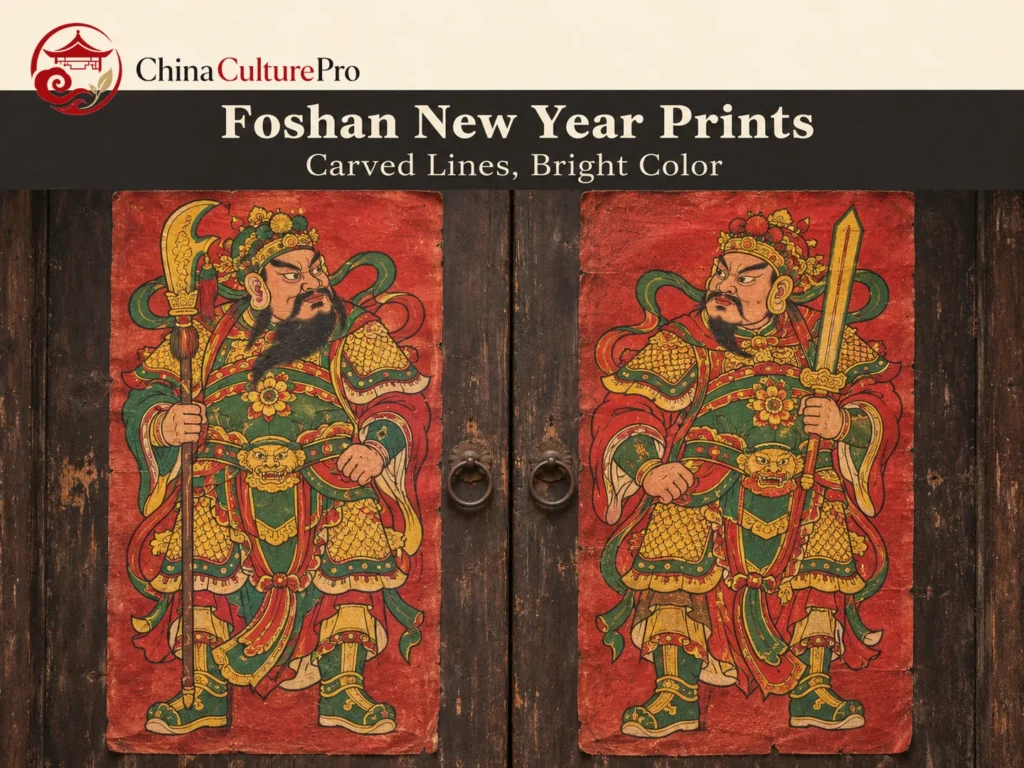

Quick Answer: What Are Foshan New Year Prints?
Foshan woodblock New Year prints (佛山木版年画, Fóshān mùbǎn niánhuà) are festival and devotional pictures made in Foshan, Guangdong. Familiar forms include paired door gods, images of deities and scenes of seasonal life. Makers can build color with separate carved blocks or work by brush over a printed outline. [1][2][3][4]
- Outline: A carved line block can print the same design on many sheets.
- Color: Separate blocks can add broad areas of red, green and yellow.
- Finishing: Some pictures carry hand-painted details, gold-colored accents or a vivid red ground. [2][3][4]
Compare the figure’s outline, face and clothing. They can show several kinds of work on one sheet.
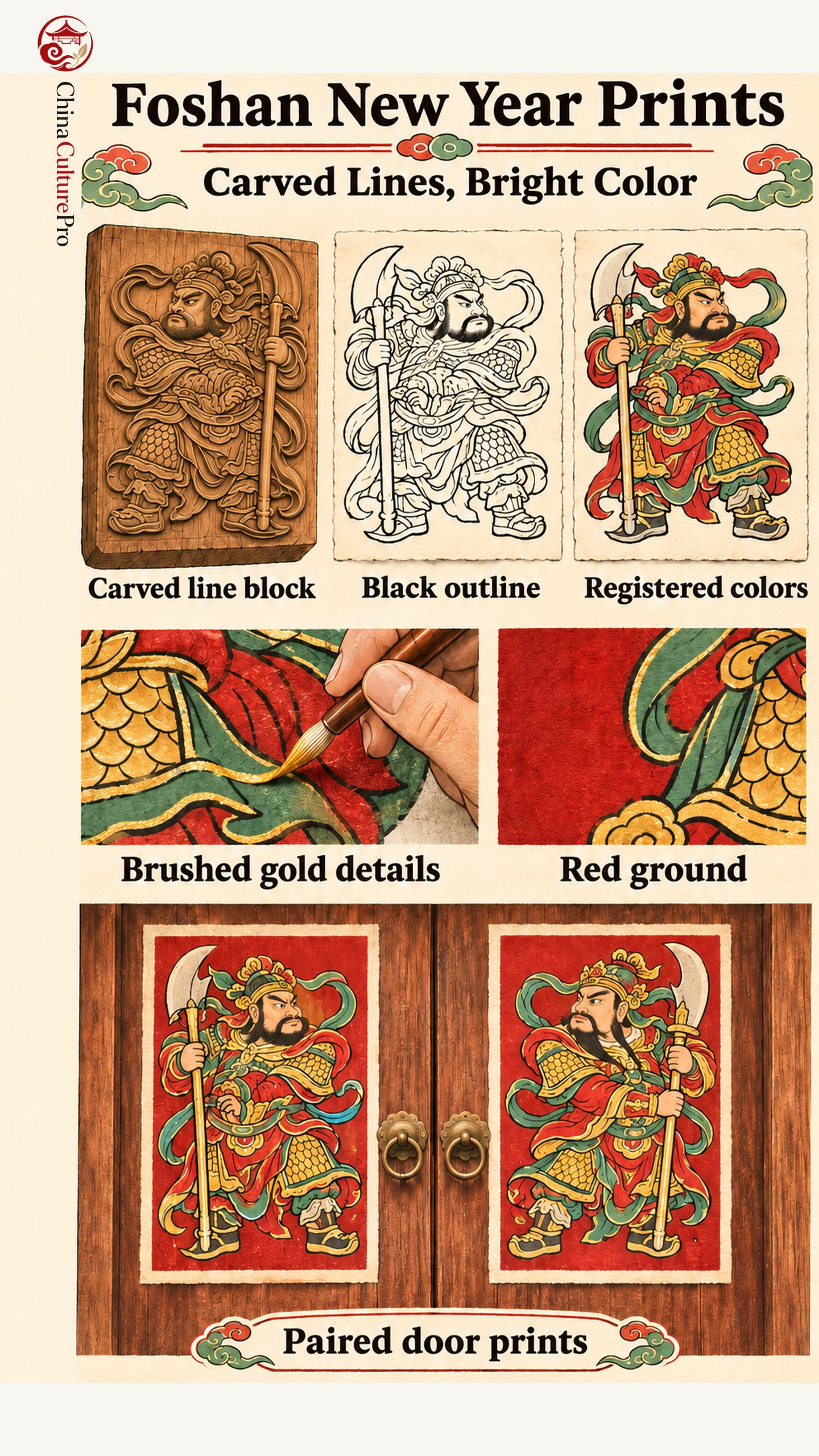
A door god’s armor can look dense with color from across a courtyard. Up close, the black contour sets the pose, the flat color establishes the costume, and small brushed marks pick out details. Different stages leave different evidence on the paper.
How the Blocks Build Up a Picture
A process account describes placing the design face down against prepared wood before carving. The block carries the design in reverse. The lines left standing receive the ink. Pressing the paper against that surface restores the intended orientation, as in other forms of Chinese woodblock printing. One line block can define both the large figure and tiny divisions within its clothing. [3]
A documented Foshan sequence begins with a black outline and prints red, green and yellow separately. Each color block needs to land in relation to the lines already on the sheet. This alignment is called registration. A color block can carry several patches that are far apart in the final image. If the sheet shifts, look for the same offset where that color meets the black lines in several places. [2][3]
What the Brush Adds
In the version known as woodblock printing with fine brushwork, a block supplies the outline and a brush can develop the face, costume and details. A Foshan process account distinguishes kāixiàng (开相), working on facial features, and miáojīn (描金), drawing gold-colored details by hand. The National Library points to gold and silver patterns on armor and belts. [2][3][4]
Another finish, tiándān (填丹), adds red to the areas around the picture. Foshan sources call the vivid red wànniánhóng (万年红). A printer can use red in the clothing and around the figure on the same sheet. The clothing color follows the shape of the garment. The surrounding red sets off the silhouette. [2][3][4]
Where Door Gods and Other Prints Belong
Door prints could be placed on the two leaves of an entrance. Pairs of Chinese door gods express a wish for protection. A deity print could serve a devotional or ritual purpose, while pictures of children, customs or festive scenes could be displayed for good fortune or decoration. [1][2][7]
The national record traces door-god painting in the Guangzhou and Foshan area back to the Song and Yuan periods. It places a flourishing phase of the print trade in the Qianlong and Jiaqing reigns of the Qing dynasty. With a reusable block, makers could supply many households with the same design. A family could paste fresh paper pictures onto a doorway without repainting the doors. [1][2]
From the Feng Workshop to Public Exhibitions
Feng Bingtang began learning paper preparation and color printing from his father in 1949. His work ranged from single-color prints to large hand-painted deity pictures over printed lines. In his Plum Blossom Children, a boy holds a sprig above two other children. The three figures make a lively scene that can be read on a single sheet. [4][7]
Feng Jinqiang discussed the stages of the work in a 2021 interview. In the same interview, Liu Zhongping recalled public open days that introduced people to the prints and their stories. In 2025, an exhibition in Guangzhou’s Yuexiu District displayed 101 works from Foshan City Museum, grouped into 61 sets, including door prints, devotional pictures, decorative works and material on how the craft is made. [5][6]
FAQs About Foshan New Year Prints
Are Foshan New Year prints all colored by hand?
A workshop can use separate blocks for color, apply fine brushwork to printed lines or combine printing and selected hand finishes. The national register also includes original hand-painted pictures in the wider Foshan tradition. [1][3][4]
What does wannianhong mean on a Foshan print?
Wannianhong is the name recorded for the vivid red used around the figures in some Foshan door pictures. The term refers to the vivid red used in the finishing stage called tiándān (填丹). [2][3]
When was Foshan New Year printing nationally listed?
The Foshan woodblock New Year picture project entered the first national intangible cultural heritage list in 2006. [1][2]
Sources
[1] China Intangible Cultural Heritage Network. Foshan Woodblock New Year Pictures
[2] National Library of China, China Memory Project. Foshan Woodblock New Year Prints
[3] New Express, with images from Guangdong Museum. The New Year Picture and Its Printing Blocks
[4] China Intangible Cultural Heritage Network. Feng Bingtang
[5] Yangcheng Evening News. New Year Pictures in Foshan Folk Art
[6] Guangzhou Daily. Foshan Woodblock Prints at Yuexiu District Museum
[7] Guangdong Provincial Intangible Cultural Heritage Protection Center. A Foshan Print Exhibition for Spring Festival