

Quick Answer: What Is a Chengni Inkstone?
A chengni inkstone (澄泥砚, chéngní yàn) is a writing tool made from fine, filtered clay that has been formed and fired. Its working surface is used to grind an inkstick with water. Jiangzhou (绛州, Jiàngzhōu), in today’s Xinjiang County, Shanxi, is one center of the craft. [1][2][3]
- Material: A fired ceramic body provides the working surface.
- Making: Makers refine the clay, form it and fire it.
- Tradition: China listed Jiangzhou’s chengni inkstone making as national heritage in 2008. [1][3][7]
The word chengni describes the material. The shape, color and place of making vary among objects. [1][2][3][4]

A chengni inkstone can look like carved rock in a museum case. Look for the working area and the way the ornament is positioned around it. Those features reveal how a tool for preparing ink also became an object of study and collecting.
How a Clay Inkstone Works
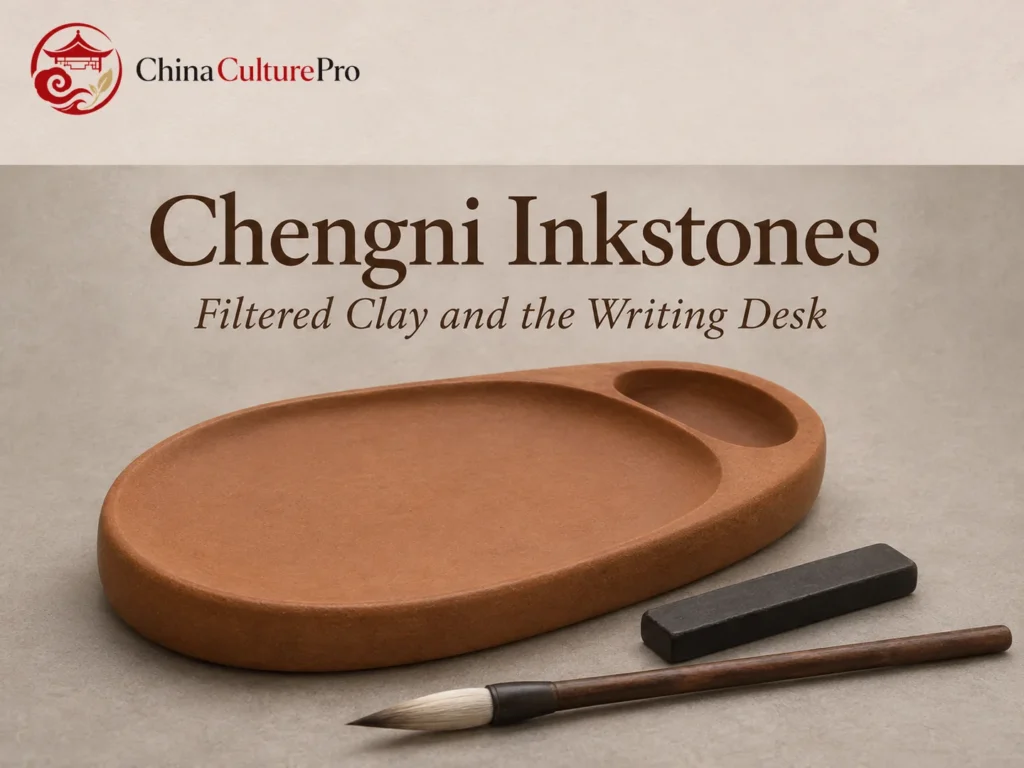
When rubbed against a working surface with a little water, an inkstick leaves particles that form liquid ink. Many inkstones have both a broad grinding area and a shallow well. The working surface needs enough texture to abrade the stick, and the well gives the prepared ink a place to collect. The inkstone then works with brush and paper as one of the Four Treasures of the Study. [2][3]
The material distinguishes this type from other Chinese inkstones. A quarried stone can be cut and carved to make an inkstone. A chengni maker first creates a ceramic body from refined clay. The same object name can describe tools whose raw materials and methods of manufacture differ. [1][2][3][6]
From Refined Mud to Fired Ceramic
The Jiangzhou heritage record describes selecting fine sediment from the Fen River area. Refining and filtering separate the fine clay used in the body. The maker shapes the prepared clay into a blank. Forming, drying and firing establish the body, while the grinding surface and ornament need separate attention. A Jiangzhou account describes a production cycle of around a year, a report about local practice rather than a standard for every workshop. [1][3][7]
Firing changes the color and character of the finished clay. The Jiangzhou register gives names such as eel yellow and rose purple. The names describe shades in the finished body. When cataloguing an object, the color term and material attribution answer different questions. [1][6][7]
What Two Museum Inkstones Reveal
The Metropolitan Museum of Art dates its Dragon and Carp inkstone to the fourteenth century, during the Yuan dynasty. It is 21.9 centimeters long and is catalogued as chengni stoneware. The museum connects its imagery with the story of a carp becoming a dragon after passing the Dragon Gate, a metaphor for success in the civil service examinations. The carved figures sit around the working area. The museum reads the space between fish and dragon in relation to the act of studying and preparing ink. [3]
A piece in the Palace Museum carries a title identifying a Jade Rabbit design in imitation of the Song. The museum records it as one of a Qianlong-period set of six archaistic chengni inkstones. It measures 12.5 centimeters across, with a round face carrying a carved rabbit scene and no recessed ink well. The earlier style named in the title and the later date of production are both part of its history. [4][5]
How Jiangzhou Makers Revived the Craft
The Palace Museum identifies several historical places associated with chengni, including areas in present-day Henan, Shanxi, Shandong and Hebei. Jiangzhou names the local Shanxi tradition. In historical writing, chengni alone can refer to the material even when the place of production is uncertain. [1][2]
A heritage account records that Lin Yongmao (蔺永茂, Lìn Yǒngmào) and his son Lin Tao (蔺涛, Lìn Tāo) brought Jiangzhou production back in the late twentieth century through research and trials. The technique gained national heritage recognition in 2008. A 2025 account describes continued teaching and exhibitions at the Jiangzhou Chengni Inkstone Cultural Park, giving the craft an audience beyond the writing desk. [1][6][7]
FAQs About Chengni Inkstones
Is chengni made from natural stone?
Chengni is a fired body made from fine, filtered clay. The Metropolitan Museum of Art classifies its Yuan example as stoneware. [1][3]
Are all chengni inkstones from Jiangzhou?
Jiangzhou is a recognized tradition in Shanxi. Historical accounts also describe chengni production in several other parts of China. [1][2]
Does a Song-style design date an inkstone to the Song dynasty?
Dating depends on evidence about the piece. The Palace Museum’s Jade Rabbit inkstone names a Song model, while the museum dates the object to the Qianlong period of the Qing. [4][5]
Sources
[1] China Intangible Cultural Heritage Digital Museum. Inkstone Making: Chengni Inkstone Making
[2] The Palace Museum. Chengni Inkstones
[3] The Metropolitan Museum of Art. Inkstone with Dragon and Carp
[4] The Palace Museum. Chengni Inkstone with a Jade Rabbit in Song Style
[5] Zhao Lihong, The Palace Museum Journal. A Preliminary Exploration of Archaistic Inkstones Produced During the Qianlong Emperor’s Reign
[6] China Intangible Cultural Heritage Digital Museum. Jiangzhou Chengni Inkstones: Refined Clay from the Fen River
[7] China Today. The Ancient Craft of Making Jiangzhou Chengni Inkstone