


Quick Answer: What Is Yunnan Copperware?
Yunnan copperware (云南铜器, Yúnnán tóngqì) covers several traditions of making and decorating copper objects in southwestern China. The province’s workshops produce everything from kettles to vessels with polished crystalline patterns or engraved silver lines.[1][2][3][4][6]
- Mottled copper (斑铜, bāntóng): Highlights and patches appear within the worked metal surface. Yunnan records describe both forged and cast forms.[1][2]
- Silver inlay on black copper (乌铜走银, wūtóng zǒuyín): Pale metal fills engraved channels in a darkened copper body.[4]
- Vessel making: Heqing workshops make practical objects such as kettles and hotpots, with separately shaped parts assembled to fit.[6]
A patch can lie within a polished surface, while an inlaid line follows a cut groove. A spout or handle shows how the vessel itself was put together.[2][4][6]
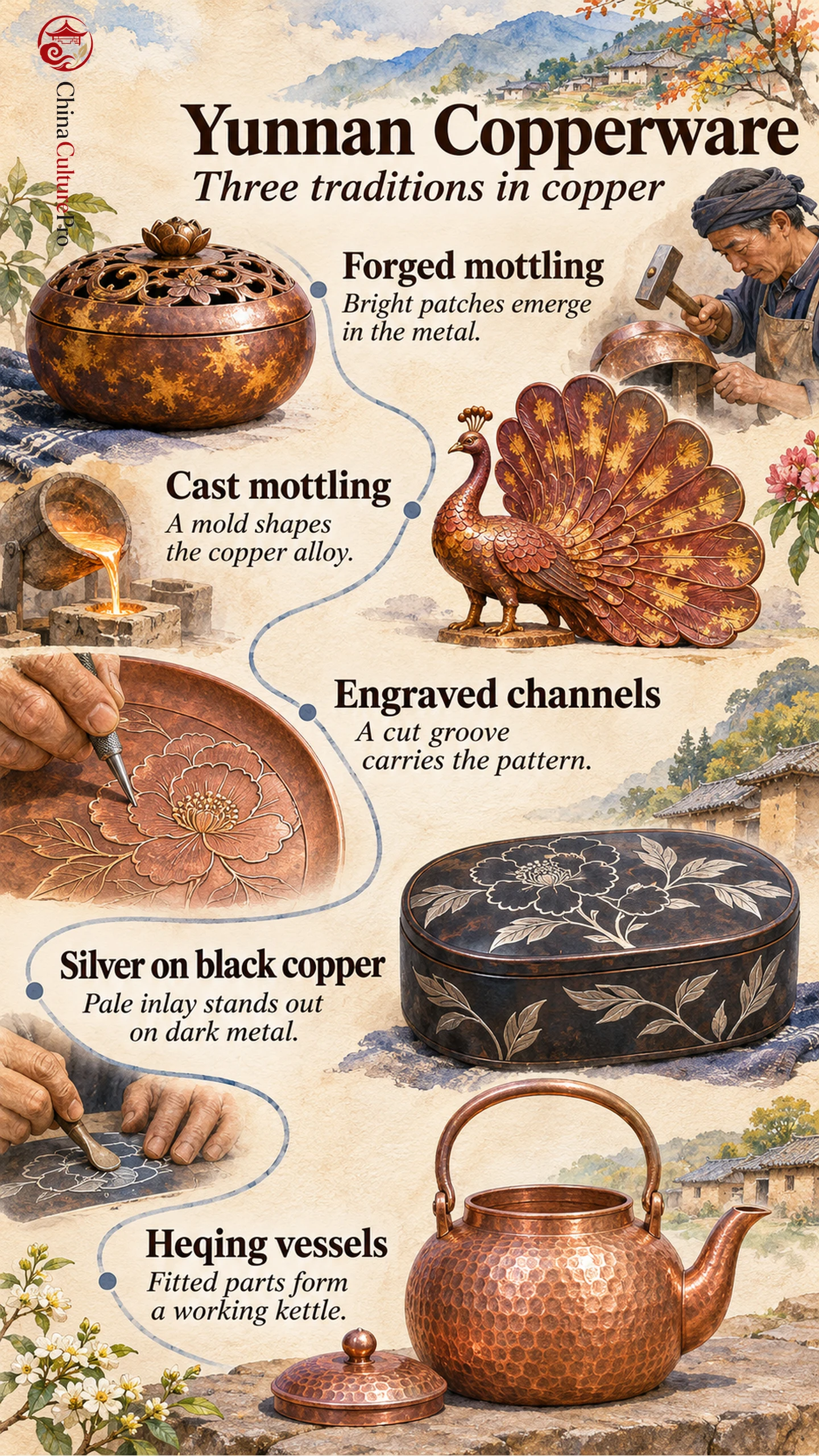
Turn a mottled copper vessel and spots on its surface catch the light at different angles. A silver-inlaid object can show a bright pattern too, but the pattern follows lines deliberately cut into the dark base.[2][3][4]
Three Copperware Traditions and What to Look For
| Tradition | What gives the object its appearance | Documented Yunnan examples |
|---|---|---|
| Mottled copper | Light catches patches in the treated and polished metal. | A forged incense box and a cast peacock in a museum display.[2][3] |
| Silver inlay on black copper | Silver follows engraved grooves against a dark field. | A paired-duck vessel and a boot-shaped water pipe in a museum display.[3][4] |
| Heqing vessel making | Hammered or machine-shaped bodies are joined with parts made for a specific function. | Kettles and hotpots from Xiuyi village workshops.[6] |
The rows describe different features of a copper object. Even a decorated kettle needs a shaped body, a fitted lid and a secure handle. A label that identifies the workshop or the method can tell you more than a close-up of the color alone.[2][4][6]
Mottled Copper: Huize and Kunming
The Yunnan heritage register records mottled-copper work in Huize, Kunming and Dongchuan. It distinguishes shengban (生斑, shēngbān), made from high-grade naturally occurring copper material, from shuban (熟斑, shúbān), cast from refined copper with other metals. The first route is associated with forging the material into shape. The second allows the maker to pour the metal into a mold and make more elaborate cast forms.[1][2][3]
Finishing makes the surface pattern visible. A report on the Yunnan Nationalities Museum describes reddish-brown forged pieces with bright patches and cast pieces with markings that can spread outward. It records a forged incense box and vase alongside a cast peacock and an ox-shaped ding vessel. These objects illustrate the two routes, without supplying a universal rule for recognizing either from color alone.[2][3]
The national register dates the inscription of mottled-copper making to 2008 and identifies Qujing as the submitting locality. The regional record covers a wider area of practice, including Kunming. These two sources answer different questions about where the craft is practiced and how it is listed.[1][2]
Silver Lines on Black Copper
In black copper with silver inlay, a maker engraves a pattern into the metal body and fills its narrow grooves with silver. Polishing reveals the design, and darkening the copper increases the contrast. Compare this with Yangzhou lacquerware, where the underlying surface and inlaid material are different even though the inserted pieces also create a visible design.[4][5]
The national heritage record associates this craft with Shiping and lists it in 2011. It reports a tradition placing its beginnings in the Yongzheng reign. A historical study by Chen Baiyu and Tian Ye questions the early date and argues for the later Tongzhi reign, citing textual problems and a lack of securely dated early pieces. The named technique, its regional association and the listing date are firmer ground than a single founding story.[4][5]
Heqing Copperware in Everyday Use
A report from Xiuyi village in Heqing County describes families passing down copperworking and workshops combining mechanical shaping with hand finishing. In its example of a kettle, the spout, handle and lid are separately made and fitted together. Look at how the lid sits in its opening and where the handle and spout join the body. Those details show how several pieces can become one usable vessel. For more on the province’s regional and community differences, see Yunnan culture.[6]
FAQs About Yunnan Copperware
Are all Yunnan copper vessels mottled?
Yunnan has several copperworking traditions. Mottled copper names one family of surfaces and techniques. Heqing kettle makers and Shiping silver-inlay makers are examples of other work.[2][4][6]
Do the bright spots in mottled copper come from silver inlay?
The bright patches in mottled copper appear in the worked metal after finishing. Silver inlay produces a separate effect by filling engraved grooves with a different metal.[2][4]
Where can you see documented examples of these crafts?
A published account of the Yunnan Nationalities Museum records forged and cast mottled pieces as well as silver-inlaid black copper. The national heritage entries identify the traditions and their regional connections.[1][3][4]
Sources
[1] China Intangible Cultural Heritage Digital Museum. Mottled-copper making, national register
[2] Yunnan Intangible Cultural Heritage Protection Network. Yunnan mottled copper and the Huize tradition
[3] People’s Daily Overseas Edition. Metalwork on display at the Yunnan Nationalities Museum
[4] China Intangible Cultural Heritage Digital Museum. Silver inlay on black copper, national register
[5] Chen Baiyu and Tian Ye. A study of the origins of Yunnan silver inlay on black copper
[6] Yunnan Daily. Copperworking workshops in Heqing