


Quick Answer: What Are Chinese Polyphonic Characters?
Polyphonic characters (多音字, duō yīn zì) have more than one reading. The word, meaning and context help select the appropriate reading. [1]
- Learn words: Keep a reading with a complete word and meaning.
- Check context: Different uses of one character may require different sounds.
- Read labels: A dictionary can distinguish ordinary, alternative or literary readings.
- Verify names: A place name or surname needs its own reliable reading.
This guide gives selected Mandarin examples, not every historical or regional reading.
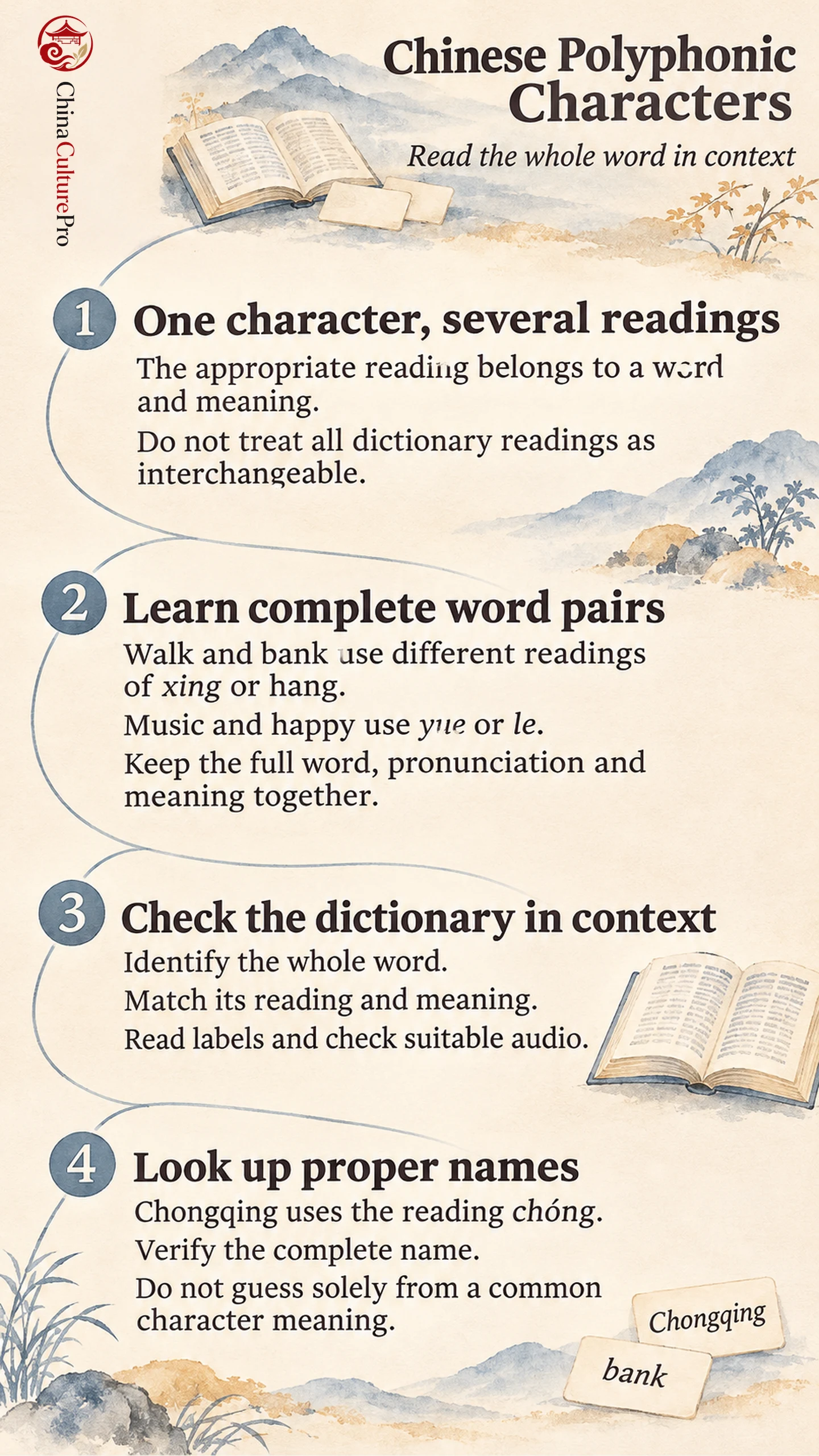
A familiar character can sound unfamiliar in a new word. That does not mean the printed text is wrong. It may represent a different lexical use, with its own established reading. Read the complete expression before deciding which pronunciation belongs there.
Understand What a Polyphonic Character Is
The defining feature is multiple readings for one written character. A dictionary may list several pronunciations and organize senses under them. The relevant reading must be selected together with its meaning, rather than treated as an optional sound that can be used anywhere. [1][5]
This is different from simply recognizing a variant character, where the question concerns written forms. Reading and shape are separate parts of the lookup task. Learning one common pronunciation does not settle every future occurrence of the same graph.
Learn Readings Through Complete Word Pairs
The following pairs show three useful contrasts. Simplified forms appear in the table; the corresponding traditional forms include 銀行 and 樂. The pinyin gives the selected whole-word reading. [2][3][4]
| Character | Word and reading | Meaning |
|---|---|---|
| 行 | 行走, xíng zǒu | walk |
| 行 | 银行, yín háng | bank |
| 重 | 重要, zhòng yào | important |
| 重 | 重新, chóng xīn | anew; again |
| 乐 | 音乐, yīn yuè | music |
| 乐 | 快乐, kuài lè | happy |
For 行, the walking use and the business-related use illustrate why a bare-character prompt is incomplete. Store the contrast as two words, not just two syllables. [2]
For 重, importance and repetition take different readings. For 乐, the music reading and the happiness reading differ even though the written character stays recognizable. The gloss belongs with the whole expression; it is not a translation rule for every compound. [3][4]
Check the Dictionary Entry Against the Sentence
Check the entry beyond its first displayed pronunciation. Dictionary conventions can distinguish an alternative reading, a literary versus colloquial reading, or different meanings under different sounds. Read those labels before selecting an entry. [5]
- Keep the whole word: Identify the word and its place in the sentence before choosing a reading.
- Match reading and meaning: Compare the relevant dictionary reading with the sense required by the sentence.
- Check labels and audio: Use the appropriate regional or historical labels and a suitable pronunciation recording.
When practicing, keep one short example sentence beside each word pair. If the readings differ, say the complete words aloud and attach their meanings again. The pinyin guide explains the spelling system; the dictionary confirms which spelling belongs to this word.
Treat Proper Names as a Separate Lookup Task
Chongqing is 重庆, Chóngqìng, with chóng for 重. Its complete established name supplies the reading; replacing it with the familiar “important” reading zhòng would produce the wrong name. [6]
The same method is useful for names more generally: find the whole name in an authoritative entry or the person’s own stated pronunciation. Do not guess a personal name solely from a common dictionary meaning. The place-name elements guide explains why recognizing components remains only one part of identifying a place.
FAQs About Chinese Polyphonic Characters
Do all readings of one character mean the same thing?
No. Dictionary conventions explicitly allow different meanings under different readings. Match the sound and sense to the word in context. [5]
Does simplifying a character remove its multiple readings?
No such rule follows from simplification. The selected 乐 examples still have different readings. The simplified and traditional distinction concerns writing, while the word supplies its pronunciation. [4]
Can an automatic pinyin tool always choose correctly?
Treat its output as something to check. If a bare character has multiple readings, supply the whole word and sentence, then compare the result with a suitable dictionary entry. [1]
Sources
[1] Ministry of Education, Taiwan. Revised Mandarin Dictionary: 多音字
[2] Ministry of Education, Taiwan. Revised Mandarin Dictionary: 行
[3] Ministry of Education, Taiwan. Revised Mandarin Dictionary: 重
[4] Ministry of Education, Taiwan. Revised Mandarin Dictionary: 樂
[5] Ministry of Education, Taiwan. Revised Mandarin Dictionary: Entry conventions
[6] Ministry of Education, Taiwan. Revised Mandarin Dictionary: 重慶市