


Quick Answer: What Are Chinese Province Abbreviations?
Chinese regional abbreviations (简称, jiǎn chēng) are shortened names used to identify regions in compact labels, references and particular coding systems. Many are one character long.
- Identification: A short form points to a regional name, not a new location.
- Categories: Common lists include provinces and other regional jurisdictions.
- Alternatives: Some regions have more than one established short form.
- Context: A reference table or coding scheme determines which form belongs there.
Use the table for recognition, then check the surrounding document before copying a code.
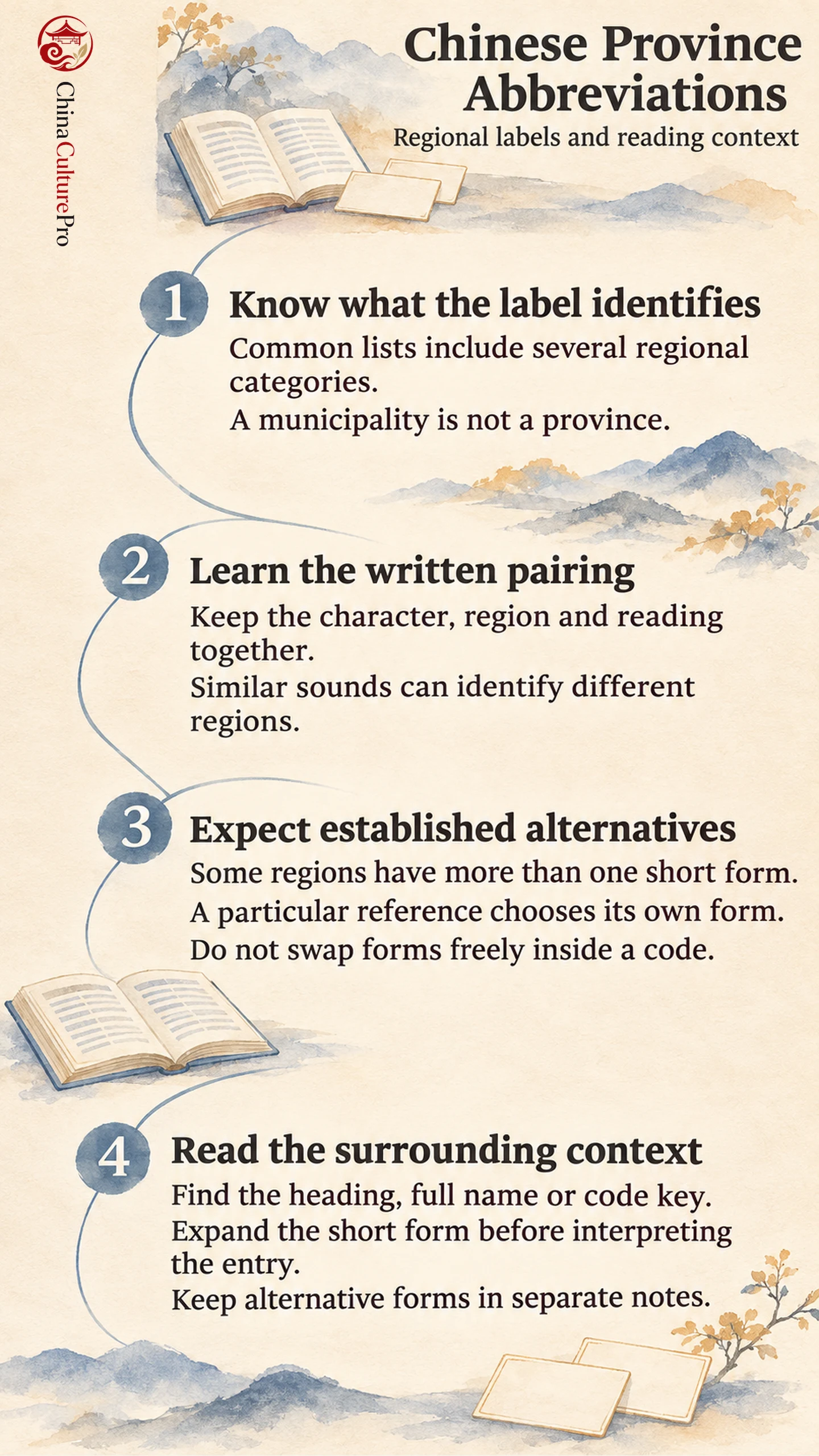
A single character can stand for a much longer regional name. That saves space while making the character-to-region pairing essential for a learner. Keep the abbreviation, Mandarin reading and expanded region together until the pairing is familiar.
Understand What a Regional Abbreviation Identifies
“Province abbreviations” is a convenient English label for a broader reference task. Provincial-level lists distinguish provinces, autonomous regions, centrally administered municipalities and special administrative regions. Beijing and Shanghai, for example, should not be described as provinces simply because their short forms appear beside provincial ones. [3]
An abbreviation is a regional label; an entire code may contain additional information. Learn the character-to-region mapping first, then consult the particular system for the rest. This article is a language reference, rather than instructions for interpreting every vehicle, statistical or administrative code.
Use a Reference Table of Common Short Forms
Common regional forms and Mandarin readings follow, including mainland labels, Hong Kong, Macao and Taiwan. [1]
| Region | Common short form | Mandarin reading |
|---|---|---|
| Beijing | 京 | jīng |
| Tianjin | 津 | jīn |
| Hebei | 冀 | jì |
| Shanxi | 晋 | jìn |
| Inner Mongolia | 蒙 | měng |
| Liaoning | 辽 | liáo |
| Jilin | 吉 | jí |
| Heilongjiang | 黑 | hēi |
| Shanghai | 沪 | hù |
| Jiangsu | 苏 | sū |
| Zhejiang | 浙 | zhè |
| Anhui | 皖 | wǎn |
| Fujian | 闽 | mǐn |
| Jiangxi | 赣 | gàn |
| Shandong | 鲁 | lǔ |
| Henan | 豫 | yù |
| Hubei | 鄂 | è |
| Hunan | 湘 | xiāng |
| Guangdong | 粤 | yuè |
| Guangxi | 桂 | guì |
| Hainan | 琼 | qióng |
| Chongqing | 渝 | yú |
| Sichuan | 川 | chuān |
| Guizhou | 贵 | guì |
| Yunnan | 云 | yún |
| Tibet (Xizang) | 藏 | zàng |
| Shaanxi | 陕 | shǎn |
| Gansu | 甘 | gān |
| Qinghai | 青 | qīng |
| Ningxia | 宁 | níng |
| Xinjiang | 新 | xīn |
| Hong Kong | 港 | gǎng |
| Macao | 澳 | ào |
| Taiwan | 台 | tái |
Distinguish Hebei’s 冀, jì, from Jilin’s 吉, jí, and Shanxi’s 晋, jìn, from Tianjin’s 津, jīn. Keep writing and tone together. [1]
Recognize Alternative Forms Without Swapping Them Freely
Some established alternatives include Sichuan’s 蜀, shǔ; Guizhou’s 黔, qián; Yunnan’s 滇, diān; Shaanxi’s 秦, qín; and Gansu’s 陇, lǒng. These alternatives account for different short forms in regional references. [2]
A scheme may select a longer form: the separate standard uses 内蒙古, Nèi Měnggǔ, where the table above uses 蒙. Follow the particular code list’s vocabulary. [1][2]
The abbreviation need not be a region’s first character. Beijing’s 京, jīng, comes from its second character. Learn the actual pairing rather than assuming a universal first-character shortcut. [4]
Read the Abbreviation Together with Its Context
Start by asking whether the character is acting as a regional label. A character can have other meanings in ordinary language, so an isolated screenshot may not supply enough information. Look for a heading, a full name nearby or a key explaining the table.
Next expand the abbreviation into the region’s full name. If the document provides a code list, use that list’s selected form. For a vocabulary note, preserve both the abbreviation and the expanded name; put an alternate form in a separate field rather than silently substituting it.
The place-name elements guide explains components in full names, while place-name changes addresses historical labels. For pronunciation practice, use pinyin alongside the actual Chinese characters.
FAQs About Chinese Province Abbreviations
Does every abbreviation use the first character of the region’s name?
No. Beijing’s 京 comes from its second character. Learn the established form rather than creating one by truncation. [4]
Can I use Shu wherever a table specifies Chuan?
No. Both can refer to Sichuan, but an individual scheme can specify its selected form. Follow the actual table or document. [2]
Are similar-sounding abbreviations interchangeable?
No. A similar sound does not establish the same regional label. Compare the written character and expanded name before interpreting the entry.
Sources
[1] Hunan Department of Transport. Integrated transport statistical reporting instructions, regional short-form table
[2] National Food and Strategic Reserves Administration. LS/T1715—2023: General code for grain storage, Table 1
[3] Central People’s Government, via Liaison Office in Hong Kong. Administrative divisions
[4] Beijing tourism authority. The Names of Beijing