

Quick Answer: How Much Are Wan and Yi?
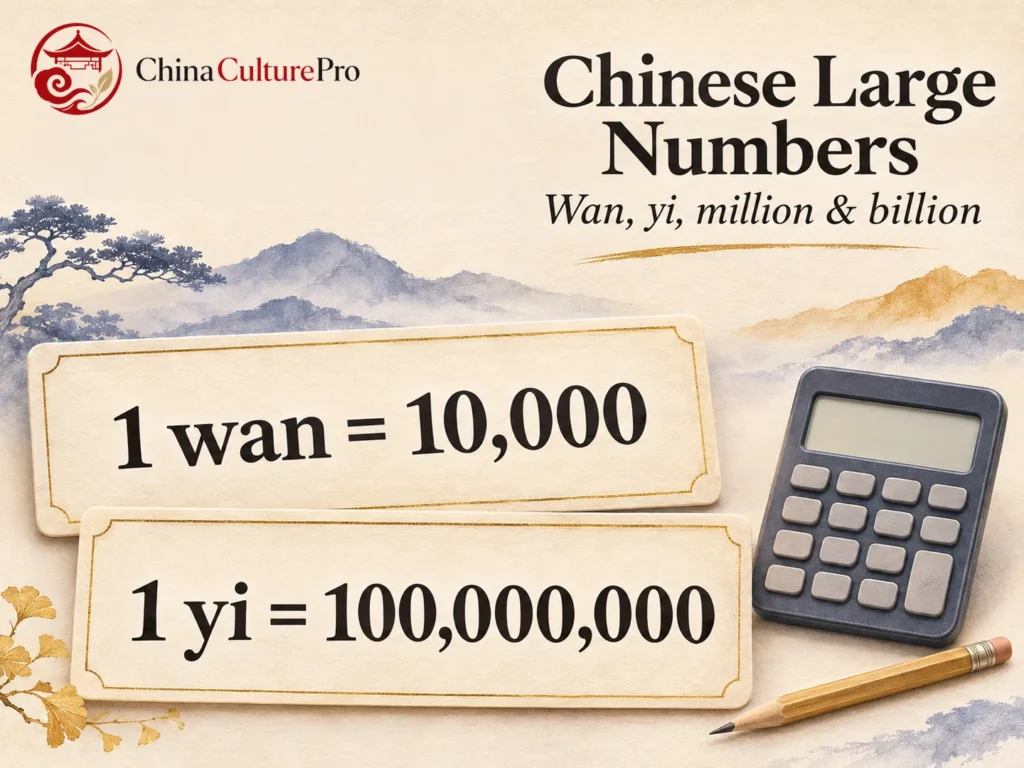
In modern Chinese counting, wan (万, wàn) means 10,000 and yi (亿, yì) means 100,000,000. One yi is one hundred million, not one billion.[2][3]
- One million: 100 wan, written 一百万.[1]
- One billion: 10 yi, written 十亿.[3]
- One conversion rule: Multiply a wan coefficient by 10,000, or a yi coefficient by 100,000,000.[2][3]
The multiplier changes the scale of the written figure. Keep its separate unit, such as people, yuan or square meters.

An English reader may recognize every digit in a Chinese table and still misread the amount. The missing information can sit in the column heading: the displayed figure might count ten-thousands of people rather than individual people.[4]
This guide uses modern ordinary numerical meanings. All worked figures below are teaching examples, not current prices, population estimates or currency quotations.
Match Wan and Yi to English Number Names
The traditional forms are 萬 and 億; their modern numerical values are unchanged. The guide to simplified and traditional Chinese explains the wider writing distinction.[2][3]
The following equivalences are exact arithmetic. Here, billion means 1,000,000,000, as in standard modern US English.
| English amount | Plain digits | Chinese unit expression |
|---|---|---|
| Ten thousand | 10,000 | 1万 |
| One hundred thousand | 100,000 | 10万 |
| One million | 1,000,000 | 100万 |
| Ten million | 10,000,000 | 1,000万 |
| One hundred million | 100,000,000 | 1亿 |
| One billion | 1,000,000,000 | 10亿 |
A useful bridge is 10,000 wan = 1 yi. Do not match an unfamiliar Chinese scale word to whichever English large-number name sounds similar.[3]
Read the Number in Four-Digit Groups
For reading aloud, group digits from the right in blocks of four. The rightmost block covers ones through thousands; the next counts wan; the next counts yi. This differs from the three-digit boundaries associated with English thousand, million and billion.[1]
For example, 123,456 becomes 12 | 3456 as a learning aid. That gives 12 wan plus 3,456: 十二万三千四百五十六. The vertical line is a learning aid, not document punctuation.
The digits and value stay the same when you regroup. A printed comma does not automatically identify a Chinese spoken-unit boundary. Keep standard digit formatting in the finished translation, and use the four-digit split privately when it helps you read.[1]
Mandarin readings use pinyin when romanized. The broader Chinese number-reading guide covers pronunciation, internal zeros and other speech details beyond this scale conversion.
Convert a Decimal Amount Without Losing Its Unit
For an illustrative amount of 36.75万元, keep the coefficient, scale and currency together throughout the calculation.
- Copy the coefficient and label: For the illustrative amount 36.75万元, keep 36.75, 万 and 元 together.
- Expand the scale: Multiply 36.75 by 10,000 to obtain 367,500 yuan.
- Reverse-check the result: Divide 367,500 by 10,000; the coefficient returns to 36.75.
- Write the result with its unit: Retain yuan in the English result; this is unit scaling, not currency exchange.
The same arithmetic works in reverse. A quantity of 2,480,000 divided by 10,000 is 248 wan. For yi, an illustrative 3.6亿 equals 360,000,000, or 360 million; it does not equal 3.6 billion.
Apply the multiplier once, then reverse-check; do not append zeros to a decimal string by sight.
Check Labels, Rounding and Common Errors
Read both the number and the header before translating a statistical table. Real tables use headings such as 万人 for ten-thousands of people and 亿元 for hundred-millions of yuan. A cell does not need to repeat its full unit for the unit to apply.[4]
- Match the measured thing: A teaching figure of 8.4 under 万人 means 84,000 people; the same coefficient under 亿元 means 840 million yuan.
- Preserve rounding: Expanding 1.2万 to 12,000 does not establish that the original measurement was exact. Retain any approximation or rounding qualification.
- Separate writing from value: Financial numerals concern character forms used to write amounts. They do not turn yi into billion.
Before sending a translation, reverse-check the coefficient and read the English unit aloud. A correct multiplication paired with the wrong currency or counted object is still a wrong translation.
FAQs About Chinese Large Numbers
Is one yi a billion?
No. One yi is 100 million in modern counting. One billion is ten yi; confusing the two makes the result ten times too small or too large.[3]
How many wan make one million?
One hundred wan make one million: 100 × 10,000 = 1,000,000. Five million therefore equals 500 wan, not five wan.[2]
Does changing from wan to plain numbers change the currency?
No. Expanding a wan amount only changes its scale notation. A figure expressed in yuan remains in yuan; converting it to dollars would require a separate exchange rate.
Sources
[1] Julian K. Wheatley, MIT OpenCourseWare. Learning Chinese: A Foundation Course in Mandarin, Unit 8
[2] Ministry of Education, Revised Mandarin Chinese Dictionary. 萬
[3] Ministry of Education, Dictionary of Chinese Character Variants. 億
[4] National Bureau of Statistics. 中华人民共和国2025年国民经济和社会发展统计公报