


Quick Answer: What Belongs in a Chinese Letter?
A Chinese letter normally identifies the recipient, gives the message, closes appropriately and identifies the sender. The relationship and purpose determine how formal those parts need to be.[3]
- Opening: Use a name, title or family relationship that suits the recipient.[1]
- Body: State the actual purpose clearly rather than relying on elaborate courtesy language.[2]
- Ending: Keep a closing to the reader distinct from the sender’s signature and date.[1]
A personal letter, an institutional notice and an email need not share one rigid visual template.
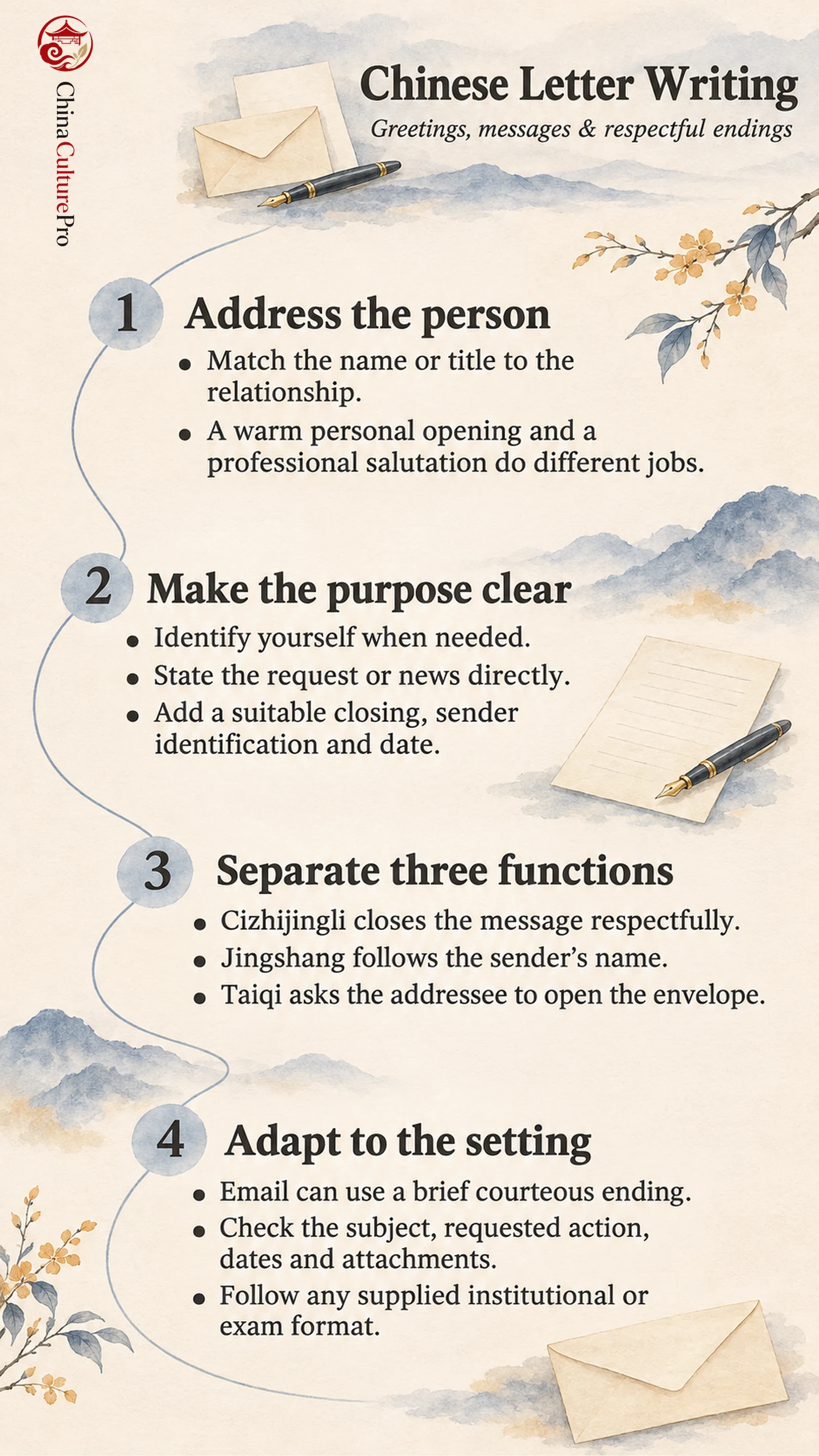
Recognizing a respectful phrase is not enough to place it correctly. An expression asking the recipient to open an envelope has a different job from a closing at the end of the message.
For an examination or an institution’s official correspondence, follow its supplied format. The conventions below provide a reading and writing foundation, not a replacement for those instructions.
Choose a Salutation That Fits the Relationship
A respectful opening can combine 尊敬的, zūn jìng de, with a surname and position. A familiar personal letter may use 亲爱的, qīn ài de, or simply a name or kinship title. These choices communicate a relationship; they are not interchangeable decorations.[1]
For example, 王老师:, Wáng lǎo shī, addresses Teacher Wang, while 亲爱的妈妈:, qīn ài de mā ma, addresses one’s mother warmly. A person’s established title is more useful than mechanically translating English dear.[1]
The guide to Chinese forms of address covers title selection beyond letters. Check the person’s name and role before choosing an opening that assumes an intimacy or office they do not have.
Build a Short Letter Around One Purpose
A practical message needs enough structure for the recipient to understand who is writing, why and what response is wanted. Institutional letters can include a title summarizing the subject, the writer’s role and a date. Some traditional courtesy components can be omitted in simpler formats.[2]
This original teaching example is a short student message to a teacher. The names are illustrative; it is not a quotation or a mandatory institutional form.
王老师:
您好!我是您班上的学生林敏。我想请教一个问题:这次作业可以用电子邮件提交吗?谢谢您的帮助。
祝您工作顺利!
学生 林敏
2026年11月7日
The message asks whether the assignment may be submitted by email. Its closing wishes the teacher well in their work. The signature identifies the student, and the date uses year, month and day. The date is part of this invented example, not a deadline.
Remove the greeting and closing as an editing test: if the request remains unclear, revise the body first. Chinese politeness and apologies provides context for respectful requests.
Read Closings and Signature Formulas
Cizhijingli (此致敬礼, cǐ zhì jìng lǐ) expresses respect at the close of a letter. One common teaching layout places 此致 on an indented line and 敬礼 on the next line at the left margin. This explains a familiar convention, not a rule that every email must reproduce.[1]
| Formula and reading | Function |
|---|---|
| Cizhijingli | A respectful closing to the recipient. |
| 敬上, jìng shàng | A respectful formula after the sender’s name. |
| taiqi (台啟, tái qǐ) | An honorific asking the addressee to open the letter. |
The signature formula belongs to the sender’s identification; the institutional-letter tradition contains several such markers and permits simplified arrangements.[2]
Taiqi belongs to the addressee’s opening instruction on an envelope, not after the writer’s name as a substitute for sincerely. In the same family of envelope expressions, 親啟, qīn qǐ, asks for the addressee to open the letter personally.[4]
Some old-fashioned salutations and courtesy formulas survive in particular settings. Do not combine every respectful expression into one letter simply because a glossary lists them.[3]
Adapt the Format for Email and Real Use
Email still benefits from a greeting and an appropriate courteous ending. A short wish such as 祝您顺利, zhù nín shùn lì, can perform that closing job; a long ceremonial formula is not the only way to be polite.[5]
Use a clear subject line and put the purpose early. Before sending, check the recipient’s title, the requested action, relevant dates, and any attachment mentioned in the message. These are practical editing checks rather than claims about one universal Chinese email format.
Keep Chinese characters readable and the paragraphs distinct. For formal correspondence, complete expressions are usually clearer to an unfamiliar reader than internet acronyms whose tone may be uncertain.
FAQs About Chinese Letter Writing
Is qinai de always the right translation of dear?
No. A personal, affectionate opening and a respectful professional title serve different relationships. Choose the form for the reader rather than translating dear automatically.[3]
Must every Chinese email end with cizhijingli?
No. A courteous greeting and suitable closing matter, but a brief well-wishing phrase can also fit email. Follow the institution’s requirements when it supplies a particular format.[5]
Is taiqi a closing after the sender’s name?
No. It addresses the recipient and asks them to open the letter. It belongs to envelope etiquette, so placing it after the sender’s signature confuses two different functions.[4]
Sources
[1] Michigan State University open textbook. Lesson 8 Dialogue 2: 给朋友的一封信
[2] The Education University of Hong Kong. 家長信:詳細介紹
[3] Chinese practical-writing teaching resource. 私人信函:寫作注意事項
[4] Chinese practical-writing teaching resource. 啟、收啟、台啟、大啟、鈞啟、懿啟、親啟
[5] Huazhong University of Science and Technology. 电子邮件礼仪规范