


Quick Answer
Xuantian Shangdi (玄天上帝, Xuántiān Shàngdì), the Supreme Emperor of the Dark Heaven, is a Daoist protector also known as Zhenwu (真武, Zhēnwǔ), the Perfected Warrior. He is associated with the north and often appears with loose hair, bare feet and a tortoise and snake. The Wudang Mountains (武当山, Wǔdāng Shān) became a major center for his worship, while Taiwanese temples developed pilgrimage traditions of their own.[1][2][3][4]
- The emblem: The tortoise and snake recall Xuanwu (玄武, Xuánwǔ), the older northern emblem.[1][2]
- The artwork: One early sixteenth-century sculpture gives Zhenwu a civil robe while keeping the long hair and bare feet.[1]
- The pilgrimage: Shoutian Temple (受天宫, Shòutiān Gōng) in Nantou has a documented pilgrimage season and a birthday rite in the third lunar month.[4][5]
The older emblem and the human-shaped deity share motifs. The title, date and arrangement of a specific object help determine which one an artist depicts.[1][2]
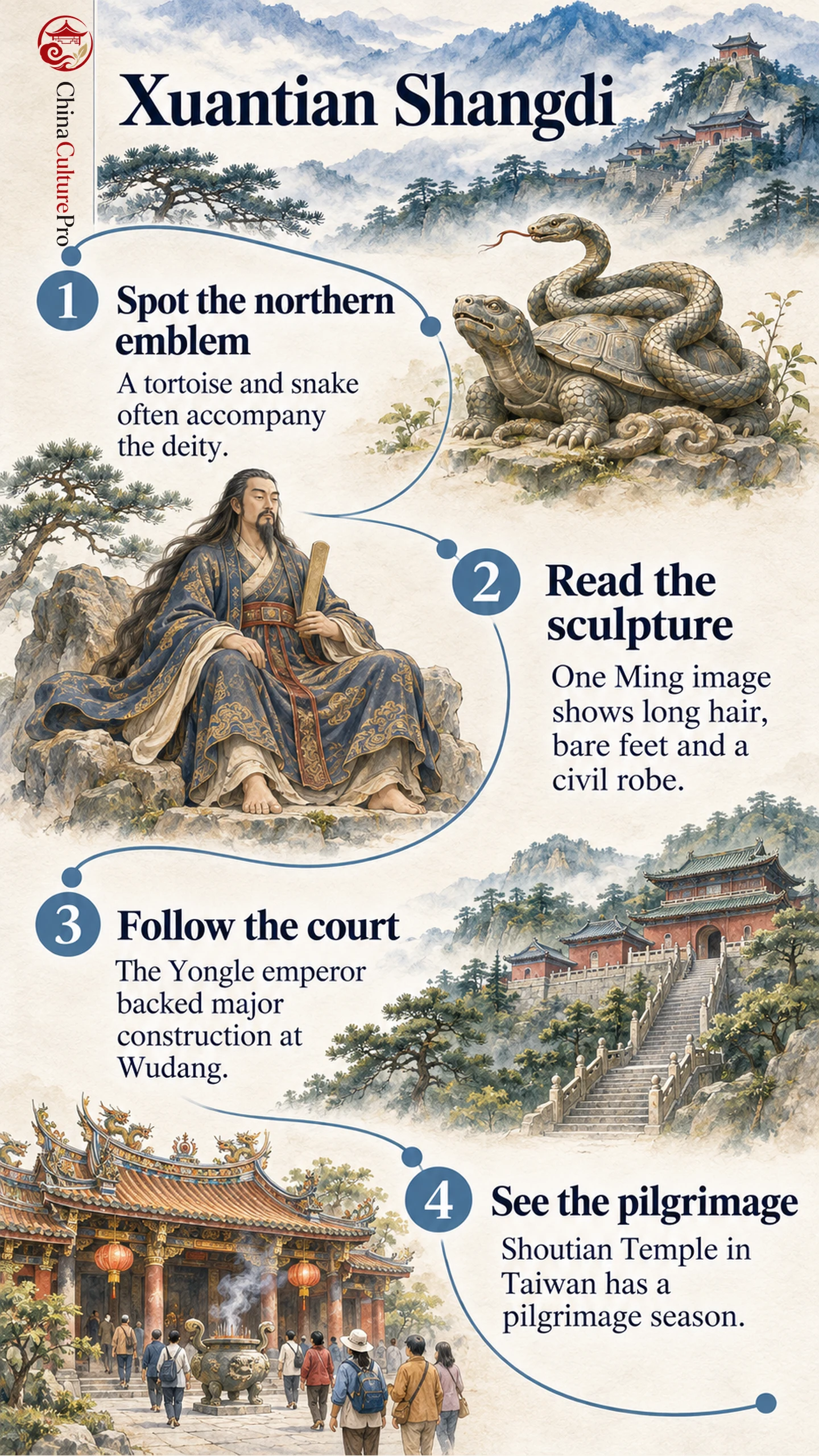
The name Perfected Warrior may suggest armor. One museum sculpture instead dresses him in the robe of a civil official. The details the artist retained help a viewer recognize him even when the costume changes.[1]
How the Northern Emblem Appears in Zhenwu Images
The tortoise entwined by a snake is associated with the north in Chinese visual culture. It also accompanies Zhenwu in many images. In a temple statue, the pair can appear below the human figure. The visual relationship helps distinguish the deity and his attributes from the <a href=”https://www.chinaculturepro.com/black-tortoise-meaning/”>Black Tortoise as a directional emblem</a> shown without a human figure.[1][2]
The Asian Art Museum’s sculpture of Zhenwu with two attendants is dated to 1506–1521. The museum points out his long hair, bare feet and robe with a dragon motif. The robe differs from armor in other depictions. The bare feet and loose hair remain useful clues. The catalog names his two attendants as Thousand-Mile Eye and Favorable Wind-Ear, part of this particular composition.[1]
What Wudang Tells Us About Imperial Worship
The Wudang Mountains in Hubei preserve buildings from multiple periods. A conservation report submitted to UNESCO describes a major construction campaign under the Yongle emperor (永乐帝, Yǒnglè Dì) in the early fifteenth century. The report dates the imperial order to 1412. The resulting construction drew on workers and craftsmen mobilized by the court.[3][6]
The Asian Art Museum connects Yongle’s reign with the prominence of Zhenwu worship. The mountains contain palaces, shrines and gateways as well as places associated with religious practice from earlier periods. The Purple Heaven Palace, for example, was first built in the twelfth century and rebuilt in the fifteenth. That surviving complex shows the Ming rebuilding within a longer history of worship on the mountain.[1][3][6]
How Taiwanese Pilgrims Honor Xuantian Shangdi
Taiwan’s religious heritage inventory documents the incense pilgrimage season at Shoutian Temple in Mingjian (名间, Míngjiān), Nantou. Visiting temple groups participate in processions and ritual performances. The record explains that this season has itself been recognized as intangible heritage. The visiting groups bring practices from their own temples into one period of worship.[4]
The temple’s annual observances identify the third day of the third lunar month as his birthday. The published program includes scripture recitation and prayers for peace. The date describes the temple’s ritual calendar. The birthday observances are part of a longer pilgrimage season at this temple.[4][5]
FAQs About Xuantian Shangdi
Is Xuantian Shangdi another name for Zhenwu?
Yes. Xuantian Shangdi and Zhenwu are names used for the Daoist deity. Temple titles and translations can vary, so a specific dedication is useful when identifying an image.[1][2][5]
Does the Perfected Warrior always wear armor?
The Asian Art Museum’s early sixteenth-century sculpture shows him in a civil robe. The catalog points to loose hair and bare feet as identifying details.[1]
When does Shoutian Temple honor his birthday?
The temple lists the third day of the third lunar month. This is a lunar observance and falls on different Gregorian dates in different years.[5]
Sources
[1] Asian Art Museum. The Daoist deity Zhenwu with two attendants
[2] National Museum of History. Image of Xuantian Shangdi
[3] UNESCO World Heritage Centre. Ancient Building Complex in the Wudang Mountains
[4] Taiwan Ministry of the Interior. The Xuantian Shangdi pilgrimage season at Shoutian Temple
[5] Shoutian Temple. Annual observances
[6] UNESCO World Heritage Centre. State of conservation report on the Wudang complex