


Quick Answer: What Is the Xu Surname Written 许?
The Xu surname (许/許,xǔ) has Mandarin’s third tone. 许 is simplified; 許 is traditional.[1][2]
- Historical tradition: One account connects the surname with the ancient state of Xu.
- Recorded spellings: Hsu, Hui and Khaw occur in actual personal-name records.
- Evidence boundary: Ancient stories and matching spellings do not establish an individual pedigree.
Read the Chinese character before merging records under the Latin spelling Xu or Hsu.
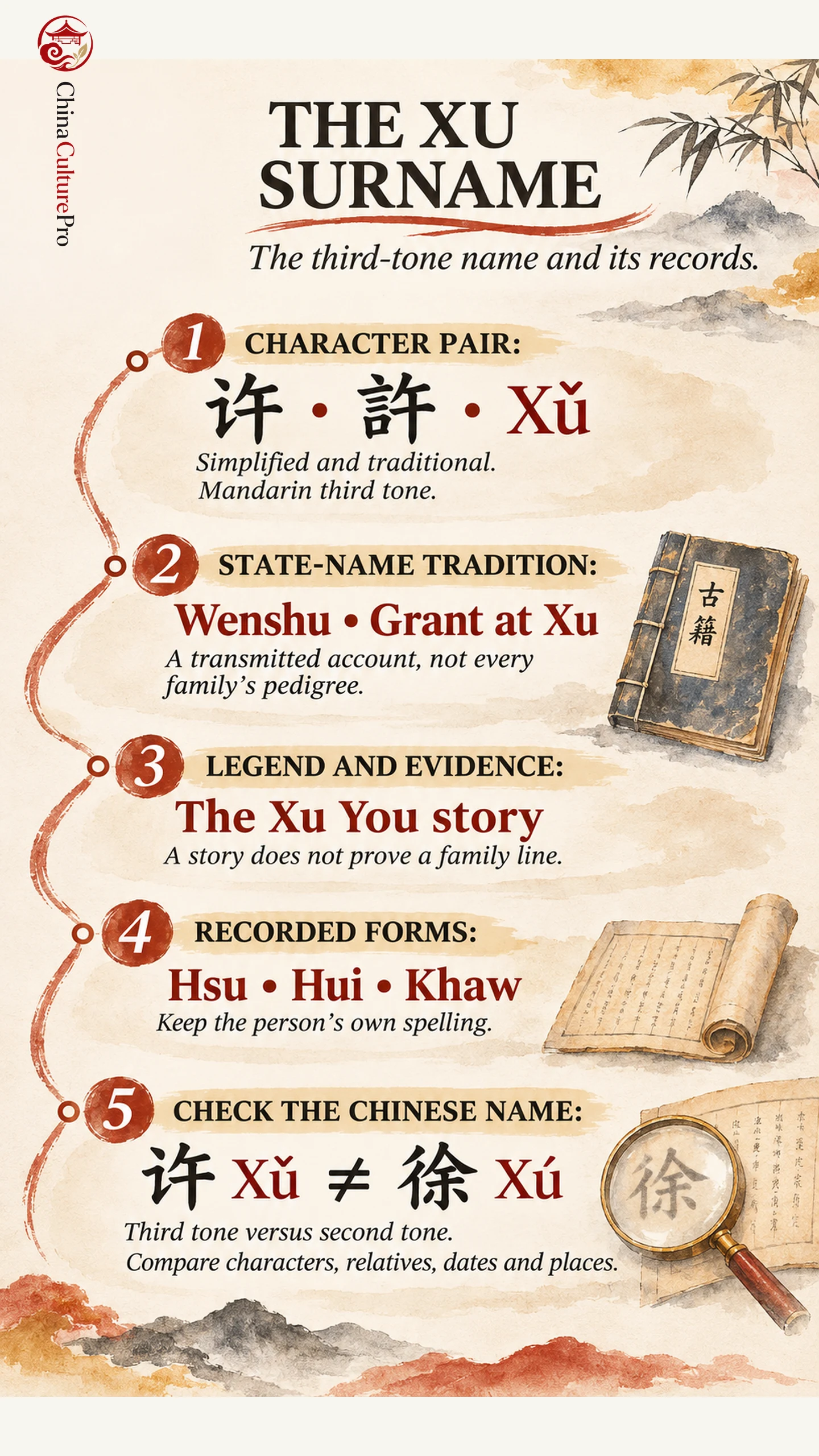
A family document saying 許 and an overseas record saying Hui may refer to the same surname. The connection needs checking, however: identical Latin letters can also represent another Chinese name.
许 and 許: The Third-Tone Name
The Ministry of Education gives xǔ and records the surname separately from meanings such as allowing, promising and expecting. A dictionary word sense does not describe the personality of someone named Xu.[1]
Academia Sinica identifies 许 as the simplified form of 許. Both written forms should be retained as they appear when transcribing historical or personal documents.[2]
2019 mainland rank: 26th.[10]
The Xu State and the Xu You Story
Tongzhi (通志,tōngzhì) describes Wenshu (文叔,wénshū) receiving a grant at Xu under King Wu of Zhou. It places this account in the Jiang lineage (姜姓,jiāng xìng), records the state’s changing centres, and mentions branches living elsewhere after its decline. This is a transmitted state-name tradition, not every modern family’s completed pedigree.[3]
Xu You (许由/許由,xǔ yóu) belongs to another story: the recluse who refused Yao’s offer of rule. Shiji (史记/史記,shǐjì) reports the tale and asks why such figures receive so little mention in established writings. Its account does not supply a verified family line from Xu You to Wenshu or to a modern household.[4]
Hsu, Hui and Khaw in Actual Names
The following records pair each spelling with a Chinese personal name. They demonstrate usage without assigning one spelling to every family in a region.
| Recorded form | Chinese-name evidence |
|---|---|
| Hsu | Cho-Yun Hsu (许倬云/許倬雲,xǔ zhuōyún), in Academia Sinica’s member record.[5] |
| Hui | Michael Hui Koon-man (许冠文/許冠文,xǔ guānwén), in Hang Seng University’s honorary citation.[6] |
| Khaw | Khaw Boon Wan (许文远/許文遠,xǔ wényuǎn), in the Chinese-name annex to a 2009 Singapore official release.[7] |
Why Xu or Hsu Can Hide a Different Surname
The second-tone Xu surname (徐,xú) is different from 许/許. Its Mandarin reading has a rising second tone, rather than xǔ’s third tone.[8]
Hsu alone cannot resolve the distinction. National Taiwan University’s record for Winston Hsu (徐宏民,xú hóngmín) uses 徐, while Cho-Yun Hsu’s record above uses 許.[5][9]
The second-tone Xu surname guide covers that separate name. In a record without Chinese characters, leave the identification open until corroborating evidence is available.
How to Compare Xu Family Documents
- Copy the Chinese character and the full personal name from each source.
- Retain recorded Latin spellings beside dates, relatives and places.
- Separate an ancient surname tradition from the generations actually supported by family records.
FAQs About the Xu Surname Written 许
Are 许 and 許 Different Surnames?
They are simplified and traditional forms of the same surname. Preserve the form actually used in the document rather than silently rewriting it.[2]
Is Every Hsu Surname Written 许?
No. The paired records for Cho-Yun Hsu and Winston Hsu show why the Chinese name matters: one uses 許 and the other 徐.[5][9]
Does the Xu You Story Prove a Family Line?
No documented chain follows from the story alone. Shiji itself raises questions about the evidence surrounding Xu You; family descent requires further records.[4]
Sources
[1] Ministry of Education. 許: Concised Mandarin Chinese Dictionary
[2] Academia Sinica. 許 and 许: Character comparison
[3] Zheng Qiao. Tongzhi, volume 26: Xu account
[4] Sima Qian. Shiji, volume 61: Opening discussion of Xu You
[5] Academia Sinica. Cho-Yun Hsu
[6] Hang Seng University of Hong Kong. Michael Hui Koon-man: Honorary citation
[7] International Enterprise Singapore. 2009 Singapore–Jiangsu Cooperation Council release, annex 3
[8] CNS11643 Character Database. 徐: Character and reading record
[9] National Taiwan University. Winston Hsu
[10] Ministry of Public Security, via reproduced report. 2019 National Name Report