


Quick Answer: What Is Weifang Kite Making?
Weifang kite making (潍坊风筝制作技艺, Wéifāng fēngzheng zhìzuò jìyì) is a Shandong craft that joins light frames, decorated coverings and the skills of flying them. Its best-known forms include hard-wing and soft-wing kites and the dragon-headed centipede kite (龙头蜈蚣风筝, lóngtóu wúgōng fēngzheng), a train of linked sections.[1][3][4]
- Frame: Tied bamboo strips can support the shape and its covering.[3][6]
- Surface: Paint or a mounted print supplies imagery that can be read on the ground or in flight.[2][4][6]
- Structure: Wing supports and linked sections distinguish several common types.[1][3]
The national inventory listed Weifang kite making in 2006.[1]
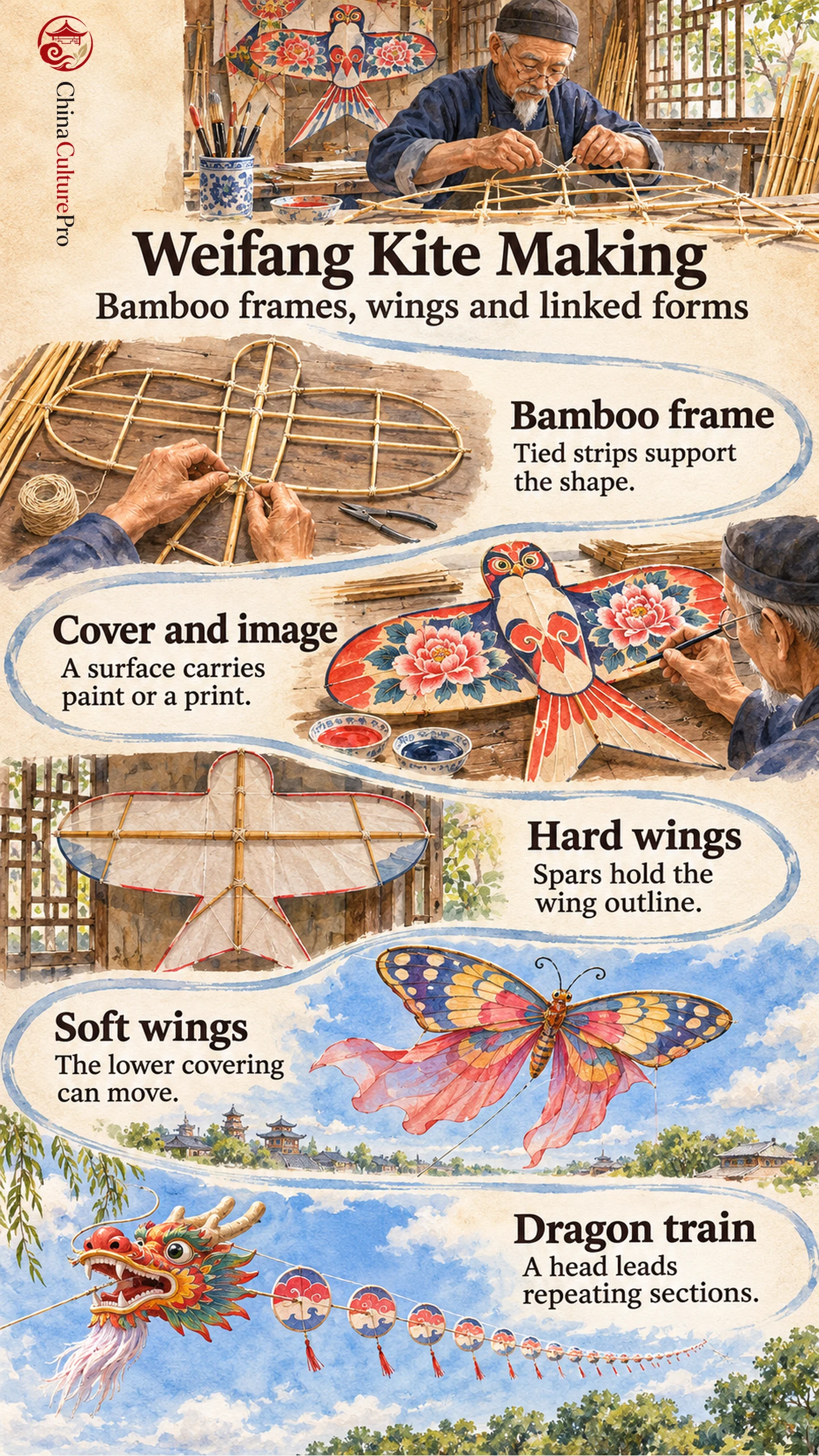
A painted butterfly kite and a long dragon train are two familiar Weifang forms. One needs wings that can move at the edge. The other stretches out into a line of linked shapes. Turn either kite over and its structure tells you how it differs.[1][3]
From Bamboo Frame to Painted Surface
Makers describe their work through four skills: tying the frame, mounting the covering, painting or decorating, and flying. Bamboo gives the frame its shape. The covering provides a surface for images. A flight test shows how the frame and covering behave under tension from the line and pressure from the wind.[4][6]
The Weifang gazetteer describes one Yangjiabu method in which figures or animals were cut out of printed sheets and mounted on a kite frame. Such work shows a direct connection with Yangjiabu New Year prints. Other kites have painted motifs shaped for the frame. Print and paint describe how imagery reaches the surface, while hard and soft wings describe the structure beneath it.[1][2][4]
Hard Wings, Soft Wings and Linked Dragon Kites
| Form | What to look for |
|---|---|
| Hard-wing kite | A more fully supported wing whose main spars hold its outline |
| Soft-wing kite | A supported upper wing with a flexible lower section |
| Dragon-headed centipede kite | A dragon head at the front and a train of linked body sections |
| Tubular or three-dimensional kite | A frame that carries the covering around a volume |
The difference between a hard wing and a soft wing can be difficult to see from the painted side. The lower covering of a soft wing has room to move in the wind. A hard-wing design uses more support to hold its shape. For a dragon train, look beyond the head. Its repeating sections give the body a visible rhythm along the train.[1][3]
A description published in Shandong gives a practical clue: its soft-wing example uses one main wing spar and leaves the lower part flexible. Its hard-wing example uses two main wing spars. A front-view photograph of the painted surface can obscure that difference, so a side or rear view can be more informative.[3]
A museum display can also contain flat kites with simple boardlike profiles. The national profile describes these among early forms in the region, alongside the development of hard-wing, linked, soft-wing and tubular designs. These shape categories leave room for birds, fish, figures and other painted or printed subjects.[1][2]
Yangjiabu Workshops and the Heritage Record
The national record places historical kite production in Yangjiabu and other parts of Weifang. It describes a connection with the materials used in New Year print workshops and records kite making as a local industry by the Qianlong period. Weifang is in Shandong, where these craft traditions form part of the broader regional setting described in Qilu culture.[1][2]
The practice has also developed through individual apprenticeships. Yang Hongwei began learning from her grandfather Yang Tongke in 1982. Xinhua describes her use of Yangjiabu print techniques in kite work. Han Fuling’s national practitioner record names his apprenticeship with Hu Jingzhu and includes a dragon-headed centipede kite among his representative pieces.[4][5]
FAQs About Weifang Kite Making
How do hard-wing and soft-wing kites differ?
A hard-wing kite has more fixed support along the wing. On a soft-wing kite, the lower covering can move while the main wing spar supports the upper part.[3]
Why is it called a dragon-headed centipede kite?
A three-dimensional dragon head can lead a sequence of linked sections. From a distance the repeating body sections suggest the segmented length of a centipede.[1][3][5]
Were all Weifang kites printed from woodblocks?
The gazetteer describes printed motifs mounted on some Yangjiabu kites. It also describes painted work, and contemporary makers can draw on both traditions.[2][4]
Sources
[1] China Intangible Cultural Heritage Digital Museum. Kite Making: Weifang Kites
[2] Shandong Local Gazetteer Archive. Weifang Kite Schools and Their Features
[3] Dazhong News. The Craft of Weifang Kites
[4] Xinhua. A Woman Inheriting Her Family’s Kite Craft
[5] China Intangible Cultural Heritage Digital Museum. Han Fuling
[6] China Intangible Cultural Heritage Digital Museum. Handicraft in Everyday Life