


Quick Answer: What Does Wan Bi Gui Zhao Mean?
Wan Bi Gui Zhao (完璧归赵, wán bì guī zhào) means returning something intact to its rightful owner. The words recall an envoy who brought a prized jade disc to Qin and ensured it went safely back to Zhao when a proposed exchange failed.[1][2]
- The object: A celebrated jade disc in the possession of the king of Zhao.[1]
- The promise: Lin Xiangru pledges to return it intact if Zhao does not receive the cities offered for it.[1]
- Modern use: The expression can describe giving a borrowed or entrusted item back in good condition.[2]
Zhao is the destination in the story and the owner’s place in the idiom.
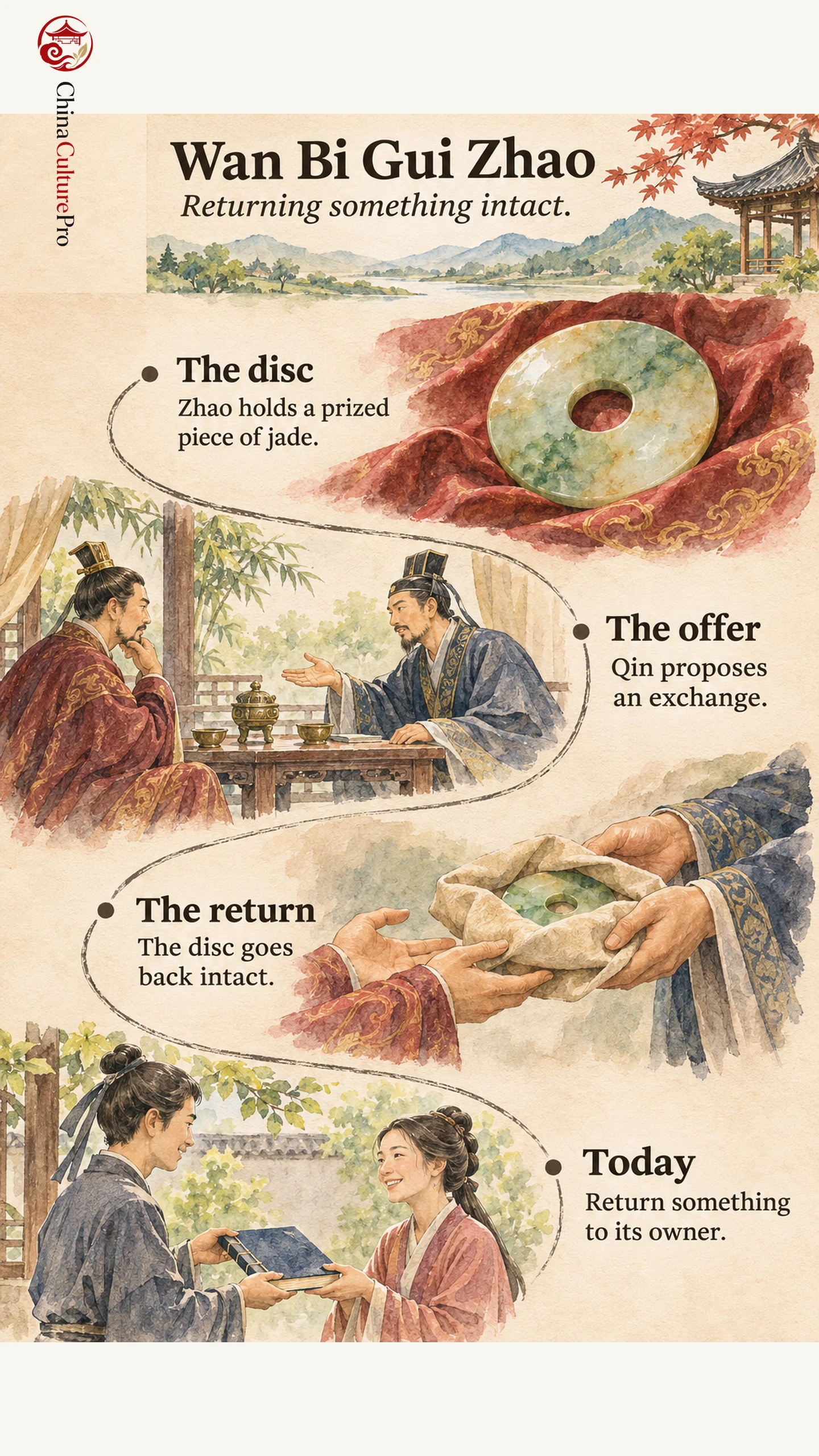
The bargain in the story is striking: cities in exchange for one piece of jade. The part that survives in everyday Chinese is Lin Xiangru’s promise about what he would bring back.[1][2]
The Jade Disc and the Offer of Cities
In the Records of the Grand Historian (史记, Shǐjì), the king of Qin offers fifteen cities for the He Family Jade Disc (和氏璧, Hé shì bì). The king of Zhao worries that Qin will take the object without keeping its side of the bargain. Lin Xiangru offers to go as envoy. He says that if the cities are transferred, the disc can stay in Qin. Otherwise, he will return it intact.[1]
Lin Xiangru’s Promise to Zhao
When the king of Qin receives the disc, Lin Xiangru sees little sign that the cities will actually be handed over. The account says he recovers possession of the disc and has an attendant return it to Zhao. The account ends the proposed exchange with the disc back in Zhao and the cities still in Qin. The words in the idiom echo the pledge made before his departure.[1][2]
What the Jade Disc Represents
A bì is a flat, round jade disc with a hole at its center. The kings in the account treat this particular disc as an exceptional treasure. In the idiom it can stand for something entrusted to another person, while the character wán emphasizes its condition when it returns.[1][2]
How to Use Wan Bi Gui Zhao
Someone handing back a borrowed book could use the expression with a smile: “Here it is, safely back with you.” A report about a valuable object being restored to its owner might choose the more formal “returned intact.” Another diplomatic story, Mao Sui Zi Jian, supplies a separate idiom about volunteering for a task.[2]
FAQs About Wan Bi Gui Zhao
What Is a Bi Disc?
A bì is a disc with a central opening, traditionally made of jade. The story concerns one named example.[1]
What Does Wan Mean in the Phrase?
Wán means whole or intact in this phrase. The promise is to return the object without damage.[1][2]
Does the Idiom Require Something Stolen?
It can describe returning an ordinary borrowed or entrusted item. The meaning is about getting it back to its owner.[2]
Sources
[1] Taiwan Ministry of Education. Dictionary of Chinese Idioms entry for Wan Bi Gui Zhao
[2] Taiwan Ministry of Education. Revised Mandarin Chinese Dictionary entry for Wan Bi Gui Zhao