


Quick Answer: What Is the Lixue School of Principle?
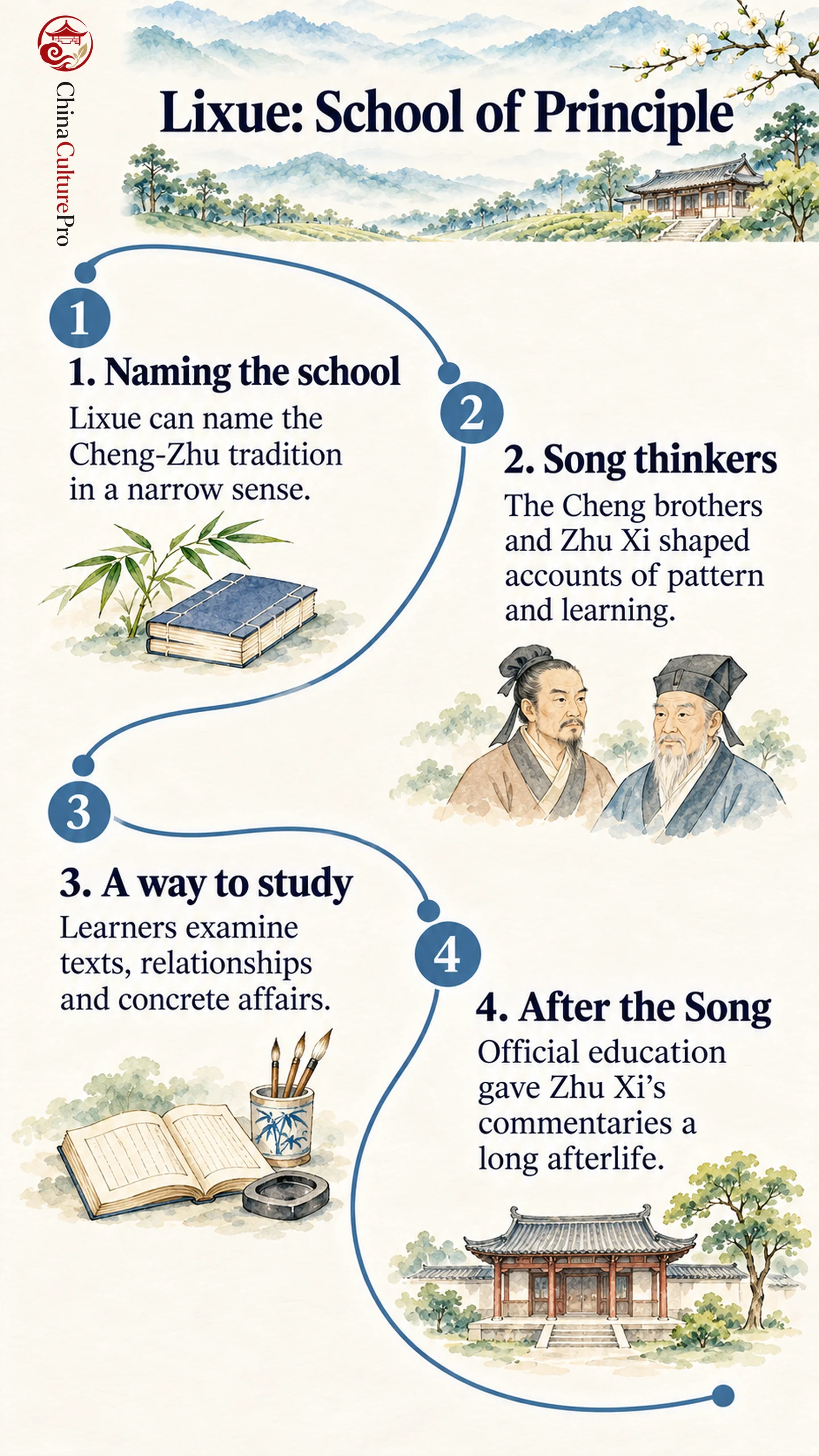
Lixue (理学, lǐxué), often translated as Learning of Principle or School of Principle, can refer broadly to Song–Ming Neo-Confucian learning. In a narrower sense it refers to the Cheng–Zhu tradition associated with Cheng Hao (程颢, Chéng Hào), Cheng Yi (程颐, Chéng Yí) and Zhu Xi (朱熹, Zhū Xī). This tradition links an account of the patterns of things and affairs with the work of learning to judge and act well.[1][2][3]
- Thinkers: The Cheng brothers shaped Northern Song debates, and Zhu Xi brought their work into a later synthesis.
- Learning: Inquiry into texts and affairs belongs with attention to one’s own conduct.
- Institutions: The use of Zhu Xi’s commentaries in examinations gave his interpretation an audience far beyond his immediate students.[2][3][5]
The narrower sense helps distinguish the Cheng–Zhu tradition from other positions within Neo-Confucianism.
A reader can encounter Lixue in a discussion of metaphysics, an account of moral education or a history of the examinations. The name has a place in all three settings because the tradition developed an account of what people should study and why that work matters.
Who Shaped the Cheng–Zhu Tradition?
The Cheng brothers were important to the philosophical debates of the Northern Song. Their work helped give pattern or principle a central role in explanations of things, human relationships and moral cultivation. Zhu Xi, writing in the Southern Song, drew on their work as well as on other thinkers such as Zhou Dunyi and Zhang Zai. Calling the result the Cheng–Zhu tradition emphasizes Zhu Xi’s inheritance and reconstruction of an earlier intellectual movement.[2][3]
The anthology Reflections on Things at Hand (近思录, Jìnsīlù), compiled by Zhu Xi and Lü Zuqian, gives readers an example of how that inheritance was arranged. The selection brings earlier thinkers into a conversation about the world, learning and conduct. A reader can compare how different passages connect everyday practices with claims about the order of the world. The arrangement makes those connections easier to see and reflects the compilers’ decisions about how to introduce their predecessors. Wing-tsit Chan’s English translation gives access to that anthology.[3][4]
How the School Understood the Work of Learning
The Great Learning (大学, Dàxué) became one of the Four Books (四书, sìshū) in Zhu Xi’s arrangement. His treatment of the investigation of things explains why inquiry matters to moral knowledge. Learners examine concrete things and affairs, make sense of connections and carry that understanding into later encounters. They can draw on classic texts without treating a passage as a substitute for looking closely at the situation it helps them understand.[2][3]
The work also requires a disposition to take the matter seriously. A student may know how a commentary describes a duty and still miss how that duty applies to a particular person. Inquiry and attentive conduct address different parts of the difficulty. The student has to understand what is going on and remain willing to let that understanding change their judgment.[2][3]
How a Set of Commentaries Became a Curriculum
Zhu Xi’s work included arranging and interpreting texts already in circulation. By the end of the Song, his interpretation had acquired considerable standing. A Yuan decision in 1313 made it a basis for civil service examinations. Generations of candidates now had a professional reason to study these readings. That requirement explains their wide circulation even when readers disagreed about what moral education should accomplish.[2][3]
The curriculum also acquired uses in imperial education and public life, as work on the Ming reception of the commentaries shows. That history concerns how officials and readers used Zhu Xi’s work after his death. It helps explain the influence of the Cheng–Zhu tradition while leaving room for later thinkers to question how it understood moral learning.[2][5]
FAQs About the Lixue School of Principle
Are Lixue and Daoxue the same thing?
Some histories use both labels broadly for the Song–Ming revival of Confucian learning. Daoxue means Learning of the Way, and the narrower use of Lixue identifies the Cheng–Zhu School of Principle. The author and period usually make the intended scope clearer.[1][2]
How does the School of Principle differ from the School of Mind?
The Cheng–Zhu tradition gives sustained inquiry into things and affairs a central place. The School of Mind associated with Lu Xiangshan and Wang Yangming gives more direct weight to moral discernment in the heart-mind. Both approaches concern the work of moral cultivation.[2]
Which texts give a first view of Lixue?
The Great Learning read with Zhu Xi’s commentary shows his approach to a classic. Reflections on Things at Hand shows how he and Lü Zuqian brought passages from earlier thinkers together for study.[3][4]
Sources
[1] Routledge. New Confucianism in Twenty-First Century China, glossary entry for Lixue
[2] Stanford Encyclopedia of Philosophy. Song-Ming Confucianism
[3] Stanford Encyclopedia of Philosophy. Zhu Xi
[4] The Anton Library of Chinese Studies. Reflections on Things at Hand: Bibliographic Record
[5] National Taiwan Normal University. Study of Zhu Xi’s Four Books Curriculum in the Ming