

Quick Answer: What Is the Guangyun Rhyme Dictionary?
The Guangyun(廣韻,Guǎngyùn), meaning “Expanded Rhymes,” is a Northern Song Chinese rhyme dictionary. It groups characters by historical sound categories and supplies explanations of their meanings.[1]
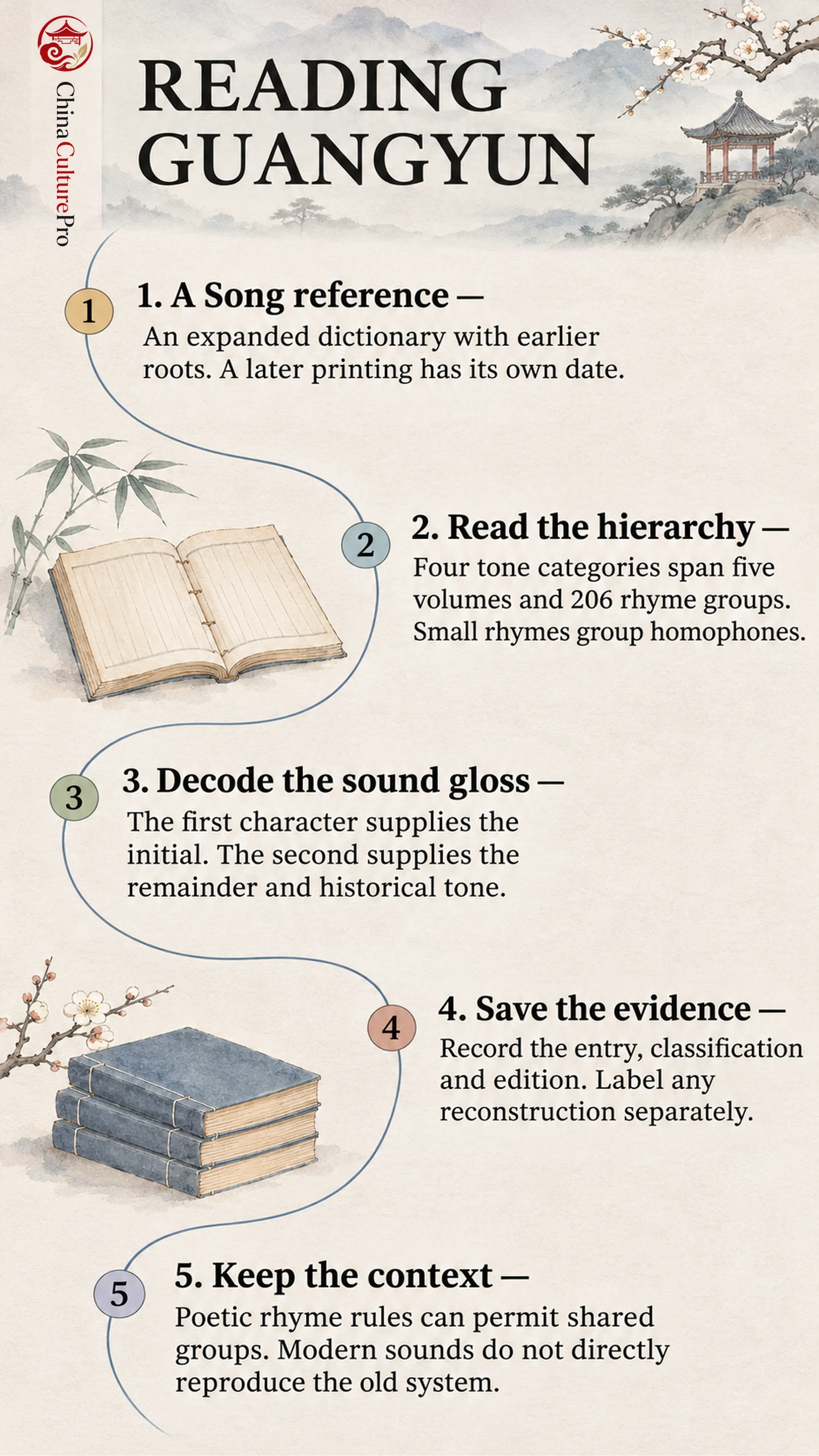
- Organization: Four traditional tone categories, divided across five volumes and 206 rhyme groups.
- Pronunciation clues: Two-character sound glosses identify the readings of homophone groups.
- Reading value: It helps readers investigate older pronunciations and the background to literary rhyming.
Its categories belong to a historical reference tradition. They do not directly teach present-day conversational Mandarin.
A character can sit beside quite different neighbors in a modern dictionary and an old rhyme book. Guangyun makes sound relationships central to finding and interpreting entries. Understanding its layout helps explain why scholars still consult this expanded medieval reference when studying Chinese words, verse and pronunciation history.[2]
A Song-Dynasty Reference with Earlier Roots
Guangyun was compiled under imperial patronage by Chen Pengnian, Qiu Yong and colleagues in the early eleventh century. It expanded the Qieyun(切韻,Qièyùn)tradition, whose foundational dictionary dates to 601. Earlier works survive incompletely; Guangyun provides a complete later witness to that reference tradition.[1][2]
Dates differ between reference accounts. The later imperial catalog records an order to revise the work in 1007 and completion in 1011; another educational reference dates compilation to 1007–1008. Distinguish the early Song compilation history from the date of a particular surviving edition. A later printing is not evidence that the dictionary itself originated then.[1][3]
This inherited classification is essential context for Middle Chinese. A Song compilation date does not mean every distinction in it describes ordinary speech in one Song city.
Four Tone Categories, Five Volumes and 206 Rhymes
The tone category selects a major section; the rhyme group narrows the search. Level-tone material occupies two volumes, so five volumes do not mean five tones. The cataloged volume sequence is shown below; the rhyme counts total 206.[1][4]
| Historical tone category | Volumes and rhyme-group count |
|---|---|
| Level tone(平聲,píngshēng) | Volumes 1–2; 28 plus 29 groups |
| Rising tone(上聲,shǎngshēng) | Volume 3; 55 groups |
| Departing tone(去聲,qùshēng) | Volume 4; 60 groups |
| Entering tone(入聲,rùshēng) | Volume 5; 34 groups |
Within a rhyme group, a small rhyme(小韻,xiǎoyùn)contains characters treated as homophones. Its leading entry supplies the sound gloss and a group count. A shared rhyme heading is consequently a broader relationship than membership in one small rhyme.[5]
Use these as historical category labels. “Rising” should not prompt you to substitute modern Mandarin’s rising pitch, and the entering category should not be forced into a modern four-tone chart.
Reading Fanqie Through the Dong Entry
The pronunciation method is fanqie(反切,fǎnqiè): the first spelling character supplies the initial consonant, and the second supplies the remaining syllable and historical tone category. The source tradition and period matter; combining today’s readings can give the wrong result.[5]
For example, the entry for 東, “east,” ends with 德紅切十七. Here 德 and 紅 are the two spelling characters, 切 marks the sound gloss, and 十七 gives the homophone group’s size. The number counts characters in this homophone group, including its head entry. The digitized entry identifies its location in the Zecuntang edition as volume 1, folio 15.[6]
Taking the initial of 德 and the remainder of 紅 describes a historical relationship. Modern Mandarin dōng and hóng have different tones, so simply joining contemporary syllables misses part of that relationship.[5]
Keep the entry’s meaning separate from its pronunciation formula. The same paragraph can contain definitions, names and citations before reaching the sound gloss; its first few words are not a phonetic transcription.[6]
How to Look Up a Character and Record the Evidence
A digital lookup is useful because historical databases can distinguish rhyme-book records from reconstructed sounds and modern dialect readings. Choose the Guangyun layer explicitly rather than treating every displayed pronunciation as text from the book.[7]
- Find the written form: Search the character, checking a traditional or variant form if the expected entry is missing.
- Record the classification: Copy the tone category, rhyme heading, small-rhyme head and fanqie exactly as displayed.
- Save the source location: Note the edition and page or folio reference when available; retain the entry link for checking.
- Label any interpretation: If you add a reconstructed reading, record its named system separately from the original characters.
The result should be a short, checkable entry note rather than an unattributed “ancient pronunciation.” Research interfaces can display Guangyun rhyme, tone and fanqie alongside modern pinyin and different scholars’ transcriptions. Those are separate fields, not interchangeable spellings.[8]
For example, a note can preserve 東 — 德紅切 — volume 1, folio 15 first, then add a separately identified interpretation. This preserves the difference between the entry and its later interpretation.
What Guangyun Can Explain About Poetry and Pronunciation
Historical rhyme groups help make older Chinese poetry intelligible, but dictionary classification and permission to rhyme together are not identical. Guangyun can mark a rhyme as independent or indicate shared use with other groups. Check those instructions and the relevant poetic convention before rejecting a rhyme solely because two characters occupy different headings.[9]
Nor can one fanqie formula settle every question about historical pronunciation. Reconstruction also compares living Chinese varieties, Chinese-derived readings in Japanese, Korean and Vietnamese, and other historical evidence. The related rhyme tables arrange sound relationships differently from a running dictionary entry.[10]
For a reader, the strongest first conclusion is often categorical: these entries share an initial, belong to different tone classes, or were grouped together in this reference. A claim about their exact spoken sounds needs an identified reconstruction and further evidence. That distinction makes Guangyun useful without turning it into a recording of every medieval speaker.
FAQs About Guangyun
Is Guangyun a Mandarin dictionary?
No. It records historical reading categories, rather than the vocabulary and pronunciation of modern spoken Mandarin.
Are the five volumes five tones?
No. There are four traditional tone categories; level-tone material takes two volumes.
Does fanqie give an exact ancient sound recording?
No. It expresses sound relationships through characters. A phonetic interpretation requires a stated reconstruction system.
Can Guangyun explain every classical rhyme?
No. Period, genre and permitted shared rhyming matter. Consult the poem’s own convention alongside the dictionary.
Sources
[1] Taiwan Ministry of Education / National Academy for Educational Research. Guangyun reference entry
[2] University of Southern California Libraries. Song Edition of the Extended Rhymes
[3] Siku Quanshu General Catalog, volume 42. Chongxiu Guangyun catalog notice
[4] National Institute of Informatics. Guangyun five-volume bibliographic record
[5] Guillaume Jacques. Introduction to Chinese Historical Phonology, pages 5–6
[6] Guangyun, Zecuntang edition, digitized by Ytenx. Dong entry, volume 1, folio 15
[7] Academia Sinica. Chinese Historical Phonology Database documentation
[8] University of Chicago. Digital Etymological Dictionary of Old Chinese: field interface
[9] Zhongwei Shen, Cambridge University Press. Middle Chinese: The Tang and Song Dynasties
[10] Huba Bartos, Eötvös Loránd University. Chinese Historical Phonology: Reconstruction