

Quick Answer: What Is Fuzhou Bodiless Lacquerware?
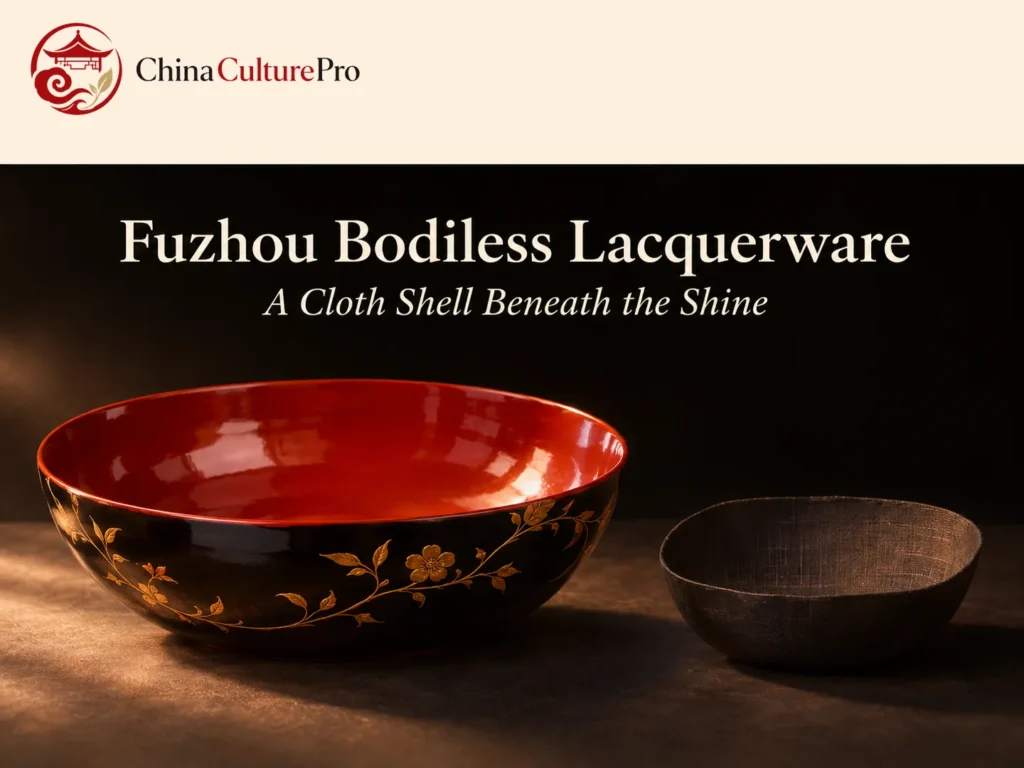
Fuzhou bodiless lacquerware (福州脱胎漆器, Fúzhōu tuōtāi qīqì) is a lacquer craft from Fuzhou, Fujian. Makers build layers of cloth and natural lacquer over a temporary mold. After the mold is removed, the cloth and lacquer hold their shape as a hollow shell that can be smoothed, colored and polished. [1][2][6]
- Temporary form: Clay or plaster can establish the shape.
- Lasting shell: Cloth and cured lacquer stay in the object.
- Finish: Lacquer, gold-colored decoration and inlay can change the look of the surface. [1][2][4][6]
The mold determines the outline. The shell carries it after the mold is gone.

A polished Fuzhou vase can look like metal from across a room. Its color and shine come from the surface. The shape beneath can be built from cloth, layered until it is strong enough to stand as a vessel.
How the Cloth Shell Comes Off the Mold
A maker starts with a shaped core. Fuzhou accounts name clay, plaster and removable wooden forms. The maker builds up layers of woven cloth, such as the cloth called xiàbù (夏布) or silk, using natural lacquer. The fabric conforms to the surface of the mold while it is still flexible. As the lacquer cures, the textile layers take on the contour. [2][3][6]
The method of release depends on the core. A Fuzhou account of Shen Shao’an describes washing clay out through a small hole. Another craft account describes breaking or lifting out a temporary mold. The freed shell can receive an ash-and-lacquer ground that is sanded smooth. Fuzhou workshops also make lacquerware on a permanent wooden core, which stays in the object through similar surface work. [1][2][3]
How Lacquer Takes on Color and Shine
The cloth gives the object structure, and ground layers prepare a smooth surface for lacquer. The national register records polishing and finishes such as gold-colored lines on red lacquer and mother-of-pearl inlay. Mother-of-pearl is a separate material applied at the surface. A workshop report describes adding a lacquer layer over the pieces and polishing until they reappear. [1][2][5]
The Fujian collection account credits the brothers Shen Zhenghao and Shen Zhengxun with developing a finish called bóliào (薄料). It describes finely ground gold or silver mixed into preparations that could be blended with colors. The museum account describes patting the colored mixture onto the surface. A curve then catches the light differently from a flat area, one surface effect within Chinese lacquerware. [4][5]
Shen Shao’an and the Shen Workshop Objects
Fuzhou sources credit the Qing lacquer worker Shen Shao’an (1767–1835) with developing the local practice from older cloth-and-lacquer work known as jiāzhù (夹纻). A local story says that seeing the cloth layer of a damaged signboard gave him an idea for the shell. Later generations of the Shen family developed its colors and finishes. [1][2][3][4]
Fujian Museum holds two works by Shen Zhenghao that model different plant forms. A bamboo-root vessel rises more than a meter, with a rim and body that follow bamboo joints. A 98-centimeter lotus-leaf vessel curls up from a group of red flowers. On the lotus piece the sheen follows the rolled edge and the bends in the green leaf. [4]
The Shanghai Museum records a painted lacquer fruit plate by Shen Zhenghao dated 1910. At 53 centimeters across and more than 66 centimeters tall overall, its display form is quite different from the two plant-shaped vessels. The national register also records Shen family lacquerware appearing at international exhibitions. [1][7]
How the Craft Is Seen and Taught Today
Fujian Daily reported in 2025 that the Shen Shao’an Lacquer Art Museum in Fuzhou’s Zhuzifang historic district showed bodiless vases and organized exhibitions and learning activities. Seeing the forms together gives visitors a chance to compare how lacquer catches light on different profiles. The same report describes broader lacquer courses at Minjiang University, where students learn to work with both the material and the surface design. [5][6]
FAQs About Fuzhou Bodiless Lacquerware
What does bodiless mean in Fuzhou lacquerware?
Bodiless refers to removing the rigid mold after building the form. The layers of cloth and lacquer remain and hold the finished shape. [2][3][6]
Does the metallic sheen mean a vase is made of metal?
A vessel can acquire a metallic sheen from the lacquer finish. Fujian Museum examples by Shen Zhenghao have metal powder in the decorative preparation over a bodiless shell. [4]
When was Fuzhou bodiless lacquerware nationally listed?
China placed the Fuzhou bodiless lacquerware finishing technique on its first national intangible cultural heritage list in 2006. [1]
Sources
[1] China Intangible Cultural Heritage Network. Fuzhou Bodiless Lacquerware Finishing Techniques
[2] China Intangible Cultural Heritage Network. Fuzhou Bodiless Lacquerware
[3] Fuzhou Local Gazetteer Commission. Shen Shao’an and the Fuzhou Lacquer Tradition
[4] Fujian Department of Culture and Tourism. Bodiless Lacquerware by Shen Zhenghao
[5] Fujian Daily via Minjiang University. Fuzhou Lacquer Art Today
[6] Fuzhou News. Fuzhou Heritage Crafts and Where They Are Shown
[7] Shanghai Museum. Fruit Plate with Legendary Turtle Decoration by Shen Zhenghao