

Quick Answer: What Is a Fenshui Oil-Paper Umbrella?
A Fenshui oil-paper umbrella (分水油纸伞, Fēnshuǐ yóuzhǐsǎn) is a folding umbrella made in the Fenshuiling area of Luzhou, Sichuan. A bamboo frame supports the paper canopy, which is treated with tung oil. Some canopies are painted by hand, and Fenshui also has a documented stone-printing tradition. [1][3][4][5]
- Frame: Slender bamboo ribs and hinged supports spread the canopy.
- Paper: A sheet or sections of paper form the umbrella’s outer surface.
- Finish: Tung oil coats the paper. Paint or printing supplies the design. [1][3][4][5]
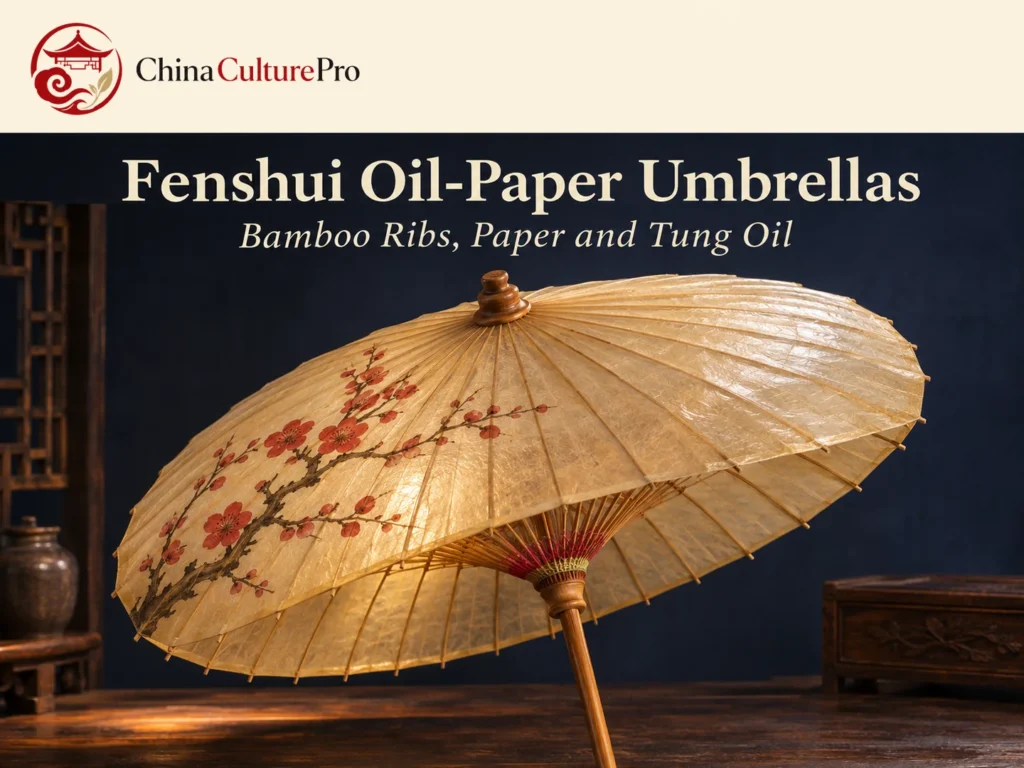
Look at the underside as well as the canopy. The ribs and the colored threading reveal different kinds of work.

From above, a paper umbrella can look like a single painted picture. Turn it over and it becomes a set of slender pieces that have to move together. An opened Fenshui umbrella shows the result of both kinds of work at once.
What the Bamboo and Thread Do
The heritage record lists bamboo, wood, paper and tung oil as local materials. Long bamboo ribs follow the slope of the opened paper. Shorter supporting members connect the ribs to the sliding part around the shaft. When that part slides upward, the short supports push the long ribs out. In the open position they hold the paper across the radius of the frame. [1][4]
Tying and threading are part of assembling the frame. Xinhua describes a version called mǎnchuānsǎn (满穿伞), in which the maker works a dense pattern with five colors of silk thread. Viewed from below, the colored strands form a second pattern around the shaft. That pattern is visible even when the picture on the outside is out of sight. [1][4][6]
How Paper, Prints and Tung Oil Meet
The paper must follow the curve of the opened frame without pulling unevenly. The Fenshui records include bark paper among the materials, and a Sichuan Daily account describes specially prepared handmade paper for a hand-painted version. The stages depend on the paper and the frame behaving together. A Fenshui workshop account notes that the weather affects how the ribs hold their shape and how flat the paper dries. A change in either part can leave the canopy uneven. [1][3][5]
Stone printing puts a repeatable design on paper. A heritage account records Bi Liufu discussing stone printing alongside hand-painted work. Xinhua photographs him transferring a pattern from a stone plate in 2025, and separately shows him painting a design by hand. Applying tung oil is another operation. A cured coating makes the paper more resistant to rain. The coating can also give the canopy a slight sheen. The workshop has to spread it evenly across the paper that moves with the ribs. [1][3][4][5]
What the Fenshui Workshop Record Shows
Fenshuiling is in Luzhou’s Jiangyang District. The national project record names the Fenshui umbrella factory as the safeguarding unit for the craft, listed in 2008. It cites a local gazetteer that dates Fenshui production to the late Ming and early Qing. An account of the workshop traces the present factory’s predecessor to an umbrella-making cooperative formed in 1952. These records describe the tradition at different stages. [1][3]
Bi Liufu learned from his father, Bi Linze, and worked at the Fenshui factory. The national profile lists an umbrella made with handmade paper and an eight-sided plum blossom model among his works. The plum blossom model makes a change to the silhouette. The handmade-paper umbrella highlights a choice about the canopy itself. [2][3]
How the Technique Is Taught Today
A 2022 college report documents a training visit to the Fenshuiling umbrella workshop and museum. Bi introduced students to making ribs, working colored thread, fitting the canopy and applying oil. Students could handle the work at different stages, including fitting paper and applying oil. An opened umbrella normally hides much of that fitting under the canopy. [6]
A 2025 Xinhua feature records Bi Liufu and his son Bi Yuanshen adding gauze in some designs and using motifs including pandas and Sichuan opera. The umbrella still brings separate decisions about frame, surface and ornament into one object, as in many Chinese traditional crafts. [4]
FAQs About Fenshui Oil-Paper Umbrellas
Is Fenshui the same place as Luzhou?
Fenshui refers to the umbrella tradition associated with Fenshuiling in Jiangyang District. Jiangyang is part of Luzhou, the city named in the national heritage record. [1][6]
Are Fenshui canopies always hand-painted?
Some are hand-painted. The Fenshui workshop record also describes stone printing, which can transfer a design to more than one canopy. [3][4][5]
Do all Fenshui umbrellas take the same number of steps?
Published accounts group the work differently. The national entry describes more than ninety operations, while a Sichuan Daily account of Bi Liufu’s work describes 108. Both accounts describe many separate tasks in preparing the ribs, threading the frame and finishing the canopy. [1][5]
Sources
[1] China Intangible Cultural Heritage Network. Umbrella Making: Oil-Paper Umbrella Making
[2] China Intangible Cultural Heritage Network. Bi Liufu
[3] China Intangible Cultural Heritage Network. Keeping the Oil-Paper Umbrella in the Rain Lane
[4] Liu Kun, Xinhua. Fenshui Oil-Paper Umbrellas and Their Makers
[5] Sichuan Daily. The Work Behind a Fenshui Umbrella
[6] Luzhou Vocational and Technical College. Oil-Paper Umbrella Heritage Training