


Quick Answer: What Is Diamond Sutra in China?
The Diamond Sutra(金刚经,Jīngāng jīng)is a Mahayana Buddhist scripture presented as a dialogue between the Buddha and Subhuti. In China, its teachings on giving without attachment became significant in religious reading, recitation and interpretation.[1]
- Text: Questions fixed ideas about self, appearances and spiritual attainment.
- Chinese reception: Known through translation and later Buddhist teaching traditions.
- Famous object: A Chinese woodblock-printed scroll bears the date 11 May 868.[2]
The scripture, its Chinese translations and that particular printed copy have different histories. The date of an object should not become the date of the teaching it contains.
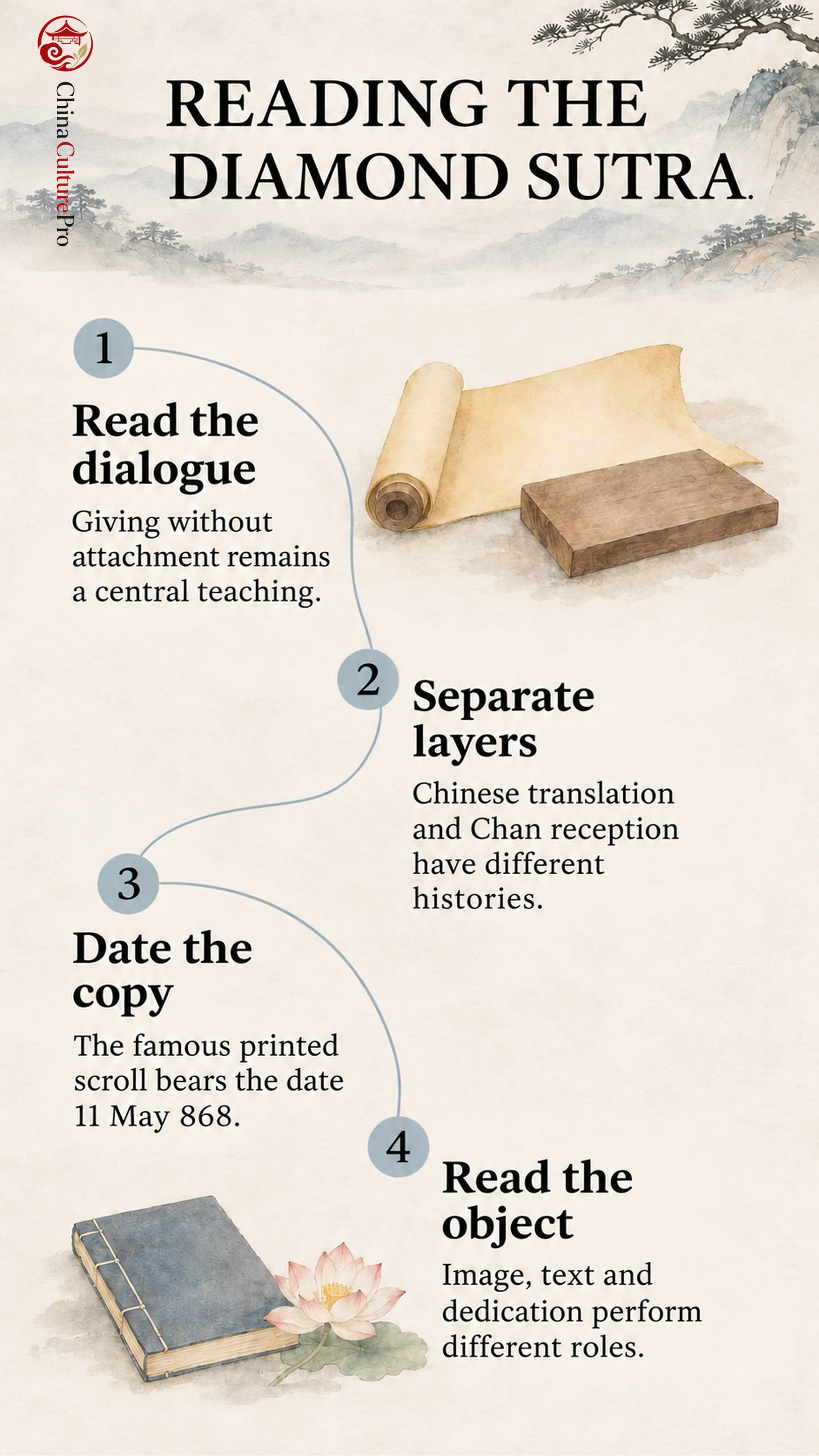
A Buddhist scripture can be both a demanding religious text and a landmark in book history. The Diamond Sutra invites both kinds of reading. This introduction places its argument within Chinese Buddhism, then distinguishes translation, religious reception and the celebrated scroll’s printed image and dedication.
The Dialogue, Non-Attachment and Generosity
The dialogue begins in an everyday setting: the Buddha returns from collecting food, eats, puts away his robe and bowl, washes his feet and sits. Subhuti then asks how those seeking awakening should direct and settle their minds.[1] The setting places the discussion within an encounter between teacher and disciple.
Giving provides a concrete example. The text calls for generosity without clinging to appearances or treating the act as a possession. The problem is not that a gift exists; it is attachment to fixed ideas about giver, recipient and achievement. The aspiration to help living beings remains present even while the text unsettles claims about a permanent self.
Its language repeatedly names something, denies that it has the fixed character assumed of it and then permits the name again. Reading only the denial can make the dialogue sound like a declaration that nothing matters. Reading the surrounding exchanges shows that ethical action and the wish for awakening continue throughout.
The raft comparison supplies another useful clue: teachings serve a purpose without becoming objects of attachment. Even a helpful doctrine can be grasped too tightly. Near the end, images of dreams, bubbles, dew and lightning encourage readers to contemplate conditioned things as unstable.[1]
These passages work together. They question possessiveness toward ideas and attainments without recommending indifference to others. A first reading becomes clearer when each striking sentence stays within the exchange that prompts it.
Chinese Translation and the Chan Tradition
Kumarajiva(鸠摩罗什,Jiūmóluóshí)is named as translator of the Chinese version catalogued as T0235. The Chinese translation associated with him dates to around 400 CE, centuries before the famous printed copy.[1][2] Translation history and printing history therefore need separate places on the timeline.
The scripture also matters to Chan Buddhism. In the *Platform Sutra*(坛经,Tánjīng)tradition, Huineng(惠能,Huìnéng)awakens while hearing the teaching about bringing forth the mind without dwelling on anything.[3] This is a religious narrative about understanding, rather than a transcript independently documenting the event.
The scripture and the lineage narrative are separate works. The Diamond Sutra supplies the teaching being heard; the later narrative places it within a Chinese lineage story. A modern commentary explaining that episode adds another interpretive layer. Identifying those layers helps readers understand why the same short phrase can appear in a translated scripture, an account of a patriarch and a contemporary teaching.
The Dated Scroll of 868 and Woodblock Printing
The British Library’s scroll Or.8210/P.2, recovered from Mogao Cave 17 near Dunhuang, comprises seven printed sheets joined into an approximately five-meter scroll. Its colophon names Wang Jie(王玠,Wáng Jiè)as sponsor and dates the work to 11 May 868. It is recognized as the earliest surviving complete printed book bearing a date.[2]
That careful description preserves what makes the object exceptional. It does not claim that no printing existed earlier. Nor does a sponsor’s name establish that he personally carved the blocks or operated the printing process.
Woodblock printing distinguishes this copy from a handwritten manuscript. A printed line can resemble brush-written characters because the block reproduces their forms. Appearance alone is insufficient to label the surviving object an autograph or identify the hand of its donor.
Reading the Frontispiece and the Donor’s Note
The opening illustration, or frontispiece, shows the Buddha preaching to an assembly.[2] It introduces the religious encounter before the columns of dialogue. In a whole-scroll reproduction, the broad field of closely repeated text columns contrasts with the picture panel: image and text occupy different reading roles.
The image establishes an assembly; the written exchanges carry the argument. Treating the picture as a decorative border would miss that relationship. Conversely, identifying the Buddha’s teaching scene does not mean that the picture itself explains every philosophical claim in the sutra.
At the other end, the dedication connects circulation with devotion to the sponsor’s parents.[2] It gives this particular copy a social purpose beyond transmitting words. The sutra itself praises receiving, reciting and explaining even a short passage.[1] Read together, text and dedication show how preserving and sharing a teaching could become an act of religious generosity. That is the devotional context of the object, not a promise that owning a reproduction guarantees spiritual results.
FAQs About Diamond Sutra in China
Is 868 the date when the Diamond Sutra was written?
No. It dates the famous printed copy. The scripture and its Chinese translation are earlier.[2]
Does non-attachment mean refusing to help people?
No. The text explicitly teaches generosity while questioning attachment to self, appearances and spiritual achievement.[1]
Is the famous scroll a handwritten manuscript?
No. Or.8210/P.2 is a woodblock print on paper, even though its lettering reproduces written character forms.[2]
Sources
[1] CBETA, hosted by National Taiwan University. Kumarajiva’s Chinese Diamond Sutra, Taisho T0235
[2] International Dunhuang Programme, British Library. Buddhist texts: The Diamond Sutra
[3] Chung Tai World. Platform Sutra teaching: the account of Huineng