


Quick Answer: What Is Chinese Tea Post-Fermentation?
Post-fermentation(后发酵,hòufājiào)in Chinese tea refers to transformations involving microorganisms after earlier leaf-processing stages, particularly in dark-tea manufacture.
- Mechanism: Microbial activity helps change the material, alongside chemical reactions and the effects of moisture and heat.
- Examples: Regional dark teas use different piling, steaming, forming and maturation sequences.
- Meaning for drinkers: Manufacturing history and subsequent storage explain more than a dark infusion or an old date alone.
This is different from calling black tea “fully fermented” to describe leaf-enzyme oxidation. It also does not mean that every tea follows one wet-piling recipe or improves indefinitely with age.
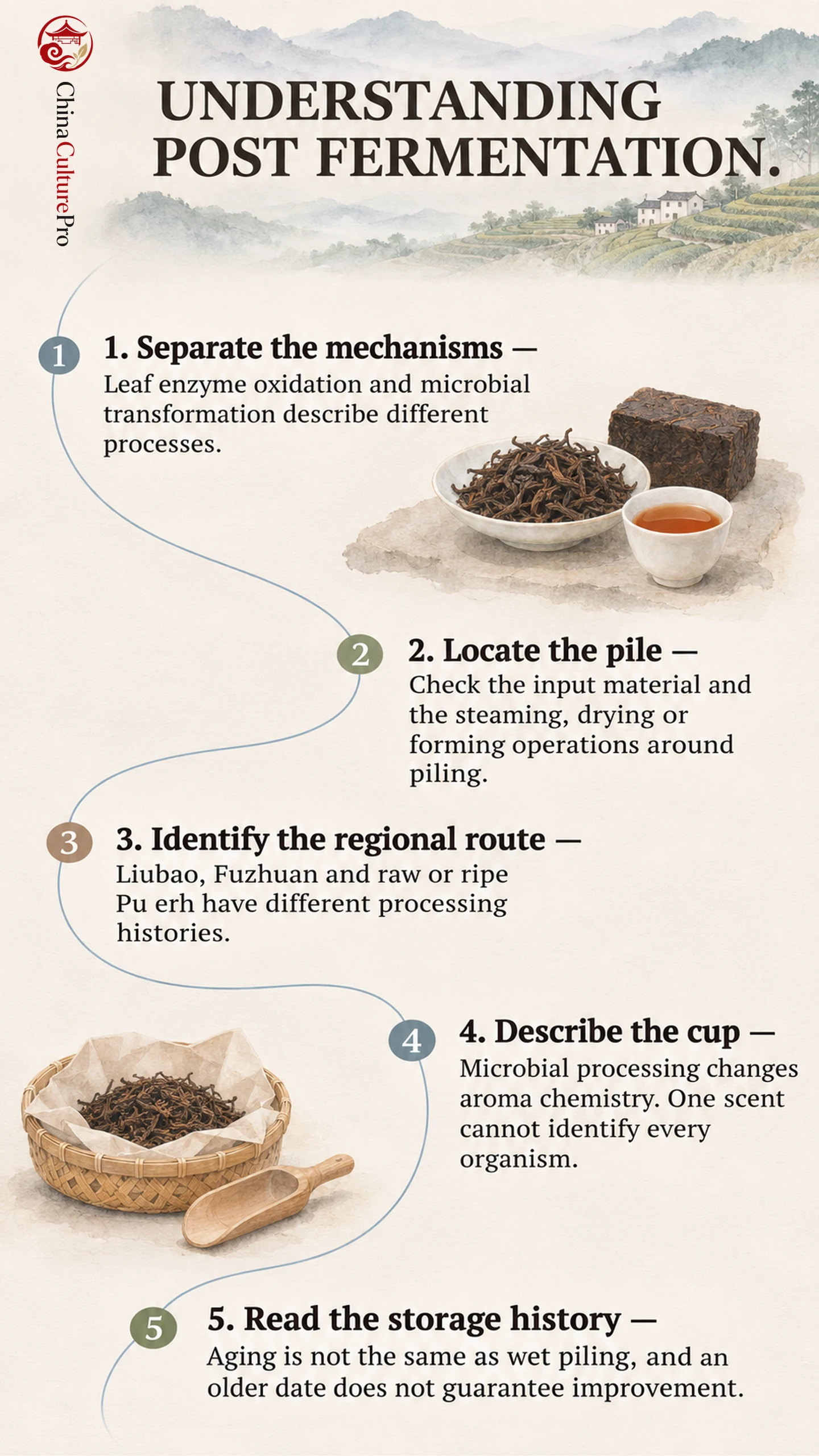
A reddish brown infusion can come from teas with quite different manufacturing histories. A loose dark tea, a pressed brick and an aged cake may share certain aromas without sharing the same production route. The useful question is what happened to the leaf before the tea reached its present form.
Oxidation and Microbial Fermentation Are Different
Black-tea manufacture uses the leaf’s own enzymes to promote oxidation after withering and rolling. Hei cha(黑茶,hēichá), usually translated as dark tea, instead has a defining microbial-processing component. Agricultural teaching material describes a representative dark-tea sequence of fixation, rolling, microbial piling and drying.[1]
These are not two positions on a single “fermentation percentage” scale. The comparison in oxidation versus fermentation concerns what drives the changes, as well as when they occur. Earlier fixation suppresses oxidation-related leaf enzymes; it does not make later microbial transformation impossible.
What Makers Manage During Piling
Wo dui(渥堆,wòduī), often translated as wet piling or pile fermentation, describes a production operation rather than ordinary damp storage. The material’s condition and its place in the wider process matter; piling is not necessarily a treatment performed only after every other manufacturing step has finished.
The official account of traditional Cangwu production records fixation and rolling followed by steaming, piling and further steaming, then drying and aging. It identifies moist heat in the steaming-to-resteaming stage as important to reducing harshness and changing leaf color.[2] That sequence challenges the idea that all post-fermentation means spraying a finished retail tea and leaving it alone.
Identify the input material and the operations surrounding the pile. “Post-fermented” by itself does not tell you whether the maker subsequently dried, steamed, formed or matured the tea. A process overview also cannot supply a safe household fermentation protocol.
Liubao, Fuzhuan and Pu-erh Take Different Routes
Liubao tea(六堡茶,liùbǎochá)is associated with Cangwu in Guangxi. Its official heritage record emphasizes the traditional steaming, piling and resteaming sequence. The technique was listed as a national intangible-cultural-heritage extension project in 2014; this records recognition of a craft rather than the invention date of every modern product.[2]
Fuzhuan tea(茯砖茶,fúzhuānchá)provides a different example. The Yiyang tradition includes a flowering stage after forming, with temperature and humidity managed to develop characteristic golden fungal growth within the brick.[3] That is a specific manufacturing feature, not an expectation that every dark tea must show golden dots.
A review comparing ripened Pu-erh tea(普洱茶,Pǔ’ěrchá), Liupao and Tibetan teas also documents differences in post-fermentation conditions and microbial communities.[4] The broad category therefore contains several manufacturing histories.
| Example | Processing distinction | What to clarify |
|---|---|---|
| Traditional Liubao | Steaming, piling and resteaming feature in the heritage account | Which production route the batch follows |
| Fuzhuan | Flowering follows forming in the recorded tradition | Whether the product is this particular brick style |
| Ripe Pu-erh | Moisture-assisted pile fermentation | Production and later storage history |
| Raw Pu-erh | Sun-dried material can be formed and changes during storage | Storage conditions rather than an assumed ripe-tea process |
Pu-erh tea requires the raw-versus-ripe distinction. A controlled-storage study made raw tea by fixing, rolling and sun-drying leaves before steaming and pressing; its account distinguishes that route from moisture-assisted piling for ripe tea.[5] Raw and ripe Pu-erh are not interchangeable labels for young and old cakes.
How Microbial Processing Changes Aroma and Taste
Post-fermentation helps reshape aroma chemistry, but it does not produce one compulsory flavor. The review of ripened Pu-erh, Liupao and Tibetan teas summarizes partly shared dominant microbial and key aroma-active profiles, alongside differences associated with fermentation conditions and communities.[4]
This supports comparing styles rather than reducing all dark tea to “earthy.” The Liubao heritage account, for example, describes an amber-red infusion and a mellow taste.[2] Those are descriptive expectations within that tradition, not measurements that authenticate an unknown sample.
Use tea-aroma vocabulary to describe what you notice, then keep that observation separate from claims about the exact organisms, origin or storage age. One familiar scent cannot identify a complete microbial community.
Post-Fermentation, Aging and Storage Claims
Manufacturing and subsequent aging can both involve microbial activity, yet they are not identical operations. In the raw-Pu-erh storage experiment, changing water activity altered fungal communities and flavor chemistry; some higher-water-activity conditions also produced undesirable volatiles.[5] Water activity is a property of available water in the material, not simply the room’s relative-humidity reading.
The result is not a universal instruction to make tea wetter. Discuss aged tea through the particular material and its storage history, rather than assuming that an extra year guarantees improvement. Follow appropriate tea-storage guidance for the product.
Research on tea-derived microbes considers quality contributions and safety risks together, including work with isolated and mixed strains.[6] Microbial manufacture is therefore not proof that any visible growth is desirable, or that the drink is a probiotic product. Deliberately dampening tea at home cannot reproduce a documented production process.
FAQs About Chinese Tea Post-Fermentation
Is post-fermented tea the same as black tea?
No. Black-tea oxidation and the microbial transformations discussed here describe different processing mechanisms.
Does raw Pu-erh turn into ripe Pu-erh with age?
No. Aging changes raw tea, but does not give it the manufacturing history of pile-fermented ripe tea.
Must every dark tea contain golden flowers?
No. Flowering is characteristic of particular products, including Fuzhuan, rather than all dark teas.
Can you post-ferment tea at home by making it damp?
That is not a reliable production method. Moisture management involves quality and safety questions beyond merely keeping leaves wet.
Sources
[1] Tea and Beverage Research Station, via Ministry of Agriculture. 臺灣特色茶分類及加工製程簡介
[2] China Intangible Cultural Heritage Network. 黑茶制作技艺(六堡茶制作技艺)
[3] China Intangible Cultural Heritage Network. 知节气 识茶事 和天下丨大暑:夏日炎炎蝉蛙鸣 浓浓茶香伴雨晴
[4] Yiwei Weng et al. The unique aroma of ripened Pu-erh tea, Liupao tea and Tietban tea: Associated post-fermentation condition and dominant microorganism with key aroma-active compound
[5] Bingsong Ma et al. New insights into optimal storage conditions for raw Pu-erh tea: modulating post-fermentation flavor via microbial metabolism under controlled water activity
[6] Lizeng Cheng et al. Metabolic function and quality contribution of tea-derived microbes, and their safety risk in dark tea manufacture