
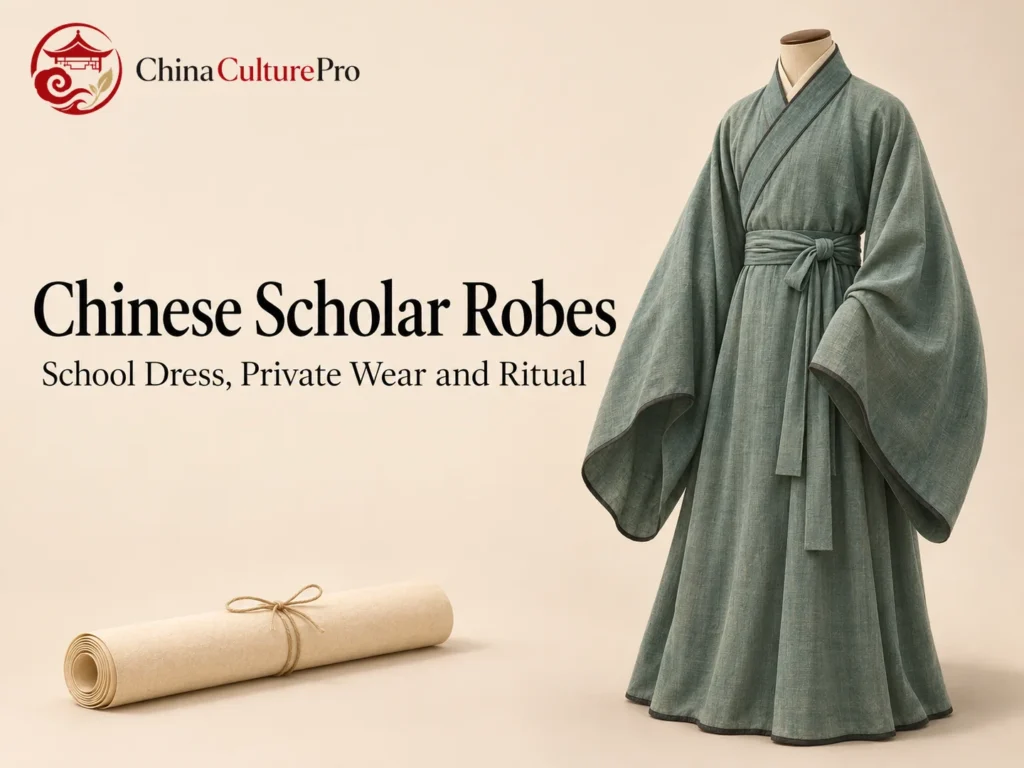

Quick Answer: What Are Chinese Scholar Robes?
Chinese scholar robes cover several forms associated with educated men. In the Ming, a school regulation, a private gathering and a classical rite could each call for a different reading of the clothes.[1][2][3][4]
- School dress: The lanshan (襕衫, lánshān) had an association with students and scholars.[1][2]
- Private wear: The daopao (道袍, dàopáo) was a wrapped robe that also appeared in some formal settings.[3]
- Ritual dress: The shenyi (深衣, shēnyī) was interpreted from classical texts.[4]
Read the garment’s cut alongside the date and occasion.

Lanshan: Banded Robes and School Dress
The lanshan’s name refers to a band. The form was associated with scholars from the Tang through the Ming, though bands could appear on other robes too.[1]
The Ming history records a student robe made of pale jade-coloured cloth or silk, with broad sleeves and dark edges. Its dress prescription includes a soft headcloth.[2]
Daopao: A Wrap Robe With More Than One Setting
The front crosses to the wearer’s right. Slits at the sides and inner fabric flaps help identify the cut in a surviving daopao from the Confucius family collection.[3]
Ming scholar and official Xu Xianqing’s illustrated biography includes the banquet that followed his 1568 success in the highest civil examination.[5]
The image records a specific celebration. For a court scene, compare the headwear and any insignia with period examples of official dress. The daopao itself could carry a badge in some circumstances, so a wrap front alone gives an incomplete reading.[3]
Shenyi: Reconstructing a Ritual Robe
Classical writings described the shenyi. Later scholars disagreed about how to turn the words into a pattern. Huang Zongxi and Jiang Yong offered different readings of the construction.[4]
Wearing a Scholar-Style Robe Today
Start with a dated image or garment that fits the setting you want to evoke. Compare the silhouette and any literati headwear, then ask for a photograph of the open robe if the front overlap matters. With the robe on, reach forward at table height to see how the sleeves fall and check that the hem clears your shoes.
FAQs About Chinese Scholar Robes
Did All Scholars Wear the Same Robe?
Students had prescribed clothes in some settings. The same educated man could wear different garments in private life, at a ritual or in office.[2][3][4]
Does a Broad Sleeve Identify a Scholar?
Broad sleeves appear in more than one robe form. The collar, lower band or seam, and surrounding dress provide additional clues.[1][2][4]
Is a Daopao a Ritual Shenyi?
The two names have different histories. The daopao can be identified from its surviving Ming cuts, while the ritual shenyi also has a history of textual reconstruction.[3][4]
Sources
[1] National Museum of China. Robes With Applied Bands and the Lanshan
[2] History of the Ming. Dress Regulations for Scholars and Students
[3] Guo Zheng. Dress in the Confucius Family Collection
[4] Minghui Hu. The Scholar’s Robe: Material Culture and Political Power in Early Modern China
[5] The Palace Museum. Xu Xianqing Attends the Examination Banquet