

Quick Answer: What Is Chinese Palm-Fiber Weaving?
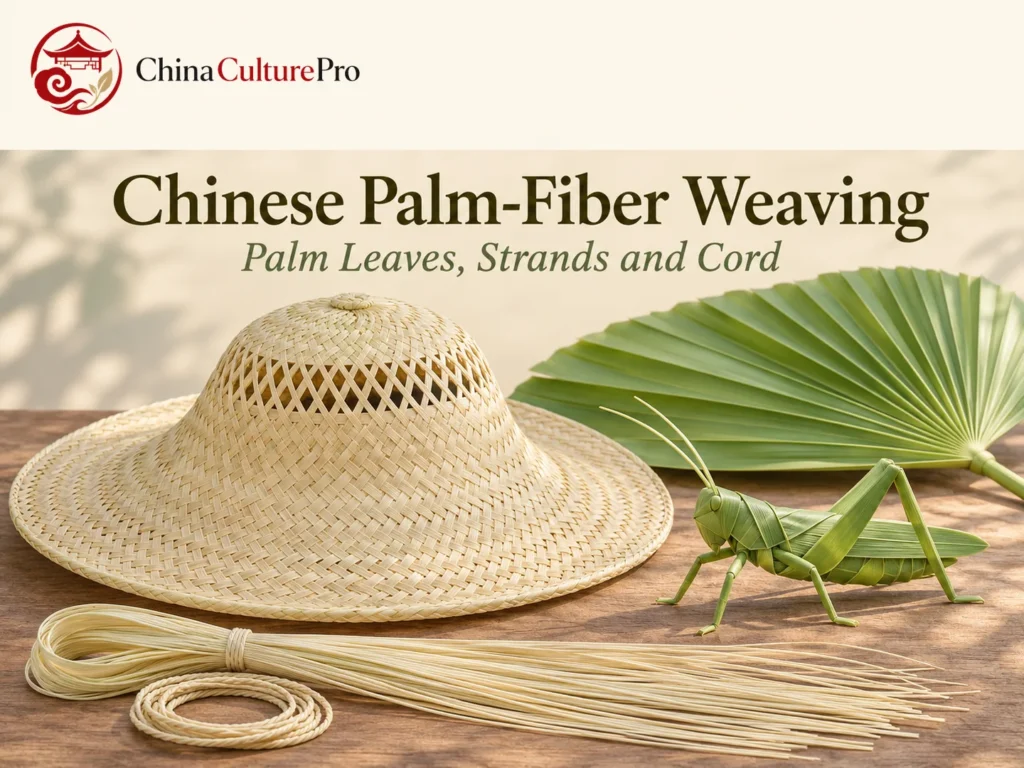
Chinese palm-fiber weaving (棕编, zōngbiān) uses pliable material from palms to make objects such as hats, sandals, bags and small figures. In Xinfan, Sichuan, artisans split tender palm leaves into fine strands. In Changsha, some figures are folded and tied from leaf strips. In Songyang, palm fibers can be spun into the cord used to weave a bed surface. [1][2][3]
- Strands: Fine split leaves can form a close or open weave.
- Strips: Wider leaf pieces can fold around the body of a small figure.
- Cord: Spun fiber can stretch across a wooden frame. [1][2][3]
Start by looking at the shape of the material between the crossings. [1][2][3]

A small palm-leaf grasshopper and a woven hat can begin with similar leaves. In one object a fold gives an insect its angled leg. In another, many fine strands build a continuous surface. The choice between a broad strip and a fine strand changes what the finished piece can do.
How the Palm Material Is Prepared
The national heritage account for Xinfan describes combing tender green palm leaves into narrow strands. Some strands are twisted into cord and dried as part of the preparation. Makers can work with pale material or dye part of it to add detail. Combing gives the maker long, flexible elements that can cross like threads. The preparation leaves a different working material from a wide strip folded as one piece. [1]
Wider leaf strips can retain a flat shape as they fold. In Changsha, weaving can combine folding, threading and tying to build a petal, wing or leg. Coarse palm fibers used for Songyang bed cord are handled differently. They are combined into a strand that can be drawn taut on a frame. [2][3]
Three Patterns in Xinfan Weaving
In Xinfan’s pepper-eye weave (胡椒眼, hújiāoyǎn), crossings outline regular diamond-shaped openings. The openings make the surface look like a small lattice. In a close weave, the same narrow kind of material can instead give the viewer a more continuous surface. The heritage register also describes a dense weave with closely repeated crossings, used for pieces such as shoes and fans. [1]
In a third method, diagonal strands create a repeated chevron, often used on hats and mats. This changes the direction the eye follows across the surface. A maker can choose a close weave for an even face or use repeated openings to break up the field. The register describes palm-leaf sandals in Xinfan by the late Jiaqing reign and later production of hats and bags. [1]
Palm Leaves in Changsha and Palm Cord in Songyang
The Hunan culture department documents Wang Zhongping’s palm leaf work in Changsha. Her repertoire includes insects, flowers and birds. The account describes her planning the pattern of a woven crane before making it. In her documented crane, the body gives the folded figure volume, while a narrower form makes the neck readable. The profile credits her with adapting plant material to birds as well as smaller forms such as insects. [2]
In Songyang, Zhejiang, a palm-cord bed (棕绷, zōngbēng) uses a net of tightly drawn cord inside a wood frame. A report on maker Huang Weibing describes spinning and combining the fiber, then crossing and tensioning the cords. The frame holds the ends in place. The cords cross one another across the opening, so the weave becomes a surface that spans the frame. [3]
How the Craft Is Passed On
Xinfan palm-fiber weaving, from Chengdu’s Xindu district, entered China’s national heritage list in 2011. It was the subject of a field visit during a Chengdu heritage workshop in 2014. A later report documents its practitioners joining artisans in related weaving traditions at a 2018 event. [1][4][5]
The Hunan account describes Wang Zhongping teaching at Hunan Women’s University and giving training at a Changsha heritage exhibition hall. In those classes and demonstrations, a finished object can be examined alongside the strips and folds that give it shape. The material and the movement of the maker’s hands are both part of what gets passed on in Chinese traditional crafts. [2]
FAQs About Chinese Palm-Fiber Weaving
Do all palm-fiber objects use thin strips of leaf?
Materials vary with the object. The Xinfan tradition uses fine split leaf strands, and a woven bed frame can use cord spun from palm fiber. [1][3]
Why are some pieces green and others pale?
Fresh palm leaves are green. The Xinfan account describes treatments that produce a pale material, as well as dyeing selected strands to make colored details. [1][2]
Is palm-fiber weaving the same as straw plaiting?
They can use similar crossing or plaiting motions. Xinfan makers use palm leaves, while Laizhou straw plaiting uses wheat stalks. The fibers and the objects made from them differ. [1][6]
Sources
[1] China Intangible Cultural Heritage Digital Museum. Xinfan Palm-Fiber Weaving
[2] Hunan Provincial Department of Culture and Tourism. Wang Zhongping, Inheritor of Changsha Palm Leaf Weaving
[3] Wang Qingli and Zhu Shaozhen, Zhejiang Online. A Palm-Cord Bed Maker in Songyang
[4] China Intangible Cultural Heritage Digital Museum. Chengdu Traditional Crafts Workstation
[5] International Training Centre for Intangible Cultural Heritage in the Asia-Pacific Region. Intangible Cultural Heritage Workshop in Chengdu
[6] China Intangible Cultural Heritage Digital Museum. Laizhou Straw Plaiting