


Quick Answer: What Makes a Korean Word Sino-Korean?
A Sino-Korean word belongs to a vocabulary layer built from Chinese-character elements and used with Korean readings. The category includes inherited borrowings and compounds formed in Korea or transmitted through Japan.[1]
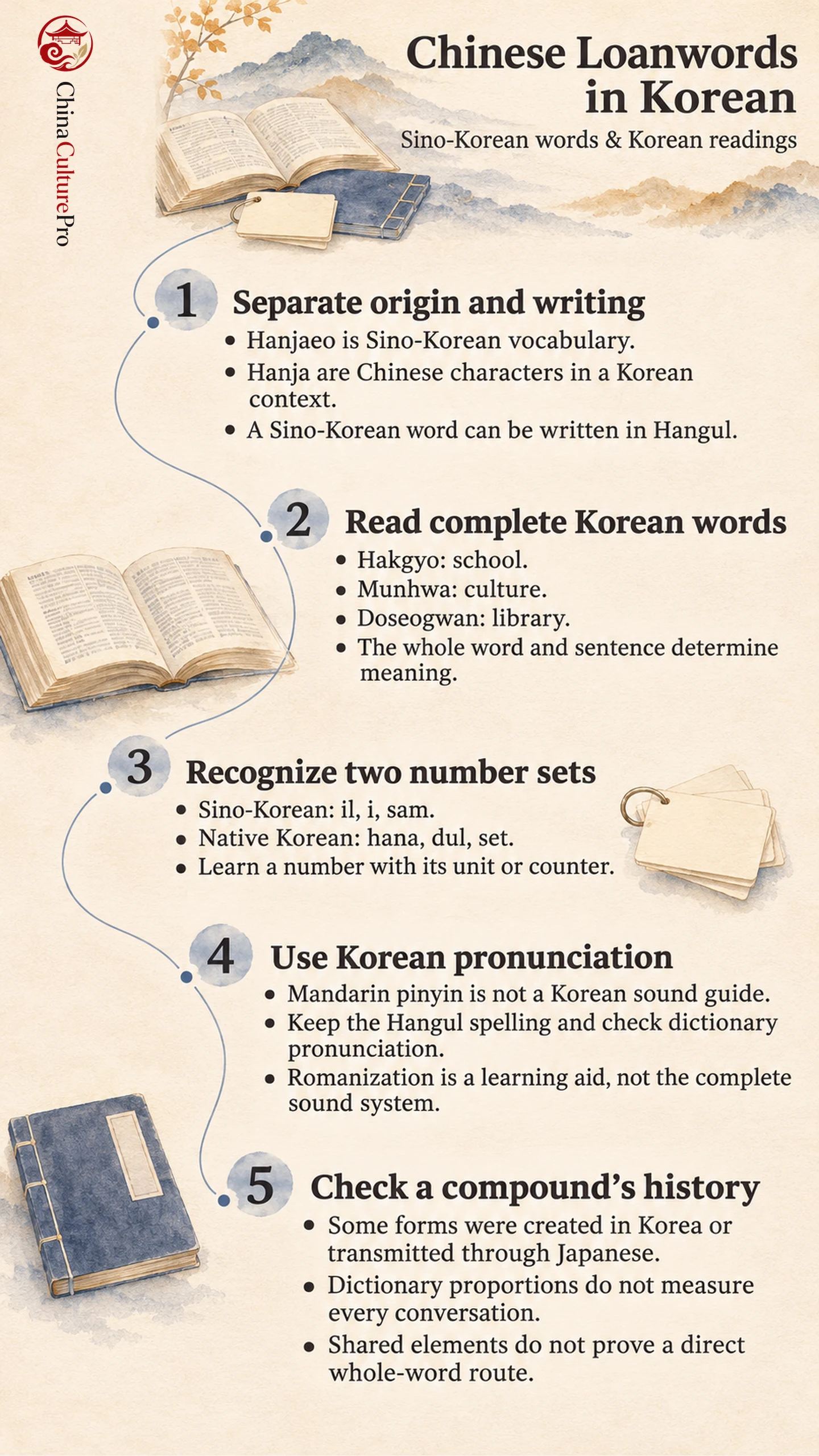
- Origin is not script: A Sino-Korean word can be written in Hangul.[2]
- Sound is Korean: Mandarin pinyin does not provide the Korean pronunciation.[6]
- Context still matters: Shared written elements do not establish the full meaning or history of every compound.[1]
Use the Korean word in its Korean sentence, then consult its character background when that helps.
An English-speaking learner may recognize a familiar Chinese character behind a Korean word yet hear a very different sound. The connection is real, but the modern languages have different pronunciation systems and vocabulary histories.
This guide focuses on recognizing the connection without treating Korean as a form of Chinese. It is a vocabulary guide rather than a complete Korean pronunciation course.
Separate Sino-Korean Vocabulary from Its Written Form
Hanjaeo (漢字語; hàn zì yǔ in Mandarin) means Sino-Korean vocabulary. Hanja (漢字; hàn zì in Mandarin) means Chinese characters used in a Korean context. The Mandarin readings identify the character forms; they are not Korean readings of the terms.[1]
Hangul is the Korean alphabet, and Sino-Korean words are commonly written with it. Changing the visible script does not change a word’s history. The Chinese characters guide supplies background on the shared writing tradition, not a replacement Korean alphabet.[2]
Record the spelling, spoken form and origin separately.
Read Three Everyday Word Examples
The romanizations below identify Korean forms. The character column supplies the relevant written elements; no claim is made here about the exact date or place when each complete modern expression was coined.
| Korean form and romanization | Character form | Meaning |
|---|---|---|
| 학교, hakgyo | 學校 | School. |
| 문화, munhwa | 文化 | Culture. |
| 도서관, doseogwan | 圖書館 | Library. |
The school example is a dictionary-confirmed Sino-Korean noun, not Mandarin xuéxiào pronounced with a different accent.[3]
The culture and library entries likewise combine a Korean word with a documented character form. The short English gloss helps identify the word; a fuller sentence may require a more specific interpretation.[4][5]
Do not translate a passage by replacing every visible syllable with a separate dictionary meaning. The complete word and its sentence remain the main reading units.
Recognize the Two Number Systems
Korean has both a Sino-Korean number set and a native Korean number set. The first three illustrate the coexistence of inherited Chinese-connected vocabulary and native forms.[2]
| Number | Sino-Korean / native Korean forms |
|---|---|
| 1 | 일, il / 하나, hana |
| 2 | 이, i / 둘, dul |
| 3 | 삼, sam / 셋, set |
The dictionary labels 일, il, meaning one, with the character 一. That does not mean every occurrence of the Hangul spelling 일 has the numeral meaning: the sentence and dictionary entry must agree.[7]
The sets are not freely interchangeable. Learn each number with its unit or counter; this table identifies vocabulary layers rather than rules for every counting expression.[2]
The Chinese number-reading guide covers the donor language’s modern system, which is a separate learning task.
Use Korean Pronunciation Rather Than Mandarin Pinyin
Korean romanization represents Korean sounds under its own conventions. It is not a translation into pinyin, and an English reader should not interpret its letters by Mandarin sound rules.[6]
The school word is conventionally romanized hakgyo, while its dictionary pronunciation is shown as 학꾜. The pronunciation field and audio are useful precisely because a learner may not recover the full spoken form from a familiar-looking written component.[3]
A romanization is an aid to learning the Korean word, not a substitute for learning Korean sound patterns. Keep the Hangul spelling with the word and check the dictionary’s actual pronunciation information.[6]
Check the Full Word’s History and Meaning
Sino-Korean vocabulary includes words inherited from Chinese use, compounds created in Korea and formations that came through Japanese. A character-based construction does not by itself settle which route a particular word followed.[1]
The related Chinese loanwords in Japanese guide helps distinguish a shared written element from a whole-word borrowing. Chinese loanwords in Vietnamese follows another adaptation history, with its own sounds and usage.
Also separate dictionary composition from ordinary speech. A high share of Sino-Korean entries in a dictionary is not a measurement of the words used in every conversation. The result depends on what is counted and on the register being examined.[2]
FAQs About Chinese Loanwords in Korean
Does writing a word in Hangul make it native Korean?
No. Hangul can write Sino-Korean vocabulary as well as native words. Script identifies the visible writing, while a word’s origin requires separate evidence.[2]
Is a Sino-Korean reading the same as Mandarin pronunciation?
No. The Korean word has Korean sounds. A Mandarin reading of related characters can help identify the written connection but does not tell you how to pronounce the Korean form.[6]
Are all Sino-Korean compounds direct loans from China?
No. The category also includes Korean-made formations and words transmitted through Japanese. Trace the complete expression rather than assuming that Chinese-character elements prove a direct route.[1]
Sources
[1] Academy of Korean Studies, Lee Yong-ju. 한자어
[2] National Institute of Korean Language. Everything You Wanted to Know about the Korean Language
[3] National Institute of Korean Language, Korean Basic Dictionary. 학교
[4] National Institute of Korean Language, Korean Basic Dictionary. 문화
[5] National Institute of Korean Language, Korean Basic Dictionary. 도서관
[6] National Institute of Korean Language. Romanization of Korean
[7] National Institute of Korean Language, Korean Basic Dictionary. 일 (一/壹)