

Quick Answer: What Are Chinese Jade Mountain Carvings?
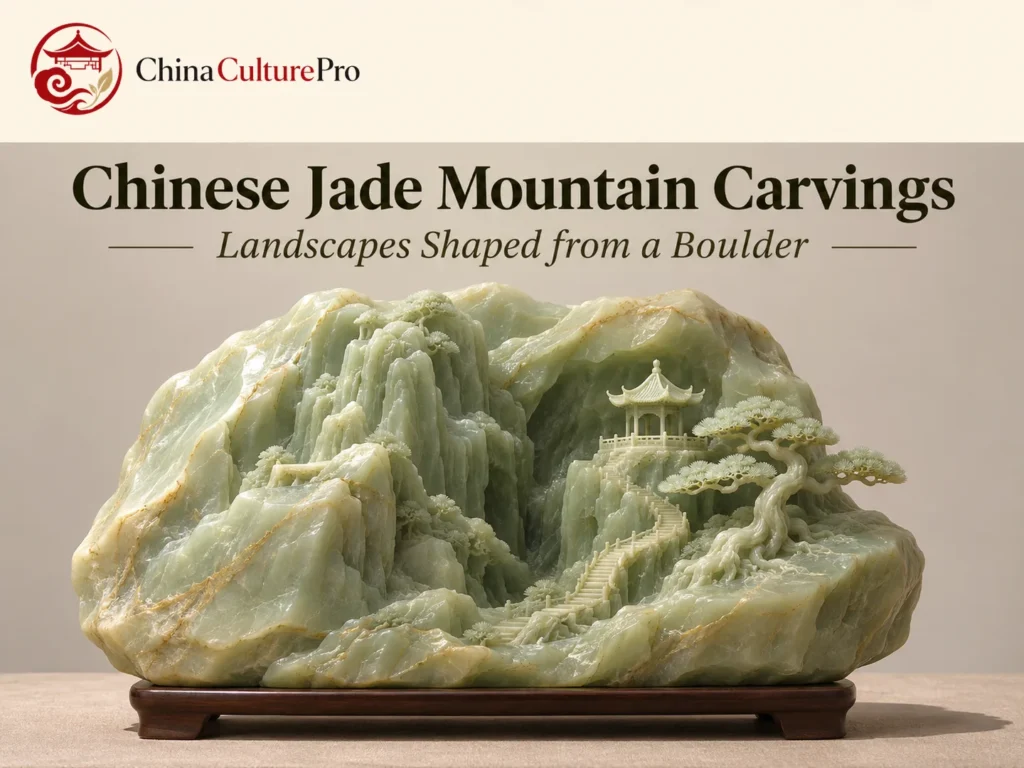
Chinese jade mountain carvings (玉山子, yùshānzǐ) are three-dimensional stone landscapes. Carvers work into a single block of jade to create peaks, cliffs, water, trees or buildings. Some are small enough for a shelf or desk. Others were commissioned on a scale that required several years of work. [1][3][5][8]
- Material: The shape and colors of a boulder help guide the landscape.
- Depth: Recesses and relief let rocks, paths and figures sit at different levels.
- Viewing: A second face may carry another scene, a poem or a seal inscription. [1][2][3]
Look around the sides before assuming that the front contains the whole scene. [1][3]

Follow a stairway carved into jade. A few steps may lead to a cave or pavilion before the route disappears behind a ridge. What would be an ink wash or blank space in a landscape painting can become a recess, shadow or change of stone color here.
How a Boulder Becomes a Landscape
The outline of the boulder sets some of the limits of the composition. A high edge can become a ridge. The broadest face may offer space for the scene, and a naturally narrow area can help set the position of a ravine. In Chinese jade carving, abrasives remove stone in stages. Deep cuts can establish cliffs and recesses, while finer lines give a roof, stair or tree its smaller details. [1][6][8]
The makers of the Palace Museum’s Travelers in Autumn Mountains worked with a 130-centimeter block. The project began in Beijing and was completed in Yangzhou by 1770. Its raw stone had many visible fissures and pale yellow patches. The museum explains how makers shaped the irregular areas into broken cliffs and used the yellow to suggest late autumn vegetation. Using the natural color to place part of the design is known as qiaose (巧色, qiǎosè). [2][8]
How to Read the Scene on More Than One Side
On a jade mountain at the National Museum of China, one face shows an older figure in a pavilion and a young attendant carrying a tray. Steps lead toward a cave, with flowing water below. Turn to the other side and the landscape includes cranes, deer and pine. The stairs direct the eye into the first scene. The cranes and deer set a different focus on the other face. [1]
A different Qing boulder at the Met depicts a Daoist paradise with immortals, cranes and deer among trees, water and rock. A pavilion and a peach tree give the viewer two places to pause, while clouds near the crest carry the eye higher. Here the landscape sets the scene for the figures. In another work, people might be travelers or participants in a remembered story. [1][2][4]
Yu the Great and the Scale of Court Workshops
The Palace Museum records a jade mountain 224 centimeters high depicting Yu the Great controlling the waters. Its boulder came from the Hotan region of Xinjiang. The Qianlong emperor selected a painting in the imperial collection as the basis for the scene. The palace workshop prepared drawings and a wooden model for the carving in Yangzhou. [3][8]
According to the museum, the stone went to Yangzhou in 1781 and the sculpted landscape was completed in 1787. In 1788 the court assigned the work of engraving an imperial poem and seals. The museum describes the poem on the back and inscriptions on more than one face. These additions followed the carving of the landscape, even though they now occupy the same block. [3]
The Craft in Yangzhou Today
Yangzhou jade carving entered China’s national intangible cultural heritage list in 2006. Its entry describes choosing a subject and working method in response to the material. That principle applies to small carving and to boulder work, where changes in color, width and thickness can become part of the setting. [2][6]
The register identifies Xue Chunmei, who studied with Gu Yongjun, as a representative practitioner. Her profile documents work on figures and carved boulders. Both kinds of carving call for attention to proportion. In a boulder landscape, a small figure beside a tree or cliff can also give the viewer a sense of the scale of the setting. [6][7]
FAQs About Chinese Jade Mountain Carvings
Are all jade mountain carvings monumental?
They vary widely in size. The Cleveland Museum of Art has a Qianlong-period miniature mountain measuring 17.5 centimeters overall. The Palace Museum’s Yu the Great carving measures 224 centimeters high. [3][5]
How does a jade mountain differ from a natural scholar’s rock?
A jade mountain has a landscape or related form worked into the stone. A carver can also deliberately echo the outlines and cavities of a scholar’s rock, as a Qianlong-period ornament at the Met shows. [1][9]
Do jade mountains always show an immortal’s paradise?
Daoist paradise is one subject. Other examples depict people traveling through mountains or Yu the Great directing work to control the waters. [2][3][4]
Sources
[1] National Museum of China. Jade Mountain with a Landscape and Figures
[2] The Palace Museum. Jade Mountain with Travelers in Autumn Mountains
[3] The Palace Museum. Jade Mountain of Yu the Great Controlling the Waters
[4] The Metropolitan Museum of Art. Boulder with Daoist Paradise
[5] Cleveland Museum of Art. Miniature Mountain with Daoist Paradise
[6] China Intangible Cultural Heritage Digital Museum. Yangzhou Jade Carving
[7] China Intangible Cultural Heritage Digital Museum. Representative Practitioner: Xue Chunmei
[8] Mingying Wang and Guanghai Shi, Gems & Gemology. The Evolution of Chinese Jade Carving Craftsmanship
[9] The Metropolitan Museum of Art. Rock-form Ornament with Poem Composed by the Qianlong Emperor