

Quick Answer: What Is Chinese Grass Weaving?
Chinese grass weaving (草编, cǎobiān) uses pliable plant material to make objects such as mats, hats, baskets and slippers. The material can include wheat stalks, local yellow grass or stems from grasslike plants. Some makers weave a broad surface from crossing elements. Others first make a narrow braid and join lengths of it to build the object. [1][2][4][7][8]
- Material: Local plants supply stalks or other pliable parts.
- Structure: Crossed strands can form a sheet or a narrow band.
- Shape: A mat, hat or basket calls for different ways of arranging and finishing the material. [1][2][4][7][8]
To recognize the structure, follow a strand near the edge and see whether it crosses the whole piece or stays within one band. [7][8]

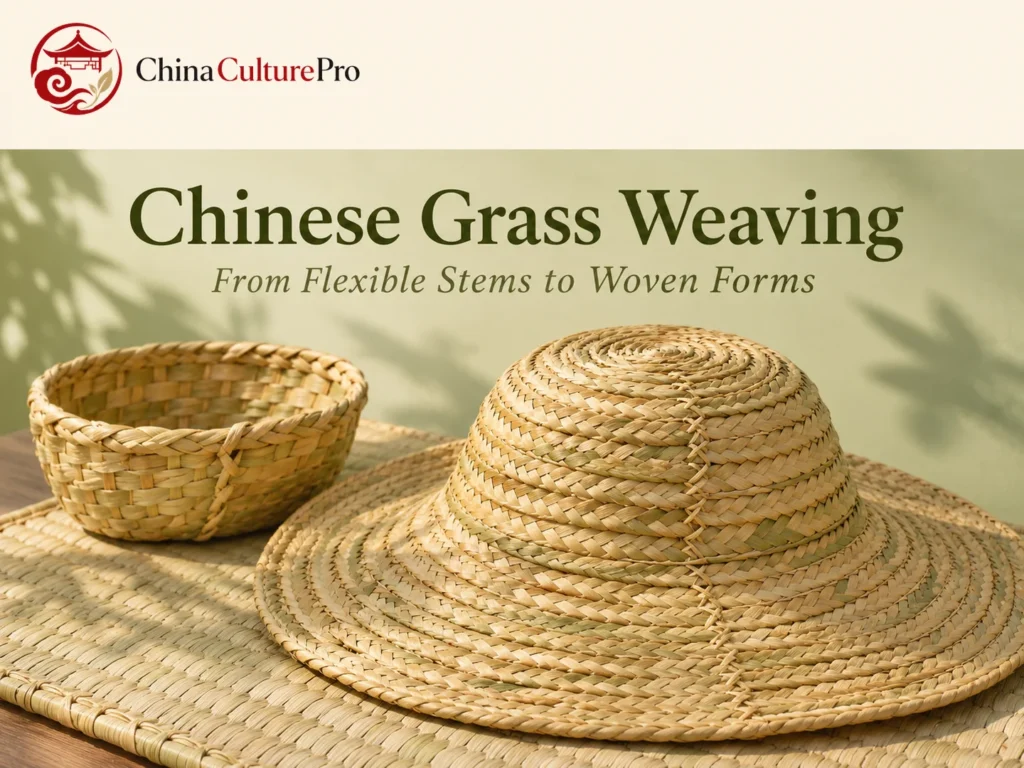
Look at the brim of a plaited straw hat and you may be able to trace one band around it. On a woven mat, a single stem runs across many lengthwise threads. The direction of those lines is a clue to how each object was made.
Why the Plant Material Matters
In Shandong’s Laizhou, the national heritage register describes artisans working with wheat straw. In Shanghai’s Xuhang, makers use stems of locally grown yellow grass. The Shanghai account describes drying and sorting the harvested material and soaking or coloring it as needed. The Xuhang tradition makes fine patterns possible on objects as small as cup sleeves. [1][2][3]
Rush (蔺草, lìncǎo) is a grasslike plant material used in woven goods such as mats. It is associated with mat making around Huang Gulin in Ningbo. The word grass in the craft name includes some materials from plants that look like grasses. A named object’s material is best read from its local record or maker’s description. [1][5][6]
How Weaving and Plaiting Build Different Forms
A straw plait (草辫, cǎobiàn) is a narrow band made by interlacing several strands. In Laizhou, the register describes versions using three, five or seven strands. Changing how the strands cross changes the pattern of the band. A maker can see each pattern in the edge and center of a sample, before any plait has been turned into a hat or sewn to another band. The pattern repeats along the strip. That narrow unit can be made separately from the final object, which is one reason plaits could be traded on their own. [1][7]
Daming artisans have long made both hats and the plaits used for them. When plaits are stitched together into a hat, the join leaves rows that can follow the crown and brim. In the Ningbo mat, rush stems cross lengthwise threads. An account of the handloom describes two makers working together, one feeding the rush and the other pressing it into place. On the mat, follow a rush stem across the warp. On the hat, follow the seam that separates one turn of plait from the next. [7][8][9]
Four Local Traditions to Compare
Two regions can use wheat straw and still be known for different forms of work. Laizhou’s heritage entry emphasizes making plaits, while Daming’s emphasizes finished household objects. Xuhang and Huang Gulin illustrate how other plants serve different purposes. In Xuhang the fine stems can take color, while Huang Gulin weavers work the rush into a broad surface that lies flat. [1][2][4][5][8]
| Place | Documented material | Example or feature |
|---|---|---|
| Laizhou, Shandong | Wheat straw | Narrow plaits in several strand counts. [1] |
| Xuhang, Shanghai | Local yellow grass | Fine woven slippers, bags and cup sleeves. [2] |
| Daming, Hebei | Wheat straw | Plaited hats and baskets. [4] |
| Huang Gulin, Ningbo | Rush | Flat handwoven mats with lengthwise warp. [5][8] |
How Weavers Pass On the Skill
The Daming account describes school lessons and small objects adapted from existing patterns. A miniature hat, for example, can use a familiar shape at the scale of a hair clip. The same account describes using woven material to make opera-mask designs. Those adaptations give students different ways to work with the straw already used for hats and baskets. [4][7]
In Ningbo, reporting documents mat weaver Zheng Renju and a teaching and exhibition space in Zhongyi Village’s cultural hall. Huang Gulin mat weaving entered Zhejiang’s provincial heritage list in 2009. The loom in a teaching space shows the arrangement of the material that a finished mat can conceal. The link between a finished object and its equipment is part of what these workshops preserve in Chinese traditional crafts. [5][8]
FAQs About Chinese Grass Weaving
Is Chinese grass weaving always made with wheat straw?
Wheat straw is used in traditions such as Laizhou and Daming. Xuhang uses local yellow grass, and Huang Gulin mat makers use rush. [1][2][4][5]
How can you recognize a plaited straw hat?
Look for narrow braided bands joined in rows. On hats assembled this way, the join between two bands follows a different line from the pattern inside each band. [7][9]
What kind of grass is used for woven mats?
Some Chinese mat traditions use rush. Huang Gulin in Ningbo is a documented example. The plant used depends on the local craft and the object. [1][5][6][8]
Sources
[1] China Intangible Cultural Heritage Digital Museum. Laizhou Straw Plaiting
[2] China Intangible Cultural Heritage Digital Museum. Xuhang Grass Weaving
[3] Shanghai Municipal Government. Xuhang Yellow Grass-Weaving
[4] China Intangible Cultural Heritage Digital Museum. Daming Grass Weaving
[5] Haishu District Government. Huang Gulin Mat Weaving in Zhongyi Village
[6] Getty Research Institute. Art & Architecture Thesaurus: Rush
[7] Geng Jiankuo, Chen Yuanqiu and Zhou Jinli, Guangming Daily. Daming Grass Weaving in Practice
[8] Liao Huilan, China Ningbo Net. Huang Gulin’s Handwoven Mats
[9] Coggeshall Museum. Straw Plaiting