


Quick Answer: What Is Siu Yuk?
Siu yuk (烧肉, Mandarin pinyin: shāoròu) is Cantonese roast pork prized for crisp skin above layers of fat and meat. A skin-on pork-belly slab makes a practical home version.[3]
- Choose: Whole skin-on belly, not thin bacon-style slices.
- Prepare: Keep meat seasoning off the skin and dry the surface in the refrigerator.
- Roast: Cook the meat, then finish the skin with carefully controlled heat.[3]
The method below uses a removable salt crust; that is one approach, not a requirement for every siu yuk recipe.
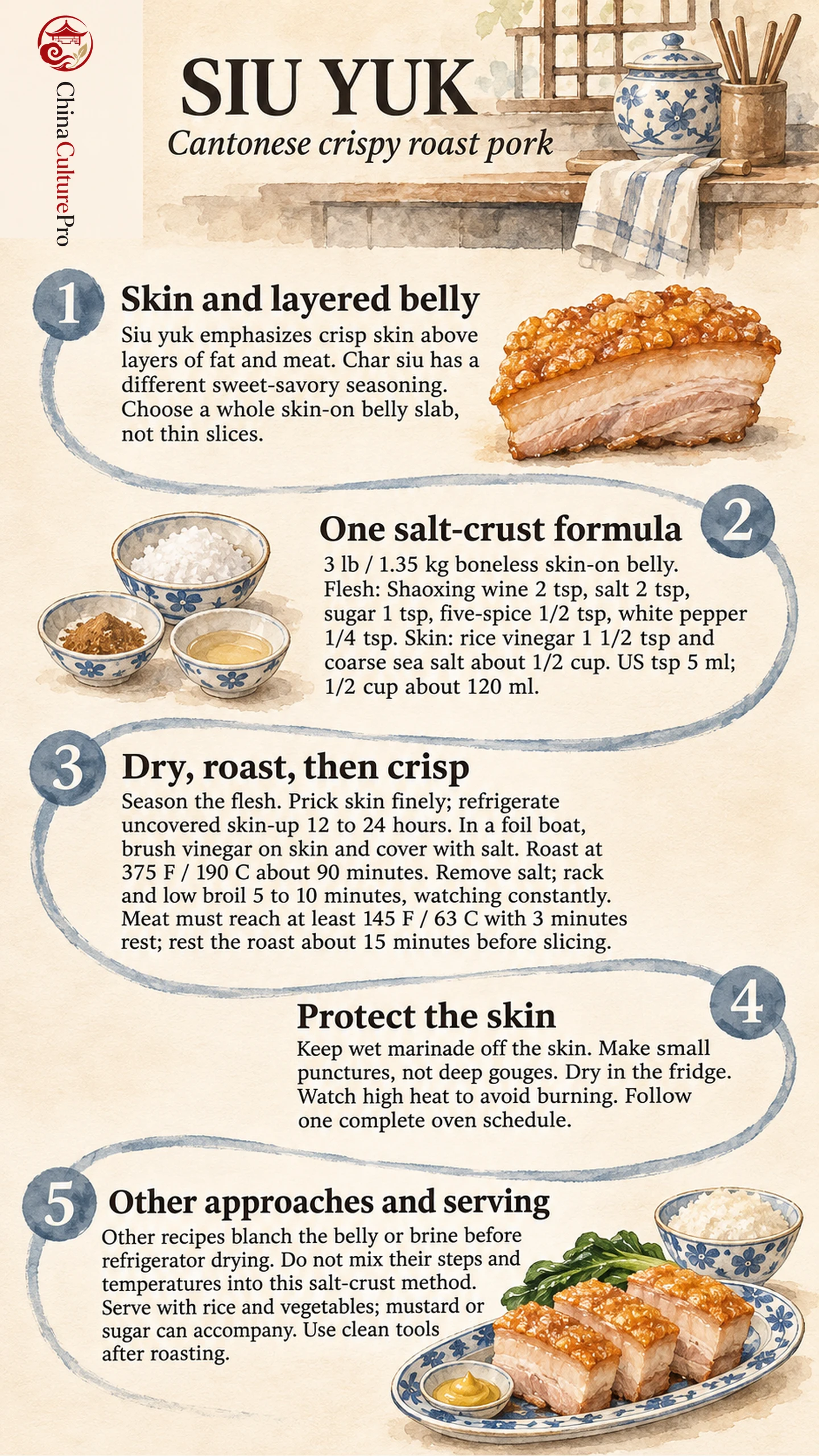
The defining contrast is a crackling top over tender, layered pork. A slab with a dark, hard skin has not necessarily achieved the same result. Successful preparation starts before the oven, with enough refrigerator space and time for the surface to dry.
Cantonese Roast Pork and the Char Siu Difference
Siu yuk is part of siu mei (烧味, Mandarin pinyin: shāowèi), the roast meats of Cantonese cuisine.[6]
Compare char siu (叉烧, Mandarin pinyin: chāshāo): its sweet-savory seasoning differs from siu yuk’s emphasis on layered belly and crisp skin.[2]
Ingredients and Equipment for a Salt-Crust Version
For a home slab serving roughly six to eight as part of a meal, prepare the following. Teaspoons are 5 ml; the half-cup measure is approximately 120 ml by volume.
- Pork: 3 lb/1.35 kg boneless, skin-on pork belly.[1]
- Meat seasoning: 2 teaspoons Shaoxing cooking wine (绍兴料酒, Shàoxīng liàojiǔ), 2 teaspoons salt, 1 teaspoon sugar, ½ teaspoon Chinese five-spice (五香粉, wǔxiāngfěn) and ¼ teaspoon white pepper.[1]
- Skin treatment: 1½ teaspoons rice vinegar and about ½ cup coarse sea salt, enough for an even covering.[1]
Use a sharp metal skewer, heavy foil, a rimmed roasting tray, a rack and a food thermometer. Choose a slab that fits the equipment and has an intact skin; thinly sliced pork cannot provide the same roasting surface.[2]
How to Make Siu Yuk in a Home Oven
Start the day before. This sequence uses a conventional oven followed by its broiler; check the appliance’s instructions for broiling and safe rack positions.
- Season the meat: Pat the pork dry. Rub wine and the mixed dry seasonings onto the flesh, keeping the skin clean.[3]
- Prick and dry: Prick skin finely without gouging the meat; refrigerate uncovered, skin-up, for 12–24 hours.[1][4]
- Roast under salt: Heat the oven to 375°F/190°C. Set pork skin-up in a snug foil boat on the tray, with a raised border. Brush skin with vinegar, cover evenly with coarse salt and roast about 90 minutes.[1]
- Crisp the skin: Remove the salt crust and unfold the foil. Place pork on the rack over the tray. Broil on low, well below the element, watching constantly; allow roughly 5–10 minutes for puffing.[1]
- Check, rest and cut: Verify the meat has reached at least 145°F/63°C; allow at least three minutes before carving or eating. This minimum is a safety threshold, not a guarantee of tender belly. Rest the roast about 15 minutes, then cut into serving pieces.[1][5]
Times are guides: slab thickness and oven behavior change the result. Keep the final high-heat stage under observation instead of walking away while the surface colors.
Why the Skin Stays Soft or Turns Hard
- Wet skin: Marinade belongs on the flesh. Surface moisture and insufficient refrigerator drying work against a crisp finish.[2][3]
- Too few careful punctures: Prepare the skin evenly. Make small holes rather than large slashes into the layers underneath.[4]
- Heat without control: A high-temperature finish can burn before the whole surface becomes golden and bubbly. Watch the skin rather than assuming a darker color means better crackling.[3]
Toaster-oven and full-size-oven recipes can use different settings. Follow one complete schedule instead of swapping isolated temperatures.[2]
Other Methods and Serving Styles
Beyond the salt-crust version above, two other home approaches manage the skin differently:
- Blanched-belly method: Briefly blanch, clean and puncture the skin, season the meat, wipe away moisture drawn out by salt, and refrigerate before roasting.[2]
- Brined and air-dried method: Brine the belly, marinate the flesh while drying the skin in the refrigerator, then use a staged oven finish.[3]
In Hong Kong food culture, roast pork can form a rice-box meal with vegetables. Mustard or sugar may accompany the pork; another serving option pairs mustard with hoisin sauce.[2][3]
After roasting, use a clean board and utensils. Crispy skin and a salty surface do not prevent contamination introduced during chopping or make prolonged room-temperature display safe.[6]
FAQs About Cantonese Roast Pork
Must I blanch the pork first?
Not for the salt-crust method above; other workflows blanch first.[2]
Can I skip the overnight drying?
That changes an important preparation stage. Plan the refrigerator drying ahead rather than leaving raw pork on the counter to dry.[2][7]
Do I eat the salt crust?
No. Remove it before the final crisping stage in this method.[1]
How do I store leftovers?
Chill promptly in shallow containers within two hours, or one hour above 90°F/32°C. Keep at 40°F/4°C or below, use cooked pork within three to four days, and reheat to 165°F/74°C.[7][8]
Sources
[1] Sarah Leung / The Woks of Life. Cantonese roast pork belly
[2] Chung Sun Lau / Made With Lau. Crispy pork belly: Siu yuk
[3] ArChan Chan / SBS Food. Crispy skin pork
[4] Yi / Yi Reservation. Crispy pork belly
[5] USDA Food Safety and Inspection Service. Is pork safe to eat?
[6] Hong Kong Centre for Food Safety. Siu mei and food safety
[7] Centers for Disease Control and Prevention. Preventing food poisoning
[8] USDA Food Safety and Inspection Service. How long to keep meat in the refrigerator