


Quick Answer: What Is the Beijing Dialect?
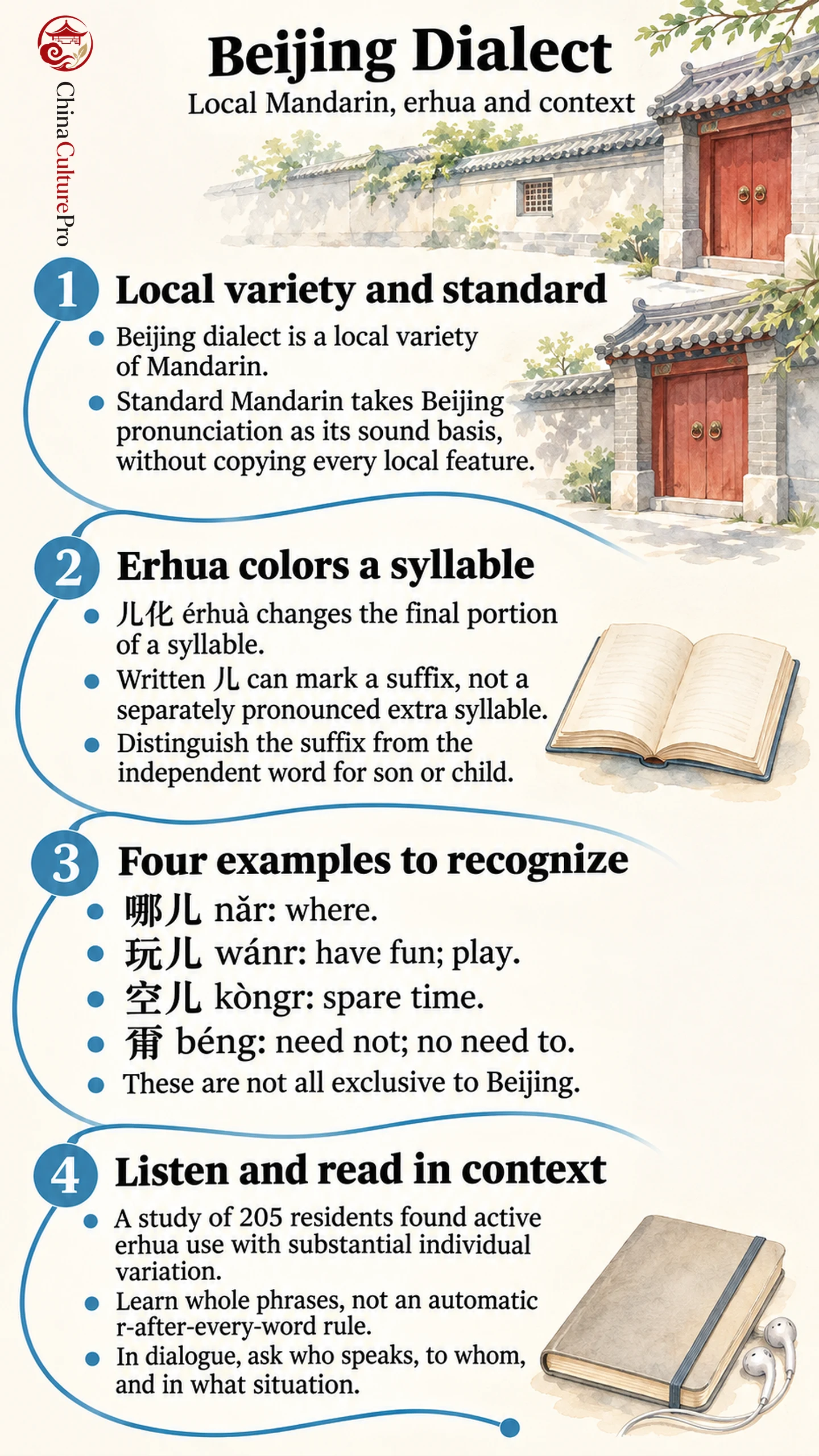
The Beijing dialect (北京话, Běijīnghuà) is a local variety of Mandarin associated with urban Beijing speech.[1]
- Relationship: Standard Mandarin uses Beijing pronunciation as its phonological basis, but does not reproduce every local feature.[1][2]
- Sound: Rhotacized endings are a conspicuous feature of local speech.[1]
- Variation: Individual speakers differ; one exaggerated accent cannot represent everyone.[6]
Read it as a living regional variety within the wider landscape of Chinese languages and dialects.
Beijing-flavored dialogue can feel familiar to a Mandarin learner while containing unfamiliar words or endings. Separate three tasks: understanding the vocabulary, hearing how a syllable changes, and recognizing the social setting of the speaker.
Beijing Speech and Standard Mandarin
Putonghua (普通话, Pǔtōnghuà), the standard language in mainland China, is defined with Beijing pronunciation as its sound norm, northern varieties as its dialectal base, and exemplary modern vernacular writing as its grammatical norm.[2]
That definition is broader than copying any one resident’s everyday speech. Local patterns of neutral tone and rhotacization can differ from the standard.[1] Listen for local features within otherwise familiar Mandarin.
For a different kind of comparison between Chinese varieties, see Mandarin versus Cantonese.
Erhua: More Than Adding an Extra Syllable
Erhua (儿化, érhuà) is rhotacization of a syllable’s final portion. Written 儿 can represent a suffix that colors the preceding syllable rather than a separately pronounced extra syllable.[1] In pinyin, the attached r helps signal this relationship.
This suffix must be distinguished from the independent word 儿 referring to a son or child.[1] Do not read every written 儿 as the same grammatical item, or assume the suffix always means “small”.
Examples to Recognize in Conversation
These examples occur in Beijing-associated or northern Mandarin contexts; they are not all exclusive to the city.
| Expression | Basic meaning | Reading clue |
|---|---|---|
| 哪儿, nǎr | Where | A location question; the r belongs to the written word’s reading.[5] |
| 玩儿, wánr | Have fun; play | An activity or leisure context.[3] |
| 空儿, kòngr | Spare time | Available time, rather than an empty physical space.[3] |
| 甭, béng | Need not; no need to | A northern colloquial form historically combining 不用, “not need”.[4] |
Learn each expression in a complete phrase and check its tone pattern. Written characters and a short English gloss cannot convey every detail of natural delivery.
Reading Local Voice Without Stereotypes
A study of 205 Beijing residents found that erhua remained active in everyday conversation, with substantial individual differences; age and education were among the factors associated with usage.[6] That finding supports expecting variation rather than treating one performance as the city’s only voice.
In written dialogue, ask who is speaking, to whom, and in what situation. Local wording can help establish voice, but a few visible endings do not describe a person’s entire identity. Use a dictionary for unfamiliar expressions and recordings for the sound of whole phrases.
FAQs About the Beijing Dialect
Should I add an r sound to every word?
No. Learn established words and phrases. Rhotacization is a structured sound pattern, not a rule to append an extra syllable indiscriminately.[1][3]
Does every written 儿 mean “child”?
No. It may write an independent lexical item or a suffix affecting the preceding syllable’s pronunciation. Context distinguishes the functions.[1]
Are these words exclusive to Beijing?
No. R-suffixed forms also occur elsewhere in northern Mandarin, and 甭 is documented as a northern dialect form. Recognizing them does not prove a speaker’s birthplace.[3][4]
Sources
[1] Zhongshi Xu, University of California, Los Angeles. Choosing rhotacization site in Beijing Mandarin
[2] Ministry of Education, China. Overview of China’s spoken and written languages
[3] Julian K. Wheatley, MIT OpenCourseWare. Learning Chinese, Unit 5: final-r
[4] Ministry of Education, Taiwan. Revised Mandarin Chinese Dictionary: 甭
[5] Julian K. Wheatley, MIT OpenCourseWare. Learning Chinese, Unit 2: location expressions
[6] Wenwen Zhang and Xiaodong Huang. Variation and evolution of erhua words in contemporary Beijing dialect