
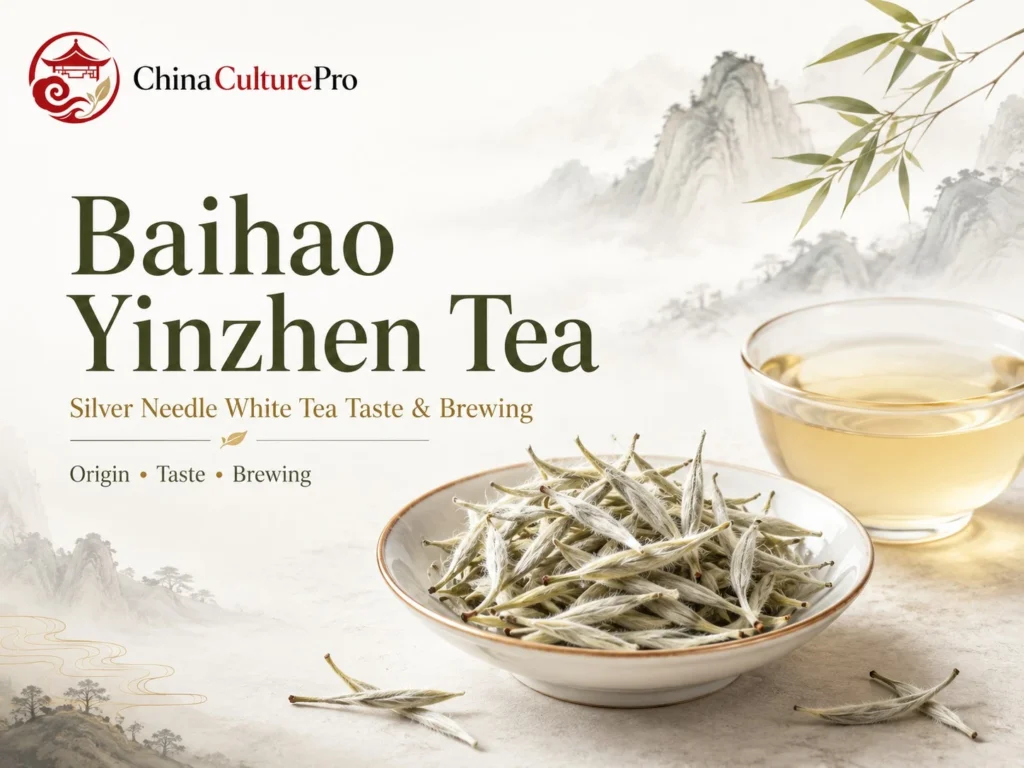

Quick Answer: What Is Baihao Yinzhen Tea?
Baihao Yinzhen Tea, also written as Bai Hao Yin Zhen, is a Chinese white tea made from single unopened tea buds. In English, it is commonly called Silver Needle White Tea, White Hair Silver Needle, or Chinese Silver Needle Tea.
It is not green tea, yellow tea, or a general name for every Silver Needle-style tea in the world. Traditional Baihao Yinzhen belongs to the Chinese white tea system, with the best-known core origins in Fuding and Zhenghe in Fujian Province.
The basic identity is clear:
Tea Type: Chinese white tea.
Chinese Name: 白毫银针.
Pinyin: Bai Hao Yin Zhen.
Common English Names: Baihao Yinzhen Tea, Silver Needle White Tea, White Hair Silver Needle.
Core Origins: Fuding and Zhenghe, Fujian, China.
Leaf Material: single unopened tea buds.
Appearance: fat buds, straight needle-like shape, dense white down, silver-white or silver-gray sheen.
Core Process: withering and drying, with no frying and no rolling.
Aroma: pure pekoe aroma, light floral notes, fresh hay, and sometimes gentle honey sweetness.
Liquor: pale apricot-yellow, pale yellow, clear, and bright.
Taste: fresh, mellow, clean, sweet, smooth, and delicate.
Brewing: usually best around 80–85°C / 176–185°F.
The value of Baihao Yinzhen is not strong aroma or heavy body. Its charm lies in single buds, dense white down, natural withering, and a cup that feels clear, fresh, sweet, soft, and refined.
To understand the broader category, read our [Chinese White Tea] guide.
Name, Tea Type, and Basic Identity
The name Baihao Yinzhen explains the tea’s appearance and identity.
| Term | Chinese | Meaning |
|---|---|---|
| Bai | 白 | white, referring to the visible white down on the buds |
| Hao | 毫 | fine white hairs or tea down on young buds |
| Yin | 银 | silver |
| Zhen | 针 | needle |
| Baihao Yinzhen | 白毫银针 | white-haired silver needle, named for its downy needle-like buds |
“Silver Needle” refers to the bud shape, not every needle-shaped tea. Baihao Yinzhen is a white tea made from unopened buds covered with fine white hairs, or hao, which help create its pale appearance and distinctive pekoe aroma.
| Identity Point | Baihao Yinzhen Tea |
|---|---|
| Tea Category | white tea |
| Raw Material | single unopened buds |
| Traditional Core Origins | Fuding and Zhenghe, Fujian |
| Main Processing | withering and drying |
| Not The Same As | green tea, yellow tea, Junshan Yinzhen, or all Silver Needle-style teas |
| Main Character | pekoe aroma, pale liquor, fresh mellow sweetness, smooth delicate taste |
Two points matter for English readers. Not every tea sold as “Silver Needle” is traditional Baihao Yinzhen; Yunnan, India, Nepal, and other regions also make Silver Needle-style teas. This article focuses on Baihao Yinzhen within the Fujian white tea tradition.
Baihao Yinzhen is also not Junshan Yinzhen. Both names include Yinzhen, meaning Silver Needle, but Baihao Yinzhen is white tea from Fujian, while Junshan Yinzhen is yellow tea from Hunan.
Main Origins: Fuding and Zhenghe
Baihao Yinzhen is most closely associated with Fujian white tea, especially the traditional origins of Fuding and Zhenghe. Both can produce authentic Baihao Yinzhen, but their styles are often different.
| Origin | Chinese | Location | Key Cultivars | Common Style Tendency |
|---|---|---|---|---|
| Fuding | 福鼎 | northeastern Fujian, near mountains and the coast | Fuding Da Bai, Fuding Da Hao | fatter buds, more visible white down, fresher aroma, smoother and more refreshing taste |
| Zhenghe | 政和 | northern Fujian / Minbei white tea region | Zhenghe Da Bai | longer buds, steadier aroma, fuller and more mellow taste |
Fuding Silver Needle is more common in the market and is often recognized for plump buds, dense white down, clean pekoe aroma, and fresh smooth sweetness. Zhenghe Silver Needle is often more restrained, with longer buds and a fuller, steadier taste.
This is not a ranking. Drinkers who like a fresher, softer, more visibly downy style may prefer Fuding; those who like a steadier, more mellow style may enjoy Zhenghe.
Other Fujian white tea areas may also produce white tea, but Fuding and Zhenghe remain the two core names that English readers should understand first.
A Chinese tea drinker does not judge Baihao Yinzhen by the name alone. Origin, bud quality, aroma, liquor, and leaf base all matter.
History and Cultural Background
Baihao Yinzhen belongs to the long tradition of Fujian white tea. Its cultural meaning is not only about rarity or price. It represents a white tea philosophy: careful buds, minimal handling, natural withering, and a clean expression of the leaf itself.
| Period / Context | Cultural Meaning |
|---|---|
| Fujian Tea Tradition | Fujian has a long tea history, and white tea developed as one of its important regional tea styles |
| Qing Dynasty Context | Baihao Yinzhen is commonly discussed in relation to Qing-period and later white tea development |
| Export History | Silver Needle became one of the white teas recognized by international markets |
| Intangible Heritage Context | Fuding white tea processing is associated with traditional techniques of withering and drying |
| Local Culture | stories around Taimu Mountain and Luxueya can be treated as local cultural references, not fixed historical proof |
The historical language should stay measured. It is not necessary to claim that the exact modern commercial form of Baihao Yinzhen existed unchanged in ancient times. What matters more is its place in Fujian white tea culture.
Baihao Yinzhen expresses the white tea idea of “less intervention.” It is not unprocessed tea: withering and drying are real skills. Compared with tea types that use high-heat fixation, rolling, or deeper oxidation, Baihao Yinzhen keeps the bud shape and white down as intact as possible.
How Baihao Yinzhen Is Made
Baihao Yinzhen is simple in process but demanding in execution. It depends on bud quality, careful picking, well-controlled withering, and clean drying.
The raw material is highly selective: only single unopened buds are used; the buds should be fat, tender, densely downy, clean, unbroken, and free from leaves or stems. Early spring buds are usually preferred, and picking should avoid rain, heavy dew, and poor weather.
A typical Baihao Yinzhen process follows this direction:
| Step | Chinese Term | What It Does | Key Point |
|---|---|---|---|
| Picking | 采摘 | selects fat unopened buds | strict raw material standard defines the tea’s quality |
| Withering | 萎凋 | lets buds slowly lose moisture and undergo slight natural transformation | the core step that develops pekoe aroma, sweetness, and smoothness |
| Drying | 干燥 | stabilizes aroma and moisture content | must be gentle enough to protect the buds and white down |
| Sorting | 拣剔 | removes broken buds, imperfect buds, and impurities | keeps the finished tea even and clean |
White tea is not “tea without processing.” It is tea with less aggressive processing. Baihao Yinzhen is not pan-fired, rolled, or force-shaped. The buds wither slowly, then dry to stabilize the finished tea.
It should also not be described as completely unoxidized. During withering, slight natural oxidation and internal change help create pure pekoe aroma, fresh mellow sweetness, and soft mouthfeel.
The phrase “no frying, no rolling” is central. Without frying, the tea does not follow the green tea path; without rolling, the buds remain whole and needle-like. Baihao Yinzhen relies on excellent buds and correct withering to reveal the leaf.
What Baihao Yinzhen Tastes Like
Baihao Yinzhen is a tea of pekoe aroma, freshness, sweetness, softness, and refinement. It should not taste strong, roasted, smoky, or heavy.
| Tasting Point | Good Baihao Yinzhen |
|---|---|
| Dry Bud | fat buds, straight needle-like shape, dense white down, silver-white or silver-gray sheen |
| Aroma | pure pekoe aroma, light floral notes, fresh hay, gentle honey sweetness |
| Liquor Color | pale apricot-yellow, pale yellow, clear and bright |
| Taste | fresh, mellow, clean, sweet, smooth |
| Mouthfeel | light but not empty, soft, delicate, silky |
| Aftertaste | clean sweetness, quiet freshness, gentle returning sweetness |
| Leaf Base | fat, soft, tender, bright |
The Chinese term hao xiang (毫香), or pekoe aroma, is essential for Baihao Yinzhen. It is the clean, soft aroma of downy young buds, not a heavy perfume smell. It should be subtle, pure, and closely tied to bud quality.
Good Baihao Yinzhen does not try to be “powerful.” It should feel clear but not sharp, sweet but not sugary, light but not empty. A Chinese tea drinker may call this you nei rong de qing — a lightness with substance.
| Good Baihao Yinzhen | Problem Baihao Yinzhen |
|---|---|
| fat, even buds with dense white down and silver-gray sheen | thin buds, broken buds, dull color, sparse white down |
| clear pekoe aroma, pure floral or hay-like notes | grassy, sour, musty, stale, or stuffy smell |
| pale apricot-yellow clear liquor | greenish, cloudy, dark, or dull liquor |
| fresh, mellow, sweet, smooth taste | bitterness, roughness, thin wateriness |
| fat, soft, tender, bright leaf base | dark, stiff, broken, or lifeless leaf base |
Baihao Yinzhen is not about intensity. Its best state is clear, fresh, sweet, soft, and delicate.
How to Taste Baihao Yinzhen Like a Tea Drinker
Baihao Yinzhen should be tasted with patience. Its quality appears in details: bud shape, down, aroma, liquor clarity, smoothness, and leaf base.
- Look At The Dry Buds The buds should be fat, even, straight, and covered with dense white down. The color should be silver-white or silver-gray with a natural sheen.
- Smell The Dry Aroma Look for pure pekoe aroma, light floral notes, fresh hay, or gentle sweetness. Avoid grassy, sour, stale, moldy, or stuffy smells.
- Watch The Buds In Water In a glass cup, the buds may slowly stand, float, open, and sink. This “Silver Needle rising and falling” is part of the visual pleasure, but it should not replace taste judgment.
- Check The Liquor Color The liquor should be pale apricot-yellow or pale yellow, clear and bright. A greenish liquor may suggest insufficient withering; a dark or dull liquor may suggest poor processing or storage.
- Smell The Wet Buds The wet aroma should stay clean. Good Baihao Yinzhen may show pekoe aroma, soft floral notes, fresh hay, or gentle honey sweetness.
- Taste The Liquor The taste should be fresh, mellow, sweet, and smooth. It should not be bitter, harsh, sour, or thin.
- Feel The Mouthfeel A good cup should be light but not watery, soft but not empty. It should have quiet substance.
- Notice The Aftertaste The returning sweetness should be clean and gentle. Baihao Yinzhen does not need a strong aftertaste to be good; it needs a pure one.
- Look At The Leaf Base The brewed buds should be fat, soft, tender, and bright. Dark, stiff, broken, or lifeless buds are warning signs.
The practical rule: good Baihao Yinzhen should look full and silver-white, smell pure, taste fresh and sweet, and finish soft.
For aroma, mouthfeel, Hui Gan, and aftertaste, read our Chinese Tea Tasting guide.
How to Brew Baihao Yinzhen Tea
Baihao Yinzhen is tender and should not be brewed with boiling water for long periods. Excessive heat can flatten the pekoe aroma and make the liquor rough.
| Brewing Method | Teaware | Water Temperature | Leaf Amount | Steeping Time | Best For |
|---|---|---|---|---|---|
| Glass Cup | tall glass or clear cup | 80–85°C / 176–185°F; 75–80°C for very tender new tea | 2–3g / 200–250ml | 3–5 minutes | watching the buds rise and fall |
| Gaiwan | 100–120ml gaiwan | 80–85°C / 176–185°F | 4–5g | 20–40 seconds for first infusion, then extend | aroma control and layered tasting |
| Porcelain Pot | small porcelain pot | 80–85°C / 176–185°F | 3–4g / 200ml | 3–5 minutes | sharing with others |
Brewing tips:
- Avoid boiling water: it can damage the delicate pekoe aroma and sweetness.
- Use soft, clean water: hard water can make the liquor flat.
- Usually do not rinse the tea: the first infusion carries the cleanest bud aroma.
- Use a glass cup for viewing: Baihao Yinzhen is one of the most beautiful teas to watch.
- Use a gaiwan for tasting: it gives better control over aroma and strength.
- Enjoy it plain: milk and sugar cover the tea’s natural clarity.
- Adjust before judging: if the tea tastes too light, use more leaf, slightly longer time, or slightly warmer water.
Baihao Yinzhen should be brewed gently, but gently does not mean weak. The goal is to bring out pekoe aroma, pale apricot liquor, fresh sweetness, and soft mouthfeel without forcing bitterness.
To learn practical brewing methods, read our How to Brew Chinese Tea guide. For glass cups, gaiwans, and porcelain pots, read our Chinese Teaware guide.
Baihao Yinzhen vs Green Tea
Baihao Yinzhen can be mistaken for green tea because it is pale, tender, and fresh. But it is white tea, and the processing logic is different.
| Point | Baihao Yinzhen | Green Tea |
|---|---|---|
| Tea Type | white tea | green tea |
| Core Process | withering and drying; no frying, no rolling | fixation, rolling, drying |
| Oxidation | slight natural transformation during withering | high-heat fixation stops oxidation early |
| Leaf Material | single unopened buds | buds and leaves, depending on the green tea |
| Liquor Color | pale apricot-yellow, pale yellow | green, yellow-green, or pale green |
| Aroma | pekoe aroma, light floral, fresh hay, gentle honey | fresh, chestnut-like, bean-like, grassy, pan-fired |
| Taste | fresh, mellow, sweet, smooth | fresh, brisk, sharper, sometimes more astringent |
| Mouthfeel | soft, delicate, silky | clearer, sharper, more direct |
The key difference is not color. Green tea uses heat fixation to preserve a fresh green character. Baihao Yinzhen is withered and dried, allowing slow, slight natural change while keeping the bud shape intact.
Green tea is often more direct and brisk. Baihao Yinzhen is softer, quieter, and more delicate. They express different tea-making philosophies.
To compare white tea and green tea, read our Chinese Green Tea guide.
Baihao Yinzhen vs Bai Mudan, Gong Mei, and Shou Mei
Baihao Yinzhen becomes easier to understand when placed inside the Chinese white tea family.
| White Tea Type | Chinese | Leaf Material | Aroma | Taste | Style |
|---|---|---|---|---|---|
| Baihao Yinzhen | 白毫银针 | single buds | pekoe aroma, pure floral, fresh hay | fresh, mellow, sweet, smooth | most delicate and refined |
| Bai Mudan / White Peony | 白牡丹 | one bud with one or two leaves | stronger floral aroma, pekoe aroma | fresh, sweet, more open | balanced and fragrant |
| Gong Mei | 贡眉 | more leaves than buds | sweet, mellow, mature | sweet, smooth, daily-friendly | practical and mellow |
| Shou Mei | 寿眉 | more mature leaves | deeper sweetness, mature aroma | fuller, thicker, more durable | common for aging and pressed cakes |
This is not only a price ladder. It is a difference in raw material, aroma, taste, and drinking scene.
A simple way to choose: select Baihao Yinzhen for quiet refinement, Bai Mudan for floral sweetness, Gong Mei for daily comfort, and Shou Mei for a fuller or aged white tea style.
To compare another classic white tea, read our Bai Mudan Tea guide. To understand a more mature white tea style, read our Shou Mei Tea guide.
Baihao Yinzhen vs Junshan Yinzhen
This comparison is necessary because both names include Yinzhen, meaning Silver Needle. English readers may also see both translated with “Silver Needle,” but they are different teas.
| Point | Baihao Yinzhen | Junshan Yinzhen |
|---|---|---|
| Chinese Name | 白毫银针 | 君山银针 |
| Tea Type | white tea | yellow tea |
| Origin | Fuding and Zhenghe, Fujian | Junshan Island, Yueyang, Hunan |
| Leaf Material | single buds with dense white down | needle-shaped buds |
| Core Process | withering and drying; no frying, no rolling | fixation, yellowing / men huang, drying |
| Liquor Color | pale apricot-yellow, pale yellow | apricot-yellow or bright yellow |
| Aroma | pekoe aroma, pure floral, fresh hay | sweet, mellow, yellow tea aroma |
| Taste | fresh, mellow, clean, sweet, smooth | sweet, mellow, soft, refined |
| Visual Feature | downy buds rising and falling | famous “three rises and three falls” effect |
Baihao Yinzhen is white tea; Junshan Yinzhen is yellow tea. Baihao Yinzhen depends on white down, natural withering, and delicate sweetness. Junshan Yinzhen depends on yellow tea processing, especially yellowing.
The names are similar, but the tea category, origin, process, and flavor are different.
To avoid confusing the names, read our Junshan Yinzhen Tea guide.
Fuding Silver Needle vs Zhenghe Silver Needle
Fuding and Zhenghe are the two most important traditional names for Baihao Yinzhen. Their differences should be understood as style tendencies, not absolute rules.
| Point | Fuding Silver Needle | Zhenghe Silver Needle |
|---|---|---|
| Chinese Origin | 福鼎 | 政和 |
| Region | northeastern Fujian | northern Fujian / Minbei |
| Key Cultivars | Fuding Da Bai, Fuding Da Hao | Zhenghe Da Bai |
| Bud Shape | often fatter and fuller | often longer and more slender |
| White Down | usually very visible | visible, but style may appear steadier |
| Aroma | fresher, cleaner, more lifted pekoe aroma | more mellow, restrained, steady aroma |
| Taste | fresh, smooth, sweet, soft | fuller, steadier, more mellow |
| Style Summary | fresh and smooth | mellow and steady |
A simple way to think about it: Fuding Silver Needle often leans toward fresh smoothness, while Zhenghe Silver Needle often leans toward mellow steadiness. This is not a fixed rule for every tea, but it helps readers understand the two classic styles.
Both are traditional representatives of Baihao Yinzhen and worth comparing side by side.
How to Choose Good Baihao Yinzhen
| Checkpoint | What To Look For | Warning Signs |
|---|---|---|
| Origin | Fuding, Zhenghe, Fujian | vague origin or non-traditional origin sold as classic Baihao Yinzhen |
| Tea Type | clearly identified as white tea | sold as green tea or only as “Silver Needle” with no tea type |
| Material | single unopened buds | leaves, stems, mixed material, many broken pieces |
| Dry Bud | fat, even buds with dense white down and silver-gray sheen | thin, broken, dark buds with sparse down |
| Aroma | pure pekoe aroma, light floral, fresh hay, clean sweetness | grassy, sour, stale, moldy, stuffy smell |
| Liquor | pale apricot-yellow, clear, bright | greenish, cloudy, dark, dull |
| Taste | fresh, mellow, sweet, smooth | bitter, rough, thin, sour |
| Leaf Base | fat, soft, tender, bright | dark, stiff, broken, lifeless |
Do not judge Baihao Yinzhen only by whether it looks extremely white. The best dry buds should look natural, full, and lively, not artificially pale or flat. Dense white down matters, but bud shape, aroma, liquor, taste, and leaf base must work together.
Three checks are especially useful: fat buds, pure pekoe aroma, and pale apricot-yellow clear liquor. Thin buds, stale aroma, or dull liquor usually mean the tea will not show the real charm of Baihao Yinzhen.
How to Store Baihao Yinzhen
Baihao Yinzhen can be stored, but its fresh tea character comes first: pekoe aroma, freshness, sweetness, and softness.
Use these storage rules:
- Seal It Well: use a sealed pouch, tin, or jar to reduce air exposure.
- Keep It Dry: moisture quickly damages pekoe aroma and clean sweetness.
- Avoid Light: strong light can dull aroma and darken the tea.
- Keep It Cool: a cool room-temperature place is usually enough.
- Avoid Odors: keep it away from spices, coffee, smoke, incense, pu-erh, and scented teas.
- Do Not Open Frequently: repeated opening brings oxygen and moisture.
- Drink Fresh Tea For Freshness: new Baihao Yinzhen is valued for pekoe aroma, fresh sweetness, and softness.
- Age Only Under Good Conditions: aged Silver Needle may develop honey, jujube, or herbal-like notes, but not every tea improves with age.
Baihao Yinzhen does not become valuable just because it is old. Good aging depends on dry tea, good raw material, clean storage, and time. Poorly stored tea simply becomes stale.
For most drinkers, the best approach is simple: enjoy new Baihao Yinzhen for its pekoe aroma and clear sweetness; age only tea that is good enough and stored properly.
Benefits and Caffeine
Important cautions:
- Baihao Yinzhen contains caffeine.
- A light taste does not mean it is caffeine-free.
- Avoid drinking large amounts before sleep.
- People sensitive to caffeine should drink moderately.
- People with stomach sensitivity should adjust amount and strength.
- Pregnant people, people taking medication, or people with medical concerns should ask a qualified professional.
- Do not treat Baihao Yinzhen as medicine.
Enjoy this tea for its taste and cultural value. Do not treat it as a weight-loss, blood-sugar, blood-pressure, cancer-prevention, or disease-treatment tea.
Final Thoughts
Baihao Yinzhen is not green tea, yellow tea, or a general name for all Silver Needle-style teas. It is Chinese Silver Needle White Tea: a representative single-bud white tea from Fujian’s Fuding and Zhenghe traditions.
Its value comes from fat unopened buds, dense white down, natural withering, careful drying, and no frying or rolling. A good Baihao Yinzhen should show silver-gray downy buds, pale apricot-yellow clear liquor, pure pekoe aroma, fresh mellow sweetness, smooth delicate taste, and a soft bright leaf base.
Its charm is not strong aroma or heavy body, but clarity, freshness, sweetness, softness, and refinement. For drinkers who enjoy quiet, delicate, deeply clean tea, Baihao Yinzhen is one of the most important names in Chinese white tea.
FAQs About Baihao Yinzhen Tea
What is Baihao Yinzhen tea?
Baihao Yinzhen Tea is Chinese Silver Needle White Tea. It is made from single unopened tea buds covered with fine white down and is most closely associated with Fuding and Zhenghe in Fujian.
Is Baihao Yinzhen the same as Silver Needle White Tea?
Yes. Silver Needle White Tea is the common English name for Baihao Yinzhen. However, not every tea sold as “Silver Needle” is traditional Fujian Baihao Yinzhen.
Is Baihao Yinzhen green tea or white tea?
Baihao Yinzhen is white tea, not green tea. It is made through withering and drying, with no frying and no rolling.
Where is Baihao Yinzhen from?
The traditional core origins are Fuding and Zhenghe in Fujian Province, China. Fuding Silver Needle is often fresher and smoother, while Zhenghe Silver Needle is often steadier and more mellow.
What does Baihao Yinzhen taste like?
Baihao Yinzhen usually tastes fresh, mellow, sweet, smooth, and delicate. It often has pekoe aroma, light floral notes, fresh hay, gentle honey sweetness, and pale apricot-yellow liquor.
How do you brew Baihao Yinzhen tea?
Use 80–85°C / 176–185°F water. For glass cup brewing, use 2–3g for 200–250ml and steep for 3–5 minutes. For gaiwan brewing, use 4–5g for 100–120ml and start with 20–40 seconds.
What is the difference between Baihao Yinzhen and Bai Mudan?
Baihao Yinzhen is made from single buds and is more delicate, with stronger pekoe aroma and cleaner sweetness. Bai Mudan uses one bud with one or two leaves and usually has a stronger floral aroma and more open taste.
Is Baihao Yinzhen the same as Junshan Yinzhen?
No. Baihao Yinzhen is white tea from Fujian. Junshan Yinzhen is yellow tea from Junshan Island in Hunan. They share the name Yinzhen, but their origins, processing, and taste are different.
What is the difference between Fuding and Zhenghe Silver Needle?
Fuding Silver Needle often has fatter buds, more visible white down, fresher aroma, and smoother sweetness. Zhenghe Silver Needle often has longer buds and a fuller, steadier, more mellow style. These are style tendencies, not fixed rankings.
Does Baihao Yinzhen have caffeine?
Yes. Baihao Yinzhen contains caffeine. Its light and gentle taste does not mean it is caffeine-free.
Can Baihao Yinzhen be aged?
Yes, Baihao Yinzhen can be aged if the tea is dry, well made, and stored properly. Aged Silver Needle may develop honey, jujube, or herbal-like notes, but not every tea improves with age.
How should I store Baihao Yinzhen?
Store Baihao Yinzhen in a sealed, dry, cool, dark place away from strong odors. Avoid frequent opening. For fresh aroma and sweetness, drink it while the pekoe aroma is still clear.