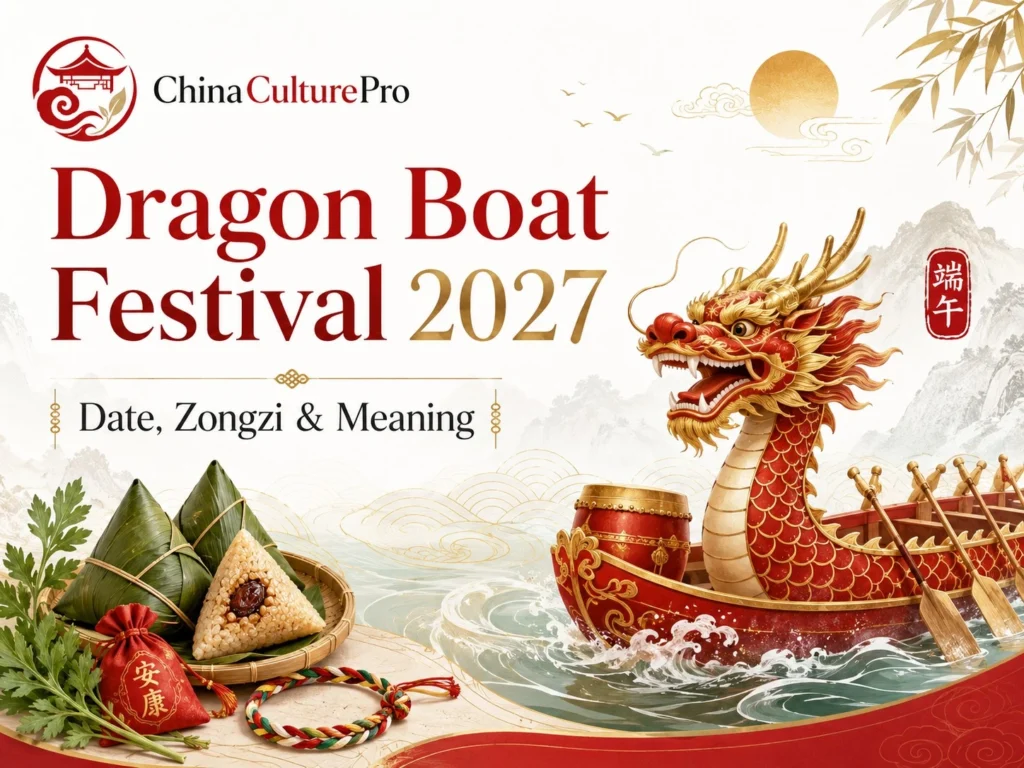

Quick Answer: What Is Dragon Boat Festival 2027?
Dragon Boat Festival 2027 falls on Wednesday, June 9, 2027. It is celebrated on the 5th day of the 5th lunar month. In Chinese, the festival is called Duanwu Jie (端午节). It is also known as Duanwu Festival, Duanyang Festival, or the Double Fifth Festival. Its main customs include dragon boat races, eating zongzi, hanging mugwort and calamus, wearing sachets, and tying five-color threads. Dragon Boat Festival is often linked with Qu Yuan, the loyal poet and statesman who drowned himself in the Miluo River. But the festival is older and broader than one story. Its deeper layer is about midsummer protection: facing heat, dampness, insects, illness, water, and unease with herbs, food, color, boats, and ritual action.| Item | Detail |
|---|---|
| 2027 Date | June 9, 2027 |
| Day of Week | Wednesday |
| Lunar Date | 5th day of the 5th lunar month |
| Chinese Name | Duanwu Jie / 端午节 |
| Also Called | Duanwu Festival, Double Fifth Festival |
| Main Food | Zongzi |
| Main Customs | Dragon boat races, zongzi, mugwort, sachets, five-color threads |
| Main Meaning | Protection, health, midsummer blessing, remembrance |
What Is Dragon Boat Festival?
Dragon Boat Festival is one of China’s most important traditional festivals. It is not soft and sweet in the same way as Chinese New Year or Mid-Autumn Festival. Its tone is firmer.
The reason lies in the season. Dragon Boat Festival falls in the fifth lunar month, when summer heat rises, dampness grows heavier, insects become active, snakes appear more often, food spoils faster, and illness becomes a real concern. In older China, this time of year was not only warm and lively. It was also risky.
Traditional people did not have modern medicine, but they watched nature closely. They understood that some seasons needed extra care. Dragon Boat Festival became a way to answer that risk with visible action.
Its customs point in the same direction:
- Mugwort and calamus protect the door.
- Sachets carry herbal fragrance on the body.
- Five-color threads protect children.
- Dragon boats face water with strength and rhythm.
- Zongzi carries memory, offering, and seasonal nourishment.
- Qu Yuan’s story adds loyalty, grief, and moral force.
Dragon Boat Festival faces summer directly. It does not hide from heat, water, illness, or unease. It turns that unease into ritual. Its answer is not fear. Its answer is action.
When Is Dragon Boat Festival? Date Rule and Upcoming Dates
Dragon Boat Festival always falls on the 5th day of the 5th lunar month. Because it follows the Chinese lunar calendar, its Gregorian date changes every year.
It usually falls between late May and late June. If you are planning travel, a cultural event, school content, or festival greetings, check the exact date for that year.
| Year | Dragon Boat Festival Date | Day of Week | Zodiac Year |
|---|---|---|---|
| 2026 | June 19, 2026 | Friday | Fire Horse |
| 2027 | June 9, 2027 | Wednesday | Fire Goat |
| 2028 | May 28, 2028 | Sunday | Earth Monkey |
| 2029 | June 16, 2029 | Saturday | Earth Rooster |
| 2030 | June 5, 2030 | Wednesday | Metal Dog |
Date note: Dragon Boat Festival is not fixed on a Gregorian date in June. It follows the 5th day of the 5th lunar month.
In Mainland China, Dragon Boat Festival is a public holiday, but the exact holiday window and make-up workday arrangements are announced by the government each year. The festival date and the official holiday schedule are related, but they are not always the same thing.
Why Dragon Boat Festival Falls in Midsummer
To understand Dragon Boat Festival, do not start only with Qu Yuan. Start with midsummer.
In traditional Chinese timekeeping, the fifth lunar month sits in a sensitive part of the year. Heat and dampness build. Insects, snakes, river water, plants, and illness all become harder to ignore. Older language sometimes called this period a difficult or poisonous month. That does not mean ancient people were simply afraid. It means they took seasonal risk seriously.
Dragon Boat Festival customs answer one practical question: What should people do when the season becomes unstable?
| Seasonal Concern | Dragon Boat Custom |
|---|---|
| Heat and dampness | Herbs, cleansing customs, protective objects |
| Insects and illness | Mugwort, calamus, sachets |
| Water and danger | Dragon boat races |
| Unease in midsummer | Five-color threads, blessings for peace and health |
Mugwort is not magic. It is lived experience. Its strong smell helped people think of cleansing, insects, and protection. Sachets are not empty superstition. They are care made visible, especially for children. Dragon boat racing is not brute force. It is a community standing together before water and summer.
This is why many Chinese people prefer the greeting Duanwu Ankang, meaning “peace and health at Dragon Boat Festival,” rather than only saying “Happy Dragon Boat Festival.” The festival is lively, but its deeper wish is safety.
The Origin of Dragon Boat Festival
Dragon Boat Festival has several origin layers. The Qu Yuan story is the most famous, but it is not the whole festival. The richness of Duanwu comes from the way seasonal custom, water ritual, historical memory, and local legends have been added together over time.
Ancient Midsummer Customs
The oldest layer is connected with the fifth day of the fifth lunar month. Long before the Qu Yuan story became central, this day was treated as a time for protection, cleansing, and caution.
People used fragrant herbs, ritual bathing, protective objects, and door decorations to guard the body and home. This layer belongs to seasonal health and folk protection. It shows how people used the festival to manage the risks of summer.
Dragon Worship and Water Rituals
Another old layer comes from water communities and dragon worship. In Chinese culture, dragons are linked with rain, rivers, water, strength, and auspicious power.
In southern areas with rivers and lakes, boat rituals and dragon-shaped boats carried meanings beyond competition. They expressed respect for water, prayers for safety, and the hope that the community could face river power together.
This layer explains why the dragon boat is not just a racing boat. It is a ritual form on water.
Qu Yuan and the Story of Remembrance
The best-known story connects Dragon Boat Festival with Qu Yuan, a poet and minister of the state of Chu during the Warring States period. After political exile and the fall of his state, Qu Yuan is said to have drowned himself in the Miluo River around the 5th day of the 5th lunar month.
According to the tradition, local people raced out in boats to search for him. They beat drums and threw rice into the river so fish and water creatures would not harm his body. Later, this story became connected with dragon boat races and zongzi.
Qu Yuan adds an important moral layer to the festival: loyalty, integrity, grief, and love for one’s country. This is why Dragon Boat Festival carries serious emotional weight in Chinese literary memory.
Other Local Figures and Regional Stories
Some regions also connect the festival with other figures, such as Wu Zixu, a loyal minister of Wu, or Cao E, a daughter remembered for filial devotion. These local stories show that Dragon Boat Festival can hold different regional memories inside one festival frame.
It is better to understand Dragon Boat Festival as layers of meaning, not one single origin.
| Origin Layer | What It Adds |
|---|---|
| Ancient Midsummer Customs | Health, protection, seasonal caution |
| Dragon Worship and Water Rituals | Water, boats, dragon power, collective ritual |
| Qu Yuan Story | Loyalty, grief, remembrance, moral force |
| Regional Legends | Local heroes, filial piety, regional memory |
| Later Festival Development | Zongzi, races, public celebrations, heritage identity |
Dragon Boat Festival Traditions and Customs
Dragon Boat Festival customs are practical, symbolic, and public. Many look festive, but their deeper logic is protection, remembrance, and health.
| Custom | What People Do | Meaning |
|---|---|---|
| Dragon Boat Races | Teams paddle long dragon-shaped boats to drumbeats | Water ritual, strength, remembrance, community |
| Eating Zongzi | Eat sticky rice dumplings wrapped in leaves | Offering, memory, seasonal food, family taste |
| Hanging Mugwort and Calamus | Hang herbs near doors | Insect repelling, disease prevention, symbolic protection |
| Wearing Sachets | Children wear cloth pouches filled with herbs | Fragrance, protection, care for children |
| Five-Color Threads | Tie five-color cords on wrists or ankles | Five Elements protection and blessing |
| Realgar Wine | Old custom of drinking or applying realgar wine | Historical anti-poison custom, not recommended today |
Dragon boat races are the most visible custom. Long boats shaped like dragons move across the water while drums set the rhythm. The race may honor Qu Yuan, but it also carries older water and dragon meanings.
Zongzi is the most important food. Families eat it at home, buy it from stores, give it as a seasonal gift, or make it together before the festival.
Mugwort and calamus are placed near doors because their strong scent and sharp symbolic form suggest protection. In older homes, the doorway was the boundary between outside risk and inside safety. Hanging herbs there made cultural sense.
Sachets and five-color threads are especially connected with children. They turn family concern into something a child can wear. The parent or grandparent does not only say “be safe.” They tie, sew, fill, hang, and prepare.
Realgar wine must be handled carefully in modern writing. It belongs to historical custom, not a health recommendation. Modern readers should treat realgar wine as cultural history and should not drink or imitate it for wellness.
Zongzi and Dragon Boat Festival Food
Zongzi is the signature food of Dragon Boat Festival. It is made with sticky rice wrapped in leaves, often bamboo leaves, reed leaves, or other regional wrapping leaves. The shape may be triangular, cone-shaped, pillow-like, or long, depending on region and family habit.
The most familiar legend says that people threw rice into the Miluo River to keep fish from harming Qu Yuan’s body. Over time, this became linked with zongzi wrapped in leaves.
But zongzi also has older meanings. Wrapping grain in leaves and steaming it is an ancient food practice in southern and river regions. It carries the smell of plants, water, rice, and home. That is why zongzi should not be treated only as a story prop in the Qu Yuan legend.
Regional differences are a major part of zongzi culture.
| Zongzi Type | Common Region / Style | Typical Filling |
|---|---|---|
| Sweet Zongzi | Often northern style | Red dates, red bean paste, candied dates, sugar |
| Savory Zongzi | Often southern style | Pork belly, salted egg yolk, mushrooms, mung beans |
| Alkaline Zongzi | Guangdong, Guangxi, and some southern areas | Plain or lightly filled, eaten with sugar or syrup |
Northern-style zongzi often leans sweet, with red dates, red bean, honey dates, or sugar. Southern-style zongzi is often savory, with pork belly, salted egg yolk, mushrooms, beans, dried seafood, or other rich fillings. Alkaline zongzi has a special golden color and springy texture and is often eaten with sugar or syrup.
The sweet-versus-savory debate is part of the fun. Chinese people themselves argue about which zongzi is “right,” but the argument is really about home. A person’s favorite zongzi usually tells you something about where they grew up.
Zongzi is not ordinary sticky rice. It is memory wrapped in leaves: the smell of home, a mother’s handwork, childhood waiting for the string to be untied, and a regional taste that tells people where they come from.
Dragon Boat Races: Water, Strength, and Community
Dragon boat racing gives the festival its English name, but it is more than a sport.
The dragon has a close relationship with water in Chinese culture. It is linked with rain, rivers, clouds, strength, and good fortune. A dragon boat lets people borrow the shape of the dragon and meet the water with discipline and courage.
A dragon boat team depends on rhythm and unity.
- The drummer sets the rhythm and acts like the heart of the boat.
- The steersperson controls direction and needs deep experience.
- The paddlers show strength, discipline, and shared timing.
- The spectators turn the race into a community event.
Modern dragon boat racing has become an international sport. Teams compete far beyond China, and overseas Chinese communities often use dragon boat festivals as major cultural events. Yet the festival root has not disappeared. On Duanwu, the drumbeat still carries older meanings of water, strength, remembrance, and protection.
A dragon boat race is not only about winning. It is a water community placing its courage, strength, and unity on the river for everyone to see. When the drum sounds and the paddles strike together, the message is clear: we stand together.
Protection Customs: Mugwort, Sachets, and Five-Color Threads
The protection customs of Dragon Boat Festival form a small but complete system. They are especially connected with children, the home, and the body.
| Protective Item | How It Is Used | Cultural Meaning |
|---|---|---|
| Mugwort | Hung near doors | Repelling insects and harmful energy |
| Calamus | Hung with mugwort | Sword-like protection |
| Sachets | Worn by children | Fragrance, care, and protection |
| Five-Color Threads | Tied on wrists or ankles | Five Elements blessing and safety |
Mugwort and calamus are the first line at the door. Mugwort has a strong scent. Calamus leaves are long and sharp, like a small sword. Together, they protect the entrance in both practical and symbolic ways.
Sachets are small cloth pouches filled with fragrant herbs. Children wear them on the body. The scent keeps the festival close and gives the child a visible sign of protection. It is both decoration and care.
Five-color threads use the colors green or blue, red, yellow, white, and black. These colors are linked with the Five Elements: Wood, Fire, Earth, Metal, and Water. In some customs, the thread is tied around a child’s wrist or ankle and later removed after the first rain, letting water carry away misfortune. This detail is regional, not universal, but it shows how color, body, and season are connected.
Dragon Boat Festival turns worry for children, family, the body, and summer risk into rituals people can see, smell, touch, and wear. Mugwort has a smell. Sachets have texture. Five-color threads have color. These are blessings made concrete.
How Dragon Boat Festival Is Celebrated Today
Today, Dragon Boat Festival is celebrated through family food, public races, school activities, community events, and overseas cultural festivals.
At home, zongzi remains the center. Many families buy zongzi from supermarkets, old food brands, restaurants, or seasonal gift boxes. Some families still make zongzi by hand. Even if fewer young people know how to wrap them, as long as one elder in the family still knows the skill, the tradition has not disappeared.
In towns and cities with rivers or lakes, dragon boat races are a major event. Some are organized by local governments. Others are run by villages, clans, associations, companies, or community groups. Even people who never step into a boat can stand on the bank, hear the drums, and feel the festival.
Schools, community centers, libraries, and cultural institutions often organize zongzi wrapping, sachet making, five-color thread weaving, and Duanwu storytelling. For younger people and international visitors, these activities may be the easiest way to understand the festival.
Overseas Chinese communities also keep the festival alive. Dragon boat events in North America, Europe, Southeast Asia, and other regions often combine racing, food markets, cultural booths, and family activities. Zongzi also becomes a seasonal item in Chinese supermarkets.
Modern people may treat some protective customs more lightly than earlier generations did. Still, the cultural memory remains. People may not fully believe in every old taboo, but they remember the smell of mugwort, the taste of zongzi, and the sound of drums on water.
How to Join Dragon Boat Festival Respectfully
You can join Dragon Boat Festival respectfully without knowing every legend or custom. Start by understanding that this is not only a fun race day. It is a festival about protection, health, remembrance, and midsummer risk.
- Watch dragon boat races from designated spectator areas and follow event rules.
- Do not enter boat storage areas, team zones, docks, or race lanes without permission.
- Try both sweet and savory zongzi before deciding what you like.
- Do not mock mugwort, sachets, or five-color threads as superstition.
- Use Duanwu Ankang as a culturally sensitive greeting.
- Treat realgar wine as history, not something to copy or try.
- If you are invited to wrap or eat zongzi with a family, accept it as a warm sign of trust.
- Do not worry if your first zongzi looks crooked. A host will usually be happy that you tried.
Duanwu Ankang means “peace and health at Dragon Boat Festival.” Many people also say Happy Dragon Boat Festival, especially in casual English. But Duanwu Ankang better fits the traditional tone because this festival is about safety and well-being more than pure happiness.
How This Guide Connects to Chinese Festivals and Zodiac Content
Dragon Boat Festival is one of the core traditional festivals in the Chinese festival year. It belongs naturally inside the larger map of Chinese seasonal customs, food traditions, and public celebrations.
For the full festival calendar, start with our Chinese Festivals and Holidays guide.
Dragon Boat Festival is different from Chinese New Year. Chinese New Year is the major family festival and the usual transition point for zodiac years. Dragon Boat Festival does not change the zodiac year, but it helps readers understand how Chinese festivals are tied to season, family, body, food, and ritual.
To understand how Dragon Boat Festival differs from the New Year season, read our Chinese New Year guide. For the full 12-animal system, see our Chinese Zodiac guide. If you need a quick birth-year sign lookup, use our Chinese Zodiac & Lunar Birthday Calculator. To understand how elements work with zodiac years, read our Five Elements Chinese Zodiac guide.
FAQs About Dragon Boat Festival
When is Dragon Boat Festival 2027?
Dragon Boat Festival 2027 is on Wednesday, June 9, 2027. It falls on the 5th day of the 5th lunar month. The Gregorian date changes each year because the festival follows the Chinese lunar calendar.
What is Dragon Boat Festival?
Dragon Boat Festival, or Duanwu Jie, is a major Chinese traditional festival on the 5th day of the 5th lunar month. It is known for dragon boat races, zongzi, mugwort, sachets, five-color threads, and remembrance of Qu Yuan.
Why is it called Dragon Boat Festival?
It is called Dragon Boat Festival in English because dragon boat racing is its most visible custom. Long dragon-shaped boats race across the water to drumbeats, combining sport, water ritual, community strength, and remembrance.
Why do people eat zongzi?
People eat zongzi during Dragon Boat Festival because of both legend and seasonal custom. The most famous story says people threw rice into the Miluo River to protect Qu Yuan’s body from fish. Zongzi also reflects older offering and seasonal food traditions.
Who was Qu Yuan?
Qu Yuan was a poet and political figure from the state of Chu during the Warring States period. He is remembered for loyalty, integrity, and sorrow for his country. His death in the Miluo River became the most famous story linked with Dragon Boat Festival.
Is Dragon Boat Festival only about Qu Yuan?
No. Qu Yuan is the most famous figure connected with the festival, but Dragon Boat Festival is older and broader. It also includes midsummer protection customs, dragon and water rituals, regional legends, health practices, and family food traditions.
What do dragon boat races mean?
Dragon boat races mean more than competition. They are linked with water, dragon power, community unity, and remembrance. The drumbeat, paddling rhythm, and shared effort turn the race into a public ritual of strength and solidarity.
Why do people hang mugwort on Dragon Boat Festival?
People hang mugwort because its strong scent was traditionally associated with repelling insects, illness, and harmful energy. Together with calamus, it protects the doorway and marks the home as prepared for the risks of midsummer.
How do you say Happy Dragon Boat Festival in Chinese?
A more traditional greeting is Duanwu Ankang, written as 端午安康. It means peace and health at Dragon Boat Festival. This fits the festival’s focus on protection and well-being better than a simple “happy” greeting.
Is Dragon Boat Festival a public holiday in China?
Yes. Dragon Boat Festival is a public holiday in Mainland China. The exact holiday arrangement can vary by year, especially when weekends or make-up workdays are involved. Travelers should check the official holiday schedule for the exact year.