
Quick Answer: What Is Chinese New Year 2027?
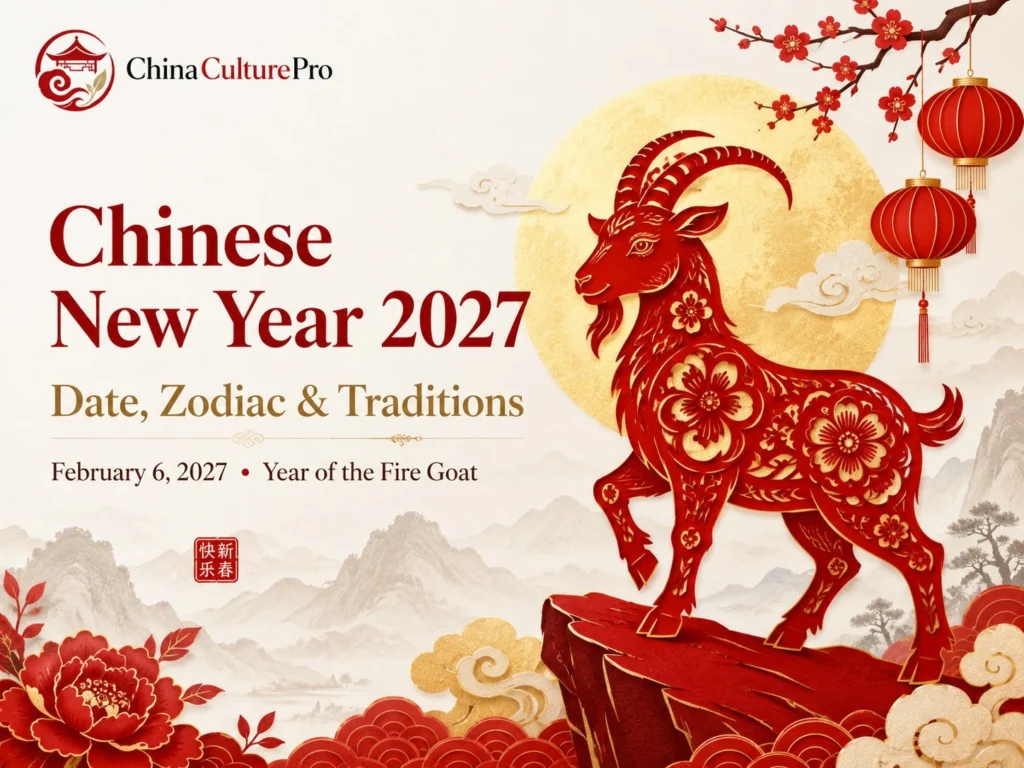
Chinese New Year 2027 begins on Saturday, February 6, 2027. This is the first day of the first lunar month and the official start of the Chinese New Year.
The zodiac animal for 2027 is the Goat, also translated as Sheep or Ram in English. Because the year belongs to the Fire element, 2027 is known as the Year of the Fire Goat.
In China, this holiday is called Spring Festival. In English, it is also often called Lunar New Year, though Lunar New Year is a broader term used by several Asian cultures. The main meaning of Chinese New Year is family reunion, leaving the old year behind, welcoming good fortune, and beginning life again with hope.
| Item | Detail |
|---|---|
| Chinese New Year Date | February 6, 2027 |
| Day of the Week | Saturday |
| Zodiac Animal | Goat |
| Element | Fire |
| Zodiac Year | Fire Goat |
| Also Called | Lunar New Year, Spring Festival |
| Main Meaning | Family reunion, renewal, good fortune |
| Celebration Period | From New Year’s Eve to Lantern Festival |
What Is Chinese New Year?
Chinese New Year, or Spring Festival, is the most important traditional festival in Chinese culture. It is not only the start of a new year on the traditional Chinese calendar. It is also a cultural ritual about time, family, blessing, memory, and renewal.
In Chinese, people often call it Guo Nian, which means “passing into the new year.” This “passing” is not a simple date change. It is marked by a series of meaningful actions. Families clean their homes to clear away the old year. They put up red couplets to welcome new hopes. They gather for reunion dinner to strengthen family bonds. They visit relatives and exchange greetings to send blessings into the year ahead.
This is why Chinese New Year is also called Spring Festival. It comes around the seasonal turn from winter toward spring. Nature begins to move again, and families also prepare for a fresh start. In this sense, the festival is both the beginning of a new year and a symbol of returning life.
For English readers, the key is simple: Chinese New Year is not mainly a party holiday. It is a festival about family, time, blessing, and restoring order. Through visible customs, Chinese people express invisible wishes: respect for ancestors, love for family, hope for children, gratitude for the past, and confidence in the future.
A short note on names:
- Chinese New Year refers to Spring Festival in the Chinese cultural context. L
- unar New Year is broader and can include Korean Seollal, Vietnamese Tết, and other Asian New Year traditions.
- Spring Festival is the common English name for 春节 in China.
This article focuses on Chinese cultural practice while respecting the wider Lunar New Year context.
When Is Chinese New Year? Dates and Calendar
Chinese New Year does not fall on January 1. Its date changes every year because the traditional Chinese calendar is a lunisolar calendar. Months follow the phases of the moon, while the year is adjusted to stay connected with the solar seasons.
Chinese New Year falls on the first day of the first lunar month. In the Gregorian calendar, this date usually lands between January 21 and February 20.
In 2027, Chinese New Year is on February 6. That date begins the Year of the Fire Goat.
| Year | Chinese New Year Date | Zodiac Animal | Element |
|---|---|---|---|
| 2026 | February 17 | Horse | Fire |
| 2027 | February 6 | Goat | Fire |
| 2028 | January 26 | Monkey | Earth |
| 2029 | February 13 | Rooster | Earth |
| 2030 | February 3 | Dog | Metal |
| 2031 | January 23 | Pig | Metal |
| 2032 | February 11 | Rat | Water |
This date is especially important for checking your Chinese zodiac sign. The zodiac year does not begin on January 1. It begins on Chinese New Year.
For example, if you were born between January 1 and February 5, 2027, your zodiac sign is still Horse, not Goat. The Goat year begins only on February 6, 2027.
To check your exact animal sign, use our Chinese Zodiac & Lunar Birthday Calculator before reading annual zodiac meanings.
Chinese New Year and the Chinese Zodiac
Chinese New Year is the boundary line between one zodiac year and the next.
The Chinese zodiac follows a 12-year cycle. Each year is linked with one animal. But this cycle does not begin on January 1. It begins on the first day of the first lunar month, which is Chinese New Year. That is why Chinese New Year does more than start a holiday. It also tells people which zodiac animal now governs the year.
The 12 zodiac animals appear in this order:
- Rat
- Ox
- Tiger
- Rabbit
- Dragon
- Snake
- Horse
- Goat
- Monkey
- Rooster
- Dog
- Pig
The year 2027 is the Year of the Goat. In English, this animal is sometimes translated as Sheep or Ram, but Goat is widely used in zodiac writing. Since 2027 belongs to the Fire element, the full zodiac name is Fire Goat.
The element matters because the Chinese zodiac is not only a 12-year animal cycle. It also works with the Five Elements: Wood, Fire, Earth, Metal, and Water. When the 12 animals combine with the Five Elements, they form a larger 60-year cycle. A Fire Goat year does not return every 12 years. It returns every 60 years.
| Status | Year | Zodiac Animal | Element |
|---|---|---|---|
| Previous | 2026 | Horse | Fire |
| Current | 2027 | Goat | Fire |
| Next | 2028 | Monkey | Earth |
This matters most if you were born in January or February. A person born before Chinese New Year still belongs to the previous zodiac year. A person born on or after Chinese New Year belongs to the new zodiac year.
If you want the complete system behind the 12 animals, start with our Chinese Zodiac guide. For a deeper reading of the 2027 animal sign, read our Year of the Goat guide. To understand why 2027 is a Fire Goat year, see our Five Elements Chinese Zodiac guide.
How Long Does Chinese New Year Last?
Chinese New Year is not only one day. It is a festival season. The celebration begins with preparation before New Year’s Eve and continues until the Lantern Festival on the 15th day of the first lunar month.
The most important moments are New Year’s Eve, New Year’s Day, the first days of family visits, the fifth day, and Lantern Festival.
| Time | Main Activities | Meaning |
|---|---|---|
| Before New Year | Cleaning, shopping, putting up couplets, preparing offerings | Clear away the old year and prepare for renewal |
| New Year’s Eve | Reunion dinner, staying up late, red envelopes | Family reunion and farewell to the old year |
| New Year’s Day | Greetings, new clothes, firecrackers | First blessings of the new year |
| Days 2–4 | Visiting relatives, married daughters returning home, family gatherings | Maintaining family and social bonds |
| Day 5 | Welcoming the God of Wealth, “breaking” early restrictions | Sending away poverty and restoring daily order |
| Lantern Festival | Lanterns, tangyuan, riddles | Reunion, completion, and the close of the festival |
Legal holidays may last only a few days, but emotionally, Chinese New Year lasts longer. Many Chinese people say, “The New Year is not over until the first lunar month is over.” The festive feeling usually continues until Lantern Festival, when the lights go out and the season comes to a close.
Chinese New Year Traditions and Their Meanings
Chinese New Year traditions may look like many separate customs, but they share one clear idea: people use visible actions to complete an invisible renewal. Each act helps a family say goodbye to the old year, welcome good luck, honor its roots, and begin again with order.
| Tradition | What People Do | Meaning |
|---|---|---|
| House Cleaning | Families clean the home before New Year | Sweeping away the dust, bad luck, and stale energy of the old year |
| Red Decorations | People put up red paper cuts, Fu characters, lanterns, and festive signs | Red represents joy, luck, protection, and celebration |
| Spring Couplets | Paired red lines are placed on both sides of the door | They express hopes for the new year and decorate the entrance with blessing |
| Reunion Dinner | The whole family gathers for a rich meal on New Year’s Eve | This is the central family ritual of Chinese New Year |
| Red Envelopes | Elders give money in red packets to younger family members | Blessing, protection, and good fortune are passed to the next generation |
| Firecrackers and Fireworks | People set them off where allowed | They drive away the legendary Nian beast and welcome the new year with sound |
| Dragon and Lion Dances | Public performances appear in streets, temples, and celebrations | The dragon suggests power and good fortune; the lion suggests courage and protection |
| Ancestor Worship | Families honor ancestors at home, graves, or ancestral halls | They remember their roots, show gratitude, and ask for protection |
| Visiting Relatives | People visit family, elders, neighbors, and friends | These visits renew family ties and social relationships |
A useful cultural view is this: Chinese New Year traditions are often misunderstood as superstition. That reading is too shallow. The heart of these customs is not fear or blind belief. It is the use of concrete rituals to express deep feelings.
Cleaning is not only cleaning. It says, “I am ready to leave the past behind.” Reunion dinner is not only dinner. It says, “We are still one family.” A red envelope is not only money. It says, “I wish you safety, growth, and good fortune.”
This is why these customs have lasted for so long. They turn hope into action. They turn family feeling into a table, a door, a greeting, a red packet, and a shared meal.
Chinese New Year Food and Symbolism
Food is one of the most powerful parts of Chinese New Year. The New Year table is not just a meal. It is a blessing written in dishes.
Chinese families place hopes for reunion, wealth, long life, success, and good luck into food. The meaning often comes from shape, sound, color, or traditional wordplay.
| Food | Symbolic Meaning | Reader Note |
|---|---|---|
| Whole Fish | Surplus and abundance | Fish, yu, sounds like “surplus.” Some fish is often left uneaten to show “more than enough.” |
| Dumplings | Wealth and reunion | Their shape looks like ancient Chinese ingots. Making dumplings together also strengthens family feeling. |
| Nian Gao | Rising higher year by year | Nian gao sounds like “year higher,” suggesting improvement in work and life. |
| Tangyuan | Reunion and completeness | The round shape represents togetherness and wholeness, especially during Lantern Festival. |
| Longevity Noodles | Health and long life | Long noodles symbolize a long life and should not be cut short. |
| Spring Rolls | Wealth and spring renewal | Their golden color suggests gold bars and a fresh start in spring. |
| Oranges and Mandarins | Luck and success | Their names sound close to lucky words, and their bright color feels festive. |
| Whole Chicken | Family completeness | Serving the chicken whole suggests wholeness, unity, and a complete family. |
China is large, so New Year foods vary by region. Northern families often value dumplings and wheat-based foods. Southern families may place more focus on nian gao, tangyuan, seafood, and regional dishes. There is no single “correct” New Year meal.
The deeper logic is the same across regions: people put their best wishes into the best food they can prepare.
Red Envelopes, Greetings, and Basic Etiquette
What Are Red Envelopes?
Red envelopes, called hongbao in Mandarin, are one of the clearest symbols of Chinese New Year. A red envelope contains money and is usually given by elders to children or younger family members. In many families, married adults also give red envelopes to unmarried younger relatives.
The red color represents good luck, joy, and protection. The money inside is not the real focus. The true meaning is the blessing being passed from one person to another.
Today, digital red envelopes are also common, especially through apps such as WeChat. This allows relatives and friends to send blessings even when they are far apart. Still, the meaning has not changed. A red envelope is a carrier of blessing, not a business transaction.
Common Chinese New Year Greetings
| Chinese | Pinyin | Meaning | Best Used For |
|---|---|---|---|
| 新年快乐 | Xīn nián kuài lè | Happy New Year | A safe greeting for everyone |
| 恭喜发财 | Gōng xǐ fā cái | Wishing you prosperity | Business, work, or wealth wishes |
| 万事如意 | Wàn shì rú yì | May everything go well | General blessing |
| 身体健康 | Shēn tǐ jiàn kāng | Good health | Especially good for elders |
| 阖家欢乐 | Hé jiā huān lè | Joy for the whole family | Family greetings |
If you only remember one phrase, use Xīn nián kuài lè. A simple greeting said with respect is better than a long phrase used awkwardly.
Simple Etiquette for Visitors
If you are joining a Chinese New Year event for the first time, these points will help you feel more natural.
- Accept a red envelope with both hands and say thank you.
- Do not open a red envelope immediately in front of the giver.
- Use a simple greeting such as “Xīn nián kuài lè.”
- If you are invited to a family dinner, treat it as a serious sign of trust and kindness.
- Bring a small gift when visiting a home.
- Do not treat Chinese New Year, Vietnamese Tết, and Korean Seollal as the same holiday.
- When unsure, be polite, observe first, and ask gently.
Chinese New Year Taboos and Good-Luck Customs
Chinese New Year taboos are not strict laws. They are folk beliefs that show how seriously people treat the beginning of a new year. The idea is simple: if the year is beginning, start it carefully and fill the first days with good signs.
| Avoid | Better Practice | Meaning |
|---|---|---|
| Sweeping or taking out trash on New Year’s Day | Clean before the holiday, or sweep inward if needed | Avoid sweeping wealth and good luck out of the home |
| Saying unlucky words | Say auspicious words and blessings | Words are believed to carry energy at the start of the year |
| Breaking dishes | Say “Sui Sui Ping An” if something breaks | The word for “broken” can be turned into a blessing for peace year after year |
| Using scissors or needles | Prepare clothes and sewing before the holiday | Sharp tools may suggest cutting off fortune |
| Giving clocks, umbrellas, or pears | Give fruit, tea, sweets, or practical gifts | These items carry unlucky homophones in Chinese |
| Collecting debts | Settle debts before New Year if possible | People prefer to begin the year with a clean mind and clean accounts |
These customs are much lighter in modern life. Many young people and city families do not follow them strictly. They may treat them as cultural memory, family habit, or playful tradition.
If you accidentally do something considered unlucky, do not panic. Many Chinese people will laugh it off or give you a lucky phrase to “fix” it. The purpose of Chinese New Year is blessing, not anxiety.
Chinese New Year Around the World
Chinese New Year is no longer only a festival in China. Wherever there are Chinese communities, there is some form of Spring Festival atmosphere.
In Mainland China, Chinese New Year is the largest family holiday of the year. For many people, the strongest image of the season is the journey home. No matter how far people work or study from their hometowns, the New Year points in one direction: back to family.
In Hong Kong, Taiwan, and Macau, Chinese New Year is also a major public holiday. Flower markets, temple visits, public decorations, and festive events are common. In Singapore and Malaysia, Chinese communities celebrate with local foods, performances, and family gatherings.
In Western countries, Chinese New Year has become more visible each year. Cities such as San Francisco, New York, Los Angeles, London, Sydney, and Vancouver often hold parades, lantern displays, lion dances, and Chinatown celebrations.
At the same time, Lunar New Year is broader than Chinese New Year. Vietnamese Tết and Korean Seollal share the wider lunar new year framework, but they have their own names, foods, family rituals, and cultural meanings. Respecting those differences is part of understanding the festival well.
How to Celebrate Chinese New Year Respectfully
You do not need to be Chinese to join a public Chinese New Year celebration. The key is to join with respect, not performance.
The best way to participate is to understand the spirit of the holiday. Chinese New Year is about blessing, family, renewal, gratitude, and hope.
- Learn the date and zodiac animal before greeting someone.
- Use one simple greeting correctly, such as “Xīn nián kuài lè.”
- If you know that 2027 is the Fire Goat year, that small detail shows real care.
- Attend public events respectfully and follow local signs or rules.
- Ask before taking close-up photos of private rituals, performers, or family moments.
- Do not force your way into private family customs.
- Avoid treating Chinese New Year as an exotic costume theme.
- Support local Chinese restaurants, markets, cultural centers, and community events.
- Remember that kindness matters more than perfect pronunciation.
A respectful visitor does not need to “act Chinese.” It is enough to be sincere, informed, and careful with cultural boundaries.
For readers comparing the current and previous zodiac years, our Year of the Horse guide explains 2026. For the next zodiac transition, see our Year of the Monkey guide.
FAQs About Chinese New Year
When is Chinese New Year 2027?
Chinese New Year 2027 begins on Saturday, February 6, 2027. This is the first day of the first lunar month and the official start of the Year of the Fire Goat.
What zodiac animal is 2027?
The zodiac animal for 2027 is the Goat. In some English sources, it may also be translated as Sheep or Ram. Because 2027 belongs to the Fire element, it is called the Year of the Fire Goat.
Is 2027 the Year of the Goat, Sheep, or Ram?
All three translations are used because the Chinese zodiac animal 羊 can refer broadly to goat, sheep, or ram. For English zodiac writing, Goat is a common choice. This article uses Goat for consistency.
Is Chinese New Year the same as Lunar New Year?
They are related, but not exactly the same. Chinese New Year refers to Spring Festival in Chinese culture. Lunar New Year is a broader term that can also include Vietnamese Tết, Korean Seollal, and other Asian New Year traditions.
Why does Chinese New Year change every year?
Chinese New Year changes because it follows the traditional Chinese lunisolar calendar, not the Gregorian calendar. It falls on the first day of the first lunar month, usually between January 21 and February 20.
How long does Chinese New Year last?
Chinese New Year traditionally lasts from New Year’s Eve through the Lantern Festival on the 15th day of the first lunar month. The most intense celebrations are usually from New Year’s Eve through the first few days of the new year.
What foods are eaten during Chinese New Year?
Common Chinese New Year foods include whole fish, dumplings, nian gao, tangyuan, longevity noodles, spring rolls, oranges, and whole chicken. These foods are chosen for meanings such as abundance, wealth, reunion, long life, and good luck.
Why are red envelopes given?
Red envelopes are given to pass blessings and good fortune to younger family members. The red color stands for luck and protection, while the money inside represents a wish for safety, growth, and prosperity.
Does my Chinese zodiac sign start on January 1?
No. Your Chinese zodiac sign does not start on January 1. It starts on Chinese New Year. If you were born in January or February, check the Chinese New Year date for your birth year before deciding your zodiac sign.