


Quick Answer: What Is Chinese Lacquer Thread Sculpture?
Chinese lacquer thread sculpture (漆线雕, qīxiàndiāo) builds raised patterns from thin cords rolled from a pliable lacquer compound. Makers apply the cords to a prepared surface, where they can form curls, borders and intricate outlines. Color and gilding can bring the finished pattern into sharper view. [1][2][3]
- Base: The maker prepares the object that will carry the lines.
- Relief: Lacquer cords are laid down, curved or stacked.
- Finish: Gilding or color can highlight the ridges and surrounding areas. [1][2]
The fine raised cord is the clearest clue to how the pattern was made. [1][2]
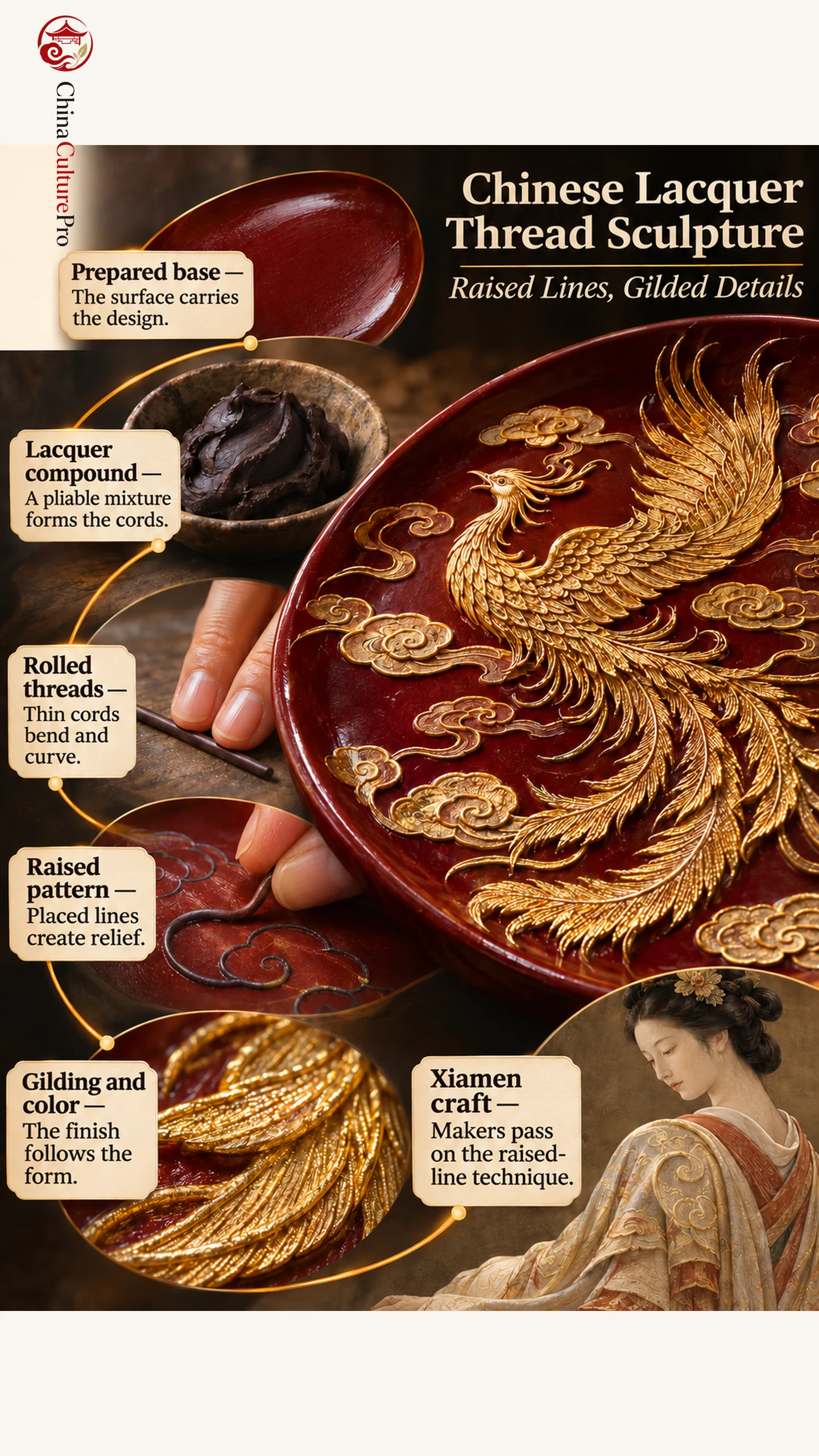
Look along the edge of a gilded line in side light. A slim shadow can follow the curl even as its bright reflection shifts. On a figure’s clothing or a dish, the shadow gives away the small amount of relief beneath the gold.
How Lacquer Becomes a Thread
In the traditional Xiamen account, the maker first shapes the base and prepares its surface. On a figure, that base already carries the posture and larger folds of clothing. The fine lines applied later can pick out a cuff, a band of ornament or the border of a headdress. [1][2][3]
The register calls the pliable compound lacquer thread clay (漆线土, qīxiàn tǔ). Its traditional materials include aged brick powder, tree lacquer and processed tung oil. Makers roll the compound by hand into narrow cords. The rolled cord can be curved and placed on the surface while it is still workable. [1][2]
How the Lines Shape the Relief
A single cord can follow a border. Closely set turns can fill a small part of a design. Where several lengths are layered, the relief becomes higher. Wider spacing lets the eye follow individual curves. Tighter turns can give a border a dense texture even when it covers little of the surface. [1][2]
Gilding and coloring come after the line work in the craft sequence described by Fujian’s heritage account. A sheet of gold can follow the contours of the raised cord. The small shadows beside the gilding still show where the line projects from the base. In other forms of Chinese lacquerware, a carver cuts down into a built-up coating to leave motifs raised. Here the applied cord supplies the extra height. [1][2][6]
From Religious Figures to Display Objects
The national heritage entry connects Xiamen’s tradition with the decoration of Buddhist images and other religious sculpture. It describes earlier raised-line methods as influences and places the development of the Xiamen craft around the late Ming and early Qing. The tradition grew alongside Xiamen’s religious sculpture workshops. An English account identifies both Xiamen and Quanzhou as centers and describes the use of raised lines to detail clothing and headwear, including on figures of deities such as Mazu. [1][2][3]
A display object gives the cords a different surface to follow. A 2017 southern Fujian heritage exhibition in Xiamen showed a gilded dragon-and-phoenix dish. The raised lines follow a circular field, where the edges of the dish set the bounds of the design. The same exhibition described a general’s figure made with a bodiless lacquer base, then decorated with gilded cords. Tigers on the chest and back belong to the applied line work. The report identifies the technique of the base and the technique of its decoration separately. [5]
How Xiamen Artisans Pass On the Craft
Xiamen lacquer thread sculpture entered China’s national intangible cultural heritage list in 2006. The register profiles Cai Shuikuang, who learned from his father, Cai Wenpei. His training included wood carving, surface preparation, rolling and placing the threads, and applying gold and color. The register also names his works on the Monkey King and records that two of his pieces entered a national arts and crafts collection in 1994. Those named works show how the same skill could be applied to a figure from a literary story. [1][4]
The 2017 exhibition documented Wang Zhiqiang and Cai Chaorong demonstrating the raised-line work in person. A demonstration makes the placement of a line visible before gilding. In the finished piece, the reflected light can make the surface color more apparent than the joins between individual cords. [5]
FAQs About Chinese Lacquer Thread Sculpture
Is lacquer thread made from silk or cotton?
The line is a cord rolled from a pliable lacquer compound. The word thread describes its narrow shape. [1][2]
What gives some pieces their gold color?
Gilding is one documented finishing step. A gold surface follows the relief created by the cords and makes that relief easier to see in changing light. [1][2][5]
How does lacquer thread sculpture differ from carved lacquer?
Lacquer thread sculpture builds relief by applying cords. In carved lacquer, the maker removes material from a thick coating to shape the design. [1][6]
Sources
[1] China Intangible Cultural Heritage Digital Museum. Xiamen Lacquer Thread Sculpture
[2] Fujian Provincial People’s Government. National ICH: Xiamen Lacquer Thread Sculpture Technique
[3] China Today, via China Culture. Lacquer Thread Sculpture
[4] China Intangible Cultural Heritage Digital Museum. Representative Practitioner: Cai Shuikuang
[5] China Intangible Cultural Heritage Digital Museum. Southern Fujian Heritage Exhibition in Xiamen
[6] The Metropolitan Museum of Art. Cinnabar: The Chinese Art of Carved Lacquer