
Quick Answer: What Do Chinese Symbols Mean?
Chinese symbols are visual forms that carry cultural meaning in Chinese writing, art, ritual, and everyday life. They can express blessings, rank, moral character, protection, family continuity, or ideas about the natural and cosmic order. A symbol may gain meaning from a written word, a spoken pun, an animal or plant’s perceived qualities, a myth, a historical institution, or a combination of several images.[1][2]
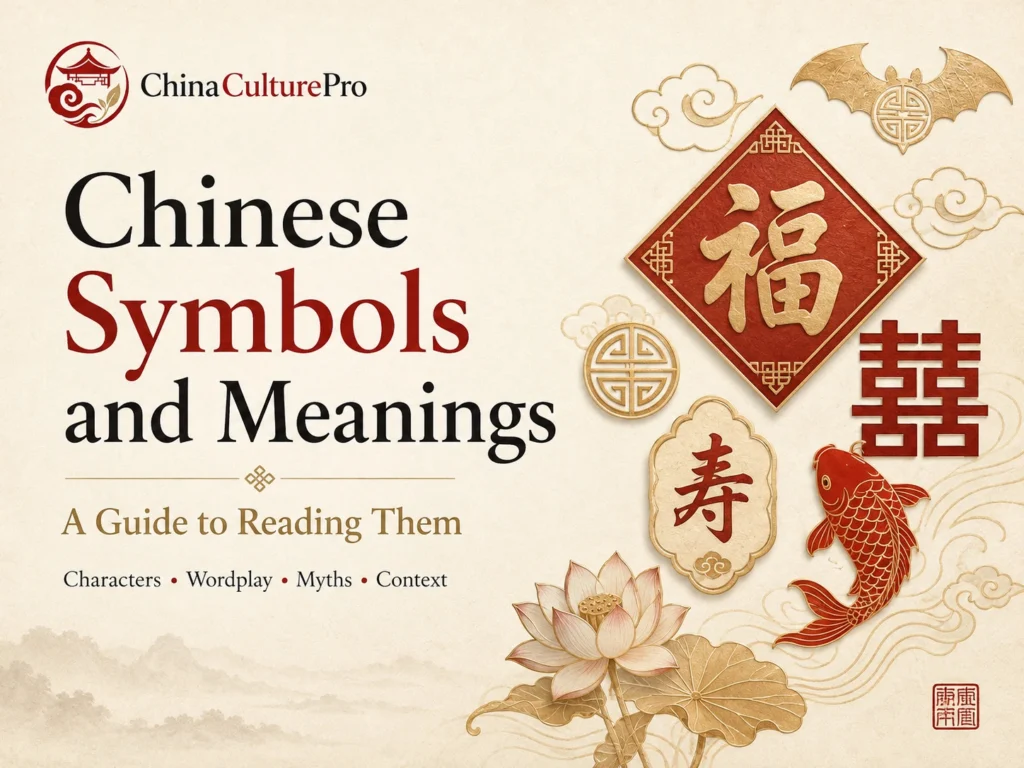
Chinese symbols are not the same as Chinese characters. Hanzi are units of written language; only some characters, such as 福 (fú, blessing) and 寿/壽 (shòu, longevity), also function as stand-alone decorative emblems.
Before interpreting a symbol, check:
- the period and social setting in which it was used;
- the other images, words, colors, and numbers around it;
- the object, recipient, and occasion for which the design was made.
Chinese ceramics, textiles, paintings, paper cuts, and buildings often contain a visual language that can be read. Their dragons, birds, flowers, fruits, and written emblems may communicate wishes, values, status, or stories rather than serving as decoration alone.
A bat beside a peach is a useful example. The bat can evoke blessing through wordplay, while the peach belongs to a long tradition of longevity imagery. Together, they create a fuller wish for blessings and long life. Such combinations became especially developed in Ming- and Qing-dynasty decorative arts, where a seemingly simple design could work like a short visual phrase.[2]
Chinese Symbols vs. Chinese Characters
English-language searches often use “Chinese symbol” for any Chinese-looking mark. That phrase may refer to a character, an animal, a decorative pattern, or even Japanese kanji. These categories overlap, but they are not interchangeable.
| Category | What it is | Examples | Important distinction |
|---|---|---|---|
| Chinese symbol | Any visual form that carries a recognized meaning in a Chinese cultural context | dragon, bat, jade, red, the number nine | Broader than written language; meaning may come from art, ritual, wordplay, or history |
| Chinese character, or Hanzi | A written unit used to record the Chinese language | 人, 山, 水, 福, 寿/壽 | Most characters are ordinary writing, not traditional auspicious emblems |
| Motif | A repeated or recognizable design used on art, clothing, architecture, or objects | cloud scrolls, waves, floral scrolls | A motif may carry meaning alone, but its message can change when combined with other elements |
| Kanji | Chinese characters used within the Japanese writing system | 和, 桜, 風 | Many forms have Chinese origins, but Japanese readings, vocabulary, conventions, and cultural associations developed in their own context |
Some characters cross the boundary between writing and visual symbolism. 福 may appear in a sentence as a word, but an enlarged or calligraphic 福 displayed for the New Year works as both language and an auspicious emblem. The ligature 囍, commonly read as shuāngxǐ or “double happiness,” is similarly recognized as a wedding design. By contrast, a dragon, fenghuang, Chinese knot, or cloud motif is not a Chinese character.
Script choice adds another layer. Simplified and traditional forms are both Chinese, while seal, clerical, regular, running, and cursive scripts are calligraphic styles rather than separate languages. A historical-looking form may be appropriate for a museum-inspired design, but legibility and the conventions of the intended community still matter more than an assumed hierarchy of authenticity.
How Chinese Symbolism Creates Meaning
Chinese symbolism does not come from one master code. Different motifs acquired meaning through several mechanisms, and more than one can operate at the same time. Rebus play—the use of an image to suggest a similar-sounding word—has a long history in Chinese art and can turn a painting or object into a message of congratulation.[3]
| Meaning mechanism | How it works | Example | Interpretation limit |
|---|---|---|---|
| Written meaning | A character communicates its ordinary lexical meaning and becomes an emblem when displayed independently | 寿/壽 (shòu) expresses longevity | Applies to written forms, not to every animal or object |
| Perceived natural quality | People associate a living thing or material with an admired trait | evergreen pine suggests endurance and long life | A cultural analogy, not a claim that the image causes an outcome |
| Homophone or rebus | An image suggests another word with the same or a similar sound | 蝠 (fú, bat) evokes 福 (fú, blessing); 鱼/魚 (yú, fish) evokes 余/餘 (yú, surplus) | Pronunciations vary by period and language variety; modern Mandarin alone cannot explain every historical rebus |
| Myth, religion, or institution | A story, belief system, court rule, or social practice gives an image a recognized role | peaches recall the immortality orchard of Xiwangmu; dragons could mark imperial authority | Meaning can change by dynasty, object, rank, and audience |
| Composite imagery | Several elements combine into a phrase-like wish | lotus and fish suggest “continuous surplus” through lián/连 and yú/余 wordplay | The whole design must be read; isolating one element can miss the intended message |
This explains why a symbol rarely has one timeless definition. A crane on a birthday hanging, a crane on an official rank badge, and a crane carrying an immortal may share visual features but perform different cultural jobs.
A practical reading therefore moves from object to context rather than from image to dictionary. First identify what is actually shown. Next ask whether sound, story, physical quality, or institutional use explains it. Finally, read the surrounding elements and the object’s purpose. This sequence prevents an attractive but unsupported interpretation from becoming a supposed cultural fact.
Find a Chinese Symbol by Meaning
Use this Chinese symbols by meaning table as a starting point, not as a universal prescription. The most suitable symbol depends on whether the setting is a wedding, birthday, New Year display, scholarly gift, religious object, or modern design.
| Meaning sought | Common choices | Best-known contexts | Important distinction |
|---|---|---|---|
| Luck and blessings | 福, bats, auspicious clouds | New Year decoration, household art, general gifts | A broad wish rather than a promise that an object produces luck |
| Wealth and abundance | fish, peony, ingot, traditional coin | New Year art, business decoration, celebratory gifts | Material abundance is not the same as official rank or scholarly success |
| Longevity | 寿/壽, peach, crane, pine, butterfly | Birthday art, gifts for elders, textiles | The butterfly gains a longevity layer through a pun on advanced age, but it can also represent joy or weddings |
| Love and marriage | 囍, paired mandarin ducks, dragon and fenghuang | Weddings, bridal textiles, marriage gifts | Marriage emblems are not universal symbols for friendship or family affection |
| Family continuity | pomegranate, lotus seeds, images of children | Wedding gifts, family furnishings, textiles | Historically connected with wishes for descendants; explain the social context rather than treating it as a modern expectation |
| Protection | guardian lions, door gods, protective Buddhist or Daoist emblems | Entrances, temples, household prints | Some forms belong to specific religious or architectural traditions |
| Success and advancement | carp, bamboo joints, deer, monkey on horseback | Study gifts, career congratulations, decorative art | Examination success, official salary, and wealth are related but distinct wishes |
| Peace and harmony | 和, vase, lotus, knot designs | Household art, diplomatic or family gifts, religious art | “Inner peace,” social harmony, and physical safety do not always use the same symbol |
| Integrity and resilience | plum, orchid, bamboo, chrysanthemum, pine | Literati painting, study decoration, character-focused gifts | These images often praise moral character rather than requesting wealth |
The table also shows why “luck” is too broad for many searches. A wedding emblem, a birthday motif, an examination wish, and an image praising integrity may all be positive, yet they address different relationships and occasions. Choosing by the desired message first is safer than selecting an image only because a marketplace labels it lucky.
Popular Chinese Symbols and Their Meanings
The following groups cover representative symbols, not every motif used across Chinese history. Each entry gives a reliable first reading; a specific artwork may require a more precise interpretation.
Written Blessings and Chinese Characters
This selection comes from the broader Chinese character symbols group and includes only characters with established independent decorative use.
| Symbol | Pinyin | Core meaning | Common setting | Context or caution |
|---|---|---|---|---|
| 福 | fú | blessing, good fortune, a favorable life | New Year displays, household decoration, gifts | An upside-down 福 plays on 倒 (dào, inverted) and 到 (dào, arrived). Placement customs vary, so it should not be presented as a rule for every doorway |
| 禄/祿 | lù | official salary, rank, career success | congratulatory art, Fu-Lu-Shou imagery | Historically closer to office and emolument than to generic cash wealth |
| 寿/壽 | shòu | longevity | birthday hangings, robes, ceramics, gifts for elders | The character appears in many stylized forms and often joins peaches, bats, cranes, or other longevity motifs.[4] |
| 喜 and 囍 | xǐ; shuāngxǐ | joy; double happiness in marriage | celebrations; 囍 on wedding paper cuts, textiles, and decorations | 囍 is a fused wedding emblem, not a general replacement for every use of 喜 |
| 和 | hé | harmony, concord | calligraphy, household or institutional decoration | Its exact sense depends on the surrounding phrase; it does not automatically mean romantic love or personal serenity |
Other words may be meaningful in a tattoo or personal design without belonging to this traditional emblem set. 爱/愛 (ài, love), 勇 (yǒng, courage), and 家 (jiā, family), for example, are ordinary vocabulary unless a particular artistic or ritual tradition gives their display an additional role. That distinction keeps a language list from being mistaken for a catalog of historical motifs.
Mythical Creatures and Guardian Figures
Chinese mythical creatures can carry moral, cosmological, and political meanings. Court use is especially context-sensitive: the number of dragon claws and the right to wear or display particular designs were regulated differently across periods and objects, so a single claw-count chart should not be applied to all Chinese history.[1]
| Figure | Core cultural roles | Context changes | Common misunderstanding |
|---|---|---|---|
| Chinese dragon, 龙/龍 (lóng) | rain and water, celestial power, auspicious authority, imperial rule | an imperial robe, a temple image, a zodiac dragon, and a modern festival dragon do not carry identical meanings | It is not the standard Western fire-breathing monster, although Chinese stories can still portray dangerous or unruly dragons |
| Fenghuang, 凤凰/鳳凰 (fènghuáng) | virtue, ordered rule, peace, beauty, and auspicious union | alone it can signal virtue or a flourishing reign; paired with a dragon it may indicate courtly or marital harmony | “Chinese phoenix” is a convenient translation, but the Western death-and-rebirth-in-fire story is not the fenghuang’s defining myth |
| Qilin, 麒麟 (qílín) | benevolent rule, the arrival of a sage or worthy child, auspicious peace | appears in court, religious, family, and folk settings | It is often called a Chinese unicorn, but its form and narrative tradition are different |
| Guardian lions, 石狮/石獅 (shíshī) | authority, protection, and the guarding of an entrance | commonly installed as a complementary pair outside important buildings | “Foo dogs” is a Western nickname; the figures are lions, not dogs |
These figures should also be read by medium. A dragon on an emperor’s robe participated in court representation; a dragon danced at a festival performs a communal and celebratory role. Likewise, a guardian lion at a gate organizes and protects an architectural threshold, while a small souvenir lion may preserve only part of that older visual language. Modern availability does not erase history, but it changes the force of the original setting.
Animals and Birds
Chinese animal symbolism develops through names, stories, artistic convention, and perceived qualities. Museum collections frequently show bats, deer, cranes, pine, and clouds sharing the same scene, where each contributes a different auspicious layer.[1][4]
| Animal | Meaning mechanism | Common meanings | Context or caution |
|---|---|---|---|
| Bat, 蝠 (fú) | exact homophone of 福 (fú) in Mandarin | blessings and happiness | five bats may represent the Five Blessings; bats are positive in many Chinese decorative contexts despite darker Western associations |
| Fish and carp, 鱼/魚 (yú), 鲤/鯉 (lǐ) | 鱼/魚 sounds like 余/餘, “surplus”; carp also connects with the Dragon Gate story | abundance; carp can add perseverance and advancement | fish, carp, and goldfish should not be treated as perfectly interchangeable wealth icons |
| Crane, 鹤/鶴 (hè) | links with immortals and long-life imagery | longevity, elevation, refined bearing | paired white-headed birds can allude to an elderly couple; cranes also had official and religious uses |
| Deer, 鹿 (lù) | homophone of 禄/祿 (lù), official salary; companion of immortals | rank, emolument, longevity | the intended layer depends on its companions, such as Shoulao, crane, peach, or pine |
| Mandarin ducks, 鸳鸯/鴛鴦 (yuānyāng) | established paired-bird convention in art and literature | marital affection and harmony | use the cultural convention, not a claim that the species forms scientifically proven lifelong pairs |
| Magpie, 喜鹊/喜鵲 (xǐquè) | name, folklore, and literary imagery | joy and approaching good news | with plum blossom it forms the familiar “joy reaches the brow” or springtime good-news theme |
Pairing and posture can be as important as species. Two birds facing one another may emphasize relationship, while a bird beside a flower can activate a seasonal, poetic, or phonetic reading. A catalog that labels every bird with one fixed keyword misses the composition’s actual message.
Flowers, Plants, and Fruits
Chinese flower and plant symbolism appears on objects made for homes, temples, scholars, and the imperial court. Its meaning may come from seasonal behavior, literature, religion, visual beauty, or wordplay rather than from a universal “flower language.”[5]
| Plant | Source of meaning | Common meanings | Context changes |
|---|---|---|---|
| Lotus, 莲/蓮 (lián) | Buddhist imagery, literary praise, seed production, and wordplay in combinations | purity, continuity, flourishing descendants, or harmony | Buddhist purity, a literati ideal, and a lotus-fish rebus are related but not identical readings |
| Peony, 牡丹 (mǔdan) | luxuriant appearance and long association with elite and popular decorative arts | wealth, honor, beauty, flourishing prosperity | prominent at court but not restricted to imperial use; widely adopted in household and folk art |
| Four Gentlemen, 四君子 | plum, orchid, bamboo, and chrysanthemum as literati subjects | resilience, refinement, integrity, and principled independence | a moral and artistic grouping, not chiefly a wealth charm |
| Three Friends of Winter, 岁寒三友/歲寒三友 | pine, bamboo, and plum endure or flourish in winter | endurance, loyalty, and steadfast character | often used in literati art and congratulatory imagery |
| Peach, 桃 (táo) | Xiwangmu’s immortality peaches and long-life art | longevity and immortality | especially appropriate in birthday themes; peach blossom may carry other literary or seasonal meanings |
| Pomegranate, 石榴 (shíliu) | many seeds | wishes for numerous descendants and family continuity | belongs to historical family and marriage imagery; use sensitively in modern personal gifts |
The same plant can therefore belong to several symbolic systems. Lotus is a Buddhist image, a poetic image of unstained integrity, and a component in family or abundance rebuses. Peony can signal splendor in courtly art and prosperity in popular decoration. The responsible question is not merely “What does this flower mean?” but “What is this flower doing in this particular composition?”
Colors, Numbers, and Abstract Signs
Chinese color symbolism and number symbolism depend on language, ceremony, class, region, and period. Red is strongly associated with vitality, good fortune, and celebration, but it can also carry political, religious, or material meanings in a particular object.[7] Number symbolism often uses sound associations in Mandarin, Cantonese, or other Chinese varieties.[8]
| Sign | Common association | Context or caution |
|---|---|---|
| Red | celebration, vitality, good fortune | especially visible in weddings and New Year decoration; it is not the correct color for every ritual context |
| Yellow and gold | centrality, earth, prestige, and imperial authority | particular shades, garments, and materials could be regulated at court; “all yellow was forbidden to everyone else” is too broad |
| White | mourning and solemnity in many traditional settings; also plainness or purity in other contexts | a funeral association does not erase its aesthetic, religious, or modern uses |
| Eight, 八 (bā) | prosperity and commercial good fortune | the association with 发/發 (fā, prosper) is phonetic rather than an exact Standard Mandarin homophone and is especially strong in Cantonese and modern popular culture |
| Nine, 九 (jiǔ) | duration because it matches 久 (jiǔ); imperial and cosmological importance | wedding, longevity, and imperial meanings should not be collapsed into one explanation |
| Four, 四 (sì) | avoided in some modern settings because it resembles 死 (sǐ), death | a popular sound-based taboo, not proof that four was negative in every historical system |
| Taijitu, 太极图/太極圖 | dynamic relationship of yin and yang | not a simple logo for good versus evil; the familiar black-and-white design represents interdependence and transformation |
Numbers also travel easily from older symbolic systems into modern consumer behavior. A phone number, license plate, wedding date, or business opening may use eight or nine without reproducing an ancient ritual. That modern use is still culturally meaningful, but it should be labeled as contemporary preference rather than projected unchanged into every dynasty.
Auspicious Objects and Decorative Motifs
Chinese auspicious objects and symbolic patterns may begin as tools, court furnishings, ritual implements, or forms valued for physical qualities. Repetition in art and ceremony can then give them an emblematic role.[1][6]
| Object or motif | Original role | Symbolic associations | Typical contexts |
|---|---|---|---|
| Chinese knot, 中国结/中國結 | practical and decorative knotwork | connection, continuity, completeness | festival decoration, clothing, wedding and household gifts |
| Ruyi, 如意 | scepter-like object and prestigious furnishing | “as you wish,” successful fulfillment | court display, congratulatory gifts, Buddhist and secular art |
| Jade, 玉 (yù) | ritual material, ornament, and luxury medium | durability, purity, cultivated virtue, status | ritual objects, personal ornaments, scholarly and court collections |
| Auspicious cloud, 祥云/祥雲 | stylized cloud motif | heaven, favorable conditions, elevated movement | architecture, textiles, ceramics, religious images |
| Gourd, 葫芦/葫蘆 (húlu) | vessel and plant with many seeds; attribute of figures such as Li Tieguai | longevity, descendants, containment of harmful forces, and later 福禄/福祿 wordplay | Daoist imagery, charms, household objects |
| Vase or bottle, 瓶 (píng) | household, ritual, and display vessel | peace through the near-homophone 平 (píng), especially in rebus combinations | ceramics, paintings, New Year and congratulatory designs |
Material matters as well as shape. Jade’s symbolic value developed through ritual use, rarity, workmanship, durability, and moral comparison; it is not simply a generic protection stone. A ruyi may be understood through its courtly and gift-giving history, while a painted ruyi-shaped cloud can borrow the outline without functioning as a hand-held object.
How Symbol Combinations Create Complete Messages
Traditional Chinese designs often work like visual phrases. The viewer identifies each component, hears or recalls the related word, and then reads the parts as one congratulatory message. Plants, animals, human figures, and objects may appear alone or together to create these pictorial puns.[2][6]
| Composite design | Combined message | How it works | Common media or occasions |
|---|---|---|---|
| Five bats around 寿/壽 | the Five Blessings gathered around longevity | bats contribute 福; the central character identifies long life | Qing court and household textiles, ceramics, furnishings, birthday art |
| Pine and crane | long life joined with evergreen endurance and elevated refinement | two established longevity motifs reinforce one another | birthday paintings, textiles, screens, gifts for elders |
| Dragon and fenghuang | auspicious union, ordered harmony, or courtly authority | the pair combines two high-status mythical beings | imperial decoration, wedding textiles, ceramics, celebratory art |
| Lotus and fish | continuous surplus, often expressed as 连年有余/連年有餘 | 莲/蓮 evokes 连/連, while 鱼/魚 evokes 余/餘 | New Year prints, paper cuts, ceramics, household decoration |
| Magpie on plum | good news arriving with spring; also read through 喜上眉梢 | magpie supplies joy, while plum and branch placement support the seasonal and verbal allusion | painting, embroidery, New Year decoration |
| Bat with peach or other longevity imagery | blessings joined with long life | 福 wordplay meets the peach and wider longevity tradition | birthday ceramics, textiles, paintings, furnishings.[4] |
These readings should remain conditional. A dragon beside a fenghuang on a wedding textile is not automatically interpreted in the same way as the pair on an imperial object. Date, patron, inscription, medium, and intended recipient can change which layer dominates.
Some designs also admit more than one defensible reading. A curator may emphasize the birthday function of an object, while a historian of rank notices deer or crane imagery and a language specialist identifies the rebus. The readings are compatible when each is supported by the complete object rather than imposed from a free-floating symbol list.
How to Interpret and Use Chinese Symbols Correctly
Use the following process when reading a museum object, choosing a gift, creating a design, or checking proposed Chinese tattoo symbols.
- Identify the form. Decide whether you are looking at a character, an animal or plant, an abstract sign, a repeated motif, or a complete pictorial composition.
- Verify the writing. Check the full character, stroke structure, orientation, and whether the simplified or traditional form fits the intended readers and setting. Do not assemble a design from unrelated online glyphs.
- Read every component. A fish, lotus, vase, bat, cloud, or number may contribute a sound or idea. Cropping out a “minor” element can change or destroy the message.
- Match the occasion and recipient. Wedding, birthday, New Year, memorial, religious, scholarly, and courtly imagery do different work. A descendants motif may be historically accurate yet unsuitable as an unsolicited modern gift.
- Check number, direction, color, and placement. These features can matter, but rules are rarely universal. Confirm the practice for the specific period, region, building, ceremony, or object rather than copying a generic placement chart.
- Separate layers of interpretation. Label documented court usage, religious or mythic meaning, folk wordplay, literary interpretation, and modern popular use instead of blending them into one timeless belief.
- Review permanent or public uses. For a tattoo, logo, memorial, product, or architectural installation, ask a literate user of the relevant Chinese variety to check the writing. If the design claims a historical, ritual, or religious meaning, obtain subject-specific review as well.
Simplified and traditional characters are both valid writing systems. The right choice depends on language community, location, historical reference, typography, and purpose—not on the claim that one form is automatically more authentic. A dictionary translation also cannot confirm whether a phrase sounds natural, whether a stylized glyph is legible, or whether a sacred or funerary motif is appropriate for commercial decoration.
For gifts and public design, describe the message as a wish or cultural reference rather than as a guaranteed effect. “A traditional wish for longevity” is more accurate than “this will make someone live longer.” That wording respects both the historical tradition and readers who appreciate the art without sharing the associated folk belief.
Final Takeaway
Chinese symbols make sense when language, image, story, object, and occasion are read together. A short list can identify a bat, peach, dragon, lotus, or character, but it cannot supply every meaning in every context. Use the categories in this guide to find the right family of symbols, then study the specific motif, period, and use before treating any definition as final.
FAQs About Chinese Symbols and Meanings
Why are there so many forms of the Shou longevity symbol?
Calligraphers and designers reshaped 寿/壽 into round, elongated, seal-script, and highly ornamental forms. The Met notes at least 100 variants in the decorative tradition, but they continue to point back to longevity rather than becoming 100 separate words.[4]
Is the Buddhist wan symbol the same as the Nazi swastika?
No. The wan sign has an ancient history in Asian religions and Chinese art that long predates Nazism; in Chinese longevity art it can denote the number ten thousand and reinforce a wish for long life. Modern display still requires care because audiences may read its orientation and context differently.[4]
Is the yin-yang symbol the same as the bagua?
No. The familiar taijitu depicts the interdependence and transformation of yin and yang. The bagua is a set of eight trigrams used in the Yijing tradition and later systems. They may appear together, but they are not interchangeable designs.
Are Chinese guardian lions the same as Japanese maneki-neko?
No. Chinese guardian lions are protective architectural figures commonly placed in pairs at entrances. Maneki-neko is a Japanese beckoning-cat figure associated with inviting customers or good fortune.
Does pinyin show how a Chinese symbol is pronounced in every Chinese language?
No. Hanyu Pinyin records Standard Mandarin pronunciation. Cantonese, Hokkien, Hakka, and other Sinitic languages can pronounce the same written character differently, which matters when a symbolic association depends on sound.
Do Chinese symbols mean the same thing in other East Asian cultures?
Sometimes meanings remain related because images and characters circulated across the region. In other cases, Japanese, Korean, Vietnamese, or local community traditions developed different readings and uses. Verify the culture in which the design will appear.
Sources
[1] USC Pacific Asia Museum. Chinese Symbols
[2] SFO Museum and Asian Art Museum of San Francisco. Hidden Meanings: Symbolism in Chinese Art
[3] Qianshen Bai. Image as Word: A Study of Rebus Play in Song Painting
[4] The Metropolitan Museum of Art. Longevity in Chinese Art
[5] The Metropolitan Museum of Art. Noble Virtues: Nature as Symbol in Chinese Art
[6] Asian Art Museum. New Year’s Celebrations: China
[7] Smithsonian National Museum of Asian Art. Red
[8] Smithsonian National Museum of Asian Art. Designing with Numbers: Lucky Numbers