
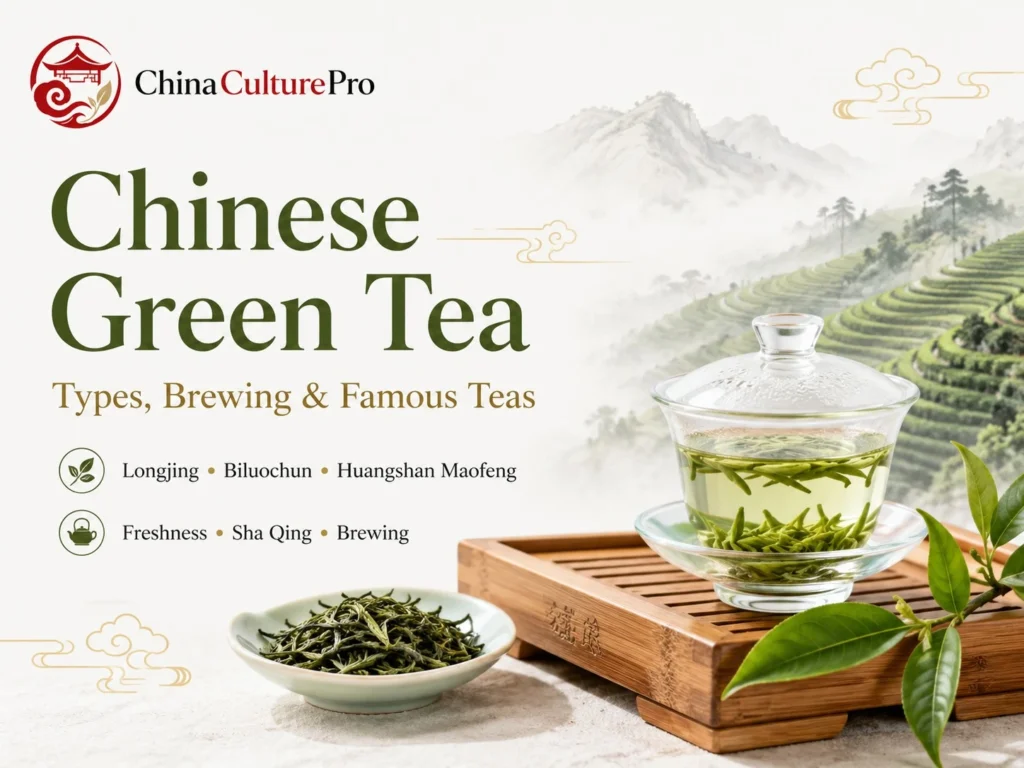

Quick Answer: What Is Chinese Green Tea?
Chinese green tea is one of the six major types of Chinese tea. In Chinese, it is called Lü Cha (绿茶). It is an unoxidized or minimally oxidized tea, and its core craft is Sha Qing (杀青), usually translated as heat-fixing or “killing the green.”
Sha Qing stops enzymatic oxidation soon after the fresh leaves are picked. This helps preserve the green color, fresh aroma, tender character, and clear taste of spring tea leaves.
Chinese green tea is known for freshness. Its taste may be grassy, chestnut-like, bean-like, vegetal, floral, brisk, clean, or lightly sweet. Good green tea is usually light but not empty, clear but not thin.
| Item | Detail |
|---|---|
| Main Topic | Chinese Green Tea / 中国绿茶 |
| Tea Category | Unoxidized or minimally oxidized tea |
| Core Craft | Sha Qing / heat-fixing |
| Taste Direction | Fresh, grassy, chestnut-like, vegetal, clear |
| Famous Examples | Longjing, Biluochun, Huangshan Maofeng |
| Key Brewing Rule | Avoid boiling water for tender green tea |
Key Point: Chinese green tea is not all Chinese tea, and it is not simply any tea that looks green. It is a specific tea category shaped by fresh leaves, early heat-fixing, careful drying, and a cultural preference for freshness.
Why Green Tea Matters in Chinese Tea Culture
Green tea matters in Chinese tea culture because it is one of the most familiar and widely recognized tea types in China.
For many Chinese people, the first famous teas they learn about are green teas: Longjing, Biluochun, Huangshan Maofeng, Xinyang Maojian, Liu’an Guapian, and Taiping Houkui. These names are not only tea names. They also suggest regions, mountains, seasons, picking standards, leaf shapes, and local pride.
Green tea is closely tied to spring. Words such as Mingqian tea, Yuqian tea, Qingming, Grain Rain, spring buds, mountain mist, and tender leaves often appear in conversations about high-quality Chinese green tea. When people talk about good green tea, they are often talking about the freshness of a specific season.
In daily life, green tea appears in many simple but meaningful scenes:
- Office drinking: a glass cup with green tea leaves floating and sinking through the day.
- Home hospitality: serving fresh spring green tea to guests.
- After meals: drinking light green tea to refresh the mouth.
- Seasonal gifting: giving new spring tea as a refined but practical gift.
- Tea tasting: comparing tenderness, aroma, liquor color, and aftertaste.
- Regional pride: connecting a tea with Hangzhou, Suzhou, Huangshan, Xinyang, Anji, or another tea region.
Chinese green tea has a lighter cultural character than many heavier teas. Wuyi Rock Tea can feel deep, roasted, and mineral. Pu’er can feel aged, thick, and shaped by time. Black tea can feel warm, sweet, and malty. Green tea is clearer, fresher, and more delicate.
Its beauty lies in qing: clean, fresh, clear, and refined.
A Chinese tea teacher might say: green tea is not the most complicated tea, but it is very demanding. Freshness must be right. Fire must be right. Water must be right. If one part is careless, the tea becomes flat, bitter, grassy, or stale.
This is why green tea represents an important Chinese tea aesthetic: clear but not thin, light but not empty.
How Chinese Green Tea Is Made
Chinese green tea is defined by craft. The most important craft step is Sha Qing (杀青), usually translated as heat-fixing or “killing the green.”
Fresh tea leaves naturally begin to oxidize after picking. If oxidation continues, the leaf moves toward oolong or black tea styles. Green tea stops that process early. Heat is applied to deactivate enzymes, preserve the green character, and keep the fresh taste of the leaf.
| Step | Chinese Term | What It Does |
|---|---|---|
| Picking | 采摘 | decides tenderness, grade, and style |
| Spreading | 摊放 | reduces moisture and softens the leaf |
| Fixing | 杀青 | stops oxidation and keeps the fresh green character |
| Shaping / Rolling | 揉捻 / 理条 | forms leaf shape and helps flavor release |
| Drying | 干燥 | stabilizes aroma and storage |
Picking decides much more than appearance. It affects tenderness, price, body, aroma, and taste direction. Some green teas use very tender buds. Others use one bud with one leaf, one bud with two leaves, or mature single leaves.
Mingqian tea, or pre-Qingming tea, is often prized because the leaves are very tender and early. Yuqian tea, picked before Grain Rain, is usually slightly stronger and often offers better value. But timing alone does not decide quality. Region, cultivar, weather, craft, and storage still matter.
Sha Qing is the soul of Chinese green tea. If Sha Qing is not enough, the tea may keep a raw grassy smell. If Sha Qing is too heavy, the fresh taste may disappear and the tea may become dull or scorched.
Different fixing methods create different aroma directions.
| Fixing Style | Aroma Direction | Examples / Notes |
|---|---|---|
| Pan-firing | chestnut, bean, roasted nut | Longjing and many Chinese green teas |
| Baking | clean, floral, soft | Huangshan Maofeng, Taiping Houkui |
| Steaming | vegetal, seaweed-like, bright | Enshi Yulu |
| Sun-drying | sun-dried base character | Yunnan sun-dried green tea, Pu’er maocha context |
Shaping also matters. Longjing is pressed into flat leaves. Biluochun is rolled into curled spirals. Huangshan Maofeng keeps tender hairy tips. Taiping Houkui has long, flat, large leaves. Liu’an Guapian uses single leaf slices. These shapes are not only visual; they come from craft and affect how the tea releases flavor in water.
A tea master might say: good green tea is not simply green. It must be fresh, fragrant, clean, and sweet in balance. The fire must remove raw greenness without burning away spring.
Chinese Green Tea vs Other Tea Types
Chinese green tea is different from other tea types because it focuses on preserving the fresh character of the leaf. It does not rely on full oxidation, post-fermentation, long aging, or heavy roasting to build depth.
| Tea Type | Main Difference From Green Tea | Taste Direction |
|---|---|---|
| White Tea | no Sha Qing; mainly withered and dried | softer, gentler, lightly sweet |
| Yellow Tea | similar base to green tea, but with a yellowing step | mellow, smooth, less sharp |
| Oolong Tea | partially oxidized, often shaken and sometimes roasted | floral, fruity, roasted, complex |
| Black Tea | fully oxidized; called Hong Cha in Chinese | warmer, sweeter, malty |
| Dark Tea | post-fermented and often aged | earthy, deep, mellow, aged |
For deeper comparisons, see our Chinese White Tea, Chinese Yellow Tea, Chinese Oolong Tea, Chinese Black Tea, and Chinese Dark Tea guides.
Green tea is the tea of freshness. It values the original spring leaf, not long transformation. A good green tea keeps the leaf’s fresh aroma, clear liquor, tender taste, and clean aftertaste.
This is why most Chinese green teas are best enjoyed fresh, usually within the same year. Unlike Pu’er or many dark teas, green tea is not usually a tea for long aging.
Famous Chinese Green Teas
Chinese green tea has many famous regional styles. Each tea has its own Chinese name, region, leaf shape, aroma, and cultural identity.
The table below gives a practical overview. Each tea can later become its own detailed guide.
| Tea | Chinese Name | Region | Leaf Style | Taste Direction | Quick Note |
|---|---|---|---|---|---|
| Longjing / Dragon Well | 龙井 | Zhejiang | flat leaf | chestnut-like, bean-like, fresh, smooth | the classic Chinese green tea anchor |
| Biluochun | 碧螺春 | Jiangsu | curled spiral leaf | floral-fruity, delicate, lively | famous for high aroma and tender leaves |
| Huangshan Maofeng | 黄山毛峰 | Anhui | tender hairy tips | fresh, sweet, soft | a gentle mountain green tea style |
| Xinyang Maojian | 信阳毛尖 | Henan | fine twisted leaf | brisk, fresh, aromatic | stronger and more forceful than many delicate green teas |
| Liu’an Guapian | 六安瓜片 | Anhui | single leaf slices | rich, clean, sweet, lightly baked | known for using leaves without buds or stems |
| Taiping Houkui | 太平猴魁 | Anhui | long flat leaves | orchid-like, elegant, mellow | visually striking, with large leaf shape |
| Anji White Tea | 安吉白茶 | Zhejiang | pale tender leaf | amino-rich, fresh, sweet, low bitterness | a green tea despite the name “White Tea” |
| Enshi Yulu | 恩施玉露 | Hubei | steamed needle-like leaf | vegetal, bright, clean | one of China’s rare steamed green teas |
Longjing, Biluochun, and Huangshan Maofeng are the easiest beginner anchors because they show three clear green tea directions: classic flat-leaf freshness, delicate high aroma, and soft mountain sweetness.
Anji White Tea needs special attention because its English name can mislead beginners. It is not a white tea by processing. It is a green tea made from a pale-leaf cultivar and is known for fresh sweetness and low bitterness.
Enshi Yulu is also useful for comparison because it represents China’s rare steamed green tea tradition, while most Chinese green teas are pan-fired or baked.
Longjing, Biluochun, and Huangshan Maofeng: Three Beginner Anchors
Beginners can feel overwhelmed by famous Chinese green teas. A useful way to start is to use three anchor teas: Longjing, Biluochun, and Huangshan Maofeng. Together, they create a simple taste map for Chinese green tea.
| Beginner Anchor | Leaf Shape | Taste Direction | What It Teaches | Beginner Note |
|---|---|---|---|---|
| Longjing | flat | chestnut-like, bean-like, fresh, smooth | the classic Chinese green tea profile: clean, fresh, smooth, and gently sweet | you do not need to start with the most expensive West Lake Longjing; a reliable Longjing-style tea can teach the basic profile |
| Biluochun | curled | floral-fruity, delicate, lively | fragrance, tenderness, and the aromatic side of green tea | useful for understanding that green tea is not only grassy |
| Huangshan Maofeng | hairy tips | soft, fresh, lightly sweet | mountain green tea, gentle sweetness, and a softer form of freshness | good for beginners who want a less sharp and less aggressive green tea |
A tea teacher might say: if you do not know where to begin, do not chase the most expensive tea first. Use these three teas to build your taste coordinates: Longjing for classic freshness, Biluochun for high aroma, and Huangshan Maofeng for softness.
Once these three are clear, other Chinese green teas become easier to understand.
What Chinese Green Tea Tastes Like
Chinese green tea is often described as grassy, but that is too simple. Good Chinese green tea can be nutty, bean-like, floral, vegetal, brisk, sweet, or clean. Its taste depends on cultivar, region, picking season, Sha Qing method, drying, freshness, storage, and brewing.
Common aroma and taste directions include:
- Chestnut-like or roasted nut: often found in pan-fired green teas, especially Longjing-style teas.
- Bean-like: a classic note in good Longjing, giving the tea a clean, warm, pan-fired character.
- Floral-fruity: common in delicate teas such as Biluochun, where the fragrance can feel high, lively, and tender.
- Fresh vegetal: linked with tender spring leaves, young buds, and fresh green tea character.
- Orchid-like: often associated with Taiping Houkui and some mountain green teas such as Huangshan Maofeng.
- Seaweed-like or steamed vegetal: more common in steamed green tea such as Enshi Yulu.
- Sweet aftertaste: a sign of clean balance. After the tea is swallowed, the mouth should feel fresh, lightly sweet, and comfortable.
- Harsh bitterness: often points to poor brewing, poor storage, old tea, too much leaf, water that is too hot, or tea of lower quality.
Good Chinese green tea is often fresh, brisk, light, clean, and gently sweet. A slight bitterness or astringency can appear, especially if the tea is stronger or brewed hotter, but good bitterness should transform. It should open into sweetness, freshness, or a clean finish.
If bitterness stays harsh and rough, the tea may have been brewed badly, stored badly, or made from lower-quality leaves.
High-quality green tea is not always “strong” in a heavy sense. It may be light but full of detail. This is why Chinese tea drinkers often value tea that is clear but not thin, light but not empty.
To learn how to evaluate aroma, mouthfeel, bitterness, sweetness, and aftertaste more systematically, read our Chinese Tea Tasting guide.
How to Brew Chinese Green Tea Without Bitterness
Many people think they dislike green tea because they have only tasted green tea brewed too hot or too long.
Chinese green tea is sensitive. Tender green tea leaves do not usually need boiling water. If the water is too hot, the tea may become bitter, rough, yellow, or cooked.
| Green Tea Style | Water Temperature | Brewing Note |
|---|---|---|
| Tender bud tea | 70–80°C / 158–176°F | gentle water, short steep |
| Longjing-style tea | 80–85°C / 176–185°F | glass cup or gaiwan |
| Stronger leaf tea | around 85°C / 185°F | slightly hotter, do not oversteep |
| Gaiwan tasting | 80–85°C / 176–185°F | short infusions |
The three basic rules are simple:
- Do not use water that is too hot.
- Do not steep for too long.
- Do not use too much leaf.
For many daily green teas, about 3 grams of tea is enough for a standard cup or small brewing session. The exact amount depends on cup size, tea style, and personal taste.
There are three common ways to add tea and water:
- Top-drop method: add water first, then tea. This works well for very tender teas such as Biluochun or Anji White Tea. The leaves slowly sink and open in warm water.
- Middle-drop method: add a small amount of water first, add tea, then add more water. This works well for medium-tender teas such as Longjing or Huangshan Maofeng.
- Bottom-drop method: add tea first, then water. This works for stronger leaf teas such as Liu’an Guapian or Taiping Houkui.
A gaiwan can also be used for green tea tasting. Use water around 80–85°C and short infusions. Do not leave the leaves sitting too long in hot water.
A Chinese tea practitioner might say: green tea brewed bitter is often not the tea’s fault. The water was too hot, the tea was too heavy, or the steep was too long. Green tea is not Pu’er. It should not be trapped in boiling water and left to stew.
A well-brewed green tea should have clear liquor, fresh aroma, and a clean taste. If the liquor becomes dark, cloudy, harsh, or cooked, check water temperature, leaf amount, and steeping time first.
Glass Cup, Gaiwan, or Teapot: Best Teaware for Green Tea
Teaware matters because Chinese green tea is sensitive to heat. Tender green tea usually prefers clean, light, fast-cooling vessels. Thick or heat-trapping vessels can cook the leaves and damage freshness.
| Teaware | Best Use | Why It Works / Risk | Best For |
|---|---|---|---|
| Glass Cup | watching tender leaves open | simple, affordable, easy to observe leaf movement and water color; avoid oversteeping | Longjing, Biluochun, Huangshan Maofeng, Anji White Tea, and other tender green teas |
| Gaiwan | tasting and controlling infusion time | gives better control over water contact and pouring speed; pour out quickly to avoid bitterness | careful tasting, comparing teas, short infusions |
| Porcelain Teapot | sharing light green tea with guests | works well if the pot is not too thick and the infusion stays light; do not leave leaves sitting too long | serving several people |
| Yixing Teapot | usually not ideal for tender green tea | holds heat and aroma strongly, which can make fresh green tea taste cooked, dull, or bitter | better suited to oolong, Pu’er, and some darker teas |
| Thermos | practical for daily convenience | long heat can make green tea stewed, yellow, red, or bitter | ordinary daily tea, not high-quality spring green tea |
For fresh spring green tea, the safest rule is simple: use glass or porcelain, avoid trapping heat, and do not let the leaves stew.
Freshness, Spring Tea, and Storage
Freshness is one of the most important qualities in Chinese green tea.
Many teas can improve or transform with time. Green tea usually does not. Most green tea is valued for freshness and is best enjoyed within the same year.
Spring Tea
Spring tea is highly valued because the leaves are tender and rich in fresh aroma.
Mingqian tea, or pre-Qingming tea, is picked before the Qingming Festival. It is often tender, delicate, and expensive. Yuqian tea, picked before Grain Rain, is usually slightly stronger and often offers good value.
Still, Mingqian does not automatically mean best. A good Yuqian tea from a reliable region can be better than a weak Mingqian tea from a poor source.
Quality depends on region, cultivar, weather, picking, processing, freshness, and storage.
New Tea and Fire
New tea often has bright aroma and fresh taste. But tea that has just been pan-fired may carry some fire energy, a dry or roasted edge from processing. Some green teas taste better after resting briefly for one or two weeks.
This does not mean green tea should be aged like Pu’er. It only means very newly made tea may need a short time to settle.
Storage
Green tea is sensitive to light, heat, moisture, odor, and oxygen.
| Factor | Why It Matters | Storage Direction |
|---|---|---|
| Light | damages color and aroma | use opaque bag or tin |
| Heat | speeds aging | keep cool |
| Moisture | causes dullness or spoilage | seal tightly |
| Odor | tea absorbs smells easily | keep away from spices |
| Oxygen | reduces freshness | limit air exposure |
A practical storage method is to keep green tea sealed, cool, dry, and away from strong smells. Many people store good green tea in the refrigerator at low temperature, but the package must be sealed well.
When taking refrigerated tea out, let it return closer to room temperature before opening. This helps reduce condensation.
The basic rule is simple: do not buy too much green tea if you cannot finish it fresh. Most green tea is not a tea for long hoarding.
Chinese Green Tea Benefits: What to Say Carefully
Many people search for Chinese green tea benefits, but this topic should be handled carefully. Green tea can be part of a healthy lifestyle, but it is not medicine.
Chinese green tea contains tea polyphenols, catechins such as EGCG, caffeine, amino acids such as L-theanine, and aromatic compounds. These compounds are often studied in relation to antioxidants, focus, metabolism, and general wellness.
- Antioxidants: Green tea contains catechins such as EGCG, which are commonly discussed for antioxidant activity.
- Focus and alertness: Green tea contains caffeine, and it also contains amino acids such as L-theanine. This combination may support a clearer, calmer kind of alertness for some people.
- After-meal refreshment: Many Chinese people drink light green tea after food because it feels clean and refreshing. This is a daily habit, not a medical treatment.
- Weight management: Green tea is not a standalone weight-loss solution. Diet, exercise, sleep, and overall lifestyle matter much more.
- Heart and metabolism: Research on green tea and metabolic health is ongoing. It is safer to describe green tea as one part of a healthy lifestyle, not as a cure or guaranteed result.
Some people should also be cautious. Strong green tea on an empty stomach may irritate the stomach. People who are sensitive to caffeine should control the amount. Pregnant or breastfeeding people, people with stomach weakness, or people taking medication should ask a qualified professional if they are unsure.
In Chinese daily life, many people value green tea not because it promises dramatic health results, but because it feels clean, refreshing, and pleasant.
That is enough. A tea does not need to become a medicine to be valuable.
Common Mistakes About Chinese Green Tea
Chinese green tea is easy to enjoy, but it is also easy to brew badly. These are the most common mistakes to avoid.
- Using boiling water: Tender green tea needs cooler water. Boiling water can extract bitterness and make the leaves taste cooked.
- Steeping too long: Bitterness increases quickly when green tea sits in hot water for too long. If the tea tastes harsh, shorten the steeping time first.
- Using too much leaf: More tea does not always mean better flavor. Too much green tea can become strong, rough, and astringent.
- Thinking Anji White Tea is white tea: Anji White Tea is green tea despite its name. The name comes from the pale young leaves of the cultivar, but the tea is made with green tea processing.
- Treating jasmine tea as the main Chinese green tea style: Jasmine tea is scented tea, often made with a green tea base. It should not be treated as the main profile of Chinese green tea.
- Thinking older green tea is better: Most Chinese green tea is valued for freshness, not age. Old green tea usually loses aroma, brightness, and fresh taste unless handled in a very specific way.
- Thinking strong bitterness means quality: Good green tea may have slight bitterness or astringency, but it should transform into sweetness, freshness, or a clean finish. Bitterness that stays harsh is not a sign of quality.
- Brewing high-quality green tea in a thermos for too long: Long heat can make green tea taste stewed, yellow, red, or bitter. A thermos is practical, but it is not ideal for fresh spring green tea.
- Thinking brighter green always means better: Natural tea color varies by cultivar, season, processing, and storage. A very bright green color does not automatically mean higher quality.
- Thinking Mingqian tea is always best: Mingqian tea is prized for tenderness and early-spring freshness, but origin, cultivar, weather, craft, and storage still matter. A well-made Yuqian tea can be better than a weak Mingqian tea.
How to Choose Chinese Green Tea for Beginners
Beginners do not need to start with the most expensive tea. A good starting tea should match the taste experience you want to understand first.
- For classic Chinese green tea: Start with Longjing. It teaches the basic profile of flat leaves, chestnut-like aroma, freshness, smoothness, and gentle sweetness.
- For floral and delicate aroma: Try Biluochun. It is useful for understanding high fragrance, tender leaves, and a more delicate green tea style.
- For a soft and fresh taste: Choose Huangshan Maofeng. It is gentle, fresh, lightly sweet, and less aggressive than stronger green teas.
- For a stronger and brisker cup: Try Xinyang Maojian or Liu’an Guapian. These teas can feel more forceful, aromatic, and structured.
- For unique leaf shape: Choose Taiping Houkui. Its large, long, flat leaves make it visually memorable, and its orchid-like aroma is easy to recognize.
- For sweetness and low bitterness: Try Anji White Tea. Despite its name, it is a green tea, and it is known for a fresh, sweet, amino-rich taste.
- For better value: Look for a reliable Yuqian tea from a good region. You do not always need to chase the most expensive Mingqian or West Lake Longjing tea.
A useful beginner strategy is to avoid chasing only the most famous or most expensive version. West Lake Longjing can be excellent, but it is not the only way to learn green tea. A reliable tea from a good region, brewed well, teaches more than an expensive tea brewed badly.
Use a glass cup. Use cooler water. Pay attention to aroma, taste, and aftertaste. First build a personal standard for what good green tea should feel like.
How Chinese Green Tea Connects to Chinese Tea Culture
Chinese green tea is the first major tea-type page under the Chinese Tea Culture core guide. It connects the larger tea system with specific green tea names, brewing methods, teaware, and storage habits.
- To understand the full tea system first, read our Chinese Tea Culture guide.
- To compare green tea with white, yellow, oolong, black, and dark tea, read our Chinese Tea Types guide.
- For China’s most famous flat-leaf green tea, read our Longjing Tea guide.
- For curled, floral Chinese green tea, read our Biluochun Tea guide.
- For soft mountain green tea from Anhui, read our Huangshan Maofeng guide.
- For brisk and aromatic green tea, read our Xinyang Maojian guide.
- For single-leaf green tea from Anhui, read our Liu’an Guapian guide.
- For large-leaf orchid-like green tea, Taiping Houkui is another important style to explore.
- For the famous green tea often mistaken for white tea, read our Anji White Tea guide.
- For rare steamed Chinese green tea, read our Enshi Yulu guide.
- For broader brewing temperatures and methods, read our How to Brew Chinese Tea guide.
- For glass cups, gaiwans, and tea tools, read our Chinese Teaware guide.
- For freshness and storage, Tea Storage can be added as a dedicated internal-link destination after that guide is published.
Final Thoughts
Chinese green tea is about freshness.
It does not rely on full oxidation like black tea. It does not rely on aging like Pu’er. Its key is to preserve the clear fragrance, tenderness, and fresh taste of spring leaves.
Sha Qing is the soul of green tea. Water temperature is the key to brewing. Freshness is the baseline of drinking.
To understand Chinese green tea, you need more than tea names. Longjing and Biluochun matter, but so do spring picking, leaf tenderness, heat-fixing, water temperature, storage, and the way bitterness turns into sweetness.
A good Chinese green tea is not necessarily heavy. It can be light, but still full of detail. It can be clear, but not thin. It can be delicate, but not empty.
That is the Chinese green tea aesthetic: fresh, clean, gentle, and alive with spring.
FAQs About Chinese Green Tea
What is Chinese green tea?
Chinese green tea is one of the six major Chinese tea types. It is unoxidized or minimally oxidized, and its core craft is Sha Qing, or heat-fixing. This process stops oxidation and preserves the fresh, green, clear, and lightly sweet character of the tea.
What are the most famous Chinese green teas?
Famous Chinese green teas include Longjing, Biluochun, Huangshan Maofeng, Xinyang Maojian, Liu’an Guapian, Taiping Houkui, Anji White Tea, and Enshi Yulu. Each has a different region, leaf shape, aroma, and taste direction.
Is Longjing a green tea?
Yes. Longjing, also called Dragon Well, is one of China’s most famous green teas. It is especially associated with Hangzhou in Zhejiang. It is known for flat leaves, chestnut-like or bean-like aroma, fresh taste, and smooth sweetness.
Is Anji White Tea actually green tea?
Yes. Anji White Tea is a green tea despite its name. The name comes from the pale color of the young leaves of a special tea cultivar. It is processed like green tea, with heat-fixing, and is known for fresh sweetness and high amino acid character.
What is the best Chinese green tea for beginners?
Longjing is a good classic starting point. Biluochun is good for floral aroma and tenderness. Huangshan Maofeng is soft and fresh. Anji White Tea is sweet and gentle. Beginners do not need to start with the most expensive tea; correct brewing matters more.
How do you brew Chinese green tea without bitterness?
Use cooler water, shorter steeping, and moderate leaf amount. Tender green tea often works best around 70–80°C / 158–176°F. Longjing-style teas often work around 80–85°C / 176–185°F. Avoid boiling water and do not let green tea steep too long.
What water temperature is best for Chinese green tea?
Most Chinese green teas brew well between 70–85°C / 158–185°F. Tender bud teas need lower temperatures. Stronger leaf teas can handle slightly hotter water. Boiling water is usually too harsh for delicate green tea.
Can Chinese green tea be brewed in a glass cup?
Yes. A glass cup is one of the best tools for Chinese green tea. It lets you watch the leaves open and helps prevent overheating. It is especially suitable for Longjing, Biluochun, Huangshan Maofeng, and Anji White Tea.
Is Chinese green tea caffeinated?
Yes. Chinese green tea contains caffeine. The exact amount depends on cultivar, leaf tenderness, harvest time, tea amount, water temperature, and steeping time. People sensitive to caffeine should drink moderately and avoid strong green tea late in the day.
Is Chinese green tea good for weight loss?
Chinese green tea may support a healthy lifestyle, but it is not a standalone weight-loss solution. It contains catechins and caffeine, but body weight depends on diet, activity, sleep, metabolism, and overall habits. Green tea should not be treated as a diet medicine.
How should Chinese green tea be stored?
Chinese green tea should be stored sealed, cool, dry, dark, and away from strong odors. Light, heat, moisture, oxygen, and smell can damage freshness. Many good green teas are stored in sealed packaging in the refrigerator and consumed within the same year.
What is the difference between Chinese green tea and Japanese green tea?
Chinese green tea is often pan-fired, creating chestnut-like, bean-like, or roasted-nut notes. Japanese green tea is often steamed, creating brighter vegetal or seaweed-like notes. Chinese green tea has many regional craft styles, while Japanese green tea is more strongly shaped by steaming traditions.