
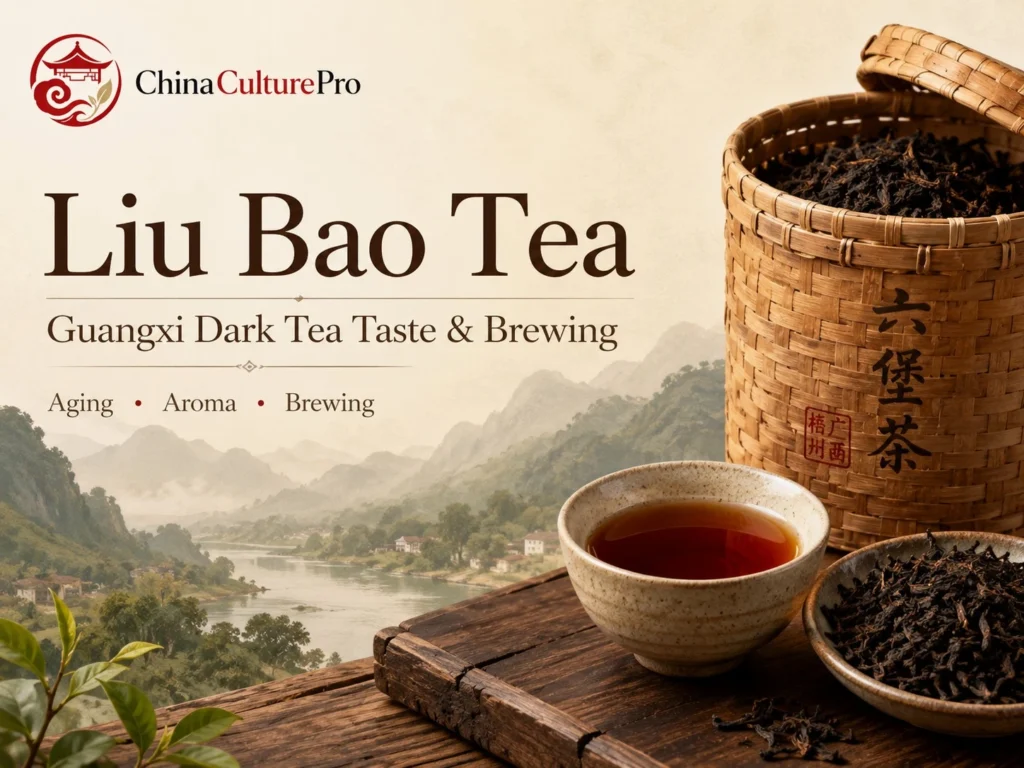

Quick Answer: What Is Liu Bao Tea?
Liu Bao Tea, also written as Liubao Tea or Liu Bao Cha, is a Chinese dark tea originating in Liu Bao Town, Cangwu County, Wuzhou, Guangxi. Its character develops through dark-tea processing, post-fermentation, resting, and storage.
Its basic identity is:
Chinese Name: 六堡茶.
Tea Type: Chinese dark tea, or hei cha.
Historical Birthplace: Liu Bao Town, Cangwu County, Wuzhou.
Modern Production Area: The wider Wuzhou region.
Main Styles: Traditional or farmer-style Liu Bao and modern factory-refined Liu Bao.
Common Forms: Loose tea, bamboo baskets, bricks, cakes, and other compressed forms.
Classic Quality Standard: Red, rich, aged, and mellow.
Representative Aroma: Betel nut aroma, although not every Liu Bao expresses it.
Common Flavors: Flowers, herbs, pine smoke, wood, fungi, jujube, medicine, dried fruit, and aged fragrance.
Liquor: Amber-red, reddish brown, or deep red.
Taste: Clean, substantial, smooth, mellow, and capable of returning sweetness.
Brewing: Near-boiling or boiling water through gongfu brewing, large-pot steeping, thermos steeping, or boiling.
Liu Bao and ripe Pu-erh can both have dark liquor and wet-piled styles, but Liu Bao has its own Guangxi origin, production traditions, bamboo-basket culture, river-trade history, and sensory language. Good Liu Bao is defined by clean aroma, bright substantial liquor, smooth texture, returning sweetness, and a comfortable throat—not extreme darkness, damp warehouse odor, age, or marketing stories.
To understand where Liu Bao fits among China’s post-fermented teas, read [Chinese Dark Tea].
Name, Tea Type, and Basic Identity
Liu Bao Tea, Liubao Tea, and Liu Bao Cha all refer to 六堡茶. The name comes from Liu Bao Town, its historical birthplace, rather than a literal story about “six forts” or “six castles.”
| Identity Point | What It Means |
|---|---|
| Chinese Name | 六堡茶 |
| Pinyin | Liu Bao Cha |
| Common English Names | Liu Bao Tea, Liubao Tea |
| Tea Category | Chinese dark tea / hei cha |
| Historical Birthplace | Liu Bao Town, Cangwu County, Wuzhou |
| Modern Protected Area | Wuzhou, Guangxi |
| Processing Character | Post-fermentation followed by resting or aging |
| Common Forms | Loose tea, bamboo baskets, bricks, cakes, and other compressed forms |
| Representative Qualities | Red liquor, rich body, clean aged aroma, mellowness, and possible betel nut character |
| Not The Same As | English black tea, Pu-erh tea, herbal tea, or betel-nut-flavored tea |
Liu Bao is dark tea rather than English black tea. Hei cha develops through piling, microbial transformation, later processing, and storage, while English black tea corresponds to Chinese hong cha and is shaped mainly through enzymatic oxidation. Liu Bao is also separate from Pu-erh, with different regional materials, processing traditions, product forms, trade routes, and aging culture.
Betel nut aroma is a natural sensory description. It does not mean that betel nut or flavoring has been added.
For an overview of China’s major processing families, see Chinese Tea Types.
Origin and History: Liu Bao Town, Wuzhou, and the Tea Boat Route
Liu Bao Town in Cangwu County is the historical birthplace of the tea, while Wuzhou later became its main refining, warehousing, production, and trading center.
| Place | Role in Liu Bao Tea |
|---|---|
| Liu Bao Town | Historical birthplace and source of the tea’s name |
| Cangwu County | County containing Liu Bao Town and surrounding tea areas |
| Wuzhou | Modern production, refining, warehousing, and trade center |
| West River System | Connected rural Guangxi with the Pearl River Delta |
| Guangzhou, Hong Kong, and Macau | Important commercial and transshipment centers |
| Malaysia and Singapore | Major historical Southeast Asian markets |
Before modern roads, tea moved from mountain villages to river landings and followed the Liu Bao, Dong’an, He, and West rivers toward Guangzhou and the Pearl River trading network. It then continued through Hong Kong or Macau to Southeast Asia. This became known as the Tea Boat Route.
Bamboo baskets were light, stackable, economical, and suitable for bulk transport and gradual moisture exchange. Basket packing therefore became central to Liu Bao’s commercial and aging history, although old baskets do not guarantee old or well-stored tea.
During the nineteenth and twentieth centuries, Liu Bao became an important tea for overseas Chinese communities in Malaysia and Singapore, including miners and laborers who valued its affordability, strong extraction, and suitability for large-pot brewing. Traditional beliefs that it reduced dampness or aided digestion belong to this cultural history rather than established medical evidence.
Liu Bao’s river and overseas trade history forms part of the wider story of Chinese Tea Culture.
Traditional and Modern Liu Bao Tea
The most useful distinction is between traditional or farmer-style Liu Bao and modern factory-refined Liu Bao. The categories can overlap because traditionally processed raw tea may later be sorted, blended, packed, and aged by a factory.
| Point | Traditional or Farmer-Style Liu Bao | Modern Factory-Processed Liu Bao |
|---|---|---|
| Historical Context | Village and origin-area production traditions | Industrial refinement developed for consistency and larger markets |
| Fermentation | Lighter, staged humid-heat transformation and gradual aging | Controlled wet-piling to accelerate fermentation |
| Young Liquor | Amber, orange-red, or lighter red | Red-brown to deep red |
| Young Aroma | Flowers, herbs, fresh wood, pine smoke, or forest plants | Wood, clean fermentation, fungi, jujube, or mellow aged notes |
| Mouthfeel | More freshness, astringency, and liveliness may remain | Usually softer, darker, and smoother earlier |
| Aging Direction | Smoke and herbal notes may develop into wood, medicine, and aged fragrance | Pile aroma may settle into cleaner wood, sweetness, and mature notes |
| Common Forms | Loose farmer tea, baskets, or later refined products | Loose tea, baskets, bricks, cakes, and other compressed forms |
Traditional Liu Bao can be lighter, fresher, and more structured than many drinkers expect. Modern wet-piled Liu Bao is usually darker and smoother earlier, although newly processed tea may retain a clean fermentation aroma that needs time to settle.
The market terms raw Liu Bao and ripe Liu Bao are convenient but do not form a historical classification equivalent to raw and ripe Pu-erh. Neither style is automatically better; quality depends on the material, fermentation control, drying, storage, and present cup quality.
How Liu Bao Tea Is Made
Traditional and modern Liu Bao share the basic logic of dark-tea processing, but differ in fermentation intensity, drying, refinement, and storage.
- Plucking And Spreading / 采摘、摊放 Leaves are selected according to the intended style and spread to release surface moisture. Liu Bao does not have to be made entirely from young buds; mature leaves can provide useful structure for fermentation and aging.
- Kill-Green / 杀青 Heat reduces enzymatic activity, softens the leaves, and prepares them for rolling without scorching them.
- Rolling / 揉捻 Rolling shapes the leaves and opens part of their structure for later humid-heat transformation.
- Steaming And Piling / 汽蒸、渥堆 Traditional processing may use steaming, piling, and repeated humid-heat treatment. The aim is to reduce raw greenness and harshness while retaining sweetness and structure.
- Traditional Drying / 传统干燥 Some traditional Liu Bao is dried using pinewood or other local wood-fired methods. Clean smoke can add warmth and structure; soot, ash, burnt bitterness, and dirty smoke are defects.
- Sorting And Blending / 筛分、拼配 Tea may be screened, cleaned, graded, and blended before refinement or packing. Blending can coordinate aroma, body, fermentation level, and batch consistency.
- Modern Wet-Piling / 现代冷水渥堆 Modern factory tea may be moistened and piled under controlled conditions. Producers monitor moisture, pile temperature, aroma, leaf color, airflow, time, and uniformity, turning the pile when needed.
- Drying And Refining / 干燥、精制 Fermented tea is spread or dried to reduce moisture and stop excessive transformation. Poor control may leave sourness, rotten odors, heavy pile aroma, or uneven color.
- Steaming And Packing / 汽蒸、装篓 Refined tea may be packed loose, placed in bamboo baskets, or compressed into bricks, cakes, and other forms.
- Resting And Aging / 静置、陈化 Newly processed tea often benefits from resting so smoke or pile aroma can settle and the liquor can become cleaner and more coordinated.
Traditional and modern methods should not be ranked automatically. A well-controlled factory tea can be better than poorly made farmer tea, while carefully produced traditional Liu Bao may offer more freshness, structure, and a different aging path.
What Does Liu Bao Tea Taste Like?
Liu Bao changes substantially with processing, fermentation, drying, age, and storage. The traditional phrase “red, rich, aged, and mellow” is best understood as a quality framework rather than a requirement that every tea be extremely dark or old.
| Style | Common Aroma and Taste |
|---|---|
| Young Traditional Liu Bao | Flowers, herbs, pine smoke, fresh wood, dry grass, sweetness, and lively structure |
| Modern Fermented Liu Bao | Wood, clean fermentation, fungi, jujube, mild medicine, and rounded body |
| Clean Aged Liu Bao | Old wood, medicine, dried fruit, cooling sensations, sweetness, and possible betel nut character |
| Poorly Stored Liu Bao | Mold, wet cellar, sourness, rotten odor, dirty earth, stale dampness, and throat discomfort |
Betel nut aroma is a representative but not compulsory Liu Bao quality. Experienced drinkers may recognize it as a combination of clean aged wood, dry herbs, a faint spicy edge, cooling or clearing sensations, sweetness, and a lingering throat impression. It does not necessarily smell like an actual areca nut.
| Desirable Character | Possible Defect |
|---|---|
| Clean wood, medicine, fungi, or aged aroma | Mold, rot, sourness, dirty dampness, or perfume |
| Integrated pine smoke | Soot, burnt oil, ash, or harsh smoke |
| Clear amber-red to deep red liquor | Muddy, oily-looking, or lifeless darkness |
| Full, smooth mouthfeel | Thin, sticky, rough, or oppressive heaviness |
| Returning sweetness and comfortable throat | Persistent dryness, irritation, locking, or dirty residue |
| Development across infusions | Dark color followed by rapid collapse |
Chinese tea drinkers distinguish mellow from empty. Mellow Liu Bao retains body, aroma, and sweetness after its roughness softens; empty tea may look dark and smooth but lacks depth, aftertaste, and development.
For a broader framework for aroma, mouthfeel, hui gan, and aftertaste, read our Chinese Tea Tasting guide.
How to Taste Liu Bao Like a Tea Drinker
Liu Bao should be judged for cleanliness before age, darkness, rarity, or aroma labels.
- Identify The Style Determine whether the tea is traditional, farmer-style, modern fermented, basket packed, loose, or compressed.
- Examine The Dry Tea Look for material appropriate to the grade without excessive dust, foreign matter, dampness, or suspicious growth.
- Smell The Dry Tea Clean wood, herbs, smoke, fungi, jujube, medicine, or aged aroma may be appropriate. Avoid sharp sourness, mold, rot, perfume, or chemical odor.
- Check The Warm Aroma After a quick rinse, smell the heated leaves. Warmth reveals fermentation and storage more clearly than the dry surface.
- Observe The Liquor Amber-red, red-brown, and deep red can all be normal. Brightness and clarity matter more than darkness.
- Evaluate The Mouthfeel Look for substance, smoothness, sweetness, and vitality without stickiness, oppressive heaviness, or emptiness.
- Follow The Aftertaste Notice returning sweetness, salivation, warmth or cooling, and throat comfort.
- Follow Later Infusions Good Liu Bao often becomes cleaner and sweeter after the first few infusions rather than collapsing after its color is extracted.
- Inspect The Leaf Base The leaves should be reasonably clean for their grade, without slime, rot, extensive mold, or chemical scent.
The practical Chinese approach is simple: first determine whether the tea is clean, then ask whether it is thick, smooth, sweet, lively, and worth continuing to drink.
How to Brew Liu Bao Tea
Liu Bao usually responds well to near-boiling or boiling water.
| Brewing Method | Teaware | Water Temperature | Leaf Amount | Steeping Time | Best For |
|---|---|---|---|---|---|
| Gongfu Brewing | Gaiwan, Yixing pot, or Nixing pottery | 95–100°C / 203–212°F | 6–8g / 100–120ml | Quick rinse, then 10–20 seconds | Evaluating aroma, texture, and later infusions |
| Large-Pot Brewing | Porcelain, glass, clay, or metal pot | Near boiling | 5–8g / 500ml | 3–5 minutes | Daily shared drinking |
| Thermos Steeping | Heat-safe thermos | Boiling | 3–5g / 500ml | 30–60 minutes | Smooth and concentrated daily tea |
| Boiling | Glass, ceramic, or metal kettle | Gentle boil | 5–8g / 700–1000ml | 5–10 minutes | Mature, coarse, or already-infused leaves |
Brewing tips:
- Use A Gaiwan For Evaluation: Porcelain shows aroma, liquor, and defects clearly.
- Use Nixing Or Yixing For Daily Drinking: Clay may soften the drinking experience but cannot repair dirty tea.
- Rinse According To Condition: One quick rinse is enough for many teas; tightly compressed, dusty, or strongly stored tea may need a second.
- Do Not Over-Rinse: Repeated washing removes flavor and cannot make contaminated tea safe.
- Use Short Early Infusions: Modern wet-piled tea can become heavy when overbrewed.
- Use Full Heat For Traditional Tea: High temperature helps open woody, smoky, herbal, and aged character.
- Extend Later Infusions Gradually: Longer steeping should reveal sweetness and body rather than storage defects.
- Use Less Leaf In A Thermos: Extraction continues much longer than in gongfu brewing.
- Boil Mature Or Spent Leaves: Boiling can deepen sweetness but may also magnify sourness or mustiness.
Clean pile or warehouse aroma may lessen after airing, rinsing, and several infusions. Sour, rotten, or moldy odors should not be treated as normal fermentation character.
For practical guidance on water, ratios, and extraction, see How To Brew Chinese Tea. For gaiwans, Yixing pots, Nixing pottery, kettles, and other brewing vessels, see our Chinese Teaware guide.
Liu Bao vs Ripe Pu-erh and Anhua Dark Tea
Liu Bao, ripe Pu-erh, and Anhua Dark Tea belong to related post-fermented traditions but are not interchangeable.
| Comparison | Liu Bao Tea | Ripe Pu-erh | Anhua Dark Tea |
|---|---|---|---|
| Origin | Wuzhou, Guangxi | Yunnan | Anhua and related areas of Hunan |
| Category | Guangxi dark tea | Yunnan post-fermented tea | Hunan dark-tea system |
| Raw Material | Guangxi regional tea material | Yunnan large-leaf sun-dried mao cha | Hunan hei mao cha and product-specific material |
| Main Fermentation | Traditional humid-heat treatment or modern wet-piling | Ripe-tea wet-piling | Piling plus product-specific refining |
| Common Forms | Loose tea, bamboo baskets, bricks, and cakes | Cakes, bricks, tuocha, and loose tea | Baskets, bricks, Huajuan cylinders, and loose tea |
| Typical Aroma | Wood, medicine, fungi, jujube, smoke, age, and possible betel nut notes | Wood, dates, fermentation, earth, and aged sweetness | Pine smoke, wood, grain, fungi, herbs, medicine, and age |
| Historical Market | South China, Hong Kong, Macau, Malaysia, and Singapore | China and the international Pu-erh market | Northwestern border trade and domestic markets |
| Aging Tradition | Basket packing, Wuzhou warehousing, and Southeast Asian trade | Cake and loose-tea storage across multiple regions | Basket, brick, Fu Brick, and Huajuan aging |
Choose Liu Bao for bamboo-basket culture, medicinal wood, possible betel-nut-like complexity, and its South China–Southeast Asia history. Choose ripe Pu-erh for Yunnan wet-piled character, or Anhua Dark Tea for pine smoke, Fu Brick flowering, and Huajuan craftsmanship.
Readers can compare them further in Pu-erh Tea and Anhua Dark Tea.
How to Choose Good Liu Bao Tea
Buying Liu Bao requires more than checking the year, basket, liquor color, or aroma label.
| Checkpoint | What To Look For | Warning Signs |
|---|---|---|
| Origin | Clear Wuzhou or Liu Bao-area information | Vague “Guangxi old tea” with no traceable source |
| Producer | Identifiable factory, cooperative, farmer, or seller | Anonymous repacking |
| Processing | Traditional, farmer-style, modern fermented, or combined process explained | Raw or ripe labels with no process details |
| Date And Batch | Plausible production, packing, or batch records | Age based only on dark leaves or packaging |
| Storage | Clean, stable, and traceable conditions | Wet cellar, mold, sourness, or unverifiable return-tea stories |
| Dry Tea | Clean material appropriate to the grade | Dampness, foreign matter, suspicious growth, or chemical odor |
| Aroma | Clean wood, medicine, smoke, fungi, jujube, age, or betel nut notes | Mold, rot, rancidity, sharp sourness, or perfume |
| Liquor | Bright amber-red to deep red | Muddy, oily-looking, or lifeless darkness |
| Mouthfeel | Full, smooth, coordinated, and lively | Thin, sticky, harsh, or oppressively heavy |
| Aftertaste | Returning sweetness and comfortable throat | Persistent dryness, irritation, or dirty residue |
| Leaf Base | Clean and reasonably coherent | Rotten, slimy, heavily moldy, or chemically scented leaves |
Marketing claims that require evidence include:
- Betel Nut Aroma: A sensory description, not proof of premium grade.
- Golden Flowers: Not required in Liu Bao and not safely identified from photos alone.
- Thirty-Year Or Fifty-Year Tea: Requires credible provenance and storage history.
- Malaysian Return Tea: Should include evidence of where and how it was stored.
- Miner’s Tea: A historical association, not a defined quality category.
- Old Basket Tea: Old wrapping does not prove old contents.
- Rare Traditional Process: The seller should explain the actual production method.
- Extremely Dark Liquor: Darkness does not prove age, richness, or quality.
Prioritize clear origin and processing, clean dry and wet aromas, bright liquor, sufficient body, smoothness, returning sweetness, and a comfortable throat. Present condition matters more than the year printed on the package.
Storage and Aging
Liu Bao can transform during storage, but time alone does not improve tea. Clean aging may soften smoke or pile aroma, integrate wood and medicinal notes, round the liquor, and clarify sweetness.
Store Liu Bao according to these principles:
- Keep It Stable: Avoid repeated temperature and humidity swings.
- Keep It Dry: Prevent condensation and sustained dampness.
- Avoid Odors: Keep it away from spices, perfume, incense, smoke, chemicals, mothballs, and scented wood.
- Use Suitable Wrapping: Retain clean original paper or basket packaging and add an odor-free outer container when needed.
- Do Not Seal Damp Tea: Plastic can trap moisture and accelerate spoilage.
- Do Not Leave It Fully Exposed: Liu Bao absorbs dust, odors, and moisture.
- Check It Periodically: Inspect the tea, wrapping, aroma, moisture, and signs of insects or mold.
Bamboo baskets support bulk storage and gradual moisture exchange, but basket packing does not guarantee successful aging. Visible yellow or golden fungal structures are not required in Liu Bao and should never compensate for mold, sourness, dirty storage, or weak tea.
A clean younger Liu Bao can be better than a poorly stored old tea. Claims such as old basket, Malaysian return, warehouse discovery, or miner’s tea require credible provenance and must still be confirmed in the cup.
Benefits and Caffeine
Liu Bao is made from Camellia sinensis and naturally contains caffeine. Its dark color, smooth taste, fermentation, or age do not make it caffeine-free or necessarily low in caffeine.
- Leaf quantity, temperature, time, and total consumption affect caffeine intake.
- Thermos steeping and boiling can produce strong extraction.
- Caffeine-sensitive drinkers should avoid concentrated tea late in the day.
- People with stomach sensitivity should reduce the amount or strength.
- Pregnant people, people taking medication, or people with medical concerns should seek professional advice.
- Liu Bao should not be treated as medicine.
Traditional claims about reducing dampness or aiding digestion belong to Liu Bao’s cultural history. They should not be presented as proof that the tea treats obesity, diabetes, high blood pressure, cancer, digestive disease, or other medical conditions.
Final Thoughts
Liu Bao is a distinctive Guangxi dark tea rooted in Liu Bao Town and shaped by Wuzhou refining, the Tea Boat Route, bamboo-basket trade, and Southeast Asian Chinese communities.
Traditional village methods and modern wet-piling both belong to the category. Their value depends on clean processing, suitable material, controlled fermentation, sound storage, and the quality of the tea in the cup.
Good Liu Bao should be clean, substantial, smooth, coordinated, and comfortable in the throat. The darkest liquor, oldest date, strongest warehouse aroma, visible fungal growth, or a betel nut claim cannot replace brightness, body, sweetness, and lasting flavor.
FAQs About Liu Bao Tea
What is Liu Bao Tea?
Liu Bao is a Chinese dark tea originating in Liu Bao Town, Cangwu County, Wuzhou, Guangxi. Its character develops through dark-tea processing, post-fermentation, resting, and aging.
Is Liu Bao Tea black tea or dark tea?
It is dark tea, or hei cha. English black tea corresponds to Chinese hong cha and follows a different oxidation process.
Is Liu Bao Tea the same as Pu-erh?
No. Liu Bao comes from Guangxi, while Pu-erh comes from Yunnan. They differ in raw material, processing, product forms, trade history, aging traditions, and typical flavor.
Where is Liu Bao Tea produced?
Its historical birthplace is Liu Bao Town in Cangwu County. The modern protected production area covers the wider Wuzhou region in Guangxi.
What does Liu Bao Tea taste like?
Liu Bao may show flowers, herbs, pine smoke, wood, fungi, jujube, medicine, aged fragrance, dried fruit, or betel-nut-like character. Good tea should be clean, full, smooth, and capable of returning sweetness.
What is betel nut aroma in Liu Bao Tea?
Betel nut aroma is a traditional sensory concept combining aged wood, herbs, mild spice, cooling sensations, sweetness, and a lingering throat impression. It is not necessarily identical to the smell of an actual areca nut.
Is betel nut added to Liu Bao Tea?
No. Authentic betel nut character develops naturally through raw material, processing, drying, storage, and aging.
What is the difference between traditional and modern Liu Bao?
Traditional or farmer-style Liu Bao generally uses lighter staged humid-heat processing and longer natural transformation. Modern factory tea commonly uses controlled wet-piling to create a darker and smoother profile earlier. Neither is automatically better.
Does Liu Bao Tea have golden flowers?
Some Liu Bao may show yellow or golden fungal structures, but they are not required and their absence is not a defect. Visible growth cannot be safely identified from color or photographs alone.
Does Liu Bao Tea improve with age?
It can improve under clean, stable storage, but age does not guarantee quality. Raw material, processing, moisture, airflow, and storage history determine whether the tea develops well or deteriorates.
How do you brew Liu Bao Tea?
Use approximately 6–8 grams per 100–120ml with 95–100°C water for gongfu brewing. Begin with short infusions and extend gradually. Large-pot brewing, thermos steeping, and boiling are also suitable.
How should Liu Bao Tea be stored?
Keep it stable, dry, odor-free, protected from insects, and suitably wrapped. Avoid sustained humidity, condensation, strong odors, and sealing damp tea in plastic.
Does Liu Bao Tea contain caffeine?
Yes. Liu Bao naturally contains caffeine. Leaf amount, water temperature, infusion time, thermos steeping, boiling, and total consumption affect intake.