

Quick Answer: What Is Chinese Dark Tea?
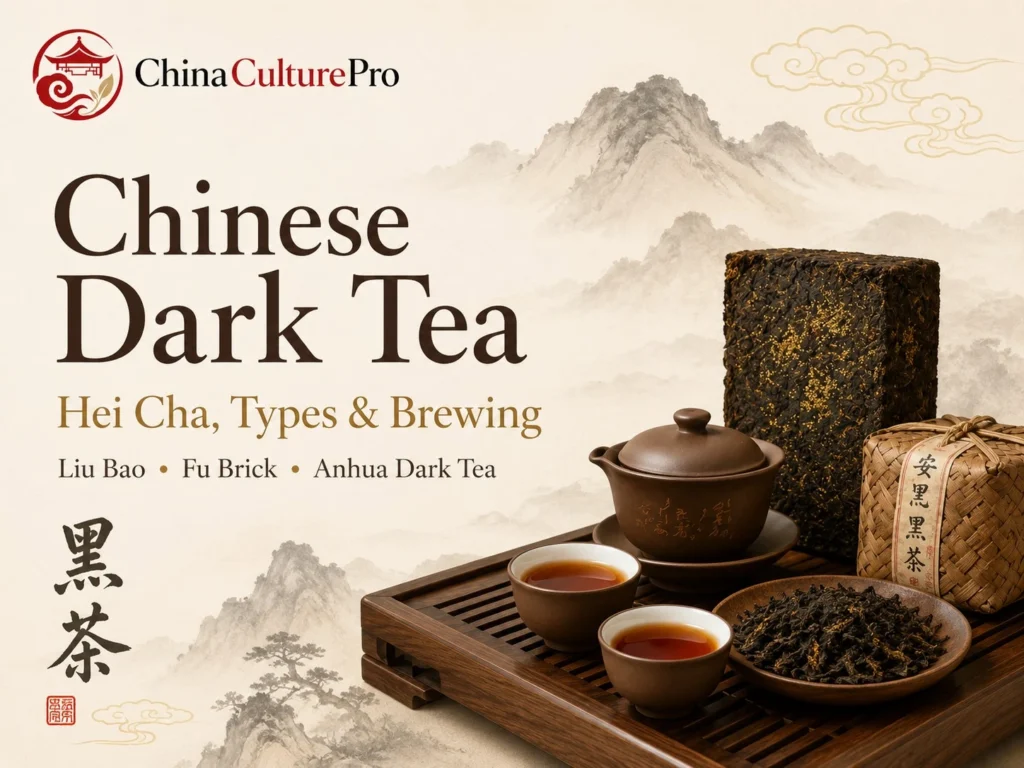
Chinese dark tea, or Hei Cha (黑茶), is one of the six major types of Chinese tea. Its core is post-fermentation, not full oxidation and not simply dark color.
This naming point is important: Chinese dark tea is not Chinese black tea. In English, “black tea” usually means Hong Cha (红茶), the fully oxidized tea category. Hei Cha is different. It is shaped by Sha Qing, rolling, piling, fermentation, drying, compression, storage, and time.
Chinese dark tea includes regional styles such as Liu Bao Tea from Guangxi, Anhua Dark Tea and Fu Brick Tea from Hunan, Qing Brick Tea from Hubei, Kang Brick and Tibetan Tea from Sichuan, and Fu Tea from Shaanxi. Pu-erh is often discussed within the dark tea world, but it has its own Yunnan system and should not be treated as all of Hei Cha.
| Item | Detail |
|---|---|
| Main Topic | Chinese Dark Tea / Hei Cha / 黑茶 |
| Tea Category | Post-fermented tea |
| Key Confusion | Dark Tea is Hei Cha, not Hong Cha / black tea |
| Core Craft | Sha Qing, piling, fermentation, drying, compression, storage |
| Famous Types | Liu Bao, Anhua Dark Tea, Fu Brick, Qing Brick, Kang Brick |
| Taste Direction | Earthy, woody, mellow, smooth, aged, jujube-like |
| Best Brewing Style | Hot water, Gongfu brewing, boiling for some brick teas |
Key Point: Chinese dark tea is special not because the leaves are black, but because post-fermentation, compression, storage, and time can turn mature tea material into a mellow, smooth, warm, and durable tea.
A good dark tea may be woody, earthy, aged, fungal, jujube-like, betel-nut-like, or slightly smoky, but it should never be moldy, sour, fishy, dirty, or harsh in the throat.
Why Dark Tea Matters in Chinese Tea Culture
Dark tea represents a practical side of Chinese tea culture: post-fermented tea, brick tea, border-sale tea, boiling tea, daily drinking, and long storage.
Green tea values freshness. White tea values natural withering and gentle sweetness. Oolong tea values aroma, roast, and layered infusions. Chinese black tea values full oxidation, red liquor, sweetness, and warmth. Pu-erh tea is tied to Yunnan, maocha, mountain character, Sheng and Shou paths, and storage.
Dark tea is broader. It carries the culture of mature leaves, fermentation, compression, transport, storage, boiling, and daily life. Historically, many dark teas were connected with border regions, Tibetan areas, Mongolian areas, Northwest China, and long-distance tea trade. They were not only tea-table drinks; they were practical teas for families, travelers, herders, and cold regions.
Experienced Chinese dark tea drinkers often judge:
- Storage cleanliness: aged aroma should not become mold smell.
- Mellow body: the liquor should feel rounded, not thin.
- Smooth throat: the tea should go down comfortably.
- Liquor clarity: red, deep, or dark liquor is fine, but it should stay clean.
- Fungal aroma: in Fu Brick and related teas, Golden Flowers may bring a clean fungal sweetness.
- Boiling endurance: many dark teas should remain sweet and drinkable after boiling.
- Brick condition: compression should support storage and brewing, not hide poor material.
Dark tea does not follow the logic of delicate bud tea. Mature leaves are not automatically low value. With suitable material, proper post-fermentation, clean drying, compression, and storage, mature leaves can produce a thick, warm, and satisfying liquor.
A Chinese tea master might say: dark tea is not about showing off tenderness. It is about steadiness. Good Hei Cha should be thick but not dirty, aged but not moldy, warm but not heavy, and durable enough for daily drinking.
Hei Cha vs Black Tea vs Pu-erh: Naming Confusion
This is the most important naming point for English readers. Dark Tea, Black Tea, and Pu-erh Tea are not the same thing.
| Term | Chinese Name | English Meaning | What It Refers To |
|---|---|---|---|
| Hei Cha | 黑茶 | Dark Tea | post-fermented Chinese tea category |
| Hong Cha | 红茶 | Black Tea | fully oxidized tea |
| Pu-erh | 普洱茶 | Pu-erh Tea | Yunnan tea, often discussed within dark tea but treated as its own system |
| Liu Bao | 六堡茶 | Liu Bao Dark Tea | Guangxi dark tea |
| Fu Brick | 茯砖茶 | Fu Brick Tea | dark brick tea often linked with Golden Flowers |
The simple rule:
- Hei Cha = Chinese Dark Tea
- Hong Cha = Chinese Black Tea
- Pu-erh = Yunnan tea system related to dark tea, but not all dark tea
Dark tea is not herbal tea. It is not any tea that looks dark. It is not the English black tea used for breakfast blends. It is a Chinese post-fermented tea category with its own regional families.
How Chinese Dark Tea Is Made
Chinese dark tea varies by region, but most dark teas are shaped by post-fermentation after Sha Qing and rolling.
| Step | Chinese Term | What It Does | Key Point |
|---|---|---|---|
| Picking | 采摘 | chooses leaf material | often uses more mature leaves than delicate green or white tea |
| Sha Qing | 杀青 | controls enzyme activity | different from black tea oxidation |
| Rolling | 揉捻 | shapes leaves and releases juice | prepares the leaf for later transformation |
| Piling | 渥堆 / 堆积 | encourages post-fermentation | one of the key dark tea transformations |
| Drying | 干燥 | stabilizes the tea | fire or smoke notes should not become dirty or burnt |
| Compression | 压制 | forms bricks, cakes, baskets, logs, or other shapes | helps transport, storage, and aging |
| Aging / Storage | 陈化 / 仓储 | allows mellowing | clean storage is essential |
Regional differences matter. Anhua Dark Tea may include pine-fire drying and different brick or basket forms. Fu Brick Tea is known for Fa Hua (发花), the process that encourages Golden Flowers inside the brick. Liu Bao Tea often involves piling, steaming, basket aging, and storage. Qing Brick and Kang Brick are tightly compressed teas closely tied to boiling and daily use.
The important point: do not reduce all dark tea to ripe Pu-erh. Dark tea is a large category with diverse materials, shapes, regional methods, and drinking habits.
Chinese Dark Tea vs Other Tea Types
Dark tea is easiest to understand when compared with other Chinese tea types.
| Tea Type | Difference From Dark Tea | Main Character |
|---|---|---|
| Green Tea | not post-fermented, best fresh | fresh, clear |
| White Tea | lightly processed, gentle aging | sweet, soft |
| Yellow Tea | yellowing step, not dark fermentation | mellow, smooth |
| Oolong Tea | partially oxidized, often roasted | aromatic, layered |
| Black Tea / Hong Cha | fully oxidized | sweet, red-bright |
| Pu-erh Tea | Yunnan dark tea system | mountain, maocha, Sheng / Shou, storage |
Dark tea is most often confused with black tea and Pu-erh. Black tea is fully oxidized. Dark tea is post-fermented. Pu-erh is closely related, but it is a Yunnan system built around its own material, maocha, Sheng and Shou paths, and storage culture.
This page focuses on the wider Hei Cha world beyond Pu-erh.
Main Chinese Dark Tea Regions and Style Families
Chinese dark tea is not one single taste. Region, material, process, compression, and storage all shape the final tea.
| Region / Style Family | Famous Teas | General Style Direction | Note |
|---|---|---|---|
| Hunan / Anhua Dark Tea | Fu Brick, Hei Zhuan, Hua Zhuan, Tian Jian, Qian Liang Cha | woody, mellow, fungal, smoky, aged | Anhua is a core dark tea region |
| Guangxi Liu Bao Tea | Liu Bao Tea | betel-nut-like, aged, woody, smooth | famous for basket aging and storage aroma |
| Hubei Qing Brick Tea | Qing Brick Tea | thick, rustic, boiled-tea friendly | border-sale brick tea tradition |
| Sichuan Tibetan Tea | Kang Brick, Tibetan Tea, Jin Jian | strong, coarse, durable, boiled | tied to Tibetan daily tea culture |
| Shaanxi Fu Tea | Jingyang Fu Tea | sweet, fungal, golden-flower aroma | known for Fu brick and Jin Hua |
| Yunnan Pu-erh | Sheng / Shou Pu-erh | complex, mountain, storage-driven | treated in a separate Pu-erh guide |
Do not read all dark tea as “earthy Pu-erh.” Liu Bao has its own storage and betel-nut-like direction. Anhua has its own dark tea family. Fu Brick has Golden Flowers. Qing Brick and Kang Brick carry strong border-sale and boiling traditions.
A region name helps locate the tea, but the final test is still the liquor: clean aroma, smooth body, clear taste, comfortable throat, and sweetness after brewing or boiling.
Famous Chinese Dark Teas
The following teas are useful entry points into the Chinese dark tea world. Each can later become its own detailed guide.
| Tea | Chinese Name | Region | Form | Taste Direction | Quick Note |
|---|---|---|---|---|---|
| Liu Bao Tea | 六堡茶 | Guangxi | basket, loose tea, brick | betel-nut-like, aged, woody, smooth | Guangxi dark tea representative |
| Anhua Dark Tea | 安化黑茶 | Hunan | brick, basket, loose, column | woody, aged, mellow, smoky, fungal | broad Hunan dark tea family |
| Fu Brick Tea | 茯砖茶 | Hunan / Shaanxi | brick | fungal, sweet, mellow, Golden Flowers | known for Jin Hua |
| Hei Zhuan Tea | 黑砖茶 | Hunan | brick | thick, aged, woody | traditional Anhua brick tea |
| Hua Zhuan Tea | 花砖茶 | Hunan | brick | mellow, aged, woody | brick form with decorative patterning |
| Tian Jian Tea | 天尖茶 | Hunan | loose or basket tea | cleaner, more refined, mellow | often treated as a higher-grade Anhua style |
| Qian Liang Cha | 千两茶 | Hunan | large column tea | thick, aged, woody | visually distinctive Anhua tea |
| Qing Brick Tea | 青砖茶 | Hubei | brick | rustic, thick, boilable | border-sale brick tea representative |
| Kang Brick Tea | 康砖茶 | Sichuan | brick | strong, durable, boilable | linked with Tibetan tea culture |
| Jingyang Fu Tea | 泾阳茯茶 | Shaanxi | brick | fungal, sweet, Golden Flowers | important Fu tea tradition |
These names should not be treated only as “old tea” or “brick tea.” They represent different regions, production habits, and drinking scenes. Some are better for Gongfu brewing. Some are better for large-pot drinking. Some are best understood through boiling.
Liu Bao, Fu Brick, and Anhua Dark Tea: Three Beginner Anchors
Beginners can understand Chinese dark tea more easily through three anchor styles: Liu Bao, Fu Brick, and Anhua Dark Tea.
| Beginner Anchor | Taste Direction | What It Teaches | Beginner Note |
|---|---|---|---|
| Liu Bao Tea | woody, betel-nut-like, aged, smooth | Guangxi dark tea and clean storage aroma | a good entry for smooth aged dark tea |
| Fu Brick Tea | mellow, fungal, sweet, golden-flower aroma | Golden Flowers and brick tea | useful for understanding Jin Hua |
| Anhua Dark Tea | woody, smoky, mellow, aged | Hunan dark tea family | shows the wider world of Hunan Hei Cha |
Liu Bao teaches the value of clean storage and smooth aged aroma. Fu Brick teaches Golden Flowers, brick tea, and fungal sweetness. Anhua Dark Tea introduces a broader Hunan system, including Fu Brick, Hei Zhuan, Hua Zhuan, Tian Jian, and Qian Liang Cha.
A beginner does not need to start with a very old or expensive tea. It is better to taste clean examples first and build a standard for what smooth, aged, and clean dark tea should feel like.
What Chinese Dark Tea Tastes Like
Chinese dark tea can be thick, aged, earthy, woody, fungal, sweet, and smooth. But it should not taste dirty.
Common dark tea taste directions include:
- Earthy notes: acceptable when clean and balanced.
- Woody aroma: common in aged and compressed dark teas.
- Mellow body: dark tea should feel rounded rather than sharp.
- Smooth liquor: good dark tea should pass through the mouth and throat comfortably.
- Jujube-like sweetness: possible in clean aged dark tea.
- Betel-nut-like aroma: especially associated with some Liu Bao tea.
- Fungal aroma: common in Fu Brick and Golden Flower teas.
- Aged aroma: should be warm and clean, not moldy.
- Smoky or pine-smoke-like notes: possible in some Anhua styles.
- Sweet aftertaste: especially after brewing or boiling.
- Thick liquor: a key pleasure of many dark teas.
Different types show these directions in different ways:
- Liu Bao Tea: aged wood, betel-nut-like aroma, smooth liquor, red thick tea soup, clean storage aroma.
- Fu Brick Tea: Golden Flower aroma, fungal sweetness, mellow body, honey-like or grain-like notes.
- Anhua Dark Tea: woody, mellow, aged, sometimes smoky or pine-smoke-like.
- Qing Brick / Kang Brick: rustic, strong, durable, coarse-leaf depth, good for boiling.
The main quality rule is cleanliness. Aged aroma is not mold smell. Fungal aroma is not dirty smell. Golden Flowers should feel clean and sweet, not rotten or dusty. Liu Bao storage aroma should be comfortable, not sharp or suffocating.
A good dark tea can be deep and earthy, but it should still be clear, smooth, and comfortable.
How to Brew Chinese Dark Tea
Chinese dark tea usually needs high heat. It is not a delicate bud tea.
| Dark Tea Type | Water Temperature | Brewing Note |
|---|---|---|
| Liu Bao Tea | 95–100°C | gaiwan, teapot, or boiling |
| Fu Brick Tea | 95–100°C or boiling | loosen brick; high heat releases sweetness |
| Tian Jian | around 95°C | short infusions preserve cleaner aroma |
| Qing Brick / Kang Brick | boiling | suitable for simmering |
| Aged Dark Tea | 95–100°C | rinse and brew with hot water |
Practical brewing rules:
- Use high heat: most dark teas need 95–100°C water to open body and sweetness.
- Loosen compressed tea carefully: pry along the brick or cake structure instead of smashing it into dust.
- Rinse if needed: one quick rinse can wake the tea and remove loose dust. Older or tighter tea may need a second rinse.
- Use Gongfu brewing for tasting: a gaiwan or small teapot helps compare aroma, body, and cleanliness.
- Use boiling for brick tea: Fu Brick, Qing Brick, Kang Brick, and some aged dark teas often show better body when simmered.
- Do not boil too aggressively: long hard boiling can make the liquor too heavy or muddy.
A Chinese tea drinker might say: dark tea often needs heat to reveal itself. Low temperature may leave a brick tea flat, while boiling can bring out thickness, sweetness, and warmth.
Best Teaware for Chinese Dark Tea
Dark tea teaware should help with heat, compression, liquor clarity, and daily drinking.
| Teaware | Best Use | Why It Works / Caution |
|---|---|---|
| Gaiwan | testing Liu Bao, Tian Jian, loose dark tea | neutral and easy to compare |
| Clay Teapot | Liu Bao, aged dark tea, Fu Brick | holds heat and rounds texture |
| Large Teapot | daily dark tea drinking | practical for family or office drinking |
| Boiling Kettle | Fu Brick, Qing Brick, Kang Brick | releases compressed tea more fully |
| Glass Fairness Cup | observing liquor clarity | helps judge cleanliness |
| Tea Knife / Pick | compressed bricks | breaks tea safely without crushing it into powder |
A gaiwan is useful for evaluation. A clay teapot is useful for warmth and roundness. A boiling kettle fits dark tea’s daily and practical character. A fairness cup is especially helpful because dark tea liquor should be deep but still clean.
Aging, Storage, and Dark Tea Value
Dark tea can age, but old tea is not automatically good tea. Value comes from material, post-fermentation, compression, storage, time, and cleanliness.
| Factor | Why It Matters |
|---|---|
| Material | mature leaves can work well, but they must be clean and suitable |
| Fermentation | creates mellow body and dark tea character |
| Compression | affects storage, transport, and brewing |
| Storage | clean storage makes or ruins dark tea |
| Time | helps mellowing but cannot fix bad tea |
| Golden Flowers | important in Fu Brick, but not universal |
Storage should support transformation without creating dirty flavors. Dark tea should be kept away from excessive dampness, mold risk, strong odors, dirty rooms, direct sunlight, and unstable storage conditions.
Golden Flowers deserve careful handling. They are important in Fu Brick Tea and related teas, but not all dark tea has Golden Flowers. More Golden Flowers do not automatically mean better tea. They should appear natural, clean, and connected with sweet, mellow liquor. If the tea smells moldy, sour, fishy, or dusty, Golden Flowers cannot rescue it.
The value rules are direct:
- Age does not guarantee quality.
- Dark color does not prove good aging.
- Heavy storage smell is not refined aged aroma.
- Mold, sourness, fishy smell, and throat irritation are defects.
- Clean aged aroma should feel comfortable.
- Good dark tea should remain sweet or mellow after brewing or boiling.
Dark tea can be thick, aged, warm, and satisfying. But its “aged” character must be clean. Dirty storage is not culture. Moldy flavor is not Chen Xiang.
Chinese Dark Tea Benefits: What to Say Carefully
Many people search for dark tea benefits, but this topic should be written carefully. Chinese dark tea can be part of a daily tea habit, but it is not medicine.
- After-meal comfort: many people enjoy dark tea after meals because it feels warm, smooth, and satisfying.
- Warm daily drinking: dark tea is often used in cold regions, family drinking, and boiled tea scenes.
- Rich and satisfying liquor: its mellow body can feel more substantial than lighter teas.
- Fermentation-related character: dark tea involves post-fermentation, but this should not be turned into a medical claim.
- Caffeine caution: dark tea contains caffeine, and sensitive drinkers should drink moderately.
- Not a medicine: dark tea should not be presented as a cure or treatment.
Do not promise weight loss, blood sugar control, lipid reduction, detox, disease treatment, or “probiotic cure.” Many people drink dark tea because it feels warm, smooth, and comfortable after food. That is a real daily experience, but it is not a medical guarantee.
Common Mistakes About Chinese Dark Tea
Chinese dark tea is easy to misunderstand because of naming, color, age, and fermentation language.
- Thinking Dark Tea means Black Tea: Dark Tea is Hei Cha. Black Tea is Hong Cha.
- Confusing Hei Cha with Hong Cha: Hei Cha is post-fermented. Hong Cha is fully oxidized.
- Thinking all dark tea is Pu-erh: Pu-erh is related, but dark tea is broader.
- Thinking all dark tea has Golden Flowers: Golden Flowers are important in Fu Brick Tea, not universal.
- Thinking more Golden Flowers always means better tea: they must be natural, clean, and connected with good liquor.
- Thinking darker color means better tea: color is not a quality standard by itself.
- Thinking older is always better: only good material, proper processing, and clean storage improve with time.
- Treating mold smell as aged aroma: mold is a defect, not Chen Xiang.
- Treating fishy or sour notes as fermentation flavor: fishy and sour notes usually signal problems.
- Accepting heavy storage odor as premium old tea: storage character should not overwhelm cleanliness.
- Buying only by brick shape or wrapper: the tea liquor matters more than packaging.
- Dismissing mature leaves as worthless: dark tea often uses mature material well.
- Thinking border-sale tea means low-value tea: it has its own historical and cultural role.
- Brewing compressed dark tea with low temperature: many brick teas need high heat or boiling.
- Treating dark tea like tender green tea: the brewing logic is different.
The better rule is simple: dark tea can be thick, aged, woody, fungal, and earthy, but it must be clean, smooth, and comfortable. If it is moldy, sour, fishy, dusty, or harsh in the throat, do not excuse it as post-fermentation.
How to Choose Chinese Dark Tea for Beginners
Beginners should not start by asking, “How old is it?” or “How many Golden Flowers does it have?” A better question is: “What kind of dark tea experience do I want first?”
- For a smooth entry: try Liu Bao Tea. It can show aged aroma, woody depth, and betel-nut-like character when clean.
- For understanding Golden Flowers: try Fu Brick Tea. It teaches fungal sweetness, brick tea, and the Fu tea tradition.
- For the Hunan dark tea family: try Anhua Dark Tea. It opens the door to Fu Brick, Hei Zhuan, Hua Zhuan, Tian Jian, and Qian Liang Cha.
- For boiling: try Fu Brick, Qing Brick, or Kang Brick. These teas often show better body through simmering.
- For daily drinking: choose basic Liu Bao or Fu Brick from a reliable source.
- For aged aroma: choose clean aged Liu Bao or aged dark tea, but judge the liquor, not the story.
- For budget control: start with small samples rather than large bricks, baskets, or old tea claims.
The beginner standard should be practical: Is the tea clean? Is it smooth? Does it feel comfortable in the throat? Is there sweetness after brewing or boiling? If the answer is yes, the tea is worth learning from.
How Chinese Dark Tea Connects to Chinese Tea Culture
Chinese dark tea is a major tea-type page under the Chinese Tea Culture core guide. It connects the six-type tea system with post-fermentation, brick tea, border-sale tea, storage, boiling, and regional dark tea traditions.
- To understand the full tea system first, read our Chinese Tea Culture guide.
- To compare dark tea with green, white, yellow, oolong, black, and Pu-erh tea, read our Chinese Tea Types guide.
- To avoid confusing Hei Cha with Hong Cha, read our Chinese Black Tea guide.
- To understand Yunnan dark tea in detail, read our Chinese Pu-erh Tea guide.
- To compare dark tea aging with aged white tea, read our Chinese White Tea guide.
- For small-vessel brewing, read our Gongfu Cha guide.
- For teapots, kettles, and fairness cups, read our Chinese Teaware guide.
- For Guangxi dark tea, read our Liu Bao Tea guide.
- For Hunan dark tea, read our Anhua Dark Tea guide.
- For Golden Flower brick tea, read our Fu Brick Tea guide.
- For storage and aging, see the Aging, Storage, and Dark Tea Value section above.
- For cautious wellness wording, see the Chinese Dark Tea Benefits section above.
Final Thoughts
Chinese dark tea is not black tea in the English sense. It is Hei Cha, a post-fermented Chinese tea category shaped by piling, fermentation, compression, storage, and time.
Pu-erh is related, but dark tea is broader. Liu Bao, Anhua Dark Tea, Fu Brick, Qing Brick, Kang Brick, Tibetan Tea, and Fu Tea all belong to this wider Hei Cha world.
Good dark tea should not be judged only by darkness, age, brick shape, or Golden Flowers. It should be judged by clean liquor, mellow body, natural aged aroma, smooth throat feeling, storage cleanliness, and whether the tea remains sweet and comfortable when brewed or boiled.
That is the Chinese dark tea aesthetic: thick, warm, aged, practical, and clean.
FAQs About Chinese Dark Tea
What is Chinese dark tea?
Chinese dark tea, or Hei Cha, is a post-fermented Chinese tea category. It is usually made through Sha Qing, rolling, piling or fermentation, drying, compression, storage, and time. Famous types include Liu Bao Tea, Anhua Dark Tea, Fu Brick Tea, Qing Brick Tea, Kang Brick Tea, and Tibetan Tea.
Is dark tea the same as black tea?
No. Dark Tea is Hei Cha, a post-fermented tea category. Black Tea is Hong Cha, the fully oxidized tea category known in English as black tea. This naming difference is one of the most common sources of confusion for English readers.
What is Hei Cha?
Hei Cha is the Chinese name for dark tea. It refers to a broad family of post-fermented teas, including Liu Bao, Anhua Dark Tea, Fu Brick, Qing Brick, Kang Brick, and related regional styles. Its core is post-fermentation, not full oxidation.
Is Pu-erh tea a dark tea?
Pu-erh tea is often discussed within the dark tea category, but it has its own Yunnan system. Pu-erh is built around Yunnan material, maocha, Sheng and Shou paths, mountain identity, and storage culture. Dark tea is broader than Pu-erh.
What are the main types of Chinese dark tea?
Major Chinese dark teas include Liu Bao Tea from Guangxi, Anhua Dark Tea from Hunan, Fu Brick Tea from Hunan and Shaanxi, Qing Brick Tea from Hubei, Kang Brick and Tibetan Tea from Sichuan, and related brick tea traditions.
What does Chinese dark tea taste like?
Chinese dark tea can taste woody, earthy, mellow, smooth, aged, jujube-like, fungal, smoky, or betel-nut-like. Good dark tea should be clean and comfortable. It should not smell moldy, sour, fishy, dirty, or harsh in the throat.
What is Liu Bao tea?
Liu Bao Tea is a dark tea from Guangxi, especially associated with Wuzhou and the Liu Bao tea tradition. It is known for aged aroma, woody depth, smooth liquor, and sometimes betel-nut-like character. Clean storage is very important for good Liu Bao.
What is Anhua dark tea?
Anhua Dark Tea is a major Hunan dark tea family. It includes Fu Brick, Hei Zhuan, Hua Zhuan, Tian Jian, Qian Liang Cha, and other forms. Its style can be woody, mellow, aged, fungal, smoky, or pine-smoke-like depending on the tea.
What is Fu Brick tea?
Fu Brick Tea is a compressed dark tea known for Golden Flowers, or Jin Hua. These golden-yellow fungal growths are associated with the Fa Hua process. Good Fu Brick should taste mellow, sweet, clean, and comfortable, not moldy or sour.
What are Golden Flowers in dark tea?
Golden Flowers, or Jin Hua, are golden-yellow fungal growths associated with Fu Brick Tea. They are part of the character of certain Fu teas, but not all dark teas have them. More Golden Flowers do not automatically mean better tea. The liquor must still be clean and sweet.
How do you brew Chinese dark tea?
Chinese dark tea is usually brewed with hot water around 95–100°C. Loose tea can be brewed in a gaiwan or teapot. Compressed tea should be loosened carefully and rinsed if needed. Many brick teas can also be boiled for a fuller, smoother liquor.
Can dark tea be boiled?
Yes. Boiling is common for many dark teas, especially Fu Brick, Qing Brick, Kang Brick, Tibetan Tea, and some aged dark teas. Gentle simmering can bring out thickness, sweetness, and warmth. Avoid boiling too aggressively for too long.
Does dark tea get better with age?
Not always. Dark tea can mellow with age, but only when the material, processing, compression, and storage are good. Time cannot fix poor tea or dirty storage. Good aged dark tea should smell clean, feel smooth, and remain sweet or comfortable.
Is Chinese dark tea caffeinated?
Yes. Chinese dark tea contains caffeine. The amount depends on leaf material, tea type, brewing strength, water temperature, and infusion time. People sensitive to caffeine should drink moderately, especially when brewing strong dark tea or boiling it for a long time.
Is dark tea good for weight loss?
Dark tea may be part of a healthy lifestyle, but it is not a weight-loss medicine. It contains caffeine and tea compounds, but body weight depends on diet, activity, sleep, metabolism, and overall habits. Do not treat dark tea as a guaranteed diet solution.
What is the best Chinese dark tea for beginners?
Liu Bao Tea is often a good smooth entry. Fu Brick Tea is useful for understanding Golden Flowers and brick tea. Anhua Dark Tea introduces the wider Hunan dark tea family. Beginners should start with clean samples instead of expensive old tea or large bricks.