
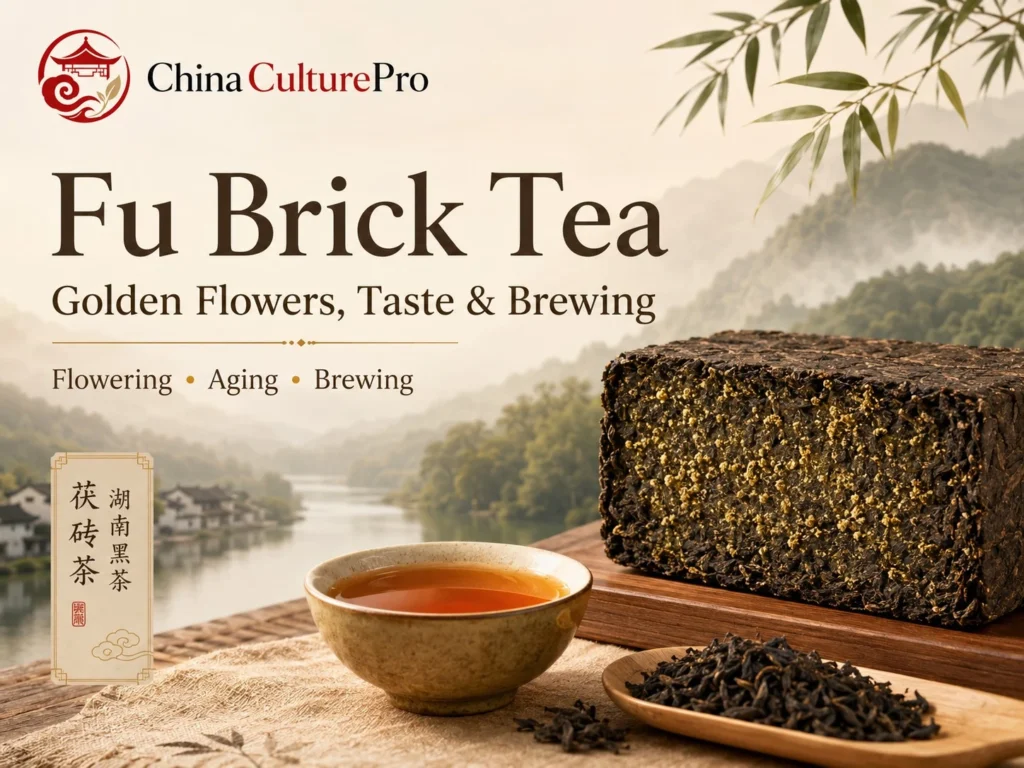

Quick Answer: What Is Fu Brick Tea?
Fu Brick Tea, also written as Fuzhuan Tea, Fu Zhuan Tea, or Fu Zhuan Cha, is a compressed Chinese dark tea defined by controlled flowering. It is normally made from hei mao cha that is sorted, blended, adjusted with moisture and heat, built or pressed into bricks, flowered under controlled conditions, and gradually dried.
The yellow or golden fungal structures created during flowering are known as golden flowers. Fu Brick Tea is not English black tea, ripe Pu-erh, flavored tea, or an ordinary brick deliberately allowed to become moldy.
Its basic identity is:
Chinese Name: 茯砖茶.
Tea Type: Chinese dark tea, or hei cha.
Common English Names: Fu Brick Tea, Fuzhuan Tea, Fu Zhuan Tea, Fu Zhuan Cha.
Related Name: Fu Tea or Fucha.
Historical Processing Center: Jingyang, Shaanxi.
Important Raw-Material Region: Anhua and other tea areas of Hunan.
Major Modern Production Center: Yiyang, Hunan.
Base Tea: Hei mao cha.
Defining Process: Fahua, or controlled flowering.
Characteristic Fungus: Aspergillus cristatus, often called Eurotium cristatum in older tea literature.
Core Aroma: Fungal-floral aroma, sweet grain, baked cereal, wood, hay, and dried fruit.
Core Taste: Mellow, substantial, smooth, sweet, and lively.
Liquor: Orange-yellow, orange-red, or reddish brown.
Brewing: Usually 95–100°C through gongfu brewing, large-pot steeping, thermos steeping, or boiling.
Fu Brick is one of the Three Brick teas within the wider Anhua Dark Tea system. Golden flowers are important, but quality also depends on traceability, brick stability, clean aroma, bright substantial liquor, sweetness, smoothness, and the absence of sour, moldy, rotten, burnt, or contaminated notes.
To understand its wider Hunan tea system, read our Anhua Dark Tea guide.
Name, Tea Type, and Basic Identity
Fu Brick Tea, Fuzhuan Tea, Fu Zhuan Tea, and Fu Zhuan Cha all refer to 茯砖茶. Fu Tea or Fucha is also widely used, although it can have a broader historical, regional, or commercial meaning.
| Identity Point | What It Means |
|---|---|
| Chinese Name | 茯砖茶 |
| Pinyin | Fu Zhuan Cha |
| Common English Names | Fu Brick Tea, Fuzhuan Tea, Fu Zhuan Tea |
| Related Market Name | Fu Tea or Fucha |
| Commercial Nickname | Golden Flower Tea |
| Tea Category | Chinese dark tea / hei cha |
| Base Material | Usually hei mao cha |
| Product Form | Compressed brick |
| Defining Process | Controlled flowering followed by gradual drying |
| Not The Same As | English black tea, ripe Pu-erh, flavored tea, herbal tea, or moldy brick tea |
Fu Brick is dark tea, not English black tea. Hei cha develops through piling, microbial transformation, later processing, and storage-related change, while English black tea corresponds to Chinese hong cha and is shaped mainly by enzymatic oxidation.
The origin of fu is not completely settled. Common explanations connect it with summer processing, a traditional comparison with tuckahoe, or the evolution of historical production and trade terminology. Golden Flower Tea is a useful market name, but golden flowers are a process result rather than the tea’s only source of value.
For an overview of China’s major tea-processing families, see Chinese Tea Types.
Origin and History: Jingyang, Hunan, and the Northwest
Fu Brick Tea developed through the movement of Hunan tea material, Jingyang processing knowledge, merchants, and northwestern consumers. Jingyang and Hunan are connected parts of this history rather than mutually exclusive origins.
| Place | Historical and Modern Role |
|---|---|
| Jingyang, Shaanxi | Historical center for brick construction, flowering, drying, trade, and distribution |
| Anhua, Hunan | Important source of hei mao cha and part of the wider Anhua dark-tea system |
| Yiyang, Hunan | Major modern production, controlled-flowering, and heritage center |
| Zi River and Hunan Waterways | Routes used to move Hunan tea toward inland markets |
| Northwestern China | Traditional market for boiled brick tea and milk-and-salt tea |
For long periods, hei mao cha from Hunan was transported to Jingyang, where makers adjusted moisture, built the tea into bricks, managed flowering, dried the product, and distributed it toward Shaanxi, Gansu, Qinghai, Ningxia, Xinjiang, Inner Mongolia, and neighboring markets. This relationship is often summarized as “Hunan tea processed in Jingyang.”
Brick form reduced volume and made tea easier to weigh, stack, transport, and store. In northwestern communities, Fu Tea was commonly boiled in large vessels and could be prepared with milk and salt. This reflects trade and food culture, not proof of medical effects.
Hunan began local Fu Brick trials in the 1940s and achieved stable local flowering during the early 1950s. Mechanized pressing expanded later in the decade, and Yiyang became a major modern production center. Today, Hunan and Jingyang both produce Fu Tea, sharing historical roots while retaining different regional materials, specifications, and identities.
Its border-tea history also forms part of the wider story of Chinese Tea Culture.
What Are Golden Flowers in Fu Brick Tea?
Golden flowers are yellow or golden fungal structures formed during the controlled flowering of Fu Brick Tea. They are often easiest to see inside an opened brick, although their visibility varies with the material, brick density, cutting position, production, drying, age, and storage.
| Golden Flower Point | What It Means |
|---|---|
| Chinese Name | 金花 |
| Main Characteristic Fungus | Aspergillus cristatus |
| Older Tea-Literature Name | Eurotium cristatum |
| Formation Stage | Controlled fahua, or flowering |
| Common Location | Usually more visible inside an opened brick |
| Aroma Association | Fungal-floral aroma, grain sweetness, wood, and mild fermentation |
| Not The Same As | Flower petals, pollen, flavoring, powder, or uncontrolled mold |
| Quality Role | One process indicator, not a complete quality grade |
During flowering, Aspergillus cristatus and associated enzymatic activity help transform aromatic compounds, polyphenols, sugars, amino acids, and other components. In the cup, this may contribute to:
- Fungal-floral aroma.
- Sweet grain or baked-cereal notes.
- Softer bitterness.
- Rounder liquor.
- Greater sweetness.
- A smoother finish.
These production-stage effects do not prove that golden flowers act as clinically established probiotics in humans. Flower quantity is also not a complete quality standard: a heavily flowered brick can still have weak material, sour fermentation, poor drying, thin liquor, or contaminated storage.
Golden Flowers vs Mold
Consumers cannot reliably identify fungal species from color or photographs alone.
| Expected In A Sound Fu Brick | Warning Signs |
|---|---|
| Traceable producer and product information | Unknown source or suspicious repacking |
| Dry and stable brick | Soft, wet, sticky, swollen, or persistently damp brick |
| Clean grain, wood, tea, or fungal-floral aroma | Strong mold, sour, rotten, rancid, or chemical odor |
| Normal internal tea material | Abnormal fuzz, slime, decay, or unidentified growth |
| Bright liquor appropriate to brewing strength | Abnormal muddiness or heaviness with off-odors |
| Mellow, substantial, sweet liquor | Sourness, rotten taste, throat irritation, or unpleasant dampness |
Yellow color alone does not prove safety. Stop drinking tea that is damp, sticky, unusually fuzzy, strongly moldy, sour, rotten, rancid, or chemically scented. Boiling cannot reliably make contaminated tea safe.
Professional flowering occurs under controlled production conditions. Adding water or storing a finished brick in sustained humidity is more likely to cause contamination than desirable flowering.
What Does Fu Brick Tea Taste Like?
Fu Brick is often described in English as mushroom-like, earthy, or funky, but Chinese tea drinkers use a broader sensory vocabulary. One important term is jun hua xiang, meaning a clean fungal-floral aroma rather than mold smell.
| Tasting Point | Good Fu Brick Tea |
|---|---|
| Dry Brick | Fungal-floral aroma, grain, dry hay, wood, mature leaves, or light baking |
| Warm Aroma | Toasted grain, fungal-floral notes, sweetness, wood, dried fruit, or mild fermentation |
| Liquor | Orange-yellow, orange-red, or reddish brown; clear and bright |
| Taste | Mellow, sweet, rounded, substantial, and clean |
| Mouthfeel | Soft but not weak, thick but not heavy, smooth but not empty |
| Hui Gan | Returning grain-like, tea, or dried-fruit sweetness |
| Throat Feel | Comfortable and free from locking or irritation |
| Mature Notes | Wood, dry herbs, medicine, dried fruit, aged sweetness, and integrated fungal-floral aroma |
| Leaf Base | Mature leaves and stems appropriate to the grade, without slime, rot, or abnormal growth |
Jun hua xiang may suggest dried mushrooms, sweet grain, baked cereal, dry hay, warm wood, dried flowers, mild fermentation, or soft nutty sweetness.
Five texture words are especially useful:
- Soft: Gentle and free from attacking roughness.
- Thick: Substantial rather than colored water.
- Smooth: Comfortable through the mouth and throat.
- Sweet: Showing grain, dried-fruit, tea sweetness, or hui gan.
- Lively: Developing across infusions rather than feeling dull.
| Desirable Character | Possible Defect |
|---|---|
| Clean fungal-floral aroma | Mold, dirty cellar, or rotten mushroom odor |
| Natural grain sweetness | Sharp artificial flavoring |
| Dry wood | Damp or decaying wood |
| Clean mature aroma | Wet-storage contamination |
| Mellow body | Empty or watery liquor |
| Full liquor | Dull, sticky, or sauce-like heaviness |
| Transforming bitterness | Persistent harshness or throat locking |
Recently produced Fu Brick may show more direct fungal-floral, grain, smoke, piling, or green-wood notes. Cleanly matured tea may develop quieter fungal-floral character with wood, herbs, medicine, dried fruit, and aged sweetness.
A useful Chinese-style standard is: soft without being watery, thick without being dull, sweet without becoming cloying, and fungal-floral without smelling dirty.
How Fu Brick Tea Is Made
Fu Brick production coordinates raw material, brick structure, moisture, flowering, drying, and stabilization.
- Selecting Hei Mao Cha / 选料 Producers choose hei mao cha according to maturity, grade, cleanliness, stem content, aroma, moisture, and suitability for the intended brick. Mature leaves and a suitable proportion of stems are normal in many traditional blends.
- Screening And Cleaning / 筛分、除杂 The tea is screened, graded by particle size, cleaned, and checked for excessive dust, foreign matter, lifeless leaves, or unsuitable stems.
- Blending / 拼配 Different grades or batches may be combined to balance aroma, sweetness, body, stem content, compression, and flowering performance.
- Piling And Moisture Adjustment / 渥堆、水分调整 The material may undergo further piling, humid-heat treatment, resting, or moisture adjustment. Too little moisture can limit flowering; too much can cause sourness, stale heat, or spoilage.
- Steaming / 汽蒸 Steam softens the tea and prepares it for brick construction.
- Building Or Pressing The Brick / 筑制、压制 The tea is weighed and built by hand or pressed mechanically. The brick must hold its shape while retaining suitable internal spacing for moisture movement and flowering.
- Fahua, Or Flowering / 发花 The bricks enter a controlled flowering space where producers coordinate moisture, temperature, humidity, airflow, brick density, stacking, time, and hygiene. During successful flowering, Aspergillus cristatus becomes a representative dominant fungus.
- Gradual Drying / 干燥 The bricks are dried gradually. Rapid drying may create harshness or uneven internal moisture, while incomplete drying increases the risk of sourness and contamination.
- Stabilizing And Resting / 稳定、静置 Finished bricks may rest so moisture and aroma can redistribute and become more coordinated.
Three stages define Fu Brick most clearly: brick construction, controlled flowering, and gradual drying. Poor control at any one stage affects aroma, liquor, and storage stability.
For a broader framework for aroma, mouthfeel, hui gan, and aftertaste, read our Chinese Tea Tasting guide.
How to Taste Fu Brick Tea Like a Tea Drinker
Tasting Fu Brick means judging whether the brick, aroma, liquor, sweetness, and finish form a clean and balanced whole.
- Look At The Brick It should be dry, stable, and appropriately compressed, without swelling, stickiness, abnormal softness, or moisture damage.
- Open An Inner Section Examine the leaf maturity, stem proportion, internal cleanliness, and flowering without judging the whole brick from one small surface.
- Smell The Dry Tea Look for clean fungal-floral, grain, hay, wood, baking, or mature tea notes. Avoid mold, sourness, rancidity, perfume, chemicals, or rot.
- Check The Warm Aroma After a quick rinse, smell the heated leaves. Warmth often reveals fermentation and storage conditions more clearly.
- Check The Liquor Orange-yellow, orange-red, and reddish brown can all be normal. Brightness and cleanliness matter more than darkness.
- Taste The Liquor Look for softness, thickness, smoothness, sweetness, and vitality without stickiness, sourness, dullness, or oppressive heaviness.
- Feel The Hui Gan And Throat Notice returning sweetness, salivation, and throat comfort. Locking, irritation, rotten flavor, or unpleasant dampness is a warning sign.
- Follow Later Infusions Good tea retains some sweetness, aroma, and structure rather than producing only dark color at the beginning.
- Look At The Leaf Base The brewed material should be reasonably clean, without slime, rot, abnormal growth, severe burning, or chemical scent.
The practical Chinese approach is simple: confirm that the brick is dry and clean, then judge whether the fungal-floral aroma is natural and whether the tea soup is bright, substantial, sweet, smooth, and comfortable.
How to Brew Fu Brick Tea
Fu Brick performs well with high-temperature water and can be prepared in several ways.
| Brewing Method | Teaware | Water Temperature | Leaf Amount | Steeping Time | Notes |
|---|---|---|---|---|---|
| Gongfu Brewing | Porcelain gaiwan, Yixing pot, or glazed clay pot | 95–100°C / 203–212°F | 6–8g / 100–120ml | Quick rinse, then 10–20 seconds | Best for aroma, body, and infusion changes |
| Large-Pot Brewing | Porcelain or clay pot | 95–100°C / 203–212°F | 4–6g / 400–500ml | 3–5 minutes | Practical for daily shared drinking |
| Thermos Steeping | Heat-safe thermos | 95–100°C / 203–212°F | 2–4g / 400–500ml | 20–40 minutes | Convenient and concentrated; use less leaf |
| Boiling | Glass, ceramic, or metal kettle | Gentle boil | 4–7g / 700–1000ml | 3–8 minutes | Suitable for mature material or already-infused leaves |
Brewing tips:
- Break The Brick Carefully: Work from the side or along natural layers with a tea knife or pick.
- Use A Representative Sample: Include inner and outer material rather than only surface pieces or powder.
- Use Hot Water: High heat helps release fungal-floral aroma, grain sweetness, and body.
- Rinse According To Condition: One quick rinse is enough for many clean bricks; a second may suit very tight, older, or dusty tea.
- Use Short Early Infusions: Faster pouring can help recently produced tea with strong process or smoke notes.
- Extend Later Infusions Gradually: Longer steeping should reveal sweetness and body, not storage defects.
- Use A Gaiwan For Evaluation: Porcelain makes aroma, liquor, and defects easier to judge.
- Boil Mature Or Spent Leaves: Boiling can deepen sweetness but also magnifies sourness, roughness, or mustiness.
Milk-and-salt Fu Tea belongs to the authentic northwestern border-tea tradition. Plain brewing remains more useful for evaluating the original brick.
For practical brewing guidance, read our How To Brew Chinese Tea guide. For gaiwans, Yixing pots, glazed clay pots, kettles, and other brewing vessels, see our Chinese Teaware guide.
Fu Brick Tea vs Anhua Dark Tea vs Liu Bao vs Ripe Pu-erh
Fu Brick, Anhua Dark Tea, Liu Bao, and ripe Pu-erh belong to related dark and post-fermented tea traditions but are not interchangeable.
| Tea | Region | Category | Defining Technique | Main Aroma | Best For |
|---|---|---|---|---|---|
| Fu Brick Tea | Hunan production with strong Jingyang historical connections | Specific flower-fermented brick | Controlled flowering | Fungal-floral aroma, sweet grain, wood, and hay | Drinkers who want jun hua xiang, sweetness, and smooth body |
| Anhua Dark Tea | Anhua, Hunan | Regional system of Jian, Brick, and Huajuan teas | Product-specific processing, including flowering and Huajuan treading | Pine smoke, wood, grain, herbs, fungal-floral notes, and age | Drinkers who want a broad Hunan dark-tea system |
| Liu Bao Tea | Wuzhou, Guangxi | Guangxi dark tea | Humid-heat processing or wet-piling; basket tradition | Wood, medicine, fungi, jujube, age, and possible betel-nut-like notes | Drinkers interested in basket culture and South China–Southeast Asia history |
| Ripe Pu-erh | Yunnan | Yunnan post-fermented tea | Ripe-tea wet-piling | Wood, dates, fermentation, earth, and aged sweetness | Drinkers who want Yunnan material and ripe Pu-erh aging culture |
Choose Fu Brick for controlled flowering and grain sweetness; another Anhua Dark Tea for Tian Jian fragrance, pine-smoke character, or Huajuan craftsmanship; Liu Bao for Wuzhou basket culture; and ripe Pu-erh for the Yunnan wet-piled tradition.
To compare other regional dark teas, read our Liu Bao Tea and Pu-erh Tea guides.
How to Choose Good Fu Brick Tea
Flower count alone cannot prove raw material, fermentation, drying, storage, or cup quality.
| Checkpoint | What To Look For | Warning Signs |
|---|---|---|
| Product Name | Clear Fu Brick or regional Fu Tea identity | Generic “Golden Flower Tea” with no explanation |
| Region | Hunan, Yiyang, Anhua, Jingyang, or another clearly stated origin | Vague or contradictory origin |
| Producer | Traceable factory, cooperative, or artisan | Anonymous repacking or incomplete information |
| Raw Material | Clear hei mao cha or regional material information | Unsupported wild, ancient-tree, or premium claims |
| Date And Batch | Plausible production and batch information | Unverifiable old-tea story |
| Brick Structure | Dry, stable, and appropriately compressed | Softness, wetness, swelling, stickiness, or internal rot |
| Flowering | Normal flowering assessed as one quality factor | Flower quantity used as the complete grade |
| Aroma | Clean fungal-floral, grain, wood, hay, or mature tea aroma | Mold, acid, rot, rancidity, perfume, or chemical scent |
| Liquor | Bright orange, red, or reddish brown | Abnormal dullness or muddiness with off-odors |
| Taste | Substantial, smooth, sweet, and lively | Thinness, stickiness, sourness, throat locking, or empty darkness |
| Leaf Base | Clean material appropriate to the grade | Slime, rot, abnormal growth, or severe burnt odor |
| Storage | Clean, stable, and odor-free history | Dampness, pests, mold, or absorbed odors |
Marketing claims that require evidence include:
- Probiotic Tea: Microbial research does not prove a human probiotic effect.
- More Golden Flowers Means Better: Flowering is one factor, not a complete grade.
- Ancient Silk Road Tea: History does not verify the current brick.
- Medicinal Tea: Fu Brick is tea, not medical treatment.
- Guaranteed Weight Loss: This is not a responsible tea claim.
- Thirty-Year Brick: Age requires provenance and storage evidence.
- Wild Or Ancient-Tree Fu Tea: Raw-material claims need documentation.
- Collector’s Brick: Collectability does not guarantee drinking quality.
- Mold-Free By Color: Color alone cannot identify microorganisms.
Five buying rules matter most: clear producer and region, a dry stable brick, clean fungal-floral aroma, bright substantial liquor, and sweetness with a comfortable finish.
Storage and Aging
Fu Brick can change during storage, but not every brick improves with time. Recently produced tea may show direct fungal-floral, grain, smoke, piling, or green-wood notes, while cleanly matured tea may develop more integrated wood, dry herbs, medicine, dried fruit, and aged sweetness.
Visible golden flowers and fungal-floral aroma do not necessarily increase with age. Material, brick structure, drying, packaging, and storage matter more than the year printed on the wrapper.
Storage rules:
- Keep It Stable: Avoid repeated temperature and humidity swings.
- Keep It Dry: Prevent condensation and sustained dampness.
- Protect The Brick: Keep it away from dust, insects, pests, and physical damage.
- Avoid Odors: Do not store it beside coffee, spices, perfume, incense, smoke, chemicals, mothballs, or scented wood.
- Use Suitable Wrapping: Retain clean, dry original paper and add an odor-free outer box when needed.
- Do Not Add Water: Home humidification cannot reproduce professional flowering.
- Do Not Seal Damp Tea: Plastic can trap moisture and accelerate spoilage.
- Do Not Leave It Fully Exposed: Fu Brick readily absorbs odors, dust, and moisture.
- Check It Periodically: Inspect the wrapping, aroma, brick condition, and signs of insects or dampness.
After opening a brick, rewrap it in clean, dry, odor-free paper and protect it inside a suitable container. Clean aging may make the tea deeper and smoother; deterioration produces sourness, mold, rancidity, stickiness, rotten odors, or unpleasant dampness.
Benefits and Caffeine
Fu Brick Tea contains caffeine. Its mellow taste, post-fermentation, and golden flowers do not make it caffeine-free or necessarily low in caffeine.
Thermos steeping, boiling, long infusion times, large leaf amounts, and repeated consumption can increase total caffeine intake. Fu Brick also contains polyphenols, amino acids, polysaccharides, aromatic compounds, and substances transformed during flowering, but laboratory or animal research should not be presented as established medical treatment in humans.
Important cautions:
- Fu Brick contains caffeine.
- Strong brewing increases extraction.
- Caffeine-sensitive drinkers should avoid strong tea before sleep.
- People with stomach sensitivity should adjust the amount and strength.
- Pregnant people, people taking medication, or people with medical concerns should seek professional advice.
- Golden flowers are not a proven human probiotic.
- Fu Brick should not be treated as medicine.
Do not use Fu Brick as a promise for weight loss, detoxification, cholesterol reduction, blood sugar control, liver protection, cancer prevention, or treatment of digestive disease.
Final Thoughts
Fu Brick Tea is a specific Chinese dark tea formed through hei mao cha selection, blending, brick construction, controlled flowering, gradual drying, resting, and storage.
Its history connects Hunan tea material, Jingyang processing knowledge, Yiyang production, and northwestern border-tea culture. Golden flowers are important, but they are only one part of quality.
Good Fu Brick should be soft but not watery, thick but not dull, sweet but not cloying, and fungal-floral but clean. Quality is proven by traceability, a dry stable brick, natural aroma, bright substantial liquor, hui gan, throat comfort, and the absence of sour, moldy, rotten, burnt, or contaminated notes.
FAQs About Fu Brick Tea
What is Fu Brick Tea?
Fu Brick Tea is a compressed Chinese dark tea made from hei mao cha through brick construction, controlled flowering, gradual drying, and resting. It is known for golden flowers, fungal-floral aroma, grain sweetness, and mellow, substantial liquor.
Is Fu Brick Tea black tea or dark tea?
Fu Brick is dark tea, or hei cha. English black tea corresponds to Chinese hong cha and follows a different oxidation process.
Are Fu Tea and Fu Brick Tea the same?
The terms overlap, but Fu Tea can have a broader historical, regional, or commercial meaning. Fu Brick Tea more specifically identifies a compressed brick made through controlled flowering.
Is Fu Brick Tea from Hunan or Jingyang?
Both are important. Hunan supplied major tea material and later developed complete modern production, especially in Yiyang. Jingyang was an important historical processing, flowering, trade, and distribution center.
What are golden flowers in Fu Brick Tea?
Golden flowers are fungal structures formed during controlled flowering. The main characteristic fungus is Aspergillus cristatus, often called Eurotium cristatum in older tea literature.
Are golden flowers probiotics?
They participate in fermentation and sensory transformation, but this does not prove a clinically established probiotic effect in humans.
Can golden flowers and mold be identified by color?
Not reliably. Judge the producer, brick condition, moisture, aroma, liquor, and signs of spoilage together. Stop drinking tea with abnormal fuzz, persistent dampness, strong mold, sourness, rancidity, or rotten odor.
What does Fu Brick Tea taste like?
Fu Brick commonly shows fungal-floral aroma, sweet grain, baked cereal, hay, wood, dried fruit, and mature herbal notes. Good liquor should be mellow, substantial, smooth, sweet, and lively.
How do you brew Fu Brick Tea?
Use approximately 6–8 grams per 100–120ml with 95–100°C water for gongfu brewing. Begin with short infusions and extend gradually. Large-pot steeping, thermos steeping, and boiling are also suitable.
Does Fu Brick Tea improve with age?
It can become more integrated under clean storage, but age does not guarantee improvement. Raw material, brick density, flowering, drying, packaging, and storage determine the result.
How should Fu Brick Tea be stored?
Keep it stable, dry, odor-free, protected from insects, and suitably wrapped. Do not add moisture to encourage new flowering or tightly seal a damp brick.
Does Fu Brick Tea contain caffeine?
Yes. Fu Brick naturally contains caffeine. Leaf amount, water temperature, steeping time, thermos brewing, boiling, and total consumption affect intake.