
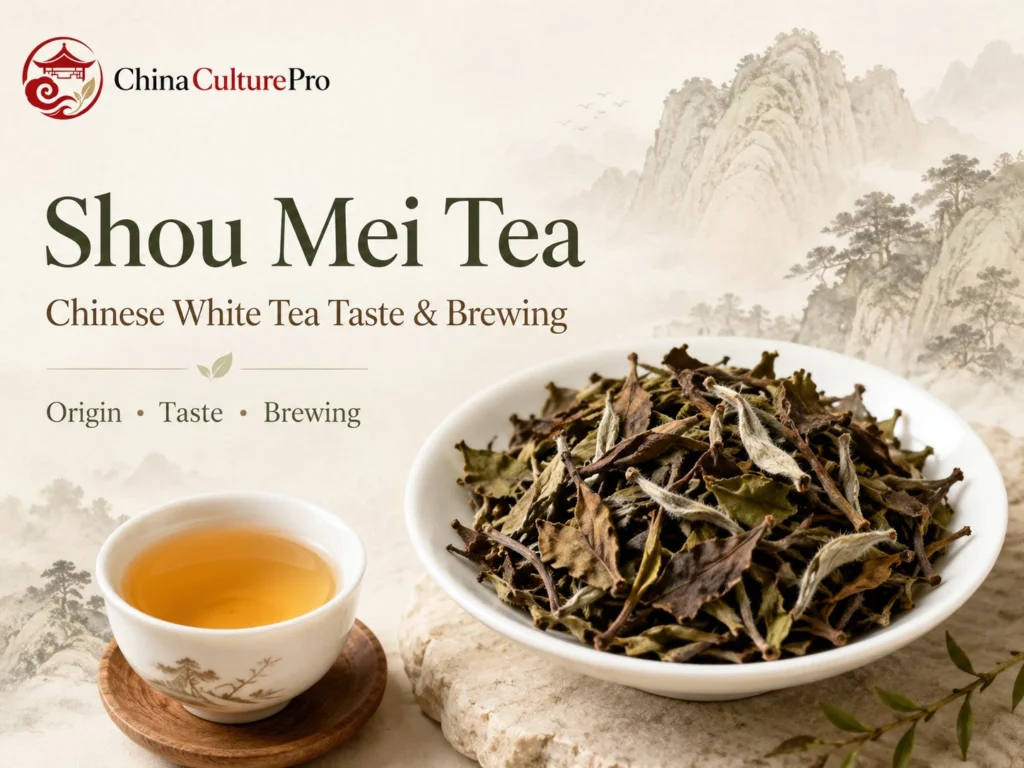

Quick Answer: What Is Shou Mei Tea?
Shou Mei Tea, also written as Shoumei Tea, is a representative Chinese white tea made from young shoots or leaves of Da Bai, Shuixian, or Qunti tea tree varieties. In English, it may also be called Shou Mei White Tea or Shoumei White Tea.
It is not green tea, black tea, dark tea, flower tea, “lowest-grade white tea,” or “bad white tea.” Shou Mei uses more mature material than Baihao Yinzhen, Bai Mudan, or Gong Mei, but maturity is not poor quality. Its value lies in thickness, sweetness, durability, affordability, and clean aging potential.
The basic identity is clear:
Tea Type: Chinese white tea.
Chinese Name: 寿眉.
Pinyin: Shou Mei.
Common English Names: Shou Mei Tea, Shoumei Tea, Shou Mei White Tea, Shoumei White Tea.
Core Material: young shoots or leaves of Da Bai, Shuixian, or Qunti tea tree varieties.
Core Origins: Fujian white tea regions, especially Fuding, Zhenghe, Jianyang / Shuiji, Songxi, and nearby areas.
Core Process: withering, drying, and sorting, with no frying and no rolling.
Dry Leaf: naturally opened leaves, more mature leaf material, and often appropriate stems.
Fresh Shou Mei Aroma: plant-like aroma, dried hay, sweet aroma, floral aroma, and clean fresh sweetness.
Aged Shou Mei Aroma: jujube, herbal aroma, clean aged aroma, woody sweetness, and honey-like sweetness.
Liquor: apricot-yellow, orange-yellow, golden, orange-red, or amber, depending on age and storage.
Taste: sweet, mellow, smooth, thick, durable, and comfortable for daily drinking.
Brewing: usually best around 90–95°C / 194–203°F; aged Shou Mei or Shou Mei cake can use near-boiling water.
The core point: Shou Mei is not “bad white tea.” It is the mature-leaf route of Chinese white tea, valued for thickness, sweetness, durability, friendliness, and clean aging potential rather than single-bud delicacy or floral standard.
To understand the broader category, read our [Chinese White Tea] guide.
Name, Tea Type, and Basic Identity
The name Shou Mei is often translated as “Longevity Eyebrow.” Shou means longevity, and Mei means eyebrow. The name is commonly linked with long eyebrow-like leaves, but this should be treated as a tea-name image rather than fixed historical proof.
| Identity Point | Shou Mei Tea |
|---|---|
| Chinese Name | 寿眉 |
| Pinyin | Shou Mei |
| Common English Names | Shou Mei Tea, Shoumei Tea, Shou Mei White Tea |
| Tea Type | white tea |
| Core Material | young shoots or leaves of Da Bai, Shuixian, or Qunti tea tree varieties |
| Main Process | withering, drying, sorting |
| Not The Same As | green tea, black tea, dark tea, flower tea, or poor-quality white tea |
| Main Character | sweet mellow taste, mature leaves, thick body, durability, aging potential |
Shou Mei is a white tea made through withering, drying, and sorting, without frying or rolling. This separates it from green tea, which uses heat fixation, and from dark tea, which follows a different post-fermentation logic.
Its raw material is broader and more mature than that of several other white teas. Baihao Yinzhen focuses on single buds, Bai Mudan on one bud with one or two leaves, and Gong Mei on Qunti young shoots. Shou Mei can use young shoots or leaves from Da Bai, Shuixian, or Qunti tea tree varieties, so the leaves are often larger, more mature, and accompanied by stems.
Two misunderstandings should be avoided.
First, Shou Mei is not simply “lowest-grade white tea.” It is usually more affordable and made from more mature material, but good Shou Mei still has clean aroma, clear liquor, sweet mellow taste, thickness, and durability.
Second, not every aged white tea is Shou Mei. Shou Mei is often used for aging and pressed cakes, but Baihao Yinzhen, Bai Mudan, and Gong Mei can also age. Shou Mei should refer to a specific white tea category, not just any old white tea.
Main Origins: Fujian, Fuding, Zhenghe, Jianyang, and Songxi
Shou Mei belongs to the Fujian white tea tradition. Fuding is the best-known name in the market, but Zhenghe, Jianyang / Shuiji, Songxi, Jian’ou, and other Fujian white tea regions also matter in the broader white tea context.
| Origin / Region | Chinese | Location | Why It Matters |
|---|---|---|---|
| Fuding | 福鼎 | northeastern Fujian | strong market recognition; common for Shou Mei, Shou Mei cakes, and aged white tea |
| Zhenghe | 政和 | northern Fujian / Minbei | traditional white tea region, often associated with fuller and steadier white tea styles |
| Jianyang / Shuiji | 建阳 / 水吉 | northern Fujian | important in Fujian white tea history and in Gong Mei / Shou Mei naming context |
| Songxi / Jian’ou | 松溪 / 建瓯 | northern Fujian | part of the broader Fujian white tea tradition |
Fuding Shou Mei is very visible in the market, especially for aged white tea and pressed cakes, and is often associated with a sweet, clean, approachable style. Zhenghe Shou Mei can feel steadier and fuller, while Jianyang / Shuiji and Songxi belong to the wider Fujian white tea context.
The key point is simple: Shou Mei should be understood through Fujian white tea tradition, not through a single marketing origin. A good tea still needs clean aroma, clear liquor, sweet mellow taste, and a soft natural leaf base.
History and Cultural Background
Shou Mei has long been associated with the everyday side of Chinese white tea: usually less expensive than Silver Needle, more durable than Bai Mudan, and common as loose tea, pressed cakes, and aged white tea.
| Context | Meaning |
|---|---|
| Fujian White Tea Tradition | Shou Mei belongs to the wider Fujian white tea system |
| Mature-Leaf Route | It represents a more mature leaf style with thickness and durability |
| Gong Mei / Shou Mei Naming | older market usage sometimes mixed the names or treated them as a grade relationship |
| Standard Clarification | current definitions make the raw material distinction clearer |
| Modern Tea Drinking | many drinkers encounter white tea through Shou Mei cakes or aged Shou Mei |
The cultural value of Shou Mei is not in being “high-end,” but in being close to everyday tea life. It is usually affordable, durable, easy to brew, and suitable for long-term storage when the tea is well made and kept clean.
Many Chinese tea drinkers first encounter aged white tea through a Shou Mei cake. It is practical, easy to share, and forgiving in brewing. A good Shou Mei does not need to look delicate; it needs to smell clean, taste sweet, brew steadily, and remain comfortable across infusions.
Shou Mei should not be romanticized as “the older, the better.” Age only helps when raw material, processing, dryness, and storage are right. Poor storage does not create aged aroma; it creates flaws.
How Shou Mei Is Made
Shou Mei follows the core white tea process: withering, drying, and sorting. The process is gentle, but it is not careless. Mature material still needs proper handling.
The raw material usually includes young shoots or leaves from Da Bai, Shuixian, or Qunti tea tree varieties. Compared with Silver Needle, Bai Mudan, or Gong Mei, it is usually more mature, with naturally opened leaves and appropriate stems, but it should not be mostly dust, rough old stems, or impurities.
A typical Shou Mei process follows this direction:
| Step | Chinese Term | What It Does | Key Point |
|---|---|---|---|
| Picking | 采摘 | selects suitable young shoots or leaves | material is usually more mature but should not be careless |
| Withering | 萎凋 | lets leaves slowly lose moisture and undergo slight natural transformation | the core step that develops sweetness, mellowness, and clean aroma |
| Drying | 干燥 | stabilizes aroma and moisture content | should preserve sweetness and prevent dull or sour notes |
| Sorting | 拣剔 | removes unsuitable leaves, coarse stems, broken pieces, and impurities | keeps the finished tea clean and drinkable |
White tea is not “tea without processing.” It is tea with less aggressive processing. Shou Mei is not pan-fired, rolled, pile-fermented, or roasted into a heavy flavor; the leaves wither slowly, then dry to stabilize the tea.
The phrase “no frying, no rolling” matters. Without frying, Shou Mei does not follow the green tea path; without rolling, the mature leaf shape remains natural, which is why Shou Mei often looks more open and rustic than Silver Needle or Bai Mudan.
Appropriate stems should not be treated as a defect. In good Shou Mei, some stems are normal and can contribute sweetness, body, and aging potential. The problem is too many coarse old stems, excessive broken material, dust, or impurities.
Because Shou Mei uses more mature leaves, it is usually thicker, more durable, and easier to brew than more delicate white teas. This is part of its identity, not a flaw.
What Shou Mei Tastes Like
Shou Mei is a tea of sweetness, mellowness, thickness, durability, and aging potential. It should not taste moldy, sour, smoky, warehouse-like, or artificially aged.
| Tasting Point | Good Shou Mei |
|---|---|
| Dry Leaf | naturally opened leaves, more mature leaf material, appropriate stems |
| Dry Leaf Color | gray-green, yellow-green, brownish-green, yellow-brown, or naturally mixed tones |
| Fresh Tea Aroma | plant-like aroma, dried hay, sweet aroma, floral aroma, clean fresh sweetness |
| Aged Tea Aroma | jujube, herbal aroma, clean aged aroma, woody sweetness, honey-like sweetness |
| Liquor Color | fresh tea: apricot-yellow, orange-yellow, golden; aged tea: orange-red, amber, deep golden |
| Taste | sweet, mellow, smooth, thick, durable |
| Mouthfeel | fuller than Bai Mudan, more mature than Gong Mei, less delicate than Silver Needle |
| Leaf Base | soft, bright, naturally opened, not blackened or stiff |
Fresh Shou Mei can be clean and lively, with plant-like sweetness, dried hay, floral hints, and golden liquor. Properly stored aged Shou Mei can become deeper and smoother, showing jujube, herbal aroma, woody sweetness, honey-like sweetness, and amber liquor. In tea tasting, herbal aroma means an aroma impression similar to dried herbs or Chinese medicinal materials; it is not a medical effect.
| Good Shou Mei | Problem Shou Mei |
|---|---|
| natural open leaves, appropriate stems, clean color | too much dust, too many coarse old stems, blackened or dull material |
| clean plant-like, sweet, floral, hay-like, jujube, or aged aroma | moldy, sour, warehouse-like, smoky, or stale smell |
| clear apricot-yellow, golden, orange-red, or amber liquor | cloudy, muddy, dark, or lifeless liquor |
| sweet, mellow, smooth, thick, durable taste | rough, thin, sour, watery, or harsh taste |
| soft, naturally opened leaf base | blackened, stiff, broken, or rotten-looking leaf base |
A useful way to understand Shou Mei: Silver Needle is about bud delicacy, Bai Mudan is about floral balance, Gong Mei is about Qunti sweetness and variation, and Shou Mei is about mature-leaf thickness, durability, and clean aging potential.
Fresh Shou Mei vs Aged Shou Mei
Shou Mei is strongly connected with aged white tea, but fresh Shou Mei should not be ignored. Fresh and aged Shou Mei are two drinking stages, not a quality ranking.
| Point | Fresh Shou Mei | Aged Shou Mei |
|---|---|---|
| Aroma | plant-like aroma, dried hay, floral sweetness, clean sweet aroma | jujube, herbal aroma, clean aged aroma, woody sweetness, honey-like sweetness |
| Liquor | apricot-yellow, orange-yellow, golden | orange-red, amber, deep golden |
| Taste | sweet, mellow, slightly refreshing, smooth | thicker, smoother, warmer, rounder |
| Mouthfeel | light but with body | deeper and more rounded |
| Brewing | 90–95°C, gaiwan or mug | near-boiling water, can be brewed and then simmered |
| Best For | daily fresh white tea drinking | aged white tea experience, colder weather, slow tasting |
| Key Risk | grassy or thin if poorly made | moldy, sour, or warehouse-like if poorly stored |
Fresh Shou Mei has its own value: sweet, easy, and comfortable, with dried hay and plant-like freshness. It should not be dismissed just because it is not old.
Aged Shou Mei can be satisfying when the tea is dry, well processed, and stored cleanly, bringing jujube aroma, herbal aroma, aged sweetness, woody sweetness, honey-like sweetness, deeper liquor, and a smoother body.
But aged Shou Mei is not automatically better. Clean storage matters more than age. Moldy smell, sour smell, heavy warehouse odor, and unclear liquor are warning signs, not good aged aroma.
To explore aged white tea more deeply, read our Aged White Tea guide.
How to Taste Shou Mei Like a Tea Drinker
- Look At The Dry Tea The leaves should be naturally opened, with appropriate stems. Avoid tea that is mostly dust, broken fragments, or coarse old stems.
- Check The Color Fresh Shou Mei may show gray-green, yellow-green, or brownish-green tones. Aged Shou Mei may be yellow-brown or brown. Avoid blackened, moldy, wet-looking, or unnaturally dull leaves.
- Smell The Dry Aroma Fresh tea may show plant-like aroma, dried hay, sweet aroma, or floral hints. Aged tea may show jujube, herbal aroma, clean aged aroma, or woody sweetness. Avoid moldy, sour, warehouse-like, smoky, or stale smells.
- Check The Liquor Color The liquor should be clear. Fresh Shou Mei is often apricot-yellow or golden; aged Shou Mei may be orange-red, amber, or deep golden. Cloudiness is a warning sign.
- Smell The Wet Leaves The wet aroma should remain clean and sweet. If the wet leaves smell sour, moldy, or dirty, the tea is not showing good aging.
- Taste The Liquor Good Shou Mei should taste sweet, mellow, smooth, and thick enough. It should not be sharply bitter, sour, thin, or rough.
- Feel The Durability Shou Mei should be fairly durable. Later infusions should still have sweetness, body, or a comfortable finish, not turn into plain water too quickly.
- Notice The Aftertaste The aftertaste should be steady and clean. Shou Mei’s sweetness is usually not sharp; it is more like a continuous mellow sweetness.
- Look At The Leaf Base The brewed leaves should be soft and naturally opened. Avoid blackened, stiff, broken, slimy, or rotten-looking leaves.
For aroma, mouthfeel, Hui Gan, and aftertaste, read our Chinese Tea Tasting guide.
How to Brew Shou Mei Tea
Shou Mei is one of the most forgiving white teas to brew. It can handle higher water temperature than Silver Needle, Bai Mudan, and many Gong Mei teas because the material is more mature.
| Brewing Method | Teaware | Water Temperature | Leaf Amount | Steeping Time | Best For |
|---|---|---|---|---|---|
| Gaiwan | 100–120ml gaiwan | 90–95°C / 194–203°F for fresh Shou Mei; near boiling for aged Shou Mei or cake | 5g | 15–30 seconds for first infusion, then extend | tasting sweetness, body, and layers |
| Glass Cup / Mug | glass cup or mug | 90–95°C / 194–203°F | 3–4g / 250ml | 3–5 minutes | daily easy brewing |
| Porcelain Pot | small porcelain pot | 90–95°C / 194–203°F | 4–5g / 200ml | 3–5 minutes | sharing with others |
| Simmering Older Shou Mei | kettle or pot | near boiling, then low heat | 3–5g / 500ml | simmer briefly | aged Shou Mei and Shou Mei cake |
Brewing tips:
- Use hot water: Shou Mei usually handles 90–95°C well, and aged Shou Mei or cake can use near-boiling water.
- Avoid water that is too cool: very low temperature can make Shou Mei taste flat.
- Do not oversteep into roughness: Shou Mei is durable, but heavy oversteeping can still bring coarse notes.
- Use a gaiwan for tasting: it shows sweetness, body, and changes across infusions.
- Use a mug for daily drinking: Shou Mei works well as a practical everyday white tea.
- Brew first, then simmer: aged Shou Mei and Shou Mei cake can be brewed first and simmered later.
- Break cakes carefully: when prying Shou Mei cake, try not to crush the leaves into too many fragments.
- Enjoy it plain: milk and sugar cover the tea’s natural sweetness and aged aroma.
A good Shou Mei session should feel relaxed rather than fragile, with sweetness, mellowness, and smoothness across multiple infusions.
To learn practical brewing methods, read our How to Brew Chinese Tea guide. For gaiwans, mugs, porcelain pots, and kettles, read our Chinese Teaware guide.
Shou Mei Cake and Pressed White Tea
Shou Mei is often sold as loose tea or pressed white tea, and Shou Mei cake is especially common in aged white tea culture.
Pressed Shou Mei is usually made by softening loose tea with steam and pressing it into cakes, bricks, or tuo. Pressing makes the tea easier to store, transport, age, and portion for brewing, but a pressed cake is not automatically better than loose tea. Good Shou Mei cake still depends on raw material, processing, pressing quality, and storage.
| Checkpoint | Good Shou Mei Cake | Problem Shou Mei Cake |
|---|---|---|
| Aroma | clean sweet aroma, aged sweetness, jujube, herbal or woody notes if aged | moldy, sour, smoky, warehouse-like, stale |
| Cake Surface | natural, not overly dusty, visible leaf material | too much dust, broken leaf, dull or dirty surface |
| Inside Material | relatively consistent with the outside | good surface material but poor broken material inside |
| Compression | firm enough to hold shape, loose enough to open in brewing | pressed too tightly and difficult to brew open |
| Liquor | clear golden, orange-red, or amber | muddy, cloudy, dark, lifeless |
| Taste | sweet, mellow, thick, smooth | sour, rough, thin, harsh |
When brewing Shou Mei cake, pry the tea gently and keep the leaves as intact as possible. If the pieces are too broken, the tea may release too quickly and taste rough. Older Shou Mei cake can be brewed first and then simmered to draw out the remaining sweetness.
Shou Mei vs Green Tea
Shou Mei can be mistaken for green tea because some leaves may look greenish or yellow-green. But Shou Mei is white tea, and the processing logic is different.
| Point | Shou Mei | Green Tea |
|---|---|---|
| Tea Type | white tea | green tea |
| Core Process | withering, drying, sorting; no frying, no rolling | fixation, rolling, drying |
| Oxidation | slight natural transformation during withering | heat fixation stops oxidation early |
| Leaf Material | more mature young shoots or leaves | varies, often tender buds and leaves |
| Liquor Color | apricot-yellow, golden, orange-red, or amber | green, yellow-green, or pale green |
| Aroma | plant-like, dried hay, sweet, floral, aged aroma | fresh, grassy, chestnut-like, bean-like, pan-fired |
| Taste | sweet, mellow, smooth, thick, durable | fresh, brisk, sharper, sometimes more astringent |
| Storage | can age if dry and clean | usually best enjoyed fresh |
Green tea uses heat fixation to preserve a fresh green character. Shou Mei uses withering and drying, allowing slow natural transformation and creating a sweeter, mellower, thicker style.
Green tea is often sharper and fresher; Shou Mei is warmer, softer, more durable, and more suitable for clean aging. They are different tea-making philosophies, not higher or lower grades.
To compare white tea and green tea, read our Chinese Green Tea guide.
Shou Mei vs Baihao Yinzhen, Bai Mudan, and Gong Mei
Shou Mei becomes clearer when placed inside the Chinese white tea family.
| White Tea Type | Chinese | Core Material | Aroma | Taste | Style |
|---|---|---|---|---|---|
| Baihao Yinzhen | 白毫银针 | single buds | pure pekoe aroma, clean sweetness | fresh, mellow, delicate | most refined and bud-focused |
| Bai Mudan | 白牡丹 | one bud with one or two leaves | pekoe aroma plus floral aroma | fresh, sweet, floral, layered | balanced and fragrant |
| Gong Mei | 贡眉 | young shoots of Qunti tea tree varieties | sweet, floral, honey-like, varied | sweet, mellow, smooth, with body | friendly, varied, daily drinkable |
| Shou Mei | 寿眉 | young shoots or leaves from Da Bai, Shuixian, or Qunti tea tree varieties | plant-like, dried hay, sweet, floral, aged aroma | sweet, mellow, thick, durable | mature, durable, common for aging and cakes |
To compare the single-bud white tea style, read our Baihao Yinzhen Tea guide. To compare the bud-and-leaf white tea style, read our Bai Mudan Tea guide.
Shou Mei vs Gong Mei
This comparison matters because Shou Mei and Gong Mei are often confused in English tea writing.
| Point | Gong Mei | Shou Mei |
|---|---|---|
| Chinese Name | 贡眉 | 寿眉 |
| Core Definition | made from young shoots of Qunti tea tree varieties | made from young shoots or leaves of Da Bai, Shuixian, or Qunti tea tree varieties |
| Raw Material Focus | Qunti / Caicha young shoots | broader raw material range, usually more mature leaves |
| Appearance | natural young-shoot form | more mature leaves, more stems |
| Aroma | sweet, floral, honey-like, varied | plant-like, dried hay, sweet, floral, aged aroma |
| Taste | sweet, mellow, somewhat finer | fuller, thicker, more durable |
| Aging | can be aged if well made and stored | very common for aging and pressed cakes |
| Price Tendency | often slightly higher than common Shou Mei | usually more accessible |
To understand Qunti white tea, read our Gong Mei Tea guide.
Shou Mei vs Bai Mudan
| Point | Bai Mudan | Shou Mei |
|---|---|---|
| Chinese Name | 白牡丹 | 寿眉 |
| Core Material | one bud with one or two leaves | young shoots or leaves from Da Bai, Shuixian, or Qunti varieties |
| Appearance | more standard bud-and-leaf form, often two leaves embracing the bud | more mature leaves, more open shape, more stems |
| Aroma | clearer floral aroma, pekoe aroma | plant-like, dried hay, sweet, floral, aged aroma |
| Taste | fresh, mellow, floral, balanced | sweet, mellow, thicker, more durable |
| Style | floral balance and standard beauty | mature-leaf thickness, durability, aging potential |
Bai Mudan is judged by bud-and-leaf standard and floral clarity. Shou Mei is judged more by mature-leaf thickness, sweetness, durability, and clean aging potential. This is not a fixed high-low relationship, but two different white tea aesthetics: one more floral and refined, the other more practical, thick, durable, and aging-friendly.
How to Choose Good Shou Mei
| Checkpoint | What To Look For | Warning Signs |
|---|---|---|
| Product Name | Shou Mei, Shoumei Tea, or Shoumei White Tea | only “white tea,” “aged tea,” or unclear naming |
| Tea Type | clearly identified as white tea | sold as green tea, dark tea, or only as “aged tea” |
| Origin | Fujian, Fuding, Zhenghe, Jianyang / Shuiji, Songxi, or credible Fujian white tea context | vague origin or non-traditional origin sold as classic Shou Mei |
| Dry Leaf | naturally opened leaves, appropriate stems, not too broken | too much dust, too many coarse stems, blackened or dull material |
| Fresh Aroma | plant-like aroma, dried hay, sweet aroma, floral hints | grassy rawness, sourness, stale smell |
| Aged Aroma | jujube, herbal aroma, clean aged aroma, woody sweetness | moldy, sour, warehouse-like, smoky smell |
| Liquor | apricot-yellow, golden, orange-red, or amber, clear and bright | cloudy, muddy, dark, dull |
| Taste | sweet, mellow, smooth, thick, durable | rough, thin, sour, watery, harsh |
| Leaf Base | soft, naturally opened, not blackened | black, stiff, broken, rotten-looking |
Do not buy Shou Mei only by year, cake shape, packaging story, or low price. Old age does not prove quality, and a pressed cake is not automatically better than loose tea. A cheap tea is not a good daily tea if it smells sour, moldy, smoky, or warehouse-like.
Three checks are especially useful: clean aroma, clear liquor, and sweet durable taste. Without these, Shou Mei cannot show its real value.
How to Store Shou Mei
Use these storage rules:
- Seal It Well: use a sealed pouch, tin, jar, or clean storage bag to reduce air exposure.
- Keep It Dry: moisture quickly damages aroma and can create sour or moldy notes.
- Avoid Light: strong light can dull aroma and darken the tea.
- Keep It Cool: a cool room-temperature place is usually enough.
- Avoid Odors: keep it away from spices, coffee, smoke, incense, pu-erh, and scented teas.
- Do Not Open Frequently: repeated opening brings oxygen and moisture.
- Drink Fresh Shou Mei For Sweetness: new Shou Mei can be enjoyable for plant-like sweetness, dried hay, floral hints, and smooth taste.
- Age Only Under Good Conditions: aged Shou Mei may develop jujube, herbal aroma, aged sweetness, woody sweetness, or honey-like sweetness, but not every tea improves with age.
- Store Pressed Cakes Carefully: Shou Mei cake still needs dry, clean, odor-free storage.
Benefits and Caffeine
Important cautions:
- Shou Mei contains caffeine.
- A mellow taste does not mean it is caffeine-free.
- Avoid drinking large amounts before sleep.
- People sensitive to caffeine should drink moderately.
- People with stomach sensitivity should adjust amount and strength.
- Pregnant people, people taking medication, or people with medical concerns should ask a qualified professional.
- Herbal aroma is an aroma note, not a medical effect.
- Do not treat Shou Mei as medicine.
Enjoy this tea for its taste and cultural value. Do not treat it as a weight-loss, blood-sugar, blood-pressure, cancer-prevention, or disease-treatment tea.
Final Thoughts
Shou Mei is not green tea, black tea, dark tea, flower tea, “lowest-grade white tea,” or “bad white tea.” It is a representative Chinese white tea made from young shoots or leaves of Da Bai, Shuixian, or Qunti tea tree varieties through withering, drying, and sorting.
Its value comes from mature leaf material, appropriate stems, Fujian white tea tradition, less aggressive processing, and a taste that is sweet, mellow, smooth, thick, durable, and friendly. A good Shou Mei should show naturally opened leaves, clean plant-like aroma, dried hay, sweet aroma, floral aroma, or clean aged aroma, clear golden or amber liquor, smooth thick body, and a soft natural leaf base.
FAQs About Shou Mei Tea
What is Shou Mei tea?
Shou Mei Tea is a Chinese white tea made from young shoots or leaves of Da Bai, Shuixian, or Qunti tea tree varieties. It is processed through withering, drying, and sorting, with no frying and no rolling.
Is Shou Mei the same as Shoumei White Tea?
Yes. Shoumei White Tea is another English form of Shou Mei Tea. This article uses Shou Mei Tea as the main name.
Is Shou Mei green tea or white tea?
Shou Mei is white tea, not green tea. It is made through withering and drying, while green tea uses heat fixation.
What does Shou Mei tea taste like?
Fresh Shou Mei is usually sweet, mellow, and smooth, with plant-like aroma, dried hay, floral hints, and golden liquor. Aged Shou Mei may show jujube, herbal aroma, woody sweetness, honey-like sweetness, and amber liquor.
Where is Shou Mei tea from?
Shou Mei belongs to the Fujian white tea tradition. Fuding, Zhenghe, Jianyang / Shuiji, Songxi, Jian’ou, and other Fujian white tea regions may appear in Shou Mei production and discussion.
What is the difference between Shou Mei and Gong Mei?
Gong Mei is made from young shoots of Qunti tea tree varieties. Shou Mei has a broader raw material range, including young shoots or leaves from Da Bai, Shuixian, or Qunti tea tree varieties. Shou Mei is usually more mature, thicker, and more common for aging and pressed cakes.
What is the difference between Shou Mei and Bai Mudan?
Bai Mudan is usually made from one bud with one or two leaves and is valued for floral clarity and bud-and-leaf balance. Shou Mei uses more mature material, often with more leaves and stems, giving it thicker body, durability, and aging potential.
What is the difference between Shou Mei and Baihao Yinzhen?
Baihao Yinzhen is made from single unopened buds and is the most delicate white tea style. Shou Mei uses more mature young shoots or leaves and is thicker, more durable, more affordable, and more suitable for daily drinking or aging.
Is Shou Mei low-grade white tea?
No. Shou Mei is often more affordable and uses more mature material, but it should not be reduced to “low-grade white tea.” Good Shou Mei has clean aroma, clear liquor, sweet mellow taste, thick body, durability, and clean aging potential.
How do you brew Shou Mei tea?
Use 90–95°C / 194–203°F water for fresh Shou Mei and near-boiling water for aged Shou Mei or Shou Mei cake. For gaiwan brewing, use about 5g for 100–120ml and start with 15–30 seconds. For mug brewing, use 3–4g for 250ml and steep for 3–5 minutes.
Can Shou Mei be aged?
Yes. Shou Mei can be aged if it is dry, well made, and stored properly. Aged Shou Mei may develop jujube, herbal aroma, aged sweetness, woody sweetness, and honey-like sweetness. But not every Shou Mei improves with age.
What is Shou Mei cake?
Shou Mei cake is pressed Shou Mei white tea. Loose tea is softened and pressed into a cake, brick, or other shape for storage, transport, aging, and brewing control. Good Shou Mei cake should smell clean, brew clear, and taste sweet and smooth.
Does Shou Mei have caffeine?
Yes. Shou Mei contains caffeine. Its mellow taste does not mean it is caffeine-free.
How should I store Shou Mei?
Store Shou Mei in a sealed, dry, cool, dark place away from strong odors. Avoid moisture and frequent opening. Clean storage matters more than age.