
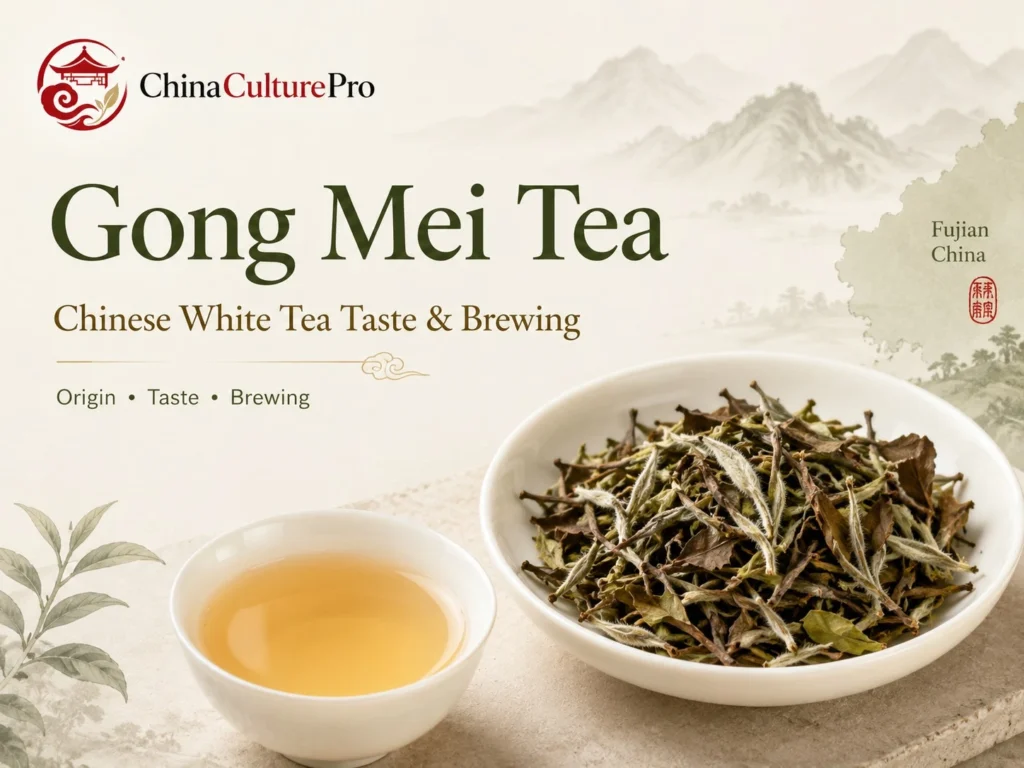

Quick Answer: What Is Gong Mei Tea?
Gong Mei Tea, also written as Gongmei Tea, is a representative Chinese white tea made from the young shoots of Qunti tea tree varieties. In English, it may also be called Gong Mei White Tea or Gongmei White Tea.
It is not green tea, dark tea, black tea, flower tea, “higher-grade Shou Mei,” or “lower-grade Bai Mudan.” In the current Chinese white tea standard, Gong Mei has its own identity: young shoots of Qunti tea tree varieties, processed through withering, drying, and sorting.
The basic identity is clear:
Tea Type: Chinese white tea.
Chinese Name: 贡眉.
Pinyin: Gong Mei.
Common English Names: Gong Mei Tea, Gongmei Tea, Gong Mei White Tea, Gongmei White Tea.
Core Material: young shoots of Qunti tea tree varieties.
Related Chinese Terms: Qunti, Caicha, Xiaobaicha, local landrace tea bushes.
Core Origins: Fujian white tea regions, especially Jianyang / Shuiji as an important traditional context, with Fuding and Zhenghe also relevant.
Core Process: withering, drying, and sorting, with no frying and no rolling.
Aroma: sweet aroma, floral aroma, honey-like aroma, dried hay, light fruit, and sometimes mild pekoe aroma.
Liquor: apricot-yellow, orange-yellow, or golden, clear and bright.
Taste: sweet, mellow, smooth, gentle, and moderately full.
Style: thicker than many Bai Mudan teas, finer than many Shou Mei teas, and very suitable for daily drinking.
Brewing: usually best around 90–95°C / 194–203°F; tender new Gong Mei can use slightly cooler water.
The core point: Gong Mei is not a simple grade label. Its value lies in Qunti young shoots, natural variation, sweetness, friendliness, and everyday drinkability — its own white tea route between single-bud refinement and mature-leaf heaviness.
To understand the broader category, read our [Chinese White Tea] guide.
Name, Tea Type, and Basic Identity
The name Gong Mei is often translated as “Tribute Eyebrow,” but it should be handled carefully. Gong can suggest tribute or offering, but this does not mean every Gong Mei was an imperial tribute tea. Mei means eyebrow, a tea-name image related to leaf shape. The name gives cultural flavor, but the tea’s identity comes from material and processing.
| Identity Point | Gong Mei Tea |
|---|---|
| Chinese Name | 贡眉 |
| Pinyin | Gong Mei |
| Common English Names | Gong Mei Tea, Gongmei Tea, Gong Mei White Tea |
| Tea Type | white tea |
| Core Material | young shoots of Qunti tea tree varieties |
| Related Material Terms | Caicha, Xiaobaicha, local landrace tea bushes |
| Main Process | withering, drying, sorting |
| Not The Same As | green tea, dark tea, flower tea, Shou Mei, or Bai Mudan |
| Main Character | sweet mellow taste, floral or honey-like aroma, clear golden liquor, daily drinkability |
Gong Mei is a white tea made through withering, drying, and sorting, without frying or rolling. Green tea uses heat fixation; Gong Mei follows the white tea logic of slow withering and gentle drying.
The most important identity point is raw material: young shoots of Qunti tea tree varieties. Qunti tea trees are genetically diverse local tea populations, often connected with Caicha or Xiaobaicha. This separates Gong Mei from Baihao Yinzhen and Bai Mudan, which are usually discussed through large white tea cultivars, single buds, or standard bud-and-leaf forms.
First, Gong Mei is not simply “higher-grade Shou Mei.” Older market language sometimes treated Gong Mei and Shou Mei loosely or as a grade relationship, but current standard usage gives them different raw material definitions.
Second, Gong Mei is not “lower-grade Bai Mudan.” Bai Mudan is mainly understood through one bud with one or two leaves and a clearer bud-and-leaf appearance; Gong Mei is centered on Qunti young shoots, natural variation, sweetness, and mellow daily drinking.
Main Origins: Fujian, Jianyang, Fuding, and Zhenghe
Gong Mei belongs to the Fujian white tea tradition. Its origin context is the relationship between Fujian white tea regions, local Qunti / Caicha resources, and traditional white tea making.
| Origin / Region | Chinese | Location | Why It Matters |
|---|---|---|---|
| Jianyang / Shuiji | 建阳 / 水吉 | northern Fujian | important traditional context for Gong Mei, Caicha, Xiaobaicha, and local white tea resources |
| Fuding | 福鼎 | northeastern Fujian | famous white tea region; also has Caicha / small white tea and Qunti-related white tea lines |
| Zhenghe | 政和 | northern Fujian / Minbei | traditional white tea area, often associated with fuller and steadier white tea styles |
| Songxi / Jian’ou | 松溪 / 建瓯 | northern Fujian | part of the broader Fujian white tea context |
Jianyang and Shuiji are especially important when discussing Gong Mei’s traditional background because they are often connected with Caicha, Xiaobaicha, and older white tea context. This gives Gong Mei a different cultural flavor from the more standardized image of Silver Needle or Bai Mudan.
Fuding and Zhenghe also matter: Fuding has strong market recognition in white tea, and Zhenghe has a long northern Fujian white tea tradition. The cleanest framing is this: Gong Mei belongs to Fujian white tea, with Jianyang / Shuiji as an important traditional line, and Fuding and Zhenghe as major white tea regions where Gong Mei-related production and interpretation also appear.
Origin matters, but it is not enough. A Chinese tea drinker also looks at whether the tea shows Qunti young-shoot character, clean sweetness, proper liquor, smooth taste, and a soft natural leaf base.
History and Cultural Background
Gong Mei has a more complicated history than many English introductions suggest. Older market usage sometimes treated Gong Mei and Shou Mei loosely, or described Gong Mei as a higher grade of Shou Mei. A more accurate modern understanding should include the current standard definition: Gong Mei is white tea made from young shoots of Qunti tea tree varieties through withering, drying, and sorting.
| Period / Context | Meaning |
|---|---|
| Traditional Fujian White Tea | Gong Mei is connected with Fujian white tea, Caicha, Xiaobaicha, and local tea resources |
| Older Market Usage | Gong Mei and Shou Mei were sometimes used loosely or treated as a grade relationship |
| Standard Clarification | Gong Mei became clearer as a category defined by Qunti young shoots and white tea processing |
| Modern Tea Drinking | More drinkers now value Gong Mei for sweetness, variation, and daily drinkability rather than just price or grade |
| Cultural Value | Gong Mei represents the local, varied, less standardized side of Chinese white tea |
The cultural value of Gong Mei is not only in the word Gong. The word may sound noble, but the deeper value lies in Qunti / Caicha tea resources and the natural variation they bring.
Silver Needle looks refined, Bai Mudan looks balanced and floral, and Shou Mei can be thick and durable. Gong Mei sits elsewhere: not always the most beautiful dry tea or the most expensive, but often sweet, friendly, and full of small changes across infusions. Many Chinese tea drinkers appreciate it because it feels honest, drinkable, and comfortable enough to return to every day.
Gong Mei and Qunti / Caicha Tea Trees
This is the key to understanding Gong Mei: it should not be explained only as a middle grade between Bai Mudan and Shou Mei. Its identity depends on Qunti tea tree varieties.
| Term | Chinese | English Explanation | Why It Matters |
|---|---|---|---|
| Qunti Tea Tree Varieties | 群体种茶树品种 | seed-grown, genetically diverse local tea populations | the core raw material identity of Gong Mei |
| Caicha | 菜茶 | local landrace tea bushes, often grown from seed | a traditional, local name connected with Qunti resources |
| Xiaobaicha | 小白茶 | small-leaf local white tea resources | often connected with older Fujian white tea traditions |
| Young Shoots | 嫩梢 | tender shoots with buds, leaves, and sometimes tender stems | the raw material used for Gong Mei |
Qunti tea trees are not a single neat cultivar like Fuding Da Bai or Fuding Da Hao. They are local populations with natural genetic variation, so the buds and leaves may look less uniform, and different batches may show different aroma and taste.
This is not a weakness. It is part of Gong Mei’s personality. Qunti / Caicha material may bring natural batch variation, less standardized dry leaves, sweet mellow taste, floral or honey-like notes, dried hay, light fruit, and a more local traditional feeling.
A Chinese tea drinker may say that good Caicha Gong Mei is not necessarily the prettiest tea on the table, but it has “content” when brewed. It can be sweet without being simple, rustic without being rough, and daily-friendly without being boring.
This should not become a marketing claim that Qunti is always better than Da Bai or Da Hao. Different tea tree resources serve different styles. Gong Mei’s value comes from Qunti young shoots and their variation, not from pretending to be Silver Needle, Bai Mudan, or Shou Mei.
How Gong Mei Is Made
Gong Mei follows the white tea processing logic: less aggressive handling, careful withering, drying, and sorting. The process looks simple, but quality depends heavily on raw material and withering control.
The raw material usually includes young shoots of Qunti tea tree varieties, with buds, leaves, and sometimes tender stems. The shape is natural and may be less uniform than Silver Needle or Bai Mudan, but the leaves should still be clean enough to wither evenly.
A typical Gong Mei process follows this direction:
| Step | Chinese Term | What It Does | Key Point |
|---|---|---|---|
| Picking | 采摘 | selects young Qunti shoots | material should be tender enough and not overly coarse |
| Withering | 萎凋 | lets the young shoots slowly lose moisture and undergo slight natural transformation | the core step that develops sweetness, mellow taste, and clean aroma |
| Drying | 干燥 | stabilizes aroma and moisture content | should preserve sweetness and avoid dull or harsh notes |
| Sorting | 拣剔 | removes coarse stems, broken leaves, and impurities | keeps the finished tea clean and drinkable |
White tea is not “tea without processing.” It is tea with less aggressive processing. Gong Mei is not pan-fired, rolled, or pile-fermented; the young shoots wither slowly, then dry to stabilize the finished tea.
The phrase “no frying, no rolling” is central. Without frying, Gong Mei does not follow the green tea path; without rolling, the natural shape of the young shoots remains visible.
Withering is especially important. Insufficient withering can make Gong Mei taste grassy, thin, or raw; excessive or poorly controlled withering can make it smell sour, stuffy, dull, or warehouse-like even when it is not truly aged. Good withering brings together sweet aroma, floral hints, honey-like notes, and a mellow body.
Because Gong Mei uses Qunti young shoots and often has more leaf presence than Silver Needle or Bai Mudan, its taste is usually thicker and more everyday-friendly, while still finer than rough, over-mature white tea.
What Gong Mei Tastes Like
Gong Mei is a tea of sweetness, mellowness, smoothness, clean aroma, and natural variation. It should not taste green, roasted, smoky, black-tea-like, or artificially scented.
| Tasting Point | Good Gong Mei |
|---|---|
| Dry Leaf | natural bud-and-leaf shape, young-shoot feeling, some silver down, not overly broken |
| Color | gray-green, yellow-green, brownish-green, or naturally mixed tones |
| Aroma | sweet aroma, floral aroma, honey-like aroma, dried hay, light fruit, mild pekoe aroma |
| Liquor Color | apricot-yellow, orange-yellow, or golden, clear and bright |
| Taste | sweet, mellow, smooth, gentle, with some body |
| Mouthfeel | fuller than many Bai Mudan teas, finer than many Shou Mei teas |
| Aftertaste | clean, comfortable, sweet, not sharp |
| Leaf Base | soft, bright, naturally opened, not black or stiff |
Gong Mei’s charm is different from Baihao Yinzhen and Bai Mudan. Silver Needle focuses on pure bud delicacy; Bai Mudan focuses on bud-and-leaf balance and floral clarity; Gong Mei focuses on Qunti sweetness, mellow body, and variation.
Good Gong Mei often has a friendly sweetness that runs through the session, with flower, honey, dried hay, light fruit, or warm plant notes. Properly stored aged Gong Mei may develop honey, jujube, herbal, aged sweetness, or light woody sweetness.
| Good Gong Mei | Problem Gong Mei |
|---|---|
| natural young-shoot appearance, not too broken | too many broken pieces, old stems, dark dull material |
| clean sweet, floral, honey-like, or dried-hay aroma | moldy, sour, warehouse-like, stuffy, or stale smell |
| apricot-yellow, orange-yellow, or golden clear liquor | cloudy, dark, muddy, or lifeless liquor |
| sweet, mellow, smooth taste with body | rough, thin, sour, bitter, or watery taste |
| soft, naturally opened leaf base | blackened, stiff, broken, or rotten-looking leaf base |
A useful way to understand Gong Mei: Silver Needle is about delicacy, Bai Mudan is about floral balance, Shou Mei is about mature thickness, and Gong Mei is about sweet variation. It may not be the most refined white tea, but it can be one of the most comfortable to drink often.
How to Taste Gong Mei Like a Tea Drinker
- Look At The Dry Tea The dry tea should show natural young-shoot character. It may have buds, leaves, and tender stems, but it should not be mostly dust, broken pieces, or old coarse stems.
- Check The Color Natural gray-green, yellow-green, brownish-green, or mixed tones can be normal. Avoid tea that looks blackened, moldy, wet, or unnaturally dull.
- Smell The Dry Aroma Look for sweet aroma, floral aroma, dried hay, light honey, or mild fruit. Avoid moldy, sour, warehouse-like, stale, or stuffy smells.
- Check The Liquor Color The liquor should be apricot-yellow, orange-yellow, or golden, clear and bright. Cloudiness or a muddy color is a warning sign.
- Smell The Wet Leaves The wet aroma should stay clean and sweet. Good Gong Mei may show warmth, honey-like sweetness, floral hints, dried hay, or aged sweetness if it has been stored well.
- Taste The Liquor The tea should taste sweet, mellow, smooth, and comfortable, with some body. It should not be sharply bitter, sour, thin, or rough.
- Feel The Durability Gong Mei is often more durable than very delicate white teas. Across infusions, there should still be sweetness, aroma, or body instead of suddenly becoming plain water.
- Notice The Aftertaste Gong Mei’s returning sweetness is usually not aggressive. It should feel steady, clean, and comfortable.
- Look At The Leaf Base The brewed leaves should be soft and naturally opened. Avoid blackened, stiff, broken, slimy, or rotten-looking leaves.
For aroma, mouthfeel, Hui Gan, and aftertaste, read our Chinese Tea Tasting guide.
How to Brew Gong Mei Tea
Gong Mei is more forgiving than Silver Needle and Bai Mudan. It can usually handle higher water temperature because the material has more leaf substance, but it should not be oversteeped until the sweetness turns rough.
| Brewing Method | Teaware | Water Temperature | Leaf Amount | Steeping Time | Best For |
|---|---|---|---|---|---|
| Gaiwan | 100–120ml gaiwan | 90–95°C / 194–203°F; 85–90°C for tender new Gong Mei | 5g | 15–30 seconds for first infusion, then extend | tasting sweetness and layers |
| Glass Cup / Mug | glass cup or mug | 90–95°C / 194–203°F | 3–4g / 250ml | 3–5 minutes | daily easy brewing |
| Porcelain Pot | small porcelain pot | 90–95°C / 194–203°F | 4–5g / 200ml | 3–5 minutes | sharing with others |
| Simmering Older Gong Mei | kettle or clay / glass pot | near boiling, then low heat | 3–5g / 500ml | simmer briefly | aged Gong Mei or pressed cakes |
Brewing tips:
- Use higher heat than Silver Needle or Bai Mudan: 90–95°C helps release sweetness and body.
- Use slightly cooler water for tender new Gong Mei: 85–90°C can keep the aroma softer.
- Do not oversteep into roughness: Gong Mei is durable, but long heavy steeping can bring coarse notes.
- Use a gaiwan for tasting: it shows the tea’s sweetness, body, and changes across infusions.
- Use a mug for daily drinking: Gong Mei works well as an everyday white tea.
- Simmer only older Gong Mei or pressed cakes: fresh loose Gong Mei should not be boiled at the start.
- Enjoy it plain: milk and sugar cover the natural sweetness and mellow body.
- Adjust before judging: if the tea is too light, use more leaf, higher water temperature, or a longer steep.
Gong Mei brewing does not need to be fragile. Its strength is daily drinkability: a good cup should be sweet, mellow, smooth, and satisfying without becoming rough.
To learn practical brewing methods, read our How to Brew Chinese Tea guide. For gaiwans, mugs, porcelain pots, and kettles, read our Chinese Teaware guide.
Gong Mei vs Green Tea
Gong Mei can be mistaken for green tea because the dry leaves may include green or yellow-green tones. But Gong Mei is white tea, and the processing logic is completely different.
| Point | Gong Mei | Green Tea |
|---|---|---|
| Tea Type | white tea | green tea |
| Core Process | withering, drying, sorting; no frying, no rolling | fixation, rolling, drying |
| Oxidation | slight natural transformation during withering | heat fixation stops oxidation early |
| Leaf Material | young shoots of Qunti tea tree varieties | varies by green tea, often tender buds and leaves |
| Liquor Color | apricot-yellow, orange-yellow, or golden | green, yellow-green, or pale green |
| Aroma | sweet, floral, honey-like, dried hay | fresh, grassy, chestnut-like, bean-like, pan-fired |
| Taste | sweet, mellow, smooth, gentle, with body | fresh, brisk, sharper, sometimes more astringent |
| Storage | can be stored if dry and clean | usually best enjoyed fresh |
Green tea uses heat fixation to keep a fresh green character. Gong Mei uses withering and drying, allowing slow natural transformation and creating a softer, sweeter, more mellow style.
Green tea is often fresher and sharper; Gong Mei is usually warmer, rounder, and more comfortable for daily drinking. They are different tea-making philosophies, not higher or lower grades.
To compare white tea and green tea, read our Chinese Green Tea guide.
Gong Mei vs Baihao Yinzhen, Bai Mudan, and Shou Mei
Gong Mei becomes clearer when placed inside the Chinese white tea family.
| White Tea Type | Chinese | Core Material | Aroma | Taste | Style |
|---|---|---|---|---|---|
| Baihao Yinzhen | 白毫银针 | single buds | pure pekoe aroma, clean sweetness | fresh, mellow, delicate | most refined and bud-focused |
| Bai Mudan | 白牡丹 | one bud with one or two leaves | pekoe aroma plus floral aroma | fresh, sweet, floral, layered | balanced and fragrant |
| Gong Mei | 贡眉 | young shoots of Qunti tea tree varieties | sweet, floral, honey-like, varied | sweet, mellow, smooth, with body | friendly, varied, daily drinkable |
| Shou Mei | 寿眉 | young shoots or leaves from Da Bai, Shuixian, or Qunti tea tree varieties | deeper sweetness, mature aroma | fuller, thicker, durable | mature, durable, common for aging |
To compare the single-bud white tea style, read our Baihao Yinzhen Tea guide. To compare the bud-and-leaf white tea style, read our Bai Mudan Tea guide.
Gong Mei vs Shou Mei
This comparison matters because Gong Mei and Shou Mei are often confused in English tea writing.
| Point | Gong Mei | Shou Mei |
|---|---|---|
| Chinese Name | 贡眉 | 寿眉 |
| Core Definition | made from young shoots of Qunti tea tree varieties | made from young shoots or leaves of Da Bai, Shuixian, or Qunti tea tree varieties |
| Raw Material Focus | Qunti / Caicha young shoots | broader raw material range, often more mature leaves |
| Appearance | natural bud-and-leaf shape, young-shoot feeling | more mature leaves, fewer buds, coarser appearance |
| Aroma | sweet, floral, honey-like, varied | deeper sweetness, mature aroma, aged notes |
| Taste | sweet, mellow, smoother, somewhat finer | fuller, thicker, more durable |
| Aging | can be aged if well made and stored | very common for aging and pressed cakes |
| Price Tendency | often slightly higher than common Shou Mei | usually more accessible |
The key difference is not simply grade. Gong Mei is centered on Qunti young shoots. Shou Mei has a broader raw material range and often uses more mature leaves.
In drinking experience, Gong Mei may feel sweeter, finer, and more varied; Shou Mei may feel thicker, more durable, and more suitable for aging or pressed cakes. Neither is automatically superior. They are different raw material and taste routes within Chinese white tea.
To understand a more mature white tea style, read our Shou Mei Tea guide.
Gong Mei vs Bai Mudan
Gong Mei is also sometimes confused with Bai Mudan because both can show buds and leaves. The key difference is raw material logic and taste direction.
| Point | Bai Mudan | Gong Mei |
|---|---|---|
| Chinese Name | 白牡丹 | 贡眉 |
| Core Material | one bud with one or two leaves, usually discussed through Da Bai or Shuixian-type material | young shoots of Qunti tea tree varieties |
| Appearance | more standard bud-and-leaf form, often two leaves embracing the bud | more natural young-shoot form, less uniform |
| Aroma | clearer floral aroma, pekoe aroma | sweet aroma, honey-like aroma, floral hints, more variation |
| Taste | fresh, mellow, floral, balanced | sweet, mellow, smoother, with more body |
| Style | standard beauty, floral balance | natural beauty, Qunti sweetness and variation |
Bai Mudan is judged heavily by bud-and-leaf standard and floral clarity. Gong Mei is judged more by Qunti young-shoot character, sweetness, mellow body, and variation.
This is not a fixed high-low relationship. Bai Mudan and Gong Mei represent two white tea aesthetics: one more standard and floral, the other more local, sweet, and naturally varied.
How to Choose Good Gong Mei
| Checkpoint | What To Look For | Warning Signs |
|---|---|---|
| Product Name | Gong Mei, Gongmei Tea, or Gongmei White Tea | only “white tea,” “aged tea,” or unclear naming |
| Tea Type | clearly identified as white tea | sold as green tea, dark tea, or only as “aged tea” |
| Raw Material | Qunti, Caicha, Xiaobaicha, local landrace tea bushes, young shoots | only vague claims, or material that does not match Gong Mei |
| Origin | Fujian, Jianyang / Shuiji, Fuding, Zhenghe, or other credible Fujian white tea context | vague origin or non-traditional origin sold as classic Gong Mei |
| Dry Leaf | natural young-shoot shape, some buds and leaves, not too broken | too much dust, old stems, dark dull color |
| Aroma | clean sweet aroma, floral aroma, honey-like notes, dried hay | moldy, sour, warehouse-like, stuffy, stale smell |
| Liquor | apricot-yellow, orange-yellow, or golden, clear and bright | cloudy, dark, muddy, dull |
| Taste | sweet, mellow, smooth, gentle, with some body | rough, thin, sour, bitter, watery |
| Leaf Base | soft, naturally opened, not blackened | black, stiff, broken, rotten-looking |
Do not buy Gong Mei only by year, cake shape, or packaging story. A very old-looking wrapper does not prove good tea, and a pressed cake is not automatically better than loose tea. Even “aged Gong Mei” still needs clean aroma, clear liquor, and smooth sweetness.
Three checks are especially useful: Qunti-related material, clean sweet aroma, and clear golden liquor. Without these, the tea is unlikely to show the real value of Gong Mei.
How to Store Gong Mei
Use these storage rules:
- Seal It Well: use a sealed pouch, tin, or jar to reduce air exposure.
- Keep It Dry: moisture quickly damages sweet aroma and can create sour or moldy notes.
- Avoid Light: strong light can dull aroma and darken the tea.
- Keep It Cool: a cool room-temperature place is usually enough.
- Avoid Odors: keep it away from spices, coffee, smoke, incense, pu-erh, and scented teas.
- Do Not Open Frequently: repeated opening brings oxygen and moisture.
- Drink Fresh Gong Mei For Sweetness: new Gong Mei can be enjoyable for sweet aroma, floral hints, dried hay, and smooth taste.
- Age Only Under Good Conditions: aged Gong Mei may develop honey, jujube, herbal, aged sweetness, or woody sweetness, but not every tea improves with age.
- Store Pressed Cakes Carefully: pressed Gong Mei still needs dry, clean, odor-free storage.
Benefits and Caffeine
Important cautions:
- Gong Mei contains caffeine.
- A mellow taste does not mean it is caffeine-free.
- Avoid drinking large amounts before sleep.
- People sensitive to caffeine should drink moderately.
- People with stomach sensitivity should adjust amount and strength.
- Pregnant people, people taking medication, or people with medical concerns should ask a qualified professional.
- Do not treat Gong Mei as medicine.
Enjoy this tea for its taste and cultural value. Do not treat it as a weight-loss, blood-sugar, blood-pressure, cancer-prevention, or disease-treatment tea.
Final Thoughts
Gong Mei is not green tea, dark tea, flower tea, “higher-grade Shou Mei,” or “lower-grade Bai Mudan.” It is a representative Chinese white tea made from young shoots of Qunti tea tree varieties through withering, drying, and sorting.
Its value comes from Qunti / Caicha tea resources, Fujian white tea tradition, less aggressive processing, and a taste that is sweet, mellow, smooth, varied, and friendly. A good Gong Mei should show natural young-shoot shape, clean sweet aroma, floral or honey-like notes, apricot-yellow, orange-yellow, or golden clear liquor, smooth body, and a soft natural leaf base.
Its charm is not the single-bud delicacy of Silver Needle or the mature-leaf heaviness of Shou Mei, but the sweetness, variation, friendliness, and everyday drinkability created by Qunti young shoots. For drinkers who want a white tea with content, comfort, and natural character, Gong Mei is a name worth knowing.
FAQs About Gong Mei Tea
What is Gong Mei tea?
Gong Mei Tea is a Chinese white tea made from young shoots of Qunti tea tree varieties. It is processed through withering, drying, and sorting, with no frying and no rolling.
Is Gong Mei the same as Gongmei White Tea?
Yes. Gongmei White Tea is another English form of Gong Mei Tea. This article uses Gong Mei Tea as the main name.
Is Gong Mei green tea or white tea?
Gong Mei is white tea, not green tea. It is made through withering and drying, while green tea uses heat fixation.
What does Gong Mei tea taste like?
Gong Mei usually tastes sweet, mellow, smooth, and gentle, with some body. It may have floral aroma, honey-like aroma, dried hay, light fruit, and clear apricot-yellow, orange-yellow, or golden liquor.
Where is Gong Mei tea from?
Gong Mei belongs to the Fujian white tea tradition. Jianyang / Shuiji is an important traditional context, while Fuding, Zhenghe, Songxi, Jian’ou, and other Fujian white tea areas may also appear in Gong Mei discussions.
What is Qunti tea tree variety?
Qunti tea tree varieties are seed-grown, genetically diverse local tea populations. They are often connected with Chinese terms such as Caicha and Xiaobaicha. Qunti young shoots are central to Gong Mei’s identity.
What is the difference between Gong Mei and Shou Mei?
Gong Mei is made from young shoots of Qunti tea tree varieties. Shou Mei has a broader raw material range, including young shoots or leaves from Da Bai, Shuixian, or Qunti tea tree varieties. Gong Mei is often sweeter and finer; Shou Mei is often thicker and more mature.
What is the difference between Gong Mei and Bai Mudan?
Bai Mudan is usually understood through one bud with one or two leaves and a clearer standard bud-and-leaf form. Gong Mei is made from Qunti young shoots and is valued for sweetness, mellow body, and natural variation.
What is the difference between Gong Mei and Baihao Yinzhen?
Baihao Yinzhen is made from single unopened buds and is the most delicate white tea style. Gong Mei uses Qunti young shoots and is sweeter, fuller, more varied, and more suitable for everyday drinking.
How do you brew Gong Mei tea?
Use 90–95°C / 194–203°F water. For gaiwan brewing, use about 5g for 100–120ml and start with 15–30 seconds. For mug brewing, use 3–4g for 250ml and steep for 3–5 minutes.
Can Gong Mei be aged?
Yes, Gong Mei can be aged if it is dry, well made, and stored properly. Aged Gong Mei may develop honey, jujube, herbal, aged sweetness, or woody sweetness, but not every Gong Mei improves with age.
Does Gong Mei have caffeine?
Yes. Gong Mei contains caffeine. Its mellow taste does not mean it is caffeine-free.
How should I store Gong Mei?
Store Gong Mei in a sealed, dry, cool, dark place away from strong odors. Avoid frequent opening. For fresh sweetness and clean aroma, drink it while the tea still tastes lively.