
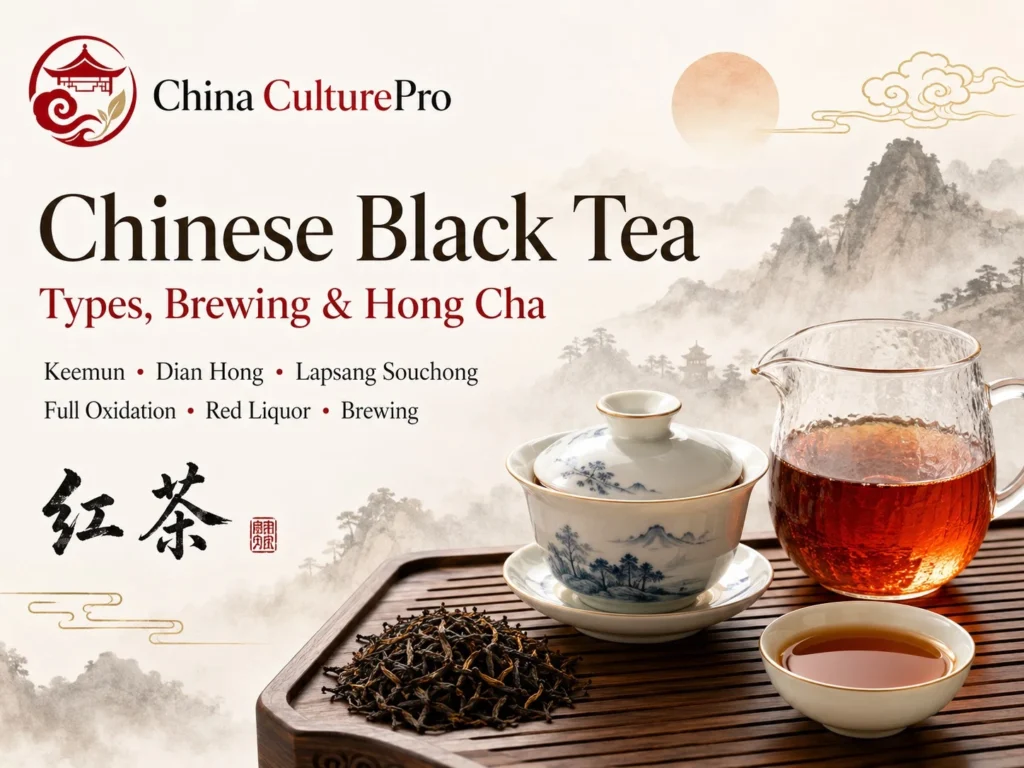

Quick Answer: What Is Chinese Black Tea?
Chinese black tea is called Hong Cha (红茶) in Chinese. It is one of the six major types of Chinese tea, and its core feature is full oxidation.
The Chinese name Hong Cha means “red tea,” but this refers mainly to the red, amber-red, copper-red, or ruby-red color of the tea liquor. In English, this tea category is usually called black tea. It should not be confused with Hei Cha (黑茶), which means Chinese dark tea or post-fermented tea.
Chinese black tea is made through withering, rolling, full oxidation, and drying. Unlike green tea, it is not fixed early to preserve fresh green character. Instead, the leaf is allowed to oxidize fully, turning fresh leaf greenness into sweetness, warmth, aroma, and red-bright liquor.
| Item | Detail |
|---|---|
| Main Topic | Chinese Black Tea / Hong Cha / 红茶 |
| Tea Category | Fully oxidized tea |
| Chinese Name Logic | Named for red or amber-red liquor |
| Core Craft | Withering, rolling, full oxidation, drying |
| Taste Direction | Sweet, malty, honey-like, fruity, floral, mellow |
| Famous Examples | Keemun, Dian Hong, Lapsang Souchong, Jin Jun Mei |
| Key Confusion | Hong Cha is black tea in English, not Hei Cha / dark tea |
Key Point: Chinese black tea is not Chinese dark tea, and it is not simply Western breakfast tea with milk and sugar. Its beauty lies in full oxidation: green leaves become red-bright liquor, natural sweetness, honey aroma, floral notes, fruit notes, sweet-potato notes, longan-like aroma, or pine-smoke character.
Why Chinese Black Tea Matters in Chinese Tea Culture
Chinese black tea matters because it represents the fully oxidized direction in Chinese tea culture.
Green tea values freshness. Oolong tea values aroma, rhyme, roast, and layered change. Dark tea often values post-fermentation and aging. Chinese black tea values sweetness, red liquor, warmth, smoothness, and natural drinkability.
It is also one of the easiest Chinese tea types for beginners to understand. A good Dian Hong or Keemun can be immediately pleasant even for someone who does not know much about tea. It can taste sweet, mellow, warm, fragrant, and smooth without milk or sugar.
Chinese black tea also has a deep connection with global tea history. Zhengshan Xiaozhong, often known in English as Lapsang Souchong, is closely associated with the early history of black tea. Keemun later became internationally famous and helped shape Western understanding of fine black tea.
In Chinese tea practice, good black tea is often judged through several qualities:
- Red-bright liquor: the tea soup should be clear, bright, and red or amber-red, not dull, muddy, or dark in a heavy way.
- Natural sweetness: good Chinese black tea should have sweetness without sugar.
- Clean aroma: honey, flower, malt, cocoa, fruit, sweet potato, longan, or pine smoke should feel clean, not sour, stale, burnt, or muddy.
- Smooth body: the liquor should feel rounded and comfortable, not rough or scraping.
- Warm character: black tea often feels warmer and softer than green tea.
- Low harshness: light astringency can appear, but it should not become coarse or dry.
- Pure drinking value: high-quality Chinese black tea should be enjoyable before adding milk or sugar.
A Chinese tea master might say: red tea should be sweet, smooth, and bright. If it is only dark, bitter, and heavy, it has missed the point.
This is why Chinese black tea has a different personality from Western breakfast tea blends. It can work with milk in some cases, but its first value is not milk strength. Its first value is the leaf itself: liquor color, aroma, sweetness, smoothness, and clean aftertaste.
Hong Cha vs Black Tea vs Dark Tea: Naming Confusion
The naming around Chinese black tea can confuse English readers because Chinese and English tea names do not match word for word.
| Term | Chinese / English Meaning | What It Refers To | Key Point |
|---|---|---|---|
| Hong Cha / 红茶 | Chinese name for black tea | fully oxidized tea with red or amber-red liquor | “red” refers mainly to liquor color |
| Black Tea | English name for Hong Cha | fully oxidized tea | the standard English name for this tea category |
| Hei Cha / 黑茶 | Chinese dark tea | post-fermented tea | a different Chinese tea category |
| Dark Tea | English name for Hei Cha | Pu’er, Liu Bao, Anhua Hei Cha, and related teas | shaped by post-fermentation, not full oxidation |
| Red Tea | literal translation of Hong Cha | can confuse English readers | may suggest rooibos or herbal red tea in English contexts |
The simplest rule is: Chinese Hong Cha = English black tea; Chinese Hei Cha = English dark tea.
Keemun, Dian Hong, Zhengshan Xiaozhong, and Jin Jun Mei are Chinese black teas. Pu’er, Liu Bao, and Anhua Hei Cha are Chinese dark teas. They should not be placed in the same category.
How Chinese Black Tea Is Made
Chinese black tea is defined by full oxidation. It is not made by roasting leaves until they turn red. It is made by allowing fresh tea leaves to oxidize under controlled conditions, then drying them at the right moment.
Unlike green tea, black tea is not fixed early to lock in fresh green character. The leaf is withered, rolled, oxidized, and dried so that its grassy rawness can transform into sweetness, red liquor, and deeper aroma.
| Step | Chinese Term | What It Does | Key Point |
|---|---|---|---|
| Picking | 采摘 | decides tenderness, bud ratio, and grade | bud teas and Gongfu black teas use different picking standards |
| Withering | 萎凋 | reduces moisture and softens the leaf | prepares aroma formation and rolling |
| Rolling | 揉捻 | breaks leaf cells and releases tea juice | helps oxidation become even |
| Oxidation | 发酵 / 氧化 | creates red liquor, sweetness, aroma, and body | the core transformation of black tea |
| Drying / Firing | 干燥 / 烘干 | stops oxidation and stabilizes the tea | fire must be clean, not burnt |
| Sorting | 精制 / 分级 | separates grades and improves consistency | especially important in Gongfu black tea |
Oxidation is the soul of Chinese black tea. If oxidation is insufficient, the tea may keep a raw green smell and lack sweetness. If oxidation goes too far, the liquor may become dull, sour, flat, or heavy.
Good Chinese black tea should show enough oxidation without becoming dull. It should be red-bright, sweet, fragrant, smooth, and clean. The liquor should not be muddy, sour, burnt, or harsh.
Chinese Black Tea vs Other Tea Types
Chinese black tea is a fully oxidized tea. It is different from green tea, white tea, yellow tea, oolong tea, and dark tea.
| Tea Type | Difference From Black Tea | Taste Direction |
|---|---|---|
| Green Tea | unoxidized, fixed early | fresh, grassy, clear |
| White Tea | lightly withered, minimal processing | soft, gentle, lightly sweet |
| Yellow Tea | yellowing step after fixing | mellow, smooth |
| Oolong Tea | partially oxidized | floral, roasted, layered |
| Dark Tea | post-fermented and often aged | earthy, deep, mellow |
The core of Chinese black tea is full oxidation: sweetness, red liquor, warmth, smooth body, and clean aroma. It does not chase the fresh leaf clarity of green tea, the partial-oxidation layers of oolong tea, or the post-fermented depth of dark tea.
Most Chinese black teas are not meant to age like Pu’er. They are usually best when their aroma, sweetness, and liquor brightness are still clear.
Main Chinese Black Tea Regions and Style Families
Chinese black tea is easier to understand by region and style family first, then by individual tea name.
| Style Family | Chinese Name | Main Region | Famous Teas | Taste Direction | What It Teaches |
|---|---|---|---|---|---|
| Keemun / Qimen | 祁门红茶 | Anhui, Qimen | Qimen Hong Cha | floral, cocoa, honey-like, refined | elegant Gongfu black tea and Qimen aroma |
| Dian Hong | 滇红 | Yunnan | Yunnan Gold, Dian Hong Gongfu | honey, malt, sweet potato, thick | big-leaf sweetness and full body |
| Fujian Black Tea | 福建红茶 | Wuyi / Tongmu / Fujian | Zhengshan Xiaozhong, Jin Jun Mei | longan, smoke, honey, flower | Xiaozhong tradition, pine smoke, premium bud tea |
| Guangdong Black Tea | 广东红茶 | Guangdong | Yingde Black Tea | sweet, floral, brisk | South China black tea strength |
| Gongfu Black Tea | 工夫红茶 | Fujian and nearby regions | Tan Yang, Bailin, Zhenghe | refined, mellow, aromatic | careful processing and refined leaf grading |
The word Gongfu in Gongfu black tea does not mean Gongfu brewing. It refers to careful, skilled, refined production. Tan Yang Gongfu, Bailin Gongfu, and Zhenghe Gongfu belong to this traditional refined black tea direction.
Famous Chinese Black Teas
Chinese black tea has many famous examples. This table gives quick recognition points rather than a full history of each tea.
| Tea | Chinese Name | Region | Style | Taste Direction | Quick Note |
|---|---|---|---|---|---|
| Keemun | 祁门红茶 | Anhui, Qimen | Gongfu Black Tea | floral, fruity, honey-like, cocoa-like | elegant and refined; famous for Qimen aroma |
| Dian Hong | 滇红 | Yunnan | Yunnan Black Tea | honey, malt, sweet potato, thick | big-leaf tea with golden tips and strong sweetness |
| Zhengshan Xiaozhong | 正山小种 | Wuyi, Fujian | Xiaozhong Black Tea | longan, pine smoke, fruit, wood | associated with early black tea history |
| Lapsang Souchong | 烟熏正山小种 | Wuyi, Fujian | Smoked Xiaozhong | pine smoke, dried longan, woody | smoked style; not all Xiaozhong is smoky |
| Jin Jun Mei | 金骏眉 | Wuyi, Fujian | Bud Black Tea | honey, flower, fruit, delicate sweetness | modern premium bud black tea |
| Yingde Black Tea | 英德红茶 | Guangdong | Guangdong Black Tea | sweet, floral, brisk | representative South China black tea |
| Jiuqu Hongmei | 九曲红梅 | Hangzhou, Zhejiang | Gongfu Black Tea | red-bright, sweet, plum-like | Hangzhou black tea from a region known for Longjing |
| Tan Yang Gongfu | 坦洋工夫 | Fujian | Gongfu Black Tea | refined, mellow, floral | one of the traditional Min Hong Gongfu teas |
| Bailin Gongfu | 白琳工夫 | Fujian | Gongfu Black Tea | floral, delicate, mellow | traditional Fujian Gongfu black tea |
| Zhenghe Gongfu | 政和工夫 | Fujian | Gongfu Black Tea | mellow, honey-like, full | traditional Fujian Gongfu black tea |
Keemun teaches elegance and refined aroma. Dian Hong teaches sweetness and body. Zhengshan Xiaozhong teaches the Fujian Xiaozhong tradition. Jin Jun Mei shows the modern premium bud-tea direction, but it should not be judged only by price, packaging, or golden color.
Lapsang Souchong also needs careful explanation. Traditional smoked Lapsang Souchong has pine-smoke character, but not all Zhengshan Xiaozhong is heavily smoky. Modern unsmoked Xiaozhong styles can show fruit, flower, honey, or longan-like aroma.
Keemun, Dian Hong, and Zhengshan Xiaozhong: Three Beginner Anchors
Beginners can feel overwhelmed by Chinese black tea names. A practical way to start is to use three anchor teas: Keemun, Dian Hong, and Zhengshan Xiaozhong.
| Beginner Anchor | Style Family | Taste Direction | What It Teaches | Beginner Note |
|---|---|---|---|---|
| Keemun | Anhui Black Tea | floral, cocoa, refined | elegant Chinese black tea | learn Qimen aroma and refined liquor |
| Dian Hong | Yunnan Black Tea | honey, malt, sweet potato, thick | sweet and full-bodied black tea | often the most beginner-friendly style |
| Zhengshan Xiaozhong | Fujian Black Tea | longan, pine smoke, caramel, fruit | Xiaozhong tradition and early black tea depth | try both smoked and unsmoked styles if possible |
A beginner does not need to start with the most expensive Jin Jun Mei. It is better to build three taste coordinates first: Keemun for elegance, Dian Hong for sweetness and body, and Zhengshan Xiaozhong for Fujian black tea tradition.
Once these three are clear, other Chinese black teas become easier to understand.
What Chinese Black Tea Tastes Like
Chinese black tea is not only bitter, strong, or suitable for breakfast blends. Good Chinese black tea can be sweet, mellow, floral, honey-like, malty, fruity, cocoa-like, longan-like, or smoky.
Common aroma and taste directions include:
- Malty: a classic black tea direction, often warm and rounded.
- Honey-like: common in Dian Hong, Jin Jun Mei, and some Fujian black teas.
- Sweet potato: often found in Dian Hong, especially Yunnan big-leaf black tea.
- Longan-like: a classic description for Zhengshan Xiaozhong and some Fujian black teas.
- Floral / orchid-like: found in Keemun, Jin Jun Mei, and refined black tea styles.
- Cocoa / chocolate-like: often associated with Keemun and some higher-grade black teas.
- Fruity / dried fruit: found in some Yunnan and Fujian black teas.
- Pine smoke: the signature direction of traditional smoked Lapsang Souchong.
- Caramel: found in some Fujian black teas or sweet Dian Hong styles.
Important tasting dimensions include:
- Red-bright liquor: the tea soup should be bright and clear, not muddy or dull.
- Sweetness without sugar: a good Chinese black tea should have natural sweetness.
- Smooth body: the liquor should feel rounded, not rough.
- Mellow warmth: black tea often feels warmer and softer than green tea.
- Low harshness: a little astringency can appear, but it should not scrape the tongue.
- Clean finish: the aftertaste should not be sour, burnt, stale, or muddy.
A good Chinese black tea should not rely on milk and sugar to hide problems. It can certainly be paired with milk in some cases, but high-quality Chinese black tea should first be tasted plain.
A tea master might say: red tea should be red-bright, not dark and dull; sweet and smooth, not bitter and rough.
That is the Chinese black tea standard.
For a broader framework for evaluating aroma, mouthfeel, liquor texture, and aftertaste, read our Chinese Tea Tasting guide.
How to Brew Chinese Black Tea
Chinese black tea can usually handle hotter water than green tea, but that does not mean every black tea should be boiled hard and steeped for a long time.
Water temperature, leaf amount, and steeping time should match the tea’s tenderness and style.
| Black Tea Style | Water Temperature | Brewing Method | Note |
|---|---|---|---|
| Keemun | 90–95°C | gaiwan or porcelain teapot | preserve Qimen aroma and refined sweetness |
| Dian Hong | 90–95°C | gaiwan, porcelain teapot, or cup | brings honey, malt, and sweet-potato notes |
| Zhengshan Xiaozhong | 90–95°C | gaiwan or porcelain teapot | opens longan, fruit, or pine-smoke aroma |
| Jin Jun Mei | 85–90°C or 90–95°C | gaiwan, short infusions | tender buds need gentler handling |
| Gongfu-style brewing | 90–95°C | higher leaf ratio, short infusions | best for tasting aroma and liquor quality |
Practical brewing rules:
- Do not treat all black tea the same: bud-heavy teas such as Jin Jun Mei need gentler handling than stronger leaf teas.
- Use 90–95°C for many Chinese black teas: this works well for Keemun, Dian Hong, Zhengshan Xiaozhong, and many Gongfu black teas.
- Use slightly lower water or shorter infusions for tender buds: Jin Jun Mei and very delicate bud teas can become sour or rough if pushed too hard.
- Avoid long stewing: long steeping can bring out rough astringency, especially in delicate black teas.
- Taste high-quality tea plain first: Chinese black tea often has natural sweetness and does not need milk or sugar at the beginning.
- Adjust by cup size: mug brewing needs less leaf or shorter time than Gongfu-style brewing.
Chinese black tea is not afraid of heat, but it is afraid of rough handling. A good brew should bring out sweetness, warmth, and clean aroma. If the cup is only bitter, dark, and heavy, check the tea quality, water temperature, leaf amount, and steeping time.
Best Teaware for Chinese Black Tea
The best teaware for Chinese black tea should show aroma, liquor color, and smoothness clearly.
| Teaware | Best Use | Why It Works / Caution |
|---|---|---|
| Porcelain Gaiwan | tasting most Chinese black teas | neutral, shows aroma and liquor clearly |
| Glass Cup | daily drinking and color observation | shows red-bright liquor |
| Porcelain Teapot | serving guests | stable, clean, suitable for sharing |
| Yixing Teapot | some stronger or roasted black teas | can round the liquor, but may absorb delicate aroma |
| Mug | simple daily brewing | practical, but avoid oversteeping |
| Gong Dao Bei | even sharing | keeps each cup consistent |
A porcelain gaiwan is the most useful tool for tasting Chinese black tea. A glass cup is practical for daily drinking and liquor-color observation. A porcelain teapot works well for serving several people. A Yixing teapot can round stronger black teas, but delicate teas such as Keemun or Jin Jun Mei may lose some aroma if the pot absorbs fragrance.
Chinese Black Tea Benefits: What to Say Carefully
Many people search for Chinese black tea benefits, but this topic should be handled carefully. Chinese black tea can be part of a healthy lifestyle, but it is not medicine.
Black tea contains caffeine, tea polyphenols, theaflavins, thearubigins, amino acids, and aromatic compounds. These are often discussed in relation to alertness, antioxidant compounds, comfort, and general wellness.
- Focus and alertness: Chinese black tea contains caffeine, which may support alertness. The effect depends on tea strength, serving size, and personal sensitivity.
- Warm and comforting drink: Many Chinese drinkers enjoy black tea in cooler weather because it feels warmer, smoother, and less sharp than green tea.
- After-meal refreshment: Some people drink black tea after meals because it feels clean and pleasant. This is a daily habit, not a medical treatment.
- Antioxidant compounds: Black tea contains theaflavins, thearubigins, and other tea compounds commonly discussed for antioxidant activity.
- Caffeine caution: People sensitive to caffeine should drink moderately. Strong black tea on an empty stomach may be uncomfortable for some people.
Chinese black tea should not be presented as a cure for disease, a guaranteed fat-loss drink, a blood-sugar treatment, or a medical solution.
In daily Chinese drinking, many people value black tea because it is warm, smooth, naturally sweet, and easy to enjoy. That is already enough. A tea does not need to become medicine to be valuable.
Common Mistakes About Chinese Black Tea
Chinese black tea is easy to misunderstand because English and Chinese naming systems do not match perfectly. These are the most common mistakes.
- Confusing Chinese black tea with Hei Cha / Dark Tea: Hong Cha is fully oxidized tea. Hei Cha is post-fermented dark tea. They are completely different categories.
- Thinking Hong Cha means rooibos or herbal red tea: Hong Cha is made from Camellia sinensis. It is not rooibos, hibiscus tea, or herbal red tea.
- Thinking all black tea needs milk and sugar: High-quality Chinese black tea is suitable for plain drinking. It should have natural sweetness, aroma, and smoothness.
- Treating Chinese black tea as English Breakfast Tea: Chinese black tea usually emphasizes loose leaf, origin, aroma, liquor texture, and natural sweetness, not only strength for milk.
- Thinking darker is always better: Good black tea should have red-bright liquor. Dark, dull, or muddy liquor is not automatically better.
- Thinking stronger is always better: Good Chinese black tea should be sweet and smooth, not only bitter, thick, and heavy.
- Oversteeping Jin Jun Mei and other bud teas: Tender bud teas need gentler handling. High heat and long steeping can bring sourness or roughness.
- Thinking all Lapsang Souchong is heavily smoky: Traditional smoked styles exist, but modern unsmoked Zhengshan Xiaozhong is also common and can show fruit, honey, or longan-like aroma.
- Knowing only Keemun: Keemun is important, but Dian Hong, Zhengshan Xiaozhong, Jin Jun Mei, Yingde Black Tea, and Gongfu black teas also matter.
- Chasing golden tips only: Golden tips can be beautiful, but they are not the only quality marker. Aroma, liquor body, sweetness, and clean aftertaste matter more.
- Buying Jin Jun Mei only by price and packaging: Jin Jun Mei is often marketed as premium, but price alone does not prove quality. Origin, bud material, aroma, liquor, and aftertaste must be judged.
- Aging black tea like Pu’er: Most Chinese black teas are best when their aroma and sweetness are still clear. Long aging is not the main standard for black tea.
- Accepting sour or dull liquor as normal: Sour, stale, muddy, or burnt notes usually point to poor processing, poor storage, or poor brewing.
The better rule is simple: good Chinese black tea should be bright, sweet, smooth, clean, and warm. It should not need bitterness, burnt notes, sourness, or milk and sugar to hide defects.
How to Choose Chinese Black Tea for Beginners
Beginners should not start by asking, “Which Chinese black tea is the most expensive?” A better question is: “Which taste direction do I want to understand first?”
- For classic elegance: Start with Keemun. It teaches Qimen aroma, refined fragrance, floral-cocoa notes, and a more elegant black tea style.
- For sweet and full-bodied entry: Try Dian Hong. It is often the most beginner-friendly Chinese black tea because it can be sweet, thick, honey-like, malty, and easy to enjoy.
- For traditional Fujian Xiaozhong: Try Zhengshan Xiaozhong. It teaches the Fujian black tea tradition and can show longan-like, fruity, woody, or smoky notes depending on style.
- For premium bud tea sweetness: Try Jin Jun Mei, but do not judge only by price or packaging. Look for clean flower-honey aroma, sweetness, and smooth liquor.
- For smoky style: Try traditional smoked Lapsang Souchong. Expect pine smoke, dried longan, wood, and a distinctive traditional profile.
- For unsmoked longan-like aroma: Try unsmoked Zhengshan Xiaozhong. It is often easier for beginners than heavily smoked styles.
- For Guangdong style: Try Yingde Black Tea. It can be sweet, floral, brisk, and strong.
- For better value: Start with ordinary Dian Hong or a reliable Gongfu black tea. You do not need to begin with Jin Jun Mei.
Chinese black tea entry is about direction: floral, honey-like, sweet-potato-like, longan-like, smoky, cocoa-like, sweet-thick, smooth, pure-drinking, or milk-friendly.
Once you know your preferred direction, choosing black tea becomes much easier.
How Chinese Black Tea Connects to Chinese Tea Culture
Chinese black tea is the third major tea-type page under the Chinese Tea Culture core guide, after Chinese Green Tea and Chinese Oolong Tea. It connects the six-type tea system with Hong Cha naming, full oxidation, famous black teas, brewing methods, teaware, and careful benefits wording.
- To understand the full tea system first, read our Chinese Tea Culture guide.
- To compare black tea with green, white, yellow, oolong, and dark tea, read our Chinese Tea Types guide.
- To see how black tea differs from fresh unoxidized tea, read our Chinese Green Tea guide.
- To compare black tea with partially oxidized tea, read our Chinese Oolong Tea guide.
- To avoid confusion between black tea and dark tea, read our Chinese Dark Tea guide.
- For elegant Anhui black tea, read our Keemun Tea guide.
- For sweet Yunnan black tea, read our Dian Hong Tea guide.
- For Fujian black tea and pine-smoke tradition, read our Lapsang Souchong guide.
- For premium bud black tea, read our Jin Jun Mei guide.
- For brewing temperatures and steeping methods, read our How to Brew Chinese Tea guide.
- For gaiwans, teapots, and cups, read our Chinese Teaware guide.
- For cautious wellness wording, use the Chinese Black Tea Benefits section above.
Final Thoughts
Chinese black tea is Hong Cha in Chinese. It is not Hei Cha, and it is not simply Western breakfast tea with milk and sugar.
Its core is full oxidation. Through withering, rolling, oxidation, and drying, fresh green leaves transform into red-bright liquor, natural sweetness, honey-like aroma, floral notes, fruit notes, sweet-potato notes, longan-like aroma, or pine-smoke character.
A good Chinese black tea should be bright, sweet, smooth, clean, warm, and not rough or harsh.
To understand Chinese black tea, readers need more than the names Keemun, Dian Hong, Zhengshan Xiaozhong, and Jin Jun Mei. They need to understand oxidation, region, bud grade, liquor brightness, natural sweetness, clean aroma, and smooth aftertaste.
That is the Chinese black tea aesthetic: red-bright, sweet, warm, clean, and quietly generous.
FAQs About Chinese Black Tea
What is Chinese black tea?
Chinese black tea is called Hong Cha, or red tea, in Chinese. It is one of the six major Chinese tea types and is fully oxidized. It is known for red-bright liquor, natural sweetness, smooth body, and aromas such as honey, malt, fruit, flower, sweet potato, longan, cocoa, or pine smoke.
Why is Chinese black tea called red tea?
Chinese black tea is called Hong Cha, or red tea, because the tea liquor is often red, amber-red, copper-red, or ruby-red. English calls the same category black tea, often based on the darker appearance of the dry leaves. Hong Cha should not be confused with Hei Cha, or dark tea.
Is Chinese black tea the same as dark tea?
No. Chinese black tea, or Hong Cha, is fully oxidized tea. Chinese dark tea, or Hei Cha, is post-fermented tea. Pu’er, Liu Bao, and Anhua Hei Cha belong to the dark tea category, not the Chinese black tea category.
What does Chinese black tea taste like?
Chinese black tea can taste sweet, malty, honey-like, floral, fruity, cocoa-like, sweet-potato-like, longan-like, caramel-like, or smoky. A good Chinese black tea should feel smooth and warm, with clear aroma, red-bright liquor, natural sweetness, and a clean finish.
What are the most famous Chinese black teas?
Famous Chinese black teas include Keemun, Dian Hong, Zhengshan Xiaozhong, Lapsang Souchong, Jin Jun Mei, Yingde Black Tea, Jiuqu Hongmei, Tan Yang Gongfu, Bailin Gongfu, and Zhenghe Gongfu. Keemun, Dian Hong, Zhengshan Xiaozhong, and Jin Jun Mei are especially useful for beginners.
Is Keemun a black tea?
Yes. Keemun, or Qimen Hong Cha, is one of China’s most famous black teas. It comes from Anhui and is known for refined aroma, often described as floral, fruity, honey-like, cocoa-like, or orchid-like. It is an important example of Chinese Gongfu black tea.
What is Dian Hong tea?
Dian Hong is Yunnan black tea. It is usually made from Yunnan big-leaf tea material and is known for golden tips, honey aroma, malt, sweet-potato notes, natural sweetness, and a fuller body. It is one of the most beginner-friendly Chinese black teas.
What is Lapsang Souchong?
Lapsang Souchong is the English name often associated with Zhengshan Xiaozhong from Fujian. Traditional smoked versions have pine-smoke and dried-longan notes. Modern unsmoked styles are also common and may show fruit, honey, flower, or longan-like aroma.
Is Jin Jun Mei a black tea?
Yes. Jin Jun Mei is a Chinese black tea from the Wuyi / Tongmu tradition in Fujian. It is a modern premium bud black tea known for honey, flower, fruit, and delicate sweetness. It should be judged by origin, bud material, aroma, liquor, and aftertaste, not only by price.
How do you brew Chinese black tea?
Chinese black tea is usually brewed with water around 90–95°C. Use a porcelain gaiwan, porcelain teapot, glass cup, or mug. Tender bud teas such as Jin Jun Mei may need slightly lower water or shorter infusions. Avoid long oversteeping, which can bring bitterness or roughness.
What water temperature is best for Chinese black tea?
Most Chinese black teas brew well around 90–95°C. Dian Hong, Keemun, and Zhengshan Xiaozhong often work well in this range. Tender bud teas such as Jin Jun Mei may do better with 85–90°C or shorter infusions, depending on the tea and brewing style.
Can Chinese black tea be drunk without milk?
Yes. High-quality Chinese black tea is often best tasted plain first. It can have natural sweetness, smooth body, red-bright liquor, and clean aroma without milk or sugar. Some stronger black teas can pair with milk, but milk should not be needed to hide poor flavor.
Is Chinese black tea caffeinated?
Yes. Chinese black tea contains caffeine. The amount depends on cultivar, leaf grade, tea amount, water temperature, and steeping time. People who are sensitive to caffeine should drink moderately and avoid strong black tea late in the day.
Is Chinese black tea good for weight loss?
Chinese black tea may be part of a healthy lifestyle, but it is not a standalone weight-loss solution. It contains caffeine and tea compounds, but body weight depends on diet, activity, sleep, metabolism, and overall habits. It should not be treated as a diet medicine.
What is the best Chinese black tea for beginners?
Dian Hong is often the easiest starting point because it is sweet, thick, honey-like, and friendly. Keemun is good for elegant aroma. Zhengshan Xiaozhong is good for traditional Fujian black tea character. Beginners should choose by taste direction, not only by price or fame.