
Quick Answer: What Is Mid-Autumn Festival 2027?
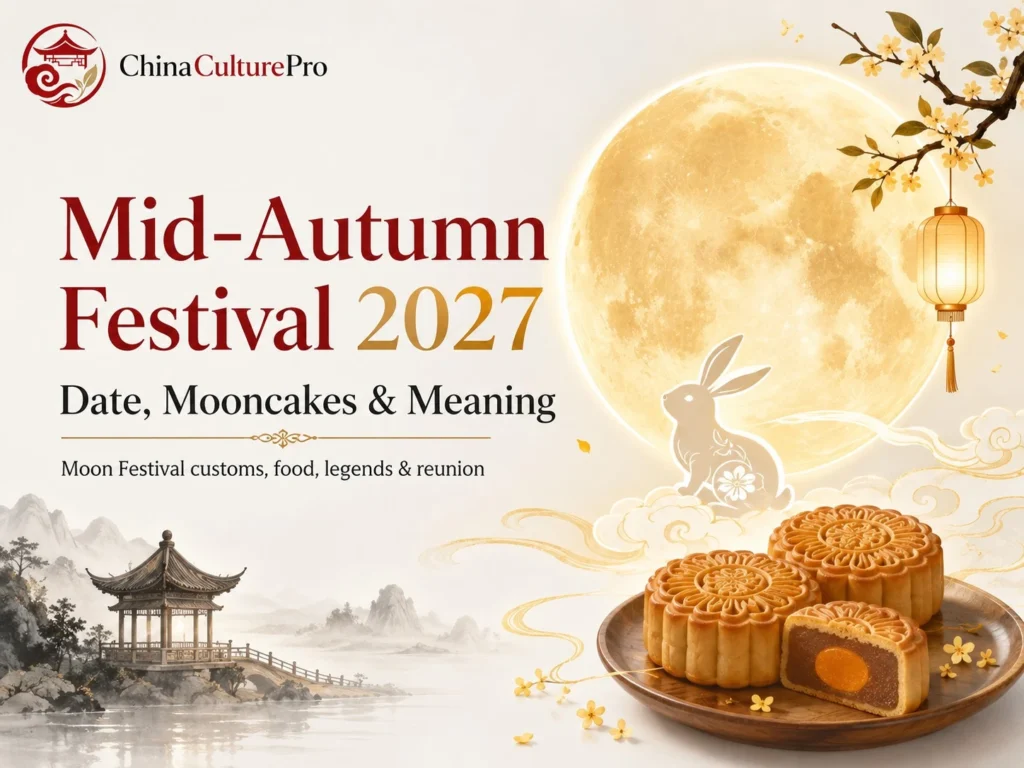
Mid-Autumn Festival 2027 falls on Wednesday, September 15, 2027. It is celebrated on the 15th day of the 8th lunar month. In Chinese, the festival is called Zhongqiu Jie (中秋节). It is also known as the Moon Festival or Mooncake Festival. Main customs include moon viewing, eating mooncakes, sharing a reunion dinner, giving mooncake gifts, carrying lanterns, and making moon offerings in some families or regions. The core meaning of Mid-Autumn Festival is reunion, completeness, harvest, and longing for people far away. Mooncakes are important, but they are not the whole festival. The deeper idea is roundness: the full moon is round, mooncakes are round, and families hope life can also feel whole.| Item | Detail |
|---|---|
| 2027 Date | September 15, 2027 |
| Day of Week | Wednesday |
| Chinese Name | Zhongqiu Jie / 中秋节 |
| Also Called | Moon Festival, Mooncake Festival |
| Date Rule | 15th day of the 8th lunar month |
| Main Food | Mooncakes |
| Main Customs | Moon viewing, reunion dinner, lanterns |
| Main Meaning | Reunion, harvest, full moon, longing |
What Is Mid-Autumn Festival?
Mid-Autumn Festival is one of the most important traditional Chinese festivals. It is not simply a mooncake festival, and it is not only a night for looking at the moon. It is a festival of family reunion, autumn harvest, and emotional connection across distance.
The name “Mid-Autumn” means the middle of autumn. In the lunar calendar, the 8th lunar month sits in the middle of autumn, and the 15th day is the middle of that month. In farming life, this timing mattered. Grain was being stored, fruits were ripe, the night air was clearer, and families had a reason to sit down after the busy growing season.
But the festival became deeply loved because of the moon.
In Chinese culture, the moon is not just a natural object. It is a sign of home, family, distance, and shared longing. In the past, when travel was slow and communication was difficult, people far from home could not send instant messages or make video calls. But they could look at the same moon.
The heart of Mid-Autumn Festival is not simply looking at the moon. It is using the moon to see people who are far away. Chinese people often say, “When the moon is full, people should be together.” But the most moving part of Mid-Autumn is this: when people cannot be together, the moon remains full for them.
When Is Mid-Autumn Festival? Date Rule and Upcoming Dates
Mid-Autumn Festival is always celebrated on the 15th day of the 8th lunar month. Because it follows the Chinese lunar calendar, its Gregorian date changes every year.
It usually falls in September or early October. If you are planning travel, festival content, mooncake gifts, school activities, or holiday greetings, check the exact date for that year.
| Year | Mid-Autumn Festival Date | Day of Week | Zodiac Year |
|---|---|---|---|
| 2026 | September 25, 2026 | Friday | Fire Horse |
| 2027 | September 15, 2027 | Wednesday | Fire Goat |
| 2028 | October 3, 2028 | Tuesday | Earth Monkey |
| 2029 | September 22, 2029 | Saturday | Earth Rooster |
| 2030 | September 12, 2030 | Thursday | Metal Dog |
Date note: Mid-Autumn Festival is not fixed on September 15. It follows the 15th day of the 8th lunar month.
In Mainland China, Mid-Autumn Festival is a public holiday. The exact holiday window and make-up workday arrangements can vary by year, so travelers should check the official schedule for the exact year.
Why the Full Moon Matters in Mid-Autumn Festival
The full moon is the center of Mid-Autumn Festival, but not only because it is beautiful. In Chinese feeling, the moon connects here and far away.
In ancient times, distance was hard. A person who left home for work, study, official service, war, or marriage might not return for years. Roads were long. Letters were slow. Families could live under the same sky but have almost no direct contact.
The moon became the most stable shared reference. The person in a far city and the family back home could not sit at the same table, but they could look at the same moon. That is why moonlight in Chinese poetry often carries homesickness, longing, and family memory.
The famous line “May we live long and share the beauty of the moon, even thousands of miles apart” expresses the soul of Mid-Autumn. It is not only romantic writing. It is a practical comfort: I cannot be beside you, but I can stand under the same moonlight.
| Moon Symbol | Cultural Meaning |
|---|---|
| Full Moon | Reunion and completeness |
| Bright Moonlight | Shared longing across distance |
| Round Shape | Family unity |
| Moon Viewing | Thinking of absent loved ones |
| Autumn Sky | Calm, harvest, distance |
Mid-Autumn does not only celebrate successful reunion. It also gives a form to separation. The moon makes distance easier to bear and turns longing into something people can see.
Mid-Autumn Festival Traditions and Customs
Mid-Autumn Festival customs center on the moon, the family table, and the idea of sharing roundness. Some customs are ancient, some are modern, and some vary by region or family.
| Custom | What People Do | Meaning |
|---|---|---|
| Moon Viewing | Watch the full moon at night | Reunion, longing, shared sky |
| Eating Mooncakes | Cut and share mooncakes | Sharing roundness and completeness |
| Giving Mooncakes | Send boxes to relatives, friends, clients | Blessing and relationship care |
| Reunion Dinner | Eat with family before moon viewing | Family gathering |
| Lanterns | Children carry or display lanterns | Festival light and childhood joy |
| Moon Offerings | Place mooncakes, fruit, tea, or incense | Respect for the moon and harvest |
| Osmanthus Wine or Tea | Drink seasonal osmanthus drinks | Fragrance of autumn |
Moon viewing is the most important custom. Families may sit in a courtyard, on a balcony, beside a window, in a park, or outdoors where the sky is clear. The action is simple: look up, share food, and think of family.
Mooncakes are usually cut into pieces and shared. This matters. A mooncake is not only a pastry. Its round shape becomes meaningful when people divide it among the family.
Giving mooncakes is also common. Families send mooncakes to elders, relatives, friends, teachers, clients, colleagues, and business partners. In modern life, mooncake gift boxes can become commercial and expensive, but the social meaning is still relationship care.
Lanterns appear in Mid-Autumn Festival too, especially for children. But they are not the same as Lantern Festival lanterns. Mid-Autumn lanterns belong more to moonlit play, childhood joy, and festival atmosphere. Lantern Festival lanterns belong more to public displays, riddles, and the closing of the Chinese New Year season.
Moon offerings are traditional and are not practiced by every modern family. Some families may place mooncakes, fruit, tea, incense, or seasonal foods under the moon to express gratitude for the moon, the season, and the harvest.
Mooncakes and Mid-Autumn Festival Food
Mooncakes are the most important food symbol of Mid-Autumn Festival. Their round shape answers the round moon and the family’s wish for reunion.
In older practice, mooncakes could be used as offerings to the moon. After the offering, families shared them. Over time, mooncakes became the central food of the festival, both for family eating and for gift giving.
The act of sharing matters more than the size or price of the mooncake. A mooncake is usually cut into small pieces, and each person takes a piece. This turns the “round” into something shared. One person eating a whole mooncake alone is not as close to the festival spirit as one mooncake divided around a table.
| Mooncake Type | Common Style / Region | Typical Filling |
|---|---|---|
| Cantonese-Style | Guangdong / Hong Kong | Lotus seed paste, salted egg yolk |
| Suzhou-Style | Jiangsu / Shanghai | Flaky crust, sweet or savory fillings |
| Beijing-Style | Northern China | Dense pastry, five-nut, traditional fillings |
| Yunnan Ham Mooncake | Yunnan | Sweet-savory ham filling |
| Snow Skin Mooncake | Modern / Hong Kong style | Chilled skin, custard, fruit, tea |
Cantonese-style mooncakes are widely known, especially lotus seed paste with salted egg yolk. The salted yolk looks like a small moon inside the mooncake. Suzhou-style mooncakes have flaky pastry and can be sweet or savory. Beijing-style mooncakes are often denser and more traditional in texture. Yunnan ham mooncakes carry a sweet-savory flavor. Snow skin mooncakes are modern, soft, chilled, and often filled with custard, fruit, tea, or other new flavors.
Common fillings include lotus seed paste, red bean paste, five-nut, salted egg yolk, ham, black sesame, custard, tea, fruit, and modern creative flavors. Mooncakes have changed quickly in recent decades, but the round shape and sharing action still hold the old meaning.
Mid-Autumn is not about eating a dessert. It is about cutting open a circle. One mooncake shared by a table is closer to the meaning of the festival than one mooncake eaten alone.
Chang’e, Jade Rabbit, and Mid-Autumn Legends
Mid-Autumn Festival has many legends, and the most famous is the story of Chang’e flying to the moon. Different versions exist, so it is better to treat the story as a shared mythic layer rather than one fixed historical account.
One common version says that Hou Yi shot down nine suns and saved the world from burning heat. As a reward, he received an elixir of immortality. His wife Chang’e later took the elixir and rose to the moon, where she lived in the moon palace. Hou Yi missed her and placed her favorite foods under the moon. People later followed this practice, and moon offerings became part of Mid-Autumn tradition.
The story gives the moon a beautiful but lonely feeling. Chang’e is a moon goddess, but the moon palace is cold and distant. This feeling fits Mid-Autumn well. The festival is about reunion, but it also understands separation.
| Legend | What It Adds |
|---|---|
| Chang’e | Moon goddess, longing, distance |
| Hou Yi | Hero, sacrifice, human choice |
| Jade Rabbit | Moon palace, medicine, companionship |
| Wu Gang | Osmanthus tree, endless labor |
The Jade Rabbit is often imagined as living on the moon and pounding medicine. Wu Gang is linked with a magical osmanthus tree and endless labor. These stories give the moon a home filled with distance, longing, and companionship, but they should not take over the whole festival.
Harvest, Autumn, and the Seasonal Meaning of Mid-Autumn
Mid-Autumn Festival also has a practical seasonal foundation: harvest.
In farming life, the 8th lunar month came near a time of stored grain and ripening fruit. The year’s hard work had begun to show results. People had food, fruit, and a clear autumn night. That material fullness made emotional reunion possible.
Harvest and reunion are not separate ideas. When the granary is fuller and fruits are ripe, the family can sit down with more peace. The moon may carry longing, but the season also carries gratitude.
| Autumn Element | Mid-Autumn Meaning |
|---|---|
| Harvest | Gratitude and abundance |
| Seasonal Fruits | Offerings and blessings |
| Cool Night | Calm reunion |
| Osmanthus | Fragrance of autumn |
| Clear Sky | Moon viewing and longing |
Seasonal foods often appear in Mid-Autumn celebrations. Pomelos are popular in some regions; the sound of the word can suggest blessing or protection for children. Pomegranates, with many seeds, can suggest many descendants. Persimmons may be linked with good wishes through sound symbolism. Taro, water caltrop, lotus root, grapes, and osmanthus foods or drinks may also appear depending on region.
These foods are not random. They are autumn’s own blessings placed on the table. They connect the moon, the harvest, the body, and the family.
The roundness of Mid-Autumn is not loud. It is the quiet roundness of an autumn night, when the grain is stored, the moon is bright, and people can finally sit still.
Is Mid-Autumn Festival the Same as Lantern Festival?
No. Mid-Autumn Festival and Lantern Festival are different Chinese festivals. English readers sometimes confuse them because both involve a full moon and lanterns, but their dates, foods, and meanings are not the same.
| Festival | Date | Main Meaning | Main Food | Lantern Role |
|---|---|---|---|---|
| Mid-Autumn Festival | 15th day of 8th lunar month | Reunion, harvest, moon | Mooncakes | Moon-night celebration |
| Lantern Festival | 15th day of 1st lunar month | New Year closing, first full moon | Tangyuan / yuanxiao | Public lantern displays |
Mid-Autumn Festival is in autumn. Its emotional core is reunion, harvest, moon viewing, and longing for people far away. Lantern Festival is in the first lunar month. It closes the Chinese New Year season with lantern displays, lantern riddles, tangyuan or yuanxiao, and public celebration.
A simple way to remember the difference is this: Mid-Autumn lanterns accompany the moon. Lantern Festival lanterns are the main event.
How Mid-Autumn Festival Is Celebrated Today
Today, Mid-Autumn Festival is celebrated through family meals, mooncakes, moon viewing, gift giving, community events, and long-distance greetings.
At home, the reunion dinner remains central. Families eat together, then cut mooncakes, make tea, and look at the moon from a balcony, courtyard, window, rooftop, or park. The mood is usually calmer than Chinese New Year. People may talk, sit quietly, or simply enjoy the night air.
Mooncake gift boxes are common before the festival. Companies give them to employees. Clients and business partners exchange them. Younger people send them to elders. Some gift boxes are elegant and expensive, and not every mooncake is actually eaten. Still, the gift carries a message: I remembered you at Mid-Autumn.
Cities, parks, malls, cultural streets, and community centers may hold Mid-Autumn events with lantern decorations, performances, markets, mooncake activities, and family programs. Children may carry lanterns, often in modern electric forms.
Overseas Chinese communities often celebrate Mid-Autumn with moon festival events, lantern walks, mooncake gatherings, school activities, and Chinatown programs. For people far from home, the festival can feel even more important because it confirms cultural memory and family identity.
For those who cannot return home, modern Mid-Autumn may mean a video call, a mailed mooncake box, a message to parents, or one quiet moment looking at the moon. That is the modern version of sharing the same moonlight across distance.
How to Celebrate Mid-Autumn Festival Respectfully
Mid-Autumn Festival is welcoming and easy to join, but it helps to understand its emotional tone. It is not only a mooncake tasting event. It is a reunion festival, and sometimes a festival for people who cannot reunite.
- Share mooncakes instead of eating one whole piece alone.
- Pair mooncakes with tea, especially if the filling is rich or sweet.
- Accept mooncake gifts politely, even if the flavor is new to you.
- Do not mock mooncakes as too heavy, too sweet, or too expensive in front of the giver.
- Do not confuse Mid-Autumn Festival with Lunar New Year or Lantern Festival.
- Use “Happy Mid-Autumn Festival” or “Zhongqiu Jie Kuai Le.”
- If invited to a family dinner or moon viewing, bring mooncakes, fruit, or tea.
- Respect Chang’e, the Jade Rabbit, and moon legends as cultural imagination, not strange superstition.
- For friends far from home, send a gentle full-moon greeting.
A warm greeting can be simple: “Wishing you and your family a peaceful reunion under the full moon.” That sentence fits the festival better than loud excitement. Mid-Autumn is joyful, but its joy is often quiet.
How This Guide Connects to Chinese Festivals and Zodiac Content
Mid-Autumn Festival is one of the core traditional festivals in the Chinese festival year. It belongs inside the larger map of Chinese seasonal customs, family rituals, food traditions, and public holidays.
For the full festival calendar, start with our Chinese Festivals and Holidays guide.
Mid-Autumn differs from Chinese New Year. Chinese New Year is physical return: people try to go home, sit at one table, and begin the year together. Mid-Autumn is emotional connection: even when people cannot return, the moon can still connect them. To compare Mid-Autumn with China’s largest family festival, read our Chinese New Year guide.
Mid-Autumn is also different from Lantern Festival and Dragon Boat Festival. To see how Mid-Autumn differs from the first full-moon festival of the New Year, read our Lantern Festival guide. For another major seasonal festival focused on protection and midsummer health, see our Dragon Boat Festival guide. To understand the spring festival of remembrance and family roots, read our Qingming Festival guide.
Mid-Autumn is not a zodiac festival. In 2027, it falls in the Fire Goat year, but the festival itself is about the moon, harvest, reunion, and longing.
FAQs About Mid-Autumn Festival
When is Mid-Autumn Festival 2027?
Mid-Autumn Festival 2027 is on Wednesday, September 15, 2027. It falls on the 15th day of the 8th lunar month. The Gregorian date changes each year because the festival follows the Chinese lunar calendar.
What is Mid-Autumn Festival?
Mid-Autumn Festival is a major Chinese traditional festival centered on the full moon, family reunion, mooncakes, harvest, and longing for distant loved ones. It is also called Moon Festival or Mooncake Festival.
Why is Mid-Autumn Festival also called Moon Festival?
It is called Moon Festival because moon viewing is the central custom. The festival falls on a full moon night, and the moon symbolizes reunion, completeness, shared longing, and family connection.
Why do people eat mooncakes?
People eat mooncakes because their round shape matches the full moon and symbolizes reunion and completeness. Mooncakes were also used as moon offerings, then became a shared family food and festival gift.
What do mooncakes symbolize?
Mooncakes symbolize reunion, completeness, harmony, and family unity. The most important act is sharing them. A mooncake cut into pieces and shared around the table carries the meaning of Mid-Autumn better than one eaten alone.
Who is Chang’e?
Chang’e is the moon goddess in Chinese mythology and the most famous figure in Mid-Autumn legends. In a common version, she takes an immortality elixir and flies to the moon, adding beauty, loneliness, and longing to the festival’s moon imagery.
Is Mid-Autumn Festival the same as Lantern Festival?
No. Mid-Autumn Festival is on the 15th day of the 8th lunar month and focuses on the moon, harvest, reunion, and mooncakes. Lantern Festival is on the 15th day of the 1st lunar month and closes the Chinese New Year season with lantern displays and tangyuan.
Is Mid-Autumn Festival a public holiday in China?
Yes. Mid-Autumn Festival is a public holiday in Mainland China. The exact holiday arrangement can vary by year, especially when weekends or make-up workdays are involved, so travelers should check the official schedule.
What should I say during Mid-Autumn Festival?
You can say “Happy Mid-Autumn Festival” or “Zhongqiu Jie Kuai Le,” written as 中秋节快乐. A warmer greeting is “Wishing you and your family reunion and peace under the full moon.”
What foods are eaten besides mooncakes?
Besides mooncakes, people may eat pomelos, pomegranates, taro, water caltrop, lotus root, osmanthus cake, or drink osmanthus wine or tea. Foods vary by region, but many carry meanings of harvest, blessing, and reunion.