
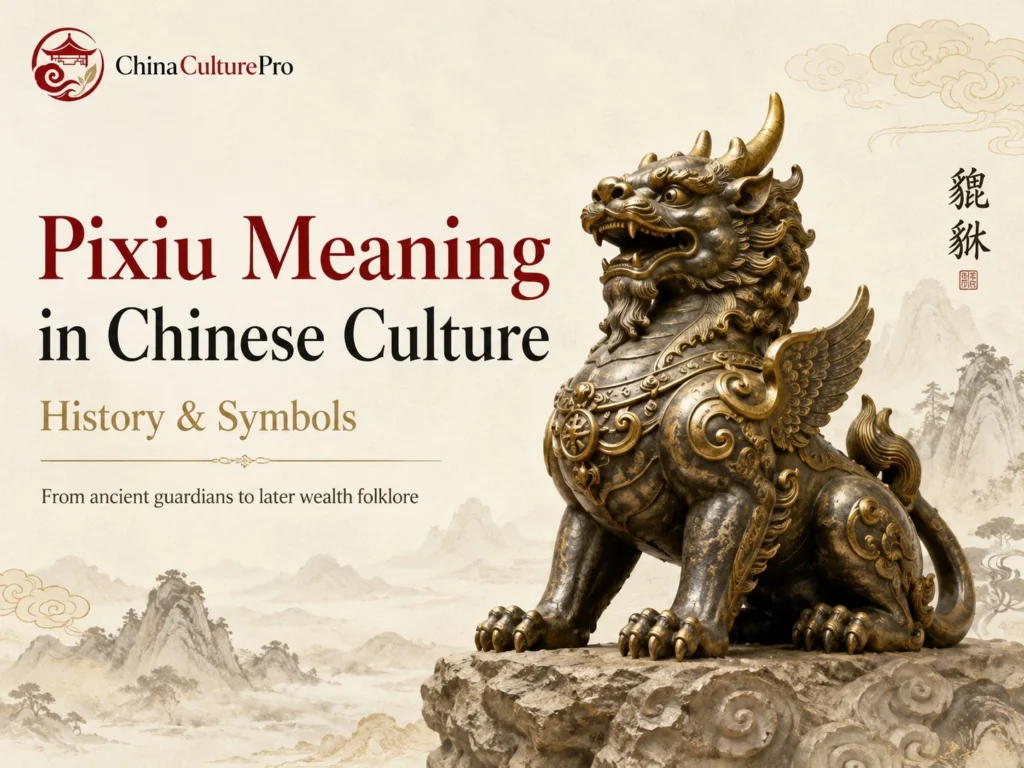

Quick Answer: What Does Pixiu Symbolize?
Pixiu (貔貅, Píxiū) is an evolving Chinese hybrid-beast symbol. It has no single appearance or meaning valid for every dynasty. Early texts connect the name with fierce animals and military force; Han and Six Dynasties art developed powerful winged guardians; later folklore added auspicious and wealth-related meanings; and modern jewelry and design made wealth retention the best-known interpretation.
- Guardianship and imposing presence: Winged hybrids guarded elite tombs, ritual spaces, or meaningful objects.
- Martial valor: Early writing used pi, xiu, or pixiu in contexts of fierce animals and formidable troops.
- Averting harmful forces: Bixie imagery expressed the wish to repel danger or disorder.
- Later wealth symbolism: Popular stories recast the creature as a collector and keeper of treasure.
- Modern cultural identity: Pixiu now appears in pendants, bracelets, statues, logos, tattoos, games, and cultural products.
Wealth is one important modern meaning, but it does not explain the creature’s entire history.
Most people now meet Pixiu through jewelry or statues marketed for wealth. Yet Pixiu was not a fixed “money beast” throughout Chinese history. Its name, appearance, and purpose changed as texts, funerary art, folklore, and commerce gave the creature new roles.
Han and Six Dynasties objects offer a useful starting point. Gold, gilt-bronze, bronze, and ceramic winged beasts survive from these periods, but their documented meanings center on status, protection, and the averting of harmful forces—not on swallowing treasure. Understanding Pixiu therefore requires several historical layers rather than one timeless legend.
What Is Pixiu?
Pixiu is written 貔貅 and pronounced Píxiū in standard Mandarin. It belongs to the wider world of Chinese mythical creatures, but it has neither a proven real-animal prototype nor one standardized form. “Chinese wealth dragon” is a convenient marketing label, not an accurate historical translation. Pixiu was not simply another form of the Chinese dragon.
The name has to be read on three levels. In early texts, pi and xiu appear among fierce creatures or in martial language. These passages do not supply the familiar modern statue with a horn, wings, coins, and an appetite for gold. In Han and Six Dynasties art, museums and scholars identify lion-like or feline winged hybrids as bixie, tianlu, chimera, or related guardian beasts. Their labels do not always align neatly with later Pixiu classifications.
Modern Pixiu is a third layer. Jewelry and decorative markets have brought many older features together into a recognizable commercial image: a powerful hybrid body, one or two horns, an open mouth, and sometimes coins or an ingot. That image is culturally meaningful, but it should not be projected unchanged onto every ancient object.
The distinction is not between a “real ancient Pixiu” and a “false modern Pixiu.” Both are cultural constructions from different periods. The task is to identify which historical layer an object represents and which claims can actually be supported for that layer.
What Pixiu Means in Different Contexts
Pixiu symbolism depends on period, carrier, and use. A Han winged beast, a palace ornament, and a jade wealth pendant may resemble one another while carrying different messages.
| Context | Primary meaning | Typical carrier | Interpretation limit |
|---|---|---|---|
| Early classical texts | Fierce animal, martial strength, or a name associated with formidable forces | Historical and philosophical texts | The exact referent is disputed; there is no developed wealth-beast image |
| Military metaphor | Courage, disciplined force, and the intimidating power of troops | Histories, memorials, and literary comparisons | This is verbal imagery, not proof of a fixed mythical species |
| Han and Six Dynasties funerary art | Protection, elite authority, and the repelling of harmful forces | Tomb sculpture, winged beasts, seals, and funerary objects | Surviving labels often use bixie or related terms; wealth is not the primary documented meaning |
| Court and elite objects | Auspicious protection, dignity, and ceremonial display | Clothing motifs, ornaments, vessels, and seals | Elite use does not establish a single imperial Pixiu rank or universal form |
| Later wealth folklore | Gathering and retaining prosperity | Oral stories, household symbols, and auspicious decoration | The symbolism expresses a wish; it does not prove a material effect |
| Modern commercial design | Wealth, protection, cultural style, or fantasy identity | Jewelry, statues, tattoos, logos, games, and film | Wearing, placement, gender, and activation rules differ by seller and tradition |
The same distinction applies across Chinese symbols and their meanings: an image cannot be interpreted safely without checking when, where, and how it was used.
How Pixiu Symbolism Developed Through History
Pixiu has no single creation story. Its modern identity developed through changes in language, art, ritual, and folk interpretation.
Early Textual Meanings: Fierce Beast and Martial Power
One famous early occurrence appears in the Records of the Grand Historian (Shiji). In the Yellow Emperor narrative, bears, grizzlies, pi, xiu, chu, and tigers are trained for the conflict at Banquan.[1] The passage places pi and xiu in a martial setting, but it does not describe the later hybrid guardian or a wealth symbol.
Interpretations differ. The terms may refer to fierce animals, animal-named groups, totemic identities, or figurative military divisions. Some readings also treat pi and xiu as separate words that were later joined as pixiu. The evidence does not justify choosing one explanation as universally settled. What the passage does establish is a cluster of ferocity, force, and warfare—not treasure collection.
Winged Guardians in Han and Six Dynasties Art
From the Han through the Six Dynasties, winged hybrid animals became prominent in elite and funerary art. A first-century solid-gold chimera may have been worn as a pendant or bead, while a third- to sixth-century example is made of gilt bronze.[2][3] A fifth-century bronze winged bixie has a muscular feline body, small horns, an open mouth, wings, and claws.[4] A Western Jin glazed candlestand uses the same protective hybrid form; related stone beasts stood before Six Dynasties royal tombs around Nanjing.[5]
These objects show a visual family rather than one perfectly standardized species. They express energy, elite presence, and protection. A Han-period seal knob also takes the form of a bixie, showing that the motif was not limited to monumental tomb sculpture.[6] None of these object records supplies the modern story of an animal that eats gold but cannot release it.
From Protective Beast to Modern Wealth Symbol
Later traditions continued to connect winged hybrids with auspicious protection. One museum synthesis places pixiu in the same broad family as tianlu and bixie and documents its use in ceremonial and funerary settings.[7] Over time, the idea of drawing in beneficial forces could be reinterpreted as drawing in prosperity.
There is no verified single year when Pixiu “became” a wealth beast. The change was gradual. In modern jewelry, feng-shui retail, and gift culture, wealth collection became the dominant sales narrative. The popular claim that Pixiu swallows gold and has no outlet gives that idea a memorable story, but the early text and ancient objects discussed above do not document it.
Why Is Pixiu Associated With Wealth?
Modern wealth symbolism turns an older protective beast into an image of acquisition and retention. The creature’s forceful mouth suggests taking in valuable energy or resources; its guarding role suggests keeping them secure. In folk interpretation, those two ideas become “gather wealth” and “prevent wealth from leaving.”
The familiar story makes the metaphor literal: Pixiu is said to eat gold, silver, or jewels and to have no anus, so treasure can enter but cannot escape. That story is now widespread in jewelry and decorative marketing. It is not present in the early Shiji passage or the museum documentation for the Han and Six Dynasties objects used in this article. It should therefore be described as later folklore, not as a proven ancient origin.
Wealth symbolism can still be culturally meaningful without being historical fact or measurable cause. A Pixiu pendant may express ambition, prudent saving, commercial success, or a family’s hope for security. It does not guarantee income, stop financial loss, or change a person’s fortune. Financial choices still depend on earnings, spending, saving, risk, and circumstances—not on the direction or material of a mythical-beast ornament.
Pixiu, Tianlu, and Bixie: Are They the Same?
Pixiu, tianlu (天禄), and bixie (辟邪) belong to an overlapping field of winged and protective creatures, but the three terms are not interchangeable in every text or object label. The problem is partly linguistic: tianlu can evoke “heavenly emolument” or blessing, while bixie literally means averting harmful influences. Such words may function as auspicious expressions as well as creature labels.
| Name | Documented use | Common modern assignment | Necessary caution |
|---|---|---|---|
| Pixiu (貔貅) | Early fierce-beast or martial language; later a broader mythical and auspicious creature | General name for the wealth beast, with one or two horns | Ancient inscriptions do not consistently use Pixiu for every winged hybrid |
| Tianlu (天禄) | Auspicious and funerary contexts associated with blessing, dignity, or guardianship | Often presented as a one-horned, male, wealth-oriented form | The one-horn/male rule is a later classification, not a universal ancient standard |
| Bixie (辟邪) | A general apotropaic expression and a label for evil-averting hybrid beasts | Often presented as a two-horned, female, protective form | The two-horn/female rule does not fit every surviving object or historical usage |
Modern catalogs often turn this fluid history into a neat taxonomy. Art-historical research warns, however, that inscriptions such as tianlu and bixie may be interpreted as species names even where the archaeological context suggests a more complicated picture.[8] Horn count can support an identification, but period, inscription, placement, and object history carry more weight.
How to Recognize Pixiu in Chinese Art
No single visual feature proves that a creature is Pixiu. Identification works best as a sequence of checks:
- Start with date and context: A Han or Six Dynasties beast from a tomb should be interpreted through its funerary setting before applying modern wealth symbolism.
- Look for an inscription or museum title: A label such as bixie or tianlu is stronger evidence than resemblance alone, although even inscriptions can require interpretation.
- Check for wings: Wings are common on early guardian hybrids, sometimes fully modeled and sometimes indicated with incised lines. Many modern Pixiu designs omit them.
- Treat horns as supporting evidence: One and two horns both occur. Horn number alone cannot establish species, sex, authenticity, or auspicious value.
- Study the body: Early examples often have a feline or leonine torso, strong shoulders, a lifted chest, a forceful head, and either claws or hoof-like feet.
- Read the pose: A standing, crouching, or forward-driving posture can communicate vigilance and authority. An open mouth is common but not compulsory.
- Notice later additions: Coins, ingots, treasure bowls, beads, and exaggerated rounded bellies usually point toward modern wealth-oriented design.
When an ancient object lacks a secure title, “winged hybrid beast” or “chimera” may be more responsible than forcing a precise Pixiu label.
Material is not a reliable shortcut either. Ancient related beasts survive in gold, gilt bronze, bronze, glazed stoneware, and stone, while modern examples may use jade, jadeite, crystal, metal, wood, or resin. No material automatically proves the creature’s identity or gives it one fixed meaning.
Pixiu vs. Similar Chinese Mythical Creatures
Pixiu shares horns, claws, feline traits, or auspicious functions with several Chinese creatures. Their systems and uses are nevertheless different.
| Creature | Core system | Main function | Key difference from Pixiu |
|---|---|---|---|
| Pixiu | Early martial language, funerary guardianship, and later wealth folklore | Protection and imposing force; later prosperity symbolism | Often winged in early art; identity and meaning changed sharply over time |
| Qilin | Classical ritual and benevolent-auspice system | Virtue, peaceful rule, and the arrival of worthy people | The Qilin is defined by benevolence rather than aggressive intimidation |
| Bixi (赑屃) | Dragon-related architectural and inscription tradition | Supporting steles and preserving commemorative writing | Bixi has a tortoise-like body and a load-bearing role; do not confuse its name with bixie |
| Xiezhi | Judicial symbolism | Distinguishing right from wrong and representing lawful judgment | Its defining association is justice, not tomb guardianship or wealth retention |
| Chinese guardian lion | Architectural and religious threshold guardianship | Protecting entrances and expressing status | Guardian lions normally work as recognizable lions without the winged-hybrid history of Pixiu |
| Jin Chan | Later folk wealth symbolism | Prosperity and money-related wishes | Jin Chan is a three-legged toad with its own legends and visual vocabulary |
The safest method is to identify the creature’s visual structure and carrier before assigning its meaning. Similar auspicious functions do not make two symbols culturally identical.
English spelling creates one additional trap: Bixi and bixie differ by only one final letter, but they refer to different Chinese names, 赑屃 and 辟邪. Checking the Chinese characters prevents a winged guardian from being confused with a tortoise-like stele bearer.
Pixiu in Jewelry, Statues, and Modern Design
Modern Pixiu designs are reinterpretations, not archaeological reconstructions. A bracelet bead may reduce the creature to a horned head with a broad mouth. A jade pendant may keep the wings but smooth away the fierce posture. A desk statue may add coins, an ingot, or a treasure bowl so the wealth message is immediately readable.
Materials also acquire new marketing stories. Jade may be associated with refinement, metal with strength, and dark stones with protection, but these are product- and community-specific interpretations rather than a universal Pixiu color or material code. Historical identification should still begin with form, inscription, date, and context.
Retail traditions offer many instructions: wear Pixiu on a particular wrist, point its head outward, avoid touching its mouth or eyes, prevent other people from handling it, or perform an activation ritual. These rules vary across sellers, communities, and feng-shui lineages and sometimes contradict one another. They should be presented as modern practices followed by some users, not as one ancient law.
Logos and cultural products can emphasize vigilance, confidence, or Chinese visual identity without making supernatural claims. Tattoos require more thought because early winged hybrids have funerary and apotropaic associations. That history does not make a Pixiu tattoo forbidden or unlucky, but it is relevant to the design’s tone. Games and film may freely invent colors, powers, personalities, or combat roles; those features belong to modern storytelling unless a source connects them to an older tradition.
How to Interpret or Use a Pixiu Symbol Correctly
Use the following process for museum interpretation, collecting, jewelry descriptions, logos, tattoos, or cultural products:
- Identify the historical layer: Decide whether the evidence belongs to an early text, Han or Six Dynasties art, later folklore, or contemporary design.
- Use cautious names: If an ancient winged beast lacks an inscription or secure catalog history, do not identify it as Pixiu solely from appearance.
- Avoid rigid visual rules: Color, horn count, mouth position, wings, body shape, and supposed gender all vary.
- Separate symbolism from results: It is accurate to say that Pixiu expresses hopes for prosperity or protection. It is not accurate to promise wealth, luck, safety, or a change of fate.
- Respect the original carrier: A funerary guardian, ceremonial ornament, bracelet, and game character do not automatically share the same meaning.
- Check permanent or commercial designs: Verify the Chinese characters, source image, cultural setting, and intended message before finalizing a tattoo, logo, or mass-produced object.
The goal is not to freeze Pixiu into one “correct” form. It is to make the design’s historical layer and modern adaptation clear.
Final Takeaway
Pixiu is best understood as a changing cultural symbol. Early texts emphasize fierce or martial force, while Han and Six Dynasties winged beasts express protection, authority, and the averting of harmful influences. Wealth gathering became a major later interpretation and now dominates jewelry and decorative culture. Reading Pixiu accurately means matching the name, object, period, and context instead of treating modern commercial folklore as its timeless definition.
FAQs About Pixiu Meaning and Symbolism
How Do You Pronounce Pixiu?
Pixiu is pronounced Píxiū in standard Mandarin: pí has a rising second tone, and xiū has a high, level first tone. A rough English approximation is “pee-shee-oh,” spoken smoothly rather than as three strongly separated words. Pinyin gives a closer guide than English phonetic spelling.
Are Pixiu and Pi Yao the Same?
Pi Yao is a nonstandard romanization commonly used in modern English-language feng-shui, jewelry, and retail material. It usually refers to the same popular wealth creature called Pixiu, not to a separate classical species. The standard modern Mandarin pinyin is Pixiu, and the standard Chinese characters are 貔貅.
Is Pixiu Part of the Chinese Zodiac?
No. Pixiu is not one of the twelve Chinese zodiac animals. The zodiac is a calendrical cycle of Rat, Ox, Tiger, Rabbit, Dragon, Snake, Horse, Goat, Monkey, Rooster, Dog, and Pig. Pixiu belongs to a different field of mythical and auspicious creatures.
Is Pixiu One of the Nine Sons of the Dragon?
Pixiu does not appear in the principal Ming lists associated with Li Dongyang or Yang Shen. Calling it a dragon’s son is a later popular claim rather than a stable classical genealogy. The competing lists and their architectural roles are explained in the guide to the Nine Sons of the Dragon.
Why Do Some Pixiu Statues Appear in Pairs?
Paired arrangements draw partly on older tomb avenues and entrances where protective animals could stand singly or in pairs, and partly on later decorative preferences. Modern sellers sometimes assign complementary genders or functions to the pair, but this is not a universal rule for all periods. Many historical and modern Pixiu-related images are single figures.
Does Pixiu Have the Same Meaning Across East Asia?
Not exactly. The written term and related guardian-beast imagery traveled through East Asian cultural networks, but names, visual forms, religious roles, and popular meanings were localized. A Japanese, Korean, or Vietnamese object should be interpreted through its own period and community rather than automatically receiving every modern Chinese Pixiu meaning.
Sources
[1] Chinese Text Project. Records of the Grand Historian: Annals of the Five Emperors
[2] The Metropolitan Museum of Art. Chimera (Bixie) (a); Magnifying Glass (b)
[3] The Metropolitan Museum of Art. Chimera (Bixie)
[4] Cleveland Museum of Art. Winged Chimera (Bixie)
[5] Cleveland Museum of Art. Candlestand in the Shape of a Chimera Bixie
[6] British Museum. Seal
[7] National Museum of Natural Science. Pixiu—A Tomb Guardian Beast
[8] Susan Bush. Labeling the Creatures: Some Problems in Han and Six Dynasties Iconography