
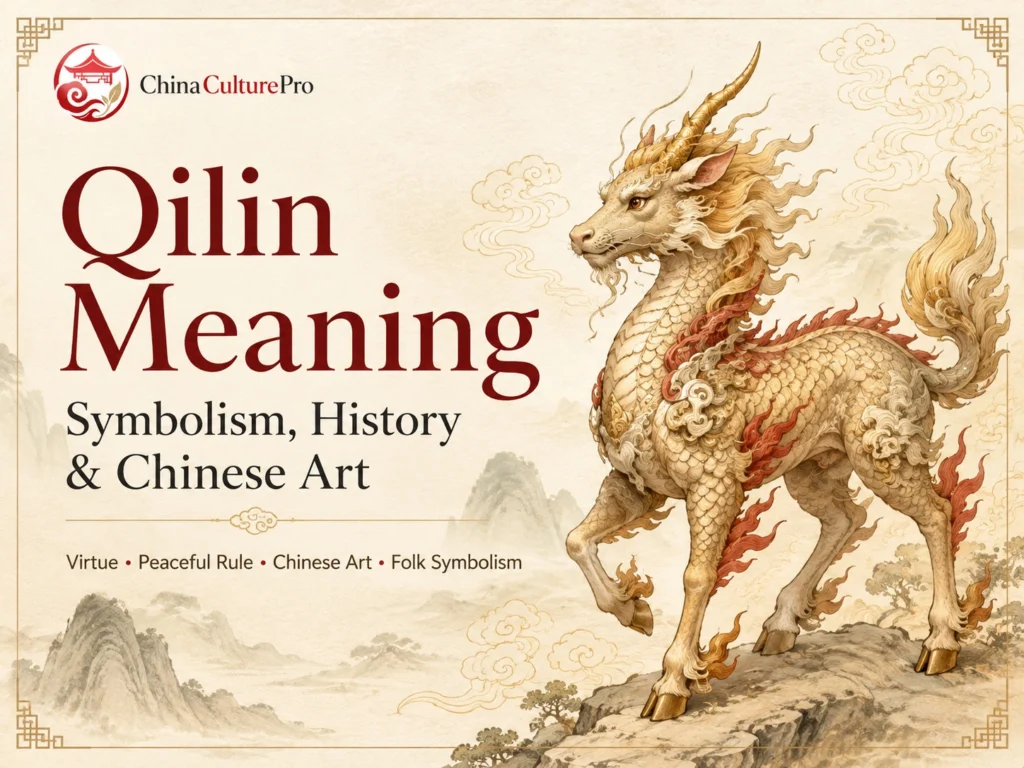

Quick Answer: What Does the Qilin Symbolize?
The Qilin (麒麟, qílín) is a benevolent mythical creature in Chinese culture. Its most established meanings are moral virtue, peaceful government, distinguished talent, and—in later folk art—the hope for admirable descendants. It belongs to the Four Numinous Creatures and is not simply a Western unicorn or a universal “good luck” charm.
- Benevolent virtue: The Qilin embodies humane, restrained, and principled conduct.
- Peaceful and worthy rule: Its appearance traditionally signals an ideal age governed by a sage ruler.
- Noble or official rank: In period-specific court art, it can mark aristocratic status or the highest military official rank.
- Talented descendants: The later “Qilin Delivering a Son” motif expresses hopes for a learned, virtuous child and a flourishing family.
- Modern cultural identity: Contemporary artists use it to suggest dignity, integrity, Chinese heritage, and auspicious beauty.
The exact meaning depends on the date, object, companion motifs, and audience. For the wider visual system, see Chinese symbols and their meanings.
Qilin—sometimes translated as “Chinese unicorn”—appears in classical texts, court paintings, rank badges, porcelain, New Year prints, and modern design. Across those settings, however, it does not carry one fixed meaning. The early lin represented humane virtue; a Qing court badge communicated official rank; a child riding a Qilin expressed a family aspiration.
Its body changed as well, from comparatively deerlike forms to richly scaled, dragon-headed creatures surrounded by flames or clouds. Reading a Qilin accurately therefore requires context: historical period, artistic medium, visual companions, and original use matter more than a single horn or a generic promise of luck.
What Is a Qilin?
The Qilin (麒麟, qílín) is a Chinese composite mythical animal with no single real-world species as its model. Early sources often use the shorter name lin (麟). Later works use Qilin as the conventional name for a creature whose body may combine hoofed-animal, dragon, bovine, and other features. Its appearance has never been limited to a white horse with one spiral horn.
The Book of Rites places the lin beside the Fenghuang, tortoise, and dragon as the Four Numinous Creatures. In that ritual vision, these creatures help distinguish an ordered, flourishing world from disorder.[1] The Qilin therefore belongs to the Four Auspicious Creatures, not the directional Four Symbols of Chinese mythology. It has no fixed east–west direction, season, color, or constellation.
“Chinese unicorn” is a convenient introductory translation, not an equivalent definition. A horn can appear, but some Qilin have two; scales, cloven hooves, a bovine tail, a dragonlike head, and flame-shaped details may be equally important. More fundamentally, the creature’s classical identity comes from benevolence and good government, not from the European unicorn’s religious, romantic, or purity narratives.
Within the wider family of Chinese mythical creatures, the Qilin is best understood as a virtue-bearing auspicious beast whose meaning changed as it moved from classics into court ceremony, popular art, and modern media.
What the Qilin Means in Different Contexts
The safest interpretation starts with the object’s cultural setting. “Luck” is too broad to explain why a Qilin appears on a classical illustration, a Qing military badge, a domestic porcelain plaque, or a contemporary logo.
| Context | Primary meaning | Typical carrier | Interpretation limit |
|---|---|---|---|
| Classical virtue and benevolence | Humane conduct, restraint, moral cultivation, and care for living beings | Classics, commentaries, didactic painting, ritual imagery | An ethical ideal—not automatically wealth, fertility, or career success |
| Sage rule and public peace | Worthy government, social order, and a flourishing realm | Court paintings, official eulogies, ceremonial furnishings | A traditional political omen, not a measurable rule of history |
| Four Numinous Creatures | An ordered world shared with the Fenghuang, tortoise, and dragon | Ritual texts and later auspicious art | No directional, seasonal, or astronomical function |
| Court rank and nobility | Aristocratic distinction or, after 1662, first-rank military status | Rank badges, robes, formal textiles | Regulations depend on dynasty and date; they are not universal |
| Qilin Delivering a Son | Hope for a learned, virtuous descendant and a flourishing household | New Year prints, porcelain, wedding or domestic decoration | A cultural aspiration, not a causal fertility claim |
| Modern art and design | Integrity, dignity, Chinese identity, and auspicious elegance | Logos, fashion, illustration, games, jewelry, and tattoos | Often a creative reinterpretation rather than a historical rule |
Several meanings can operate at once. A court Qilin may draw authority from the creature’s ancient virtue while its exact placement signals rank. A popular print may use the same benevolent reputation to praise the hoped-for qualities of a child. Companion motifs narrow the message further: a child, book, banner, clouds, waves, sun, or court insignia can be more decisive than horn count.
This is also why “Qilin means good luck” is incomplete. Auspiciousness is the broad category; benevolent conduct, orderly rule, official achievement, or an exemplary descendant is the specific message. The distinction helps readers identify the intended human value instead of treating every image as a supernatural promise.
How Qilin Symbolism Changed Through History
The Lin in Early Classical Texts
The Qilin’s cultural foundation lies in early texts, although those texts do not provide one exhaustive anatomical description. The poem “Lin Zhi Zhi” in the Book of Poetry praises the feet, forehead, and horn of the lin while comparing them with the noble sons, grandsons, and kindred of a prince.[2] The poem establishes an early relationship between the creature and admirable human lineage without describing the later “Qilin Delivering a Son” picture.
Other textual and commentarial traditions characterize the lin as an “animal of mercy,” gentle enough not to injure living things. Museum scholarship uses that tradition to explain why the Qilin became a model of benevolent power rather than predatory force.[3] The Book of Rites then situates the lin within the Four Numinous Creatures, giving it a place in ritual accounts of cosmic and social order.[1]
These layers are related but should not be collapsed. The early poetic lin, the ethical “benevolent beast,” and the later scaled court creature belong to a developing tradition, not one unchanged design manual.
Confucius, the Captured Lin, and Later Birth Legends
Confucius-related Qilin stories come from different periods and genres. The Spring and Autumn Annals records the capture of a lin during a western hunt in 481 BCE. Traditional historiography associated this episode with Confucius’s sorrow over a numinous creature appearing in a disordered age and with the end of his chronicle. “Capturing the lin” thus became a literary image of virtue unrecognized by its time. It should be presented as a classical record and traditional interpretation, not as independently verifiable evidence that a mythical animal was hunted.
A separate legend developed later around Confucius’s birth. In this story, a Qilin appears before his birth and produces a jade book predicting the arrival of an extraordinary sage. Over time, the learned-child theme entered popular imagery and contributed to Qilin Songzi (麒麟送子), “Qilin Delivering a Son.” The Palace Museum explicitly connects a Qing porcelain example with this later jade-book tradition.[7]
The sequence matters: the hunt episode, the birth prophecy, and the domestic son-delivery motif are not one original Spring and Autumn narrative. Later communities reworked the Qilin’s ancient virtue into a family wish for a child of character and learning.
The Ming Giraffes and Imperial Legitimacy
In 1414, envoys from Bengal presented a giraffe to the Yongle court. Because the unfamiliar animal could be matched to existing descriptions of a gentle, long-necked auspicious beast, Ming observers identified it as a Qilin. Court artists depicted it, and officials composed congratulatory texts that interpreted its arrival through the language of sage rule and political legitimacy.[5]
The National Palace Museum preserves this episode through the painting commonly known as Painting of a Qilin and Shen Du’s Eulogy. Its exhibition research identifies the Bengal mission and shows how image and eulogy turned the exotic animal into politically useful auspicious communication.[6] The animal itself ultimately came from East Africa through Indian Ocean exchange before reaching the Ming court through Bengal’s diplomatic network.
This event does not prove that the giraffe was the biological origin of the Qilin. The cultural category already existed for centuries. The process ran in the opposite direction: Chinese viewers used an established mythical and textual framework to interpret a newly encountered animal. Nor did later Qilin art simply become naturalistic giraffe imagery. Dragonlike heads, scales, horns, flames, and hoofed bodies continued to vary across media.
How to Recognize a Qilin in Chinese Art
There is no cross-dynastic “correct” Qilin anatomy. Early images can be comparatively restrained and deerlike, while later examples may have a dragon head, scaled body, powerful chest, cloven hooves, curling mane, and flame-shaped ornament. A Cleveland Museum rank badge even shows a two-horned Qilin, directly contradicting the idea that every authentic example must have one horn.[3]
Use a cluster of features rather than a single test:
- Begin with the hoofed body. Many examples have a deer-, ox-, or horse-like base rather than the serpentine body of a dragon or the feline body of a lion.
- Check the head and skin together. Later Qilin often combine a dragonlike head, mane, scales, and one or two horns. No one feature is compulsory in every period.
- Look at the feet and tail. Cloven hooves and a bovine or tufted tail frequently separate it from clawed guardian beasts.
- Read flames and clouds as context. On Qing rank badges, flames can communicate supernatural power; they do not make the creature demonic or violent.[4]
- Assess demeanor and action. Qilin are typically poised, advancing, kneeling, or carrying a child. The ideal is controlled strength, not attack.
- Use the object type. A square court badge, a son-delivery plaque, and a modern statue activate different interpretations even when their creatures look similar.
Do not identify every antlered or scaled animal as a Qilin. Compare the full body, companion figures, ground pattern, and original placement. Museum labels, inscriptions, and collection records are especially useful because the same visual trait may belong to another creature in another system. For a general method, see Chinese symbolism in art.
Qilin vs. Chinese Unicorn
Calling the Qilin a “Chinese unicorn” offers English readers a quick mental bridge, but it also creates the page’s most common misconception. The two creatures developed in independent traditions and are not defined by the same body, legends, or cultural functions.
| Comparison | Chinese Qilin | Western unicorn |
|---|---|---|
| Cultural framework | Early Chinese classics, ritual order, court symbolism, and folk art | Classical and medieval European texts, Christian allegory, romance, and fantasy |
| Typical body | Variable hoofed composite with scales, mane, bovine tail, dragonlike or animal head | Usually a horse- or goat-like animal with a single prominent horn |
| Horn rule | One horn, two horns, or a less emphasized horn depending on period and work | One horn is the defining visual feature |
| Core symbolism | Benevolence, worthy rule, public peace, rank, talent, and exemplary descendants | Purity, chastity, sacred power, capture, healing, and later fantasy |
| Major narratives | Four Numinous Creatures, captured lin, jade-book prophecy, Ming giraffe, son-delivery image | Virgin and unicorn, miraculous horn, hunt and capture, Christological allegory |
| Traditional media | Ritual texts, court painting, rank badges, porcelain, New Year prints | Bestiaries, tapestries, religious art, heraldry, and romance literature |
Getty’s account of the medieval bestiary shows how the Western unicorn became an emblem of purity and, in Christian interpretation, Christ and the Incarnation.[9] Those meanings do not define the Chinese Qilin. Likewise, Qilin beliefs about benevolent rule or talented descendants should not be transferred to a European unicorn.
“Chinese unicorn” is therefore acceptable as a loose search term or introductory gloss if the limitation is stated immediately. In accurate cultural writing, Qilin should remain the primary name.
Qilin vs. Similar Chinese Mythical Creatures
Scales, horns, flames, and an auspicious setting can make several Chinese creatures look alike. Their functions, however, are distinct. The following comparison is more reliable than matching one anatomical detail.
| Creature | Core system | Main meaning | Key distinction |
|---|---|---|---|
| Qilin (麒麟) | Four Numinous Creatures and benevolent-beast tradition | Virtue, worthy rule, high rank, talent, and exemplary descendants | Hoofed composite whose strength is restrained by benevolence |
| Chinese dragon (龙) | Natural power, cosmic order, imperial ritual, and auspicious culture | Water, rain, authority, legitimacy, and cultural identity | Usually elongated, clawed, and associated with clouds or water; see Chinese dragon meaning |
| Xiezhi (獬豸) | Judicial and official symbolism | Discernment, justice, and punishment of wrongdoing | Its horn and confrontational role serve law rather than family aspiration; see Xiezhi meaning |
| Pixiu (貔貅) | Guardian and later wealth symbolism | Protection and, especially in modern popular use, wealth attraction | More forceful guardian character and no classical role as the benevolent lin; see Pixiu meaning |
| Chinese guardian lions (石狮) | Architectural guardianship and status display | Entrance protection, stability, authority, and household prestige | Lion-based pair placed at gates; see Chinese guardian lions |
The Fenghuang and Qilin are closer in ritual classification: both belong to the Four Numinous Creatures, yet one is an auspicious bird and the other a hoofed benevolent beast. Their companion scenes and later court roles also differ; the Chinese Fenghuang developed especially strong associations with virtue, peaceful rule, and later feminine nobility.
The practical lesson is to classify by system, body, action, and setting together. An isolated horn is not enough to distinguish Qilin from Xiezhi, and scales alone do not make it a dragon.
How Qilin Meaning Changed in Court and Folk Art
Qilin Rank Badges and Political Status
On official dress, the Qilin could operate as an exact institutional sign rather than a general blessing. Before the early Qing rank system was standardized, Qilin badges were associated with nobles. The Metropolitan Museum of Art notes that after 1662 the creature became the insignia of a first-rank military official, the highest grade in the military hierarchy.[4]
A typical badge places the Qilin above stylized waves or rocks, facing the sun amid clouds and flames. The composition is not a random collection of lucky images. Its square format, placement on the robe, prescribed animal, and surrounding cosmological motifs made the wearer’s position visible. Flames around the creature could signify supernatural power rather than aggression, while the sun could serve as the courtward point of orientation.
These rules should not be projected backward or applied to every Qilin textile. A Ming noble’s badge, a post-1662 Qing military badge, and a domestic embroidery may show similar creatures but encode different status. Rank is established by date, garment type, provenance, and institutional context—not by the Qilin alone. For readers exploring other achievement imagery outside court regulation, the guide to Chinese symbols for success separates official rank from broader wishes for advancement.
What Does Qilin Delivering a Son Mean?
Qilin Songzi (麒麟送子), “Qilin Delivering a Son,” transforms the ancient benevolent beast into a family-centered image. Its message is more specific than fertility: it expresses the hope that a household will welcome a child who is learned, virtuous, distinguished, and capable of bringing honor to the family. The later legend of a Qilin producing a jade book before Confucius’s birth helps explain why wisdom and sage potential are central to the motif.[7]
Compositions vary. A Kangxi-period Palace Museum porcelain plaque shows five children, one riding the Qilin, accompanied by banners, red clouds, architecture, rocks, and railings.[7] A Metropolitan Museum New Year print from early twentieth-century Foshan demonstrates the motif’s continued life in popular visual culture.[8] Other versions may include a book, lotus, attendants, or different auspicious surroundings, but no single inventory is mandatory for every authentic work.
The motif belongs to the broader history of Chinese symbols for family, marriage, lineage, education, and social aspiration. It does not mean that an image, statue, or ritual will cause pregnancy or guarantee a son. It also reflects historical preferences for male heirs. A responsible modern explanation can document that context without endorsing son preference: today the image can be read more inclusively as a wish for any child to grow in wisdom and character.
How to Interpret or Use a Qilin Symbol Correctly
For museum viewing, collecting, home decoration, branding, or tattoo planning, use a context-first checklist:
- Date the image. Separate the early textual lin, Ming auspicious court imagery, Qing rank insignia, later son-delivery art, and contemporary fantasy.
- Identify the whole creature. Compare head, horns, scales, hooves, tail, posture, and demeanor. Do not decide from one horn alone.
- Read every companion motif. A child, book, sun, waves, flames, clouds, or badge border can change the meaning from family hope to official rank.
- Determine the original setting. Court dress, ceremonial painting, domestic porcelain, temple decoration, and a commercial logo do not follow identical rules.
- Separate cultural categories. Do not substitute a Western unicorn, Xiezhi, Pixiu, dragon, or guardian lion for the Qilin.
- Avoid causal claims. Treat luck, peace, descendants, and advancement as symbolic wishes, not guaranteed effects of owning or displaying an image.
- Review permanent designs. Before publishing a logo or commissioning a Chinese tattoo symbol, have the complete artwork and any Chinese text checked by a qualified Chinese-language or cultural reviewer.
Modern reinterpretation is valid when it is labeled honestly. A sleek one-horned Qilin may work in a game or brand identity, but it should not be presented as the only historically authentic form. For decorative compositions, consult the broader guide to Chinese symbolic patterns and motifs.
Final Takeaway
The Qilin is not a Western unicorn with a Chinese name or a statue that mechanically produces luck. It is a layered symbol whose meanings grew from classical benevolence into political auspiciousness, court rank, family hopes, and modern cultural design. Accurate interpretation depends on the period, object, body form, companion motifs, and original audience. Read those elements together, and the Qilin becomes a precise expression of virtuous power rather than a generic lucky beast.
FAQs About Qilin Meaning and Symbolism
How Do You Pronounce Qilin?
In standard Mandarin, Qilin is pronounced qílín: both syllables use the second, rising tone. A rough English approximation is “chee-lin,” but the Mandarin initial q is a lightly aspirated sound produced farther forward than English “ch.” Pinyin spelling is preferable to invented phonetic spellings because it preserves the standard Chinese name.
Is the Qilin a God or a Mythical Creature?
The Qilin is primarily a mythical creature, ritual symbol, and auspicious image rather than a god with one standardized nationwide cult. It appears in classics, court art, popular prints, and later religious or local settings. Practices can vary, so the most accurate general statement is that its main cultural role is symbolic—not that no community has ever treated an image devotionally.
Is the Qilin One of the Chinese Zodiac Animals?
No. The Qilin is not one of the twelve animals in the Chinese zodiac. The dragon is the zodiac’s only mythical member. Qilin symbolism comes from the separate Four Numinous Creatures, classical literature, court institutions, and folk art. There is therefore no traditional “Year of the Qilin” in the twelve-year zodiac cycle.
Are Qilin and Japanese Kirin the Same?
Japanese kirin derives historically from the Chinese Qilin, but Japanese language, art, religion, and popular culture localized the creature. The word has also become the ordinary Japanese name for a giraffe, reflecting the historical identification discussed above. Shared origins do not make every Chinese Qilin and Japanese kirin image interchangeable; identify the culture, period, and object before assigning meaning.
Can a Qilin Be Male or Female?
Some traditional lexical explanations divide the compound so that qi refers to the male and lin to the female. In later usage, however, Qilin generally functions as the creature’s combined name. Horn number, color, flames, or body shape do not provide a reliable universal gender code, so a museum object or modern design should not be sexed from those features alone.
Does a Qilin Statue Bring Good Luck?
A Qilin statue can express wishes for benevolence, peace, worthy achievement, an admirable family, or auspicious order, depending on its design and setting. There is no verifiable evidence that owning or positioning one automatically causes wealth, fertility, promotion, or protection. Choose it for its cultural meaning and artistic value, and avoid presenting symbolic tradition as a guaranteed real-world outcome.
Sources
[1] Chinese Text Project. Book of Rites: Li Yun
[2] Chinese Text Project. Book of Poetry: Lin Zhi Zhi
[3] Cleveland Museum of Art. Fantastic Beasts in Chinese Culture—and Where to Find Them
[4] The Metropolitan Museum of Art. Rank Badge with Qilin
[5] The Metropolitan Museum of Art. Giraffe with Two Keepers
[6] National Palace Museum. Painting of a Qilin and Shen Du’s Eulogy
[7] The Palace Museum. Famille Rose Plaque with Qilin Delivering a Son
[8] The Metropolitan Museum of Art. Qilin Delivering a Son
[9] The J. Paul Getty Museum. The Medieval Bestiary