
Quick Answer: What Is Qixi Festival 2027?
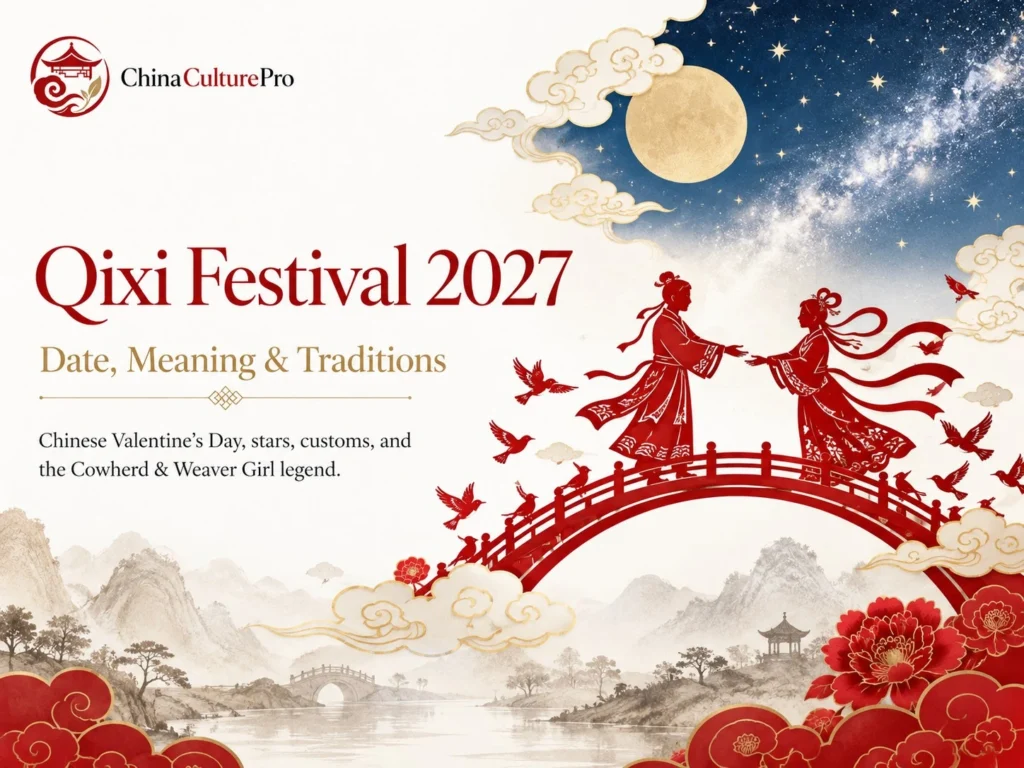
Qixi Festival 2027 falls on Sunday, August 8, 2027. It is celebrated on the 7th day of the 7th lunar month. In Chinese, the festival is called Qixi Jie (七夕节). “Qi” means seven, and “xi” means evening, so Qixi means the evening of the seventh day of the seventh lunar month. It is also called Chinese Valentine’s Day, Double Seventh Festival, and Qiqiao Festival. The core story is the annual meeting of Niulang, the Cowherd, and Zhinü, the Weaver Girl, on a bridge of magpies across the Milky Way. Modern Qixi is often treated as a romantic festival, but its traditional meaning is wider. It is about love, distance, promise, women’s skills, wisdom, and the hope of meeting again after long separation.| Item | Detail |
|---|---|
| 2027 Date | August 8, 2027 |
| Day of Week | Sunday |
| Chinese Name | Qixi Jie / 七夕节 |
| Also Called | Chinese Valentine’s Day, Double Seventh Festival, Qiqiao Festival |
| Date Rule | 7th day of the 7th lunar month |
| Core Story | Cowherd and Weaver Girl |
| Main Customs | Stargazing, Qiqiao, needle threading, qiaoguo, modern dating |
| Main Meaning | Love, distance, promise, skill, annual reunion |
What Is Qixi Festival?
Qixi Festival is often introduced as Chinese Valentine’s Day, but that label is only an entrance. Qixi is not simply China’s version of February 14. It is a Chinese festival of love, distance, stars, craft, and promise.
The name Qixi means the seventh night. It falls on the 7th day of the 7th lunar month. Unlike Mid-Autumn Festival, it is not centered on the full moon. Unlike Qingming Festival, it is not a solar term. Qixi became meaningful because of a story: the Cowherd and the Weaver Girl.
In that story, a mortal cowherd and a heavenly weaver love each other but are separated by the Milky Way. They can meet only once a year, when magpies form a bridge across the sky. The plot is simple, but its emotional force is deep. It touches one of the hardest parts of love: distance.
Qixi love is not mainly about loud confession or immediate possession. It is quieter. It is the belief that two people can be separated and still keep a promise.
Qixi’s most moving point is not “being together every day.” It is “meeting only once a year, and still not breaking.”
When Is Qixi Festival? Date Rule and Upcoming Dates
Qixi Festival is always celebrated on the 7th day of the 7th lunar month. Because it follows the Chinese lunar calendar, its Gregorian date changes every year.
It usually falls in August, though some years may place it in late July. Qixi is culturally important, especially for couples and traditional culture events, but it is not a public holiday in Mainland China.
| Year | Qixi Festival Date | Day of Week | Zodiac Year |
|---|---|---|---|
| 2026 | August 19, 2026 | Wednesday | Fire Horse |
| 2027 | August 8, 2027 | Sunday | Fire Goat |
| 2028 | August 26, 2028 | Saturday | Earth Monkey |
| 2029 | August 16, 2029 | Thursday | Earth Rooster |
| 2030 | August 5, 2030 | Monday | Metal Dog |
Date note: Qixi is not fixed on the Gregorian calendar and is not February 14. It follows the 7th day of the 7th lunar month. If you are planning events, gifts, greetings, or cultural content, check the exact date for that year.
Why Qixi Is More Than Chinese Valentine’s Day
Calling Qixi “Chinese Valentine’s Day” is useful for English readers because it quickly explains the romance angle. But the label is incomplete.
Qixi did not begin as a modern couple’s shopping day. Its older layers include star worship, the Cowherd and Weaver Girl legend, women’s craft traditions, Qiqiao prayers, marriage wishes, and folk customs tied to skill and patience.
| Modern Label | Traditional Qixi |
|---|---|
| Chinese Valentine’s Day | Qiqiao / Begging for Skills Festival |
| Romantic dates and gifts | Skill, wisdom, devotion, marriage wishes |
| Direct expression of love | Quiet longing and annual reunion |
| Couple-centered | Also women-centered and craft-centered |
| Modern commercial layer | Older star and folk-custom layer |
Western Valentine’s Day often emphasizes open expression: flowers, chocolates, cards, dinner, and direct romantic words. Modern Qixi can include these, but traditional Qixi is more restrained. Its emotional core is not “I can have you now.” It is “I keep the promise even when I cannot cross the distance.”
Qixi is also not only about men giving gifts to women. In older practice, it was a women-centered festival. Young women prayed to Zhinü for skill, wisdom, needlework ability, and a good marriage.
“Chinese Valentine’s Day” is an entrance, not the destination. If readers see Qixi only as a reason to buy flowers, they miss its deepest layer: love defined not by possession, but by keeping a promise.
The Cowherd and the Weaver Girl: Qixi’s Core Legend
The Cowherd and Weaver Girl story is the heart of Qixi Festival. Almost every Chinese person knows it in some form, though details vary by region and retelling. One common version tells the story this way.
Niulang, the Cowherd, is a poor but kind young man who lives with an old ox. Zhinü, the Weaver Girl, is a heavenly maiden who weaves clouds and celestial colors. The two meet, fall in love, marry, and have children.
But the union between heaven and earth breaks celestial rules. In many versions, the Queen Mother of the West or another heavenly authority takes Zhinü back to the sky. Niulang tries to follow her, carrying the children with him. Just as he nearly reaches her, the Queen Mother draws a line across the sky with her hairpin. That line becomes the Milky Way, separating the lovers.
Moved by their devotion, magpies gather once a year on the 7th day of the 7th lunar month. They form a bridge across the Milky Way so Niulang and Zhinü can meet for one night.
| Story Element | Cultural Meaning |
|---|---|
| Niulang | Earthly love, ordinary life, persistence |
| Zhinü | Skill, beauty, heavenly order |
| Milky Way | Distance, fate, separation |
| Magpie Bridge | Help, hope, annual reunion |
| Once-a-Year Meeting | Faithfulness despite distance |
Some folk sayings add that if it rains on Qixi night, the rain is the tears of the lovers: tears of joy when they meet, or tears of sadness when they must separate again. This is not a fixed rule, but it shows how deeply the story shaped Chinese feeling.
The legend is not only a romantic tale. It is a story about boundaries, longing, help, and the weight of a promise. The Magpie Bridge matters because it gives separation one night of mercy.
Qiqiao: The Older Festival of Skills and Women’s Wishes
Before Qixi became widely known in modern English as Chinese Valentine’s Day, it had another important identity: Qiqiao Festival.
Qiqiao means Begging for Skills. The person people prayed to was Zhinü, the Weaver Girl. In traditional society, weaving, sewing, embroidery, and fine handwork were not just household tasks. They were tied to a woman’s competence, dignity, economic value, and marriage prospects.
On Qixi night, young women might set up offerings in the courtyard, place fruit and tea, look toward the stars, worship Zhinü, and pray for clever hands, patient minds, better needlework, wisdom, and a good marriage. Some customs involved threading needles under moonlight or dim light to test skill and steadiness.
| Qiqiao Custom | What It Expresses |
|---|---|
| Praying to Zhinü | Wisdom, skill, good marriage |
| Threading Needles | Dexterity and patience |
| Displaying Handmade Work | Pride in craft |
| Offering Fruit and Tea | Respect and wishes |
| Watching the Stars | Connection with Zhinü and Niulang |
This layer is crucial. It shows that Qixi was not only about waiting for a lover. It was also about women asking for the ability to shape their own lives with skill. In that older context, “skill” meant more than decoration. It meant survival, respect, and the power to manage life well.
The older heart of Qixi is not “men buying gifts for women.” It is women standing under the stars and asking Zhinü for skill, wisdom, and the ability to live well. Zhinü is not only the heroine of a love story. She is also a figure of craft, order, and female strength.
Qixi Festival Traditions and Customs
Qixi customs vary by region and generation. Modern dating customs now sit beside much older rituals of stargazing, praying for skills, eating qiaoguo, and honoring Zhinü.
| Custom | What People Do | Meaning |
|---|---|---|
| Stargazing | Look for Vega and Altair | Seeing love and distance in the sky |
| Qiqiao Prayers | Pray to Zhinü for skill and wisdom | Women’s wishes, craft, good marriage |
| Needle Threading | Thread needles in moonlight or dim light | Dexterity and patience |
| Worshiping Zhinü | Set offerings such as fruit, tea, or incense | Respect and personal wishes |
| Eating Qiaoguo | Eat small sweet or fried pastries | Cleverness, sweetness, blessing |
| Modern Dating | Flowers, gifts, dinners, movies | Contemporary romantic expression |
| Qixi Water | Store water or dew in some regions | Folk belief, seasonal blessing |
Stargazing connects the festival to its sky story. People look for Zhinü, often associated with Vega, and Niulang, associated with Altair, across the Milky Way. This turns the night sky into a festival text.
Needle threading and Qiqiao prayers express the older women’s festival layer. These customs are not practiced everywhere today, but they remain important for understanding what Qixi used to mean.
Qiaoguo gives the festival a food symbol tied to skill. The word “qiao” points to cleverness, dexterity, and the wish to become more capable.
Modern dating is the newest layer. Couples may give flowers, gifts, jewelry, red envelopes, or go to dinner and movies. This does not erase the traditional festival. It adds a modern surface over older meanings.
Regional customs should not be treated as national rules. Some areas have stories about Qixi water, nail dyeing, or special offerings. Other families may do none of these. Qixi has never had only one form.
Qixi Food: Qiaoguo and Traditional Festival Foods
The most representative traditional Qixi food is qiaoguo. The word qiao means skill, cleverness, or dexterity, directly linking the food with Qiqiao.
Qiaoguo can vary by region, but it is often made from flour, sugar, oil, sesame, honey, or similar ingredients. It may be shaped into small forms such as flowers, birds, fish, insects, or other delicate patterns, then fried or baked until crisp.
In older practice, young women might make qiaoguo before Qixi, offer it to Zhinü, and then share it with family. The process itself mattered. Making, shaping, presenting, and sharing the food all displayed the idea of skill.
| Food | Region / Style | Meaning |
|---|---|---|
| Qiaoguo | Traditional Qixi pastry | Skill, sweetness, cleverness |
| Five Seeds | Some regional customs | Fertility, blessing, family wishes |
| Fruits | Offerings to Zhinü | Freshness, sincerity, wishes |
| Tea and Wine | Ritual or family setting | Respect and festival atmosphere |
| Modern Desserts | Urban romance | Contemporary love expression |
Some regional customs include “five seeds,” such as longans, red dates, hazelnuts, peanuts, or melon seeds. These can carry wishes for family prosperity, fertility, or blessing. Fruits, tea, and wine may also appear as offerings or family foods.
Modern Qixi food often looks more like Valentine-style dining: desserts, cakes, themed meals, coffee, chocolate, or couple’s menus. That is fine as a modern expression, but it should not replace qiaoguo in a cultural explanation.
Qixi food is not mainly a Valentine-style dinner. It is about the word qiao. Qiaoguo carries the wish to become skillful, clever, patient, and able to live life well.
Qixi, Stars, and the Milky Way
Qixi is not only a love story. It is a love story written into the sky.
The festival is connected with real stars. Zhinü is associated with Vega, the bright star in Lyra. Niulang is associated with Altair, the bright star in Aquila. The Milky Way becomes the Heavenly River that separates them.
If you look at the summer night sky away from city lights, the Milky Way can appear as a pale band across the sky. Vega and Altair stand on opposite sides of that river of light. In folk imagination, the two smaller stars near Altair can be seen as Niulang’s children, as if he is carrying them while trying to reach Zhinü.
| Star / Sky Image | Cultural Meaning |
|---|---|
| Vega / Zhinü | Weaver Girl, skill, beauty, distance |
| Altair / Niulang | Cowherd, earthly devotion, persistence |
| Milky Way | Separation and fate |
| Magpie Bridge | Help, hope, reunion |
| Seventh Night | Annual meeting and promise |
The Magpie Bridge is a cultural answer to a cosmic distance. The sky says they are separated. The story says help can arrive, even if only for one night.
Qixi romance is not the romance of a candlelit dinner. It is the romance of knowing where the other person is, knowing what stands between you, and still remembering the way back.
How Qixi Festival Is Celebrated Today
Today, Qixi is celebrated in both modern and traditional ways. In many Chinese cities, it functions as a romantic day for couples, but traditional culture is also returning in new forms.
Modern urban Qixi often includes:
- Romantic dinners
- Flowers and gifts
- Jewelry, beauty, and fashion promotions
- Movies and dates
- Digital red envelopes or online messages
- Social media posts and couple photos
Restaurants, malls, florists, hotels, jewelry brands, and beauty brands often create Qixi campaigns. In that sense, modern Qixi can look similar to Valentine’s Day.
But another layer is also visible. Some cities, museums, schools, cultural centers, and communities organize Hanfu events, Qiqiao handcraft workshops, stargazing activities, traditional markets, and storytelling programs. Young people may wear Hanfu, make qiaoguo, try needle threading, or learn the Cowherd and Weaver Girl story.
For people who are not in a romantic relationship, Qixi can still be meaningful. It can be a day to learn a craft, make something by hand, look at the stars, or think about patience and promise. Zhinü is not only someone’s distant lover. She is also a symbol of making life orderly and skillful.
Overseas Chinese communities may hold Qixi or Chinese Valentine’s Day events, though Qixi is usually smaller than Chinese New Year or Mid-Autumn Festival abroad.
Qixi can be a date night, a Qiqiao night, or a stargazing night. These forms do not conflict as long as the older meaning is not forgotten.
How to Celebrate Qixi Festival Respectfully
Qixi is easy to join, but it should not be treated as a simple copy of Western Valentine’s Day. It helps to understand the story, the stars, and the Qiqiao layer.
- Dating, flowers, and gifts are fine, but learn the Niulang and Zhinü story.
- Add a night-sky element if possible, such as stargazing after dinner.
- Try qiaoguo, handcrafts, needle threading, or writing a personal wish.
- Do not mock Qiqiao customs as superstition.
- Respect women’s skill wishes as a serious historical layer.
- Use “Happy Qixi Festival” or “Qixi Kuai Le / 七夕快乐.”
- For a more traditional blessing, mention lasting love, keeping promises, skill, or the Magpie Bridge.
- If invited to a Hanfu, Qiqiao, or handcraft event, participate with openness rather than treating it as costume play only.
A simple greeting is “Happy Qixi Festival.” In Chinese, you can say Qixi Kuai Le, written as 七夕快乐. A more traditional-style wish could be: “May you be skillful in heart and hand, and may the one you love stay close in promise.”
How This Guide Connects to Chinese Festivals and Zodiac Content
Qixi Festival is one of the traditional festivals in the larger Chinese festival year. It has a very different emotional structure from festivals centered on family reunion, ancestors, harvest, or New Year renewal.
For the full festival calendar, start with our Chinese Festivals and Holidays guide.
Qixi is different from Chinese New Year. Chinese New Year is about family return, household renewal, and the zodiac year transition. Qixi is about love, distance, stars, and promise. To compare Qixi with China’s largest family festival, read our Chinese New Year guide.
Qixi also differs from Lantern Festival and Mid-Autumn Festival. To see how Qixi differs from the first full-moon festival of the New Year, read our Lantern Festival guide. To understand another sky-centered festival about distance and family, read our Mid-Autumn Festival guide.
Qixi is not a zodiac festival. In 2027, it falls in the Fire Goat year, but the festival itself belongs more to the star-legend and folk-custom system than the Chinese Zodiac system.
FAQs About Qixi Festival
When is Qixi Festival 2027?
Qixi Festival 2027 is on Sunday, August 8, 2027. It falls on the 7th day of the 7th lunar month, so its Gregorian date changes every year.
What is Qixi Festival?
Qixi Festival is a traditional Chinese festival on the 7th day of the 7th lunar month. It is linked with the Cowherd and Weaver Girl legend, Qiqiao customs, stargazing, qiaoguo food, women’s skill wishes, and modern romance.
Why is Qixi called Chinese Valentine’s Day?
Qixi is called Chinese Valentine’s Day because its central legend is about love: Niulang and Zhinü meeting once a year across the Milky Way. Modern couples also use Qixi for dates, gifts, flowers, and romantic greetings.
Is Qixi Festival the same as Valentine’s Day?
No. Qixi can be romantic, but it is not the same as Western Valentine’s Day. Valentine’s Day focuses more on direct romantic expression and gifts. Qixi also includes distance, promise, the Cowherd and Weaver Girl story, and the older Qiqiao tradition of praying for skill and wisdom.
Who are Niulang and Zhinü?
Niulang is the Cowherd, an earthly young man. Zhinü is the Weaver Girl, a heavenly maiden associated with weaving and the star Vega. In the Qixi legend, they love each other but are separated by the Milky Way and meet once a year on the Magpie Bridge.
What is the Magpie Bridge?
The Magpie Bridge is a bridge formed by magpies across the Milky Way on Qixi night. It allows Niulang and Zhinü to meet once a year. It symbolizes help, hope, reunion, and faithful love despite distance.
What does Qiqiao mean?
Qiqiao means Begging for Skills. In older Qixi customs, young women prayed to Zhinü for clever hands, wisdom, needlework skill, patience, and a good marriage. This is one of the most important traditional layers of Qixi.
What food is eaten during Qixi Festival?
The most representative traditional Qixi food is qiaoguo, a small pastry linked with cleverness and skill. Some regions also use fruits, tea, wine, five seeds, or other offerings. Modern celebrations may include desserts, cakes, or romantic dinners.
Is Qixi Festival a public holiday in China?
No. Qixi Festival is culturally important, but it is not a public holiday in Mainland China. People usually work or study as usual, though businesses, couples, and cultural groups may mark the festival.
What should I say during Qixi Festival?
You can say “Happy Qixi Festival” or “Qixi Kuai Le,” written as 七夕快乐. A more traditional blessing can mention lasting love, keeping promises, skill, wisdom, or meeting again like Niulang and Zhinü on the Magpie Bridge.