

Quick Answer: What Is Cantonese Naamyam?
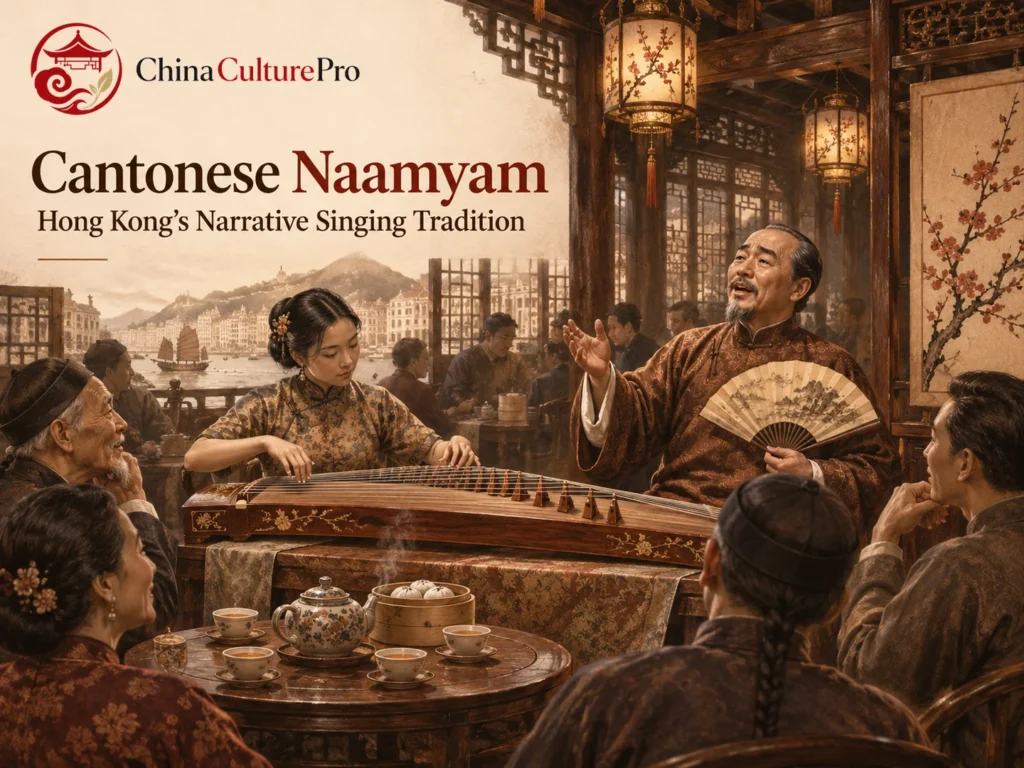
Cantonese naamyam (南音, nán yīn) is a form of narrative singing that flourished in early twentieth-century Hong Kong. Its name is also romanized as nanyin. Singers tell stories in Cantonese, sometimes to an accompaniment of plucked or bowed strings and clappers. The same written name also refers to a different musical tradition in southern Fujian. [1][2][4]
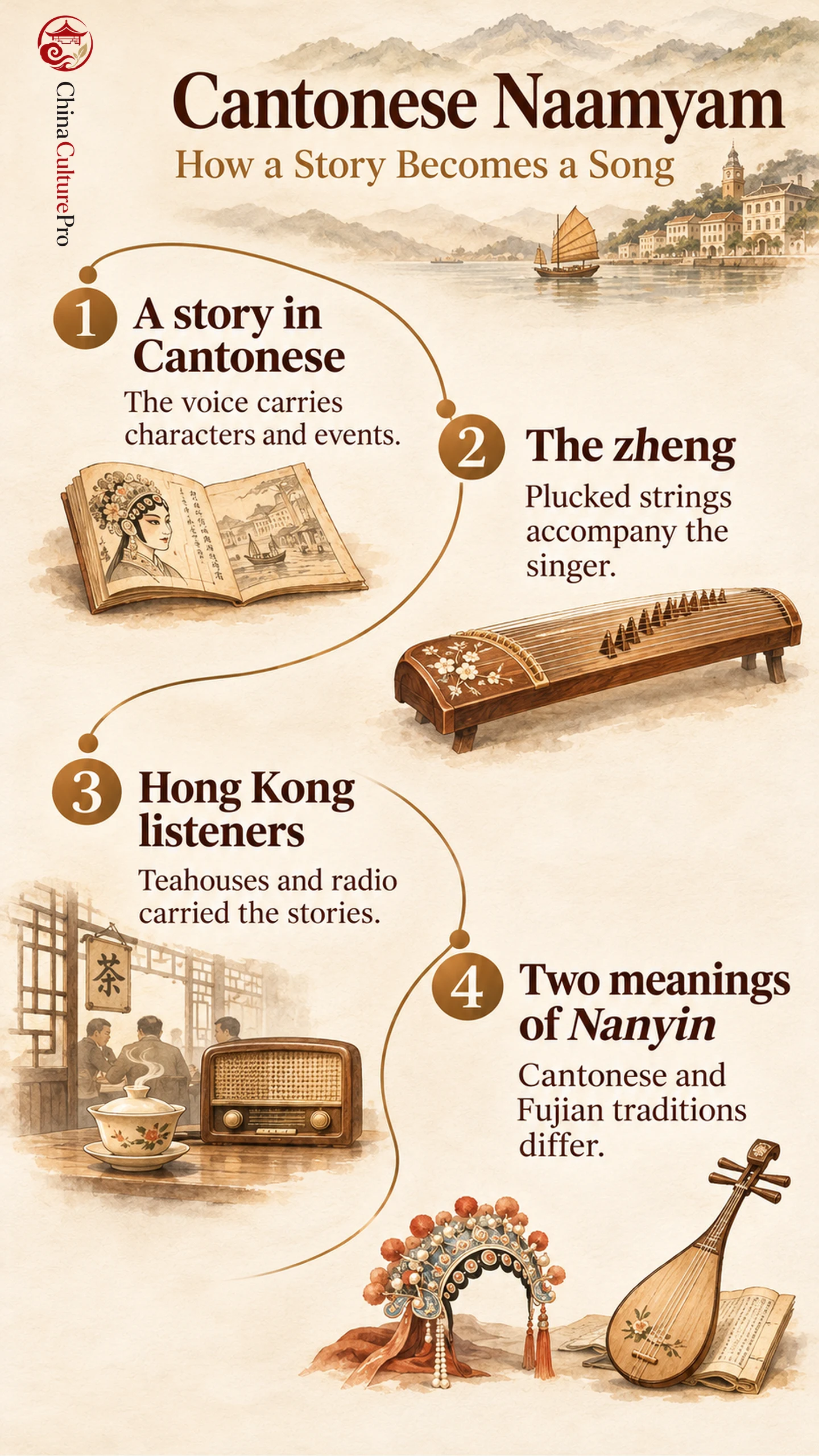
- Story: The sung text can carry characters, events and details of everyday lives.
- Sound: A zheng zither, yehu fiddle and clappers are among the instruments associated with the Cantonese form.
- Setting: Historical performances reached listeners in venues such as teahouses, and recordings preserve examples.
Naamyam can also appear inside Cantonese opera. A stand-alone narrative song gives the singer room to develop the story at greater length. [1][2][3]
A naamyam recording rewards attention to the words. Follow who is speaking, what has happened and how the delivery changes as the story moves forward.
How the Voice Carries a Story
Extended narratives can unfold in a series of episodes, with a character’s fate becoming clear only as the singer advances the plot. A pause, an instrumental response or a change in vocal emphasis can help mark a new moment. Hong Kong’s heritage office notes that many lyrics reflected ordinary people’s hardships. A piece can sustain interest through a character’s circumstances and the choices described in the verse. [1][3]
Many of the historical performers documented by the heritage office were blind. The singer Dou Wun left recordings that show how a performer could sustain a story over time. The Chinese University of Hong Kong has made his recording of Revenge in Guang Chang Long a focus of preservation and study. [1][2]
Where to Place Naamyam in Hong Kong Performance
A historical teahouse song and a passage inside Cantonese opera give listeners different amounts of time to follow a narrative. The story, voice and instruments carry a stand-alone song. Inside opera, naamyam can be one component of a staged production. [1][3]
Hong Kong’s festival bamboo theatres help illustrate the different spatial demands of a staged opera. Reading about the stage clarifies the setting without implying that historical naamyam needed one. [1][5]
Cantonese Naamyam and Fujian Nanyin Compared
| Feature | Cantonese naamyam | Fujian Nanyin |
|---|---|---|
| Language and place | Cantonese tradition documented in Hong Kong and the wider Cantonese-speaking region | Southern Fujian tradition associated with Minnan speech and Quanzhou |
| Performance focus | A sung narrative, on its own or as an element within opera | Instrumental and vocal forms transmitted as a distinct tradition |
| Instrument to notice | The zheng in documented Hong Kong examples | The pipa held horizontally in the Fujian ensemble |
The shared characters can make English searches ambiguous. Include “Cantonese,” “Hong Kong,” or a performer’s name when you want naamyam. Read the guide to Fujian Nanyin for its own ensemble and history. [1][3][4]
FAQs About Cantonese Naamyam
Is naamyam pronounced the same way as Nanyin?
Naamyam represents a Cantonese reading. Nanyin is the usual unaccented Mandarin romanization of the same characters. Either spelling can appear in English-language references, so use the regional context. [1][2][4]
What instrument accompanies Dou Wun in naamyam?
The zheng, a long plucked zither, is documented in Dou Wun’s naamyam repertoire. Accompaniment varies across material and performances. [3]
Can I hear naamyam inside Cantonese opera?
Yes. Cantonese opera and operatic song can incorporate naamyam as a singing element. [1]
Sources
[1] Hong Kong Intangible Cultural Heritage Office. Nanyin: Southern Tunes
[2] Chinese University of Hong Kong. Flashbacks to Cantonese Naamyam
[3] Hong Kong University Press. Study of Cantonese Narrative Song and Dou Wun
[4] UNESCO Intangible Cultural Heritage. Nanyin
[5] Hong Kong Heritage Museum. The Majestic Stage: Cantonese Opera Theatres